Market Summary
Executive Summary and Global Market Analysis
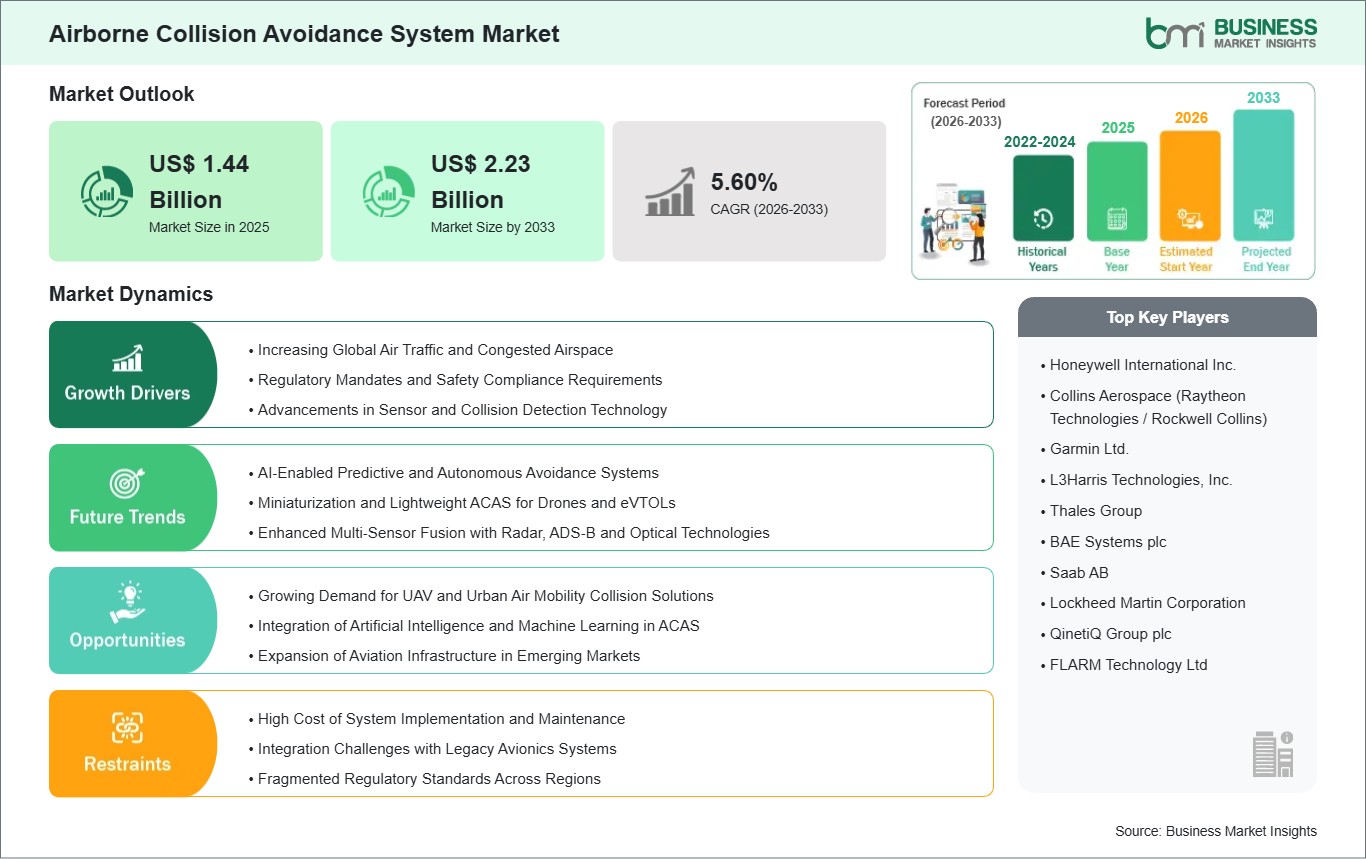
An airborne collision avoidance system (ACAS) is an advanced avionics system designed to prevent mid-air collisions by continuously monitoring surrounding airspace and providing pilots with timely alerts and maneuver guidance. ACAS leverages radar, transponders, and real-time processing algorithms to detect potential collision threats and recommend safe resolutions. Common technologies include ACAS I & TCAS I, ACAS II & TCAS II, PCAS, and FLARM, which serve different aircraft platforms, including fixed wing, rotary wing, and UAVs.
The global ACAS market is growing steadily, driven by rising air traffic, increasing aircraft deliveries, and stringent regulatory mandates for collision avoidance systems across commercial, general, and unmanned aviation. Growth is further fueled by technological advancements, including AI-based predictive algorithms, high-performance processors, and enhanced display units that improve situational awareness and pilot decision-making. The expansion of UAV operations in commercial airspace and the rising need for retrofitting older aircraft with modern ACAS systems also contribute to market growth. Key drivers include aviation safety regulations, the increasing adoption of UAVs, and rising air passenger traffic worldwide. Market restraints include high system costs, long certification timelines, and technical complexity in integrating ACAS with existing avionics systems.
Segment Analysis
Airborne Collision Avoidance System Market Segmentation
Key segments that contributed to the derivation of the Accelerometer and gyroscope market analysis are type, dimension, and industry vertical.
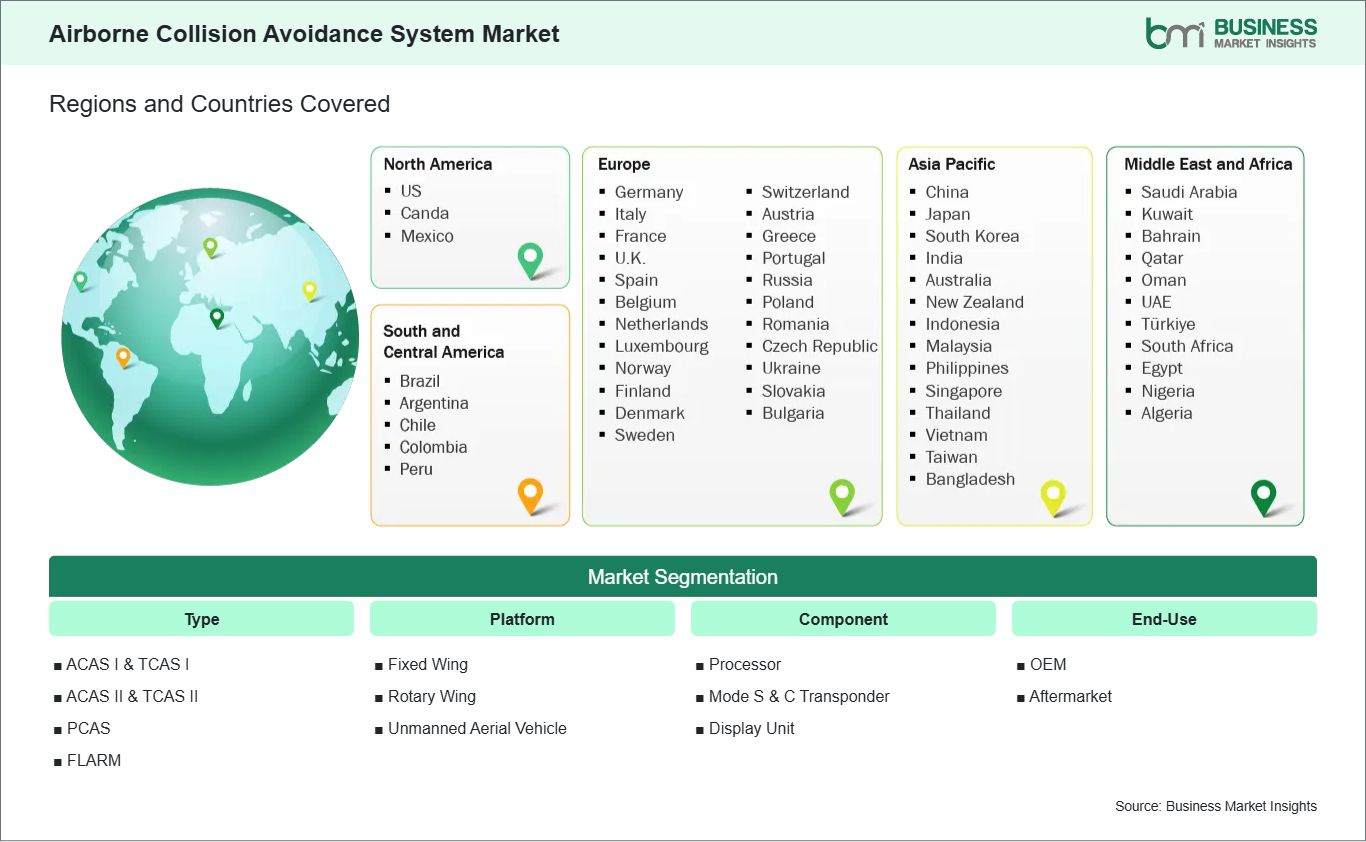
By type, the market is segmented into ACAS I & TCAS I, ACAS II & TCAS II, PCAS, and FLARM. The ACAS II & TCAS II segment held the largest share of the market in 2025.
By platform, the market is segmented into fixed wing, rotary wing, and UAV. The fixed wing segment held the largest share of the market in 2025.
By component, the market is segmented into processor, Mode S & C transponder, and display unit. The Mode S & C transponder segment held the largest share in 2025.
By end use, the market is segmented into OEM and aftermarket. The OEM segment held the largest share in 2025.
Market Forces
Airborne Collision Avoidance System Market Drivers and Opportunities
Integration with Advanced Avionics and UAV Ecosystems
The integration of ACAS with modern avionics systems and UAV platforms is a major driver of market growth. In commercial and general aviation, ACAS is being embedded with other navigation and surveillance technologies to improve flight safety and airspace management. UAVs equipped with ACAS or sense-and-avoid systems enhance operational safety in congested airspace. In OEM applications, ACAS is integrated with cockpit displays, autopilot systems, and flight management software to provide seamless threat detection and resolution guidance. As aviation systems evolve toward intelligent and connected airspace management, demand for high-performance, interoperable ACAS solutions is expected to rise, driving sustained market growth.
AI-Enabled Predictive Collision Avoidance
The convergence of ACAS with AI and predictive analytics presents significant growth opportunities. AI-enabled systems can analyze flight patterns, airspace traffic, and aircraft behavior to predict potential conflicts before they occur. In commercial aviation, AI-enhanced ACAS improves pilot decision-making, reduces false alerts, and supports automated resolution advisories. In UAV and rotary-wing applications, predictive analytics enables dynamic route adjustments and safer autonomous operations. The combination of ACAS and AI is also enabling enhanced training simulators for pilots, allowing realistic scenario-based learning that improves airspace safety.
Size and Share Analysis
Airborne Collision Avoidance System Market Size and Share Analysis
By Type, the market is segmented into ACAS I & TCAS I, ACAS II & TCAS II, PCAS, and FLARM. The ACAS II & TCAS II segment held the largest share of the market in 2025. ACAS II & TCAS II provide advanced traffic collision avoidance by detecting nearby aircraft and issuing resolution advisories, ensuring enhanced mid-air safety. The strong demand for this technology is driven by regulatory mandates requiring commercial aircraft to install ACAS II, as well as its adoption in regional and business jets for collision prevention. Its widespread use across commercial aviation, general aviation, and UAV applications continues to propel the growth of the ACAS II & TCAS II segment in the airborne collision avoidance system market.
By Platform, the market is segmented into Fixed Wing, Rotary Wing, and Unmanned Aerial Vehicle (UAV). The Fixed Wing segment held the largest share of the market in 2025. Fixed wing aircraft, including commercial and regional jets, rely heavily on ACAS technologies for safe navigation in congested airspace. The strong adoption is driven by the need to comply with international aviation safety regulations, manage growing air traffic, and enhance pilot situational awareness. The increasing integration of ACAS in UAVs and rotary wing platforms is also supporting market expansion, particularly in emerging markets and for autonomous flight operations.
By Component, the market is segmented into Processor, Mode S & C Transponder, and Display Unit. The Mode S & C Transponder segment held the largest share of the market in 2025. Transponders are critical components of ACAS systems, as they enable the aircraft to transmit and receive signals from nearby aircraft for collision detection and resolution advisories. The growing adoption of Mode S & C transponders in commercial, military, and UAV applications is driven by the need for accurate air traffic monitoring and compliance with airspace safety standards. Advanced processors and display units complement these systems by providing real-time analysis and actionable alerts to pilots.
By End-Use, the market is segmented into OEM and Aftermarket. The OEM segment held the largest share of the market in 2025. Original equipment manufacturers integrate ACAS systems during aircraft production to ensure compliance with regulatory mandates and enhance overall flight safety. The aftermarket segment is witnessing growth as airlines and private aircraft operators retrofit older aircraft with updated ACAS systems to meet current safety standards and improve operational efficiency. Increasing investments in fleet modernization and aircraft safety upgrades continue to drive demand in both OEM and aftermarket applications.
Report Coverage
Airborne Collision Avoidance System Market Report Coverage and Deliverables
The "Airborne Collision Avoidance System Market Size and Forecast (2022–2033)" report provides a detailed analysis of the market covering below areas:
- Accelerometer and gyroscope market size and forecast at global, regional, and country levels for all the key market segments covered under the scope
- Accelerometer and gyroscope market trends, as well as market dynamics such as drivers, restraints, and key opportunities
- Accelerometer and gyroscope market analysis covering key market trends, global and regional framework, major players, regulations, and recent market developments
- Industry landscape and competition analysis covering market concentration, heat map analysis, prominent players, and recent developments for the Accelerometer and gyroscope market
- Detailed company profiles, including SWOT analysis
Geographic Insights
Airborne Collision Avoidance System Market Geographic Insights
The geographical scope of the Accelerometer and gyroscope market report is divided into five regions: North America, Asia Pacific, Europe, Middle East & Africa, and South & Central America. The Accelerometer and gyroscope market in Asia Pacific is expected to grow significantly during the forecast period.
The Asia Pacific region has emerged as a leading and fastest-growing market for ACAS, driven by the rapid expansion of commercial aviation, increasing UAV operations, and robust demand across multiple end-user industries. Countries such as China, Japan, South Korea, and India are at the forefront of this growth, supported by rising air traffic, growing aircraft deliveries, and increasing regulatory emphasis on airborne collision avoidance systems. The adoption of ACAS in commercial airlines, regional aircraft, UAVs, and rotary-wing platforms is driving strong market momentum in the region.
In addition, the region benefits from a large base of aviation operators, growing investments in autonomous and unmanned flight technologies, and escalating development of advanced avionics systems. Government initiatives promoting aviation safety regulations, airspace modernization, UAV integration, and digital air traffic management further bolster the adoption of ACAS across commercial, defense, and industrial aviation segments.
Industry Activity
Recent Developments
The Accelerometer and gyroscope market is evaluated by gathering qualitative and quantitative data post primary and secondary research, which includes important corporate publications, association data, and databases. A few of the key developments in the Accelerometer and gyroscope market are:
- In December 2025, Sinoboom has developed CARS (Collision Avoidance Radar System), a system for the detection and avoidance of collision risks for its boom lift ranges. The system deploys a set of sensors placed around the boom lift’s platform, forming a three-dimensional sensing array that detects both stationary and mobile risks in the boom lift’s surroundings in real time.
- In March 2025, European legislation clears aircraft to fly with ACAS Xa collision-avoidance systems. European air transport legislation has been revised to enable introduction of airborne collision-avoidance systems based on alternative conflict-resolution modelling. The European Union legislation – which enters into force on 10 March – requires aircraft authorised to carry more than 19 passengers to be equipped either with the new ACAS Xa system or the current ACAS II version 7.1
Trust & Transparency
Research Methodology
The market analysis combines proprietary research with secondary data from government agencies, company disclosures, regulatory filings, industry databases and expert interviews. Market estimates are validated through data triangulation, cross-market benchmarking and analyst
review.
View Full Research Methodology
Key Sources Referred:
World Bank – Global Trade Indicators World Trade Organization (WTO) International Monetary Fund (IMF) International Trade Administration (ITA) Company website Company annual reports Company investor presentations