
Cold Brew Coffee Market Outlook: Size, Share, Trends, Growth Analysis, Competitive Landscape & Forecast, 2026-2033

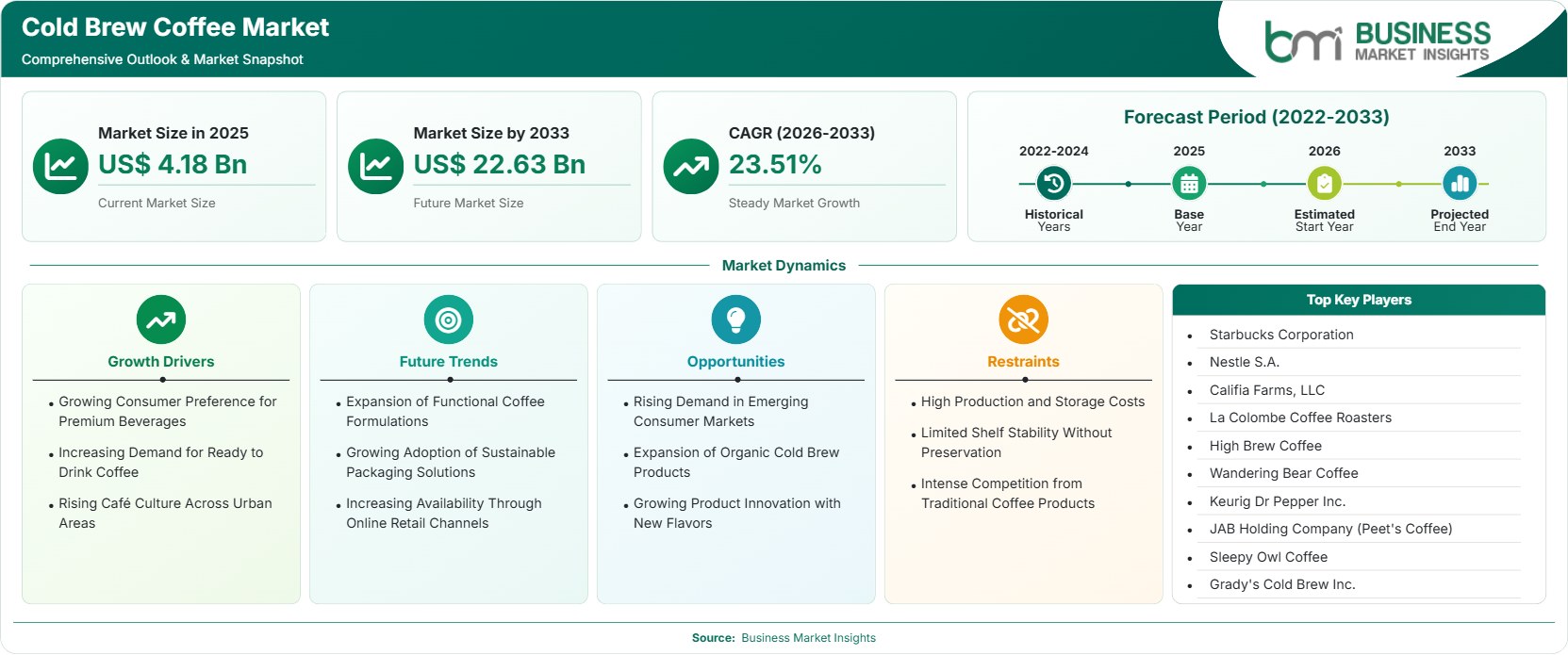
The Cold Brew Coffee Market size was valued at US$ 4.18 Billion in 2025 and is projected to reach US$ 22.63 Billion by 2033, growing at a CAGR of 23.51% during 2026–2033, driven by premium beverage demand, ready-to-drink adoption, café expansion, product innovation, and emerging market opportunities.

Report Coverage
  • Packaging: Glass Bottle, Plastic Bottle, Cans
  • Distribution Channel: Supermarket/Hypermarket, Specialty Stores, Convenience Stores/Grocery Stores, E-commerce
US$ 4.18 Bn Market size in 2025
US$ 22.63 Bn Market Size by 2033
23.51% CAGR, 2026 - 2033
2026-2033 Forecast Period

AI Overview

Cold Brew Coffee Market Summary

  • North America Region: North America holds a market share of 42%–46% in 2025, growing with a CAGR of 21%–24% driven by specialty coffee adoption, convenience beverages, premiumization, and expanding retail availability. The US market demonstrates strong penetration with a CAGR of 22%–24% between 2026–2033 due to established coffee culture, innovative product launches, and strong consumer demand.
  • Fastest Growing Region: Asia Pacific records a market share of 22%–26% in 2025, expanding at a CAGR of 25%–28% supported by urbanization, rising disposable income, digital commerce growth, and increasing acceptance of international coffee formats across younger consumer demographics.
  • Leading Segment: Glass Bottle packaging maintains a market share of 38%–42% in 2025, growing at a CAGR of 20%–23% due to premium positioning, product visibility, sustainability perception, and consumer preference for high-quality ready-to-drink coffee experiences.
  • High Growth Segment: E-commerce distribution represents a market share of 18%–22% in 2025, achieving a CAGR of 27%–30% through direct-to-consumer brands, subscription models, wider geographic access, and increasing online beverage purchasing behavior.
  • Key Market Opportunity: Companies can capture growth through functional cold brew beverages, sustainable packaging, emerging market expansion, personalized coffee experiences, and innovative flavors targeting health-conscious and convenience-focused consumers globally.
  • Major Market Players: Starbucks Corporation, Nestlé S.A., Califia Farms, LLC, La Colombe Coffee Roasters, High Brew Coffee, Wandering Bear Coffee, Keurig Dr Pepper Inc., JAB Holding Company, Sleepy Owl Coffee, and Grady's Cold Brew Inc.
Strategic Insights

Cold Brew Coffee Market: Strategic Insights

Cold Brew Coffee Market Strategic Framework
FREE PDF
Request your free sample
Request free sample
Stakeholder View

Key Takeaways

  • Value chain integration is increasing because coffee producers, specialty roast masters, beverages companies, packagers, and retail stores are collaborating to optimize sourcing, product quality, and distribution.
  • Ready-to-drink products, high-end bottled beverages, and Internet sales represent the most promising options for growth as customers demand convenient beverages with specialized coffee qualities.
  • Product innovation is shifting toward functional formulations, plant-based additions, organic ingredients, nitrogen-infused variants, and environmentally responsible packaging solutions.
  • Asia Pacific offers a compelling investment opportunity due to rising café culture, expanding middle-class consumers, and accelerating digital commerce adoption in countries including China, India, Japan, and Southeast Asian markets.
  • There is an increase in strategic investments and partnerships where established beverages firms buy out specialty coffee firms in order to develop their premium beverages portfolios and reach young consumers.
Geographic Outlook

Cold Brew Coffee Market Regional Highlights

North America Cold Brew Coffee Market

North America remains the largest regional contributor, accounting for a market share of 42%–46% in 2025 and expanding at a CAGR of 21%–24% during 2026–2033. The region benefits from mature specialty coffee consumption, strong retail infrastructure, and established beverage brands. The Cold Brew Coffee Market share remains concentrated in the United States, where premium ready-to-drink products, café chains, and convenience channels support sustained demand.

  • Specialty coffee adoption continues expanding across the United States and Canada as consumers increasingly prefer smoother, lower-acidity coffee beverages with premium positioning and convenient consumption formats.
  • Retailers are expanding cold brew availability through refrigerated sections, private-label offerings, and multi-pack formats, improving accessibility among household consumers and supporting category penetration.
  • Beverage companies are investing in sustainable packaging solutions and recyclable materials to address environmental concerns while maintaining product freshness and extending distribution capabilities.
  • Digital ordering platforms and subscription models are strengthening direct-to-consumer sales channels, allowing brands to reach targeted customer segments with personalized product selections.

US Cold Brew Coffee Market

The US represents the dominant country within North America, holding a regional share contribution of 35%–39% in 2025 and growing at a CAGR of 22%–24% between 2026–2033. The market is supported by widespread coffee consumption, established specialty chains, and strong consumer acceptance of ready-to-drink beverages. The Cold Brew Coffee Market growth in the US is influenced by premium product launches, convenience-focused lifestyles, and expanding e-commerce availability.

  • Major beverage companies are introducing new cold brew variations, including flavored, nitrogen-infused, and functional beverages, to capture evolving consumer preferences across younger demographics.
  • Convenience stores and supermarkets are increasing shelf presence for bottled cold brew products, improving visibility and supporting impulse purchasing among daily coffee consumers.
  • Specialty coffee brands are leveraging digital marketing, loyalty programs, and online subscriptions to build stronger consumer relationships and improve recurring purchases.
  • Sustainable sourcing initiatives and transparent ingredient communication are influencing purchasing decisions among environmentally conscious US consumers seeking premium beverage options.

Europe Cold Brew Coffee Market

Europe accounts for a market share of 18%–22% in 2025 and is projected to grow at a CAGR of 22%–25% through 2026–2033. The region is experiencing increased demand for specialty beverages, particularly in Germany, the United Kingdom, France, and Nordic countries. Premium coffee consumption, café culture expansion, and sustainable packaging adoption are shaping the Cold Brew Coffee Market trends across European markets.

  • Germany demonstrates strong growth potential due to specialty coffee expansion, increasing retail availability, and rising consumer interest in premium ready-to-drink beverage alternatives.
  • The United Kingdom continues adopting cold brew products through café chains, supermarkets, and convenience retailers targeting younger consumers seeking innovative coffee experiences.
  • Nordic countries are supporting category development through sustainability-focused consumers who prioritize ethical sourcing, recyclable packaging, and environmentally responsible beverage brands.
  • European manufacturers are developing organic and clean-label cold brew formulations aligned with regional preferences for natural ingredients and transparent production processes.

Asia Pacific Cold Brew Coffee Market

Asia Pacific represents the fastest-growing region with a market share of 22%–26% in 2025 and a CAGR of 25%–28% from 2026–2033. Rapid urbanization, rising disposable income, expanding café culture, and digital retail adoption are accelerating category growth. Countries such as China, India, Japan, South Korea, and Australia are creating strong opportunities as consumers increasingly explore international coffee formats.

  • China is witnessing increasing cold brew adoption through premium cafés, online platforms, and younger consumers seeking convenient alternatives to traditional tea-based beverages.
  • India presents significant potential due to expanding urban coffee consumption, growing café chains, and increasing acceptance of ready-to-drink beverage categories among millennials.
  • Japan and South Korea are supporting innovation through demand for premium coffee experiences, compact packaging formats, and technologically advanced beverage solutions.
  • Southeast Asian markets are attracting investment because of rising middle-class populations, expanding retail networks, and growing interest in global beverage trends.

Rest of World Cold Brew Coffee Market

The Rest of World region contributes a market share of 10%–14% in 2025 and expands at a CAGR of 24%–27% during 2026–2033. South and Central America benefit from strong coffee production capabilities, while Middle East and Africa markets are developing through premium beverage adoption and modern retail expansion. Brazil, Mexico, UAE, and South Africa represent important growth markets.

  • Latin American producers are leveraging regional coffee expertise to develop locally sourced cold brew products with stronger brand differentiation and premium positioning.
  • Brazil is creating opportunities through domestic specialty coffee growth, expanding cafés, and increasing consumer awareness of alternative coffee preparation methods.
  • Middle Eastern countries are experiencing demand growth through luxury cafés, hospitality applications, and premium beverage concepts targeting urban consumers.
  • Africa presents emerging opportunities as retail modernization, young populations, and increasing international beverage exposure encourage new category adoption.
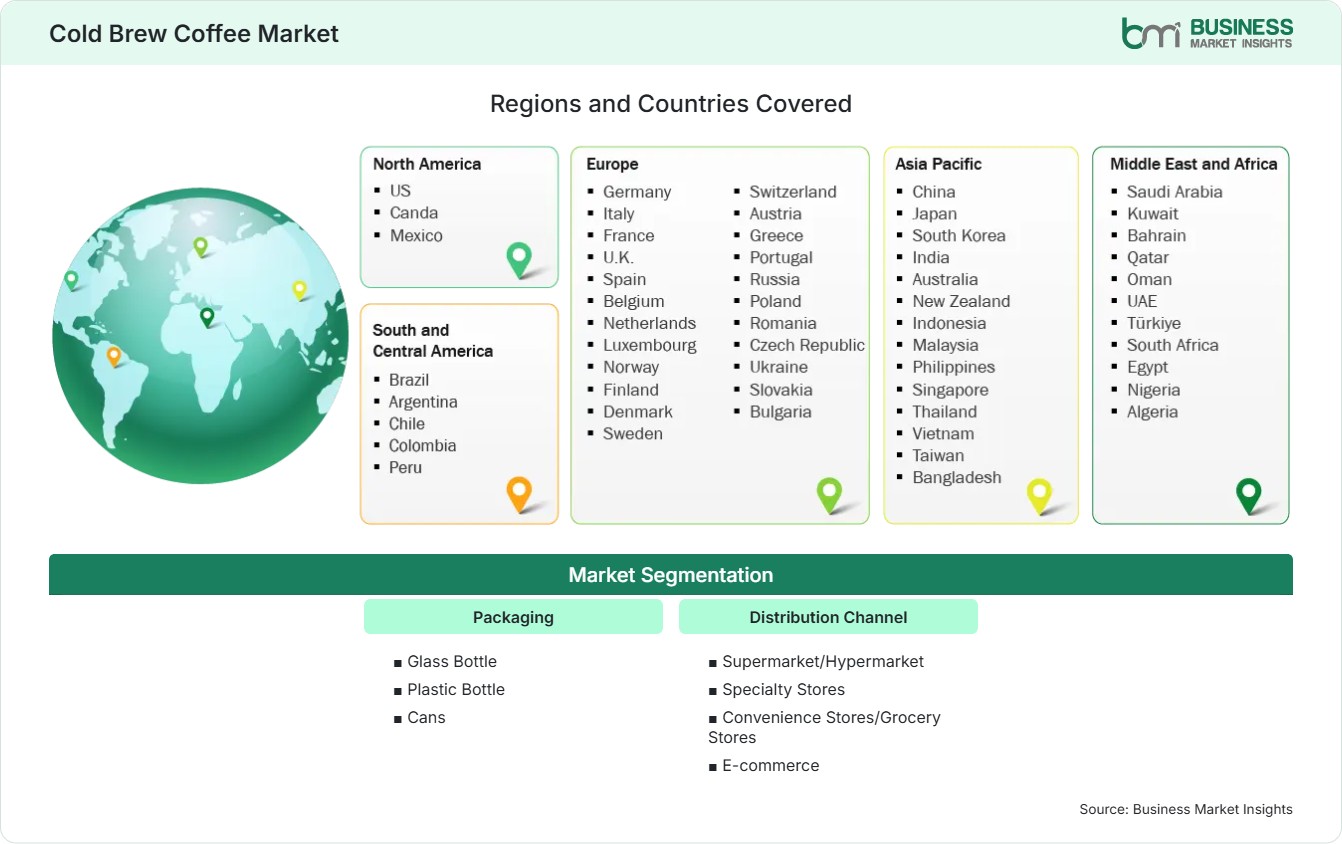
Global Market Geography
FREE PDF
Request your free sample
Request free sample
Segment Analysis

Cold Brew Coffee Market Segmentation

Packaging

Packaging plays a critical role in product positioning, preservation, and consumer appeal. The segment accounted for a market share of 38%–42% in 2025 and is projected to expand at a CAGR of 20%–23% between 2026–2033. The Cold Brew Coffee Market scope within packaging is influenced by sustainability priorities, premium branding strategies, and demand for convenient beverage formats.

  • Glass Bottle: Glass bottles support premium positioning through visual appeal, recyclability advantages, and preservation characteristics, making them popular among specialty coffee brands targeting quality-focused consumers.
  • Plastic Bottle: Plastic bottles provide lightweight handling, cost efficiency, and improved logistics flexibility, supporting large-scale distribution through supermarkets, convenience stores, and beverage retailers.
  • Cans: Cans are gaining adoption due to portability, durability, efficient transportation, and compatibility with ready-to-drink coffee consumption occasions among active consumers.

Distribution Channel

Distribution channels determine product accessibility and consumer reach, representing a major factor influencing purchasing behavior. The segment held a market share of 58%–62% in 2025 and is estimated to grow at a CAGR of 24%–27% through 2026–2033. Digital retail expansion and omnichannel strategies continue shaping Cold Brew Coffee Market trends across global markets.

  • Supermarket/Hypermarket: Supermarkets and hypermarkets provide extensive consumer reach through dedicated beverage sections, promotional campaigns, and wide product assortment supporting mainstream adoption.
  • Specialty Stores: Specialty stores attract consumers seeking premium coffee experiences through curated products, expert recommendations, and differentiated offerings from artisan brands.
  • Convenience Stores/Grocery Stores: Convenience channels support quick purchasing decisions by placing cold brew products near high-traffic locations and daily consumption points.
  • E-commerce: E-commerce platforms enable direct brand engagement, subscription services, broader geographic coverage, and personalized recommendations, supporting rapid category expansion.
Market Forces

Cold Brew Coffee Market Dynamics

Key Market Drivers

Growing Consumer Preference for Premium Beverages

Ready-to-drink coffee demand is increasing as consumers prioritize convenience, portability, and immediate consumption solutions across workplaces, travel environments, and outdoor activities. The Cold Brew Coffee Market growth is driven by increased consumer preferences for milder and less bitter coffee options than regular brewing methods. Current market trends show increased uptake of cold brew by millennial and Gen Z consumers who value premium blends, sustainability, and transparency in their brands. This trend has led to increased offerings from specialty coffee shops, beverage makers, and food service providers to tap into this growing market segment. Increased disposable incomes in developing economies have created new consumer segments for premium ready to drink coffee.

Increasing Demand for Ready to Drink Coffee

Ready-to-drink coffee demand is increasing as consumers prioritize convenience, portability, and immediate consumption solutions across workplaces, travel environments, and outdoor activities. Cold Brew Coffee Market has gained from the growth in the category of refrigerated beverages, advancements in packaging technology, and greater availability through retail outlets. There have been developments of products that come in single-serve packs, multi-packs, and extended shelf life to cater to varied needs of consumers. Increasing investments by global beverage companies have enhanced the capacity for manufacturing and logistics. The trend of consuming beverages while on the go has resulted in innovation in flavors of cold brew coffees, including dairy free, organic, and functional variants.

Rising Cafe Culture Across Urban Areas

Urban cafe culture is expanding globally as consumers increasingly view coffee outlets as social, professional, and lifestyle destinations. This trend is aiding in the increased recognition of specialty drinks along with encouraging innovation within cold brews. Coffee brands and cafés are launching seasonal flavors and customized drinks and offering high-end cold brews in order to attract younger generations. Increasing urbanization, especially in the Asia Pacific and Latin America regions, is aiding in the development of cafes and innovation in beverages. The increased integration of cafés with digital ordering systems and delivery options is aiding in increased accessibility.

Key Market Opportunities

Rising Demand in Emerging Consumer Markets

Emerging markets offer immense opportunities for growth on account of urbanization, increased disposable incomes, and familiarity with foreign tastes in beverages. Companies take advantage of Cold Brew Coffee Market Forecasts by targeting young people in the Asia Pacific region, Latin America, and Middle Eastern nations through regional flavors, cost-effective packaging solutions, and marketing through digital platforms. The increase in retailing capabilities and the presence of e-commerce portals has made it possible for companies to target customers beyond the big cities. Collaborations with distributors and café owners can facilitate fast-track entry into such markets along with minimal operational constraints.

Expansion of Organic Cold Brew Products

Clean label beverages and organic beverages provide opportunities as consumers begin considering the quality and source of ingredients, as well as the eco-friendly nature of the brands. Coffee companies are now designing organic cold brews that use ethically grown coffee and clear production processes to appeal to health-conscious consumers. This opens up an opportunity based on higher pricing power and increased brand loyalty among sustainability-minded consumers. Companies that certify their products, work with environmentally sound farming partners, and use eco-friendly packaging are able to create differentiation for themselves in the crowded marketplace.

Growing Product Innovation with New Flavors

Product innovation through new flavors, functional ingredients, and customized formulations is creating additional growth opportunities for beverage manufacturers. Companies have come up with flavors such as vanilla, caramel, chocolate, botanical flavoring, protein additions, and other plant-based flavors to broaden their offerings. The use of such innovations assists in targeting customers who do not drink coffee traditionally and increasing their purchase rates. With the help of the new extraction techniques and formulation abilities, coffee companies are able to develop products of unique taste without compromising on taste consistency. The collaboration among coffee companies, ingredient suppliers, and retailers can lead to quick innovations in the field.

Market Restraints and Challenges

High Production and Storage Costs

Factor: Complex brewing processes, longer extraction periods, specialized equipment requirements, and refrigerated storage needs increase manufacturing expenses for cold brew producers. Impact: Higher operational costs can reduce profit margins and create pricing challenges, particularly for smaller brands competing against established beverage companies. Quality maintenance of the product during transport and storage is only possible through the efficient use of cold chain logistics, which makes the logistics process more complex. The company should put in place an optimal production system, efficient inventory, and distribution systems to help keep costs down. The use of premium pricing policies may help cover some costs but will make the product expensive.

Limited Shelf Stability Without Preservation

Factor: Cold brew products often require controlled preservation methods because natural formulations may have shorter shelf lives compared with conventional beverages. Impact: Limited shelf stability can restrict distribution reach, increase waste risks, and complicate inventory management across retail channels. Manufacturers are investing in improved processing technologies, packaging innovations, and quality control systems to extend product durability while maintaining flavor characteristics. However, balancing preservation requirements with consumer demand for clean-label products remains challenging. Companies must develop solutions that protect freshness without compromising ingredient transparency, especially as consumers increasingly prefer minimally processed beverage options.

Company Analysis

Competitive Landscape

The Cold Brew Coffee Market analysis highlights increasing competition among global beverage corporations, specialty coffee brands, and innovative direct-to-consumer companies. Market participants are focusing on product diversification, sustainable packaging, retail expansion, and digital engagement strategies to strengthen competitive positions.

Company Name

Overview

Products and Services relevant to this market

Starbucks Corporation

Global coffeehouse leader with extensive beverage expertise, retail presence, and strong consumer recognition across international markets.

Offers bottled cold brew beverages, ready-to-drink coffee products, café-based cold brew options, and seasonal specialty formulations.

Nestlé S.A.

Global food and beverage company with significant coffee operations and broad distribution capabilities across multiple regions.

Provides ready-to-drink coffee beverages, premium coffee products, and cold brew solutions through established beverage brands.

Califia Farms, LLC

Specialty beverage company recognized for plant-based products and innovative coffee alternatives targeting modern consumers.

Produces bottled cold brew coffees, dairy-free coffee beverages, and premium refrigerated ready-to-drink offerings.

La Colombe Coffee Roasters

Specialty coffee company focused on high-quality coffee experiences and innovative beverage formats.

Offers draft latte products, bottled cold brew beverages, and specialty coffee solutions through retail channels.

High Brew Coffee

Ready-to-drink coffee brand specializing in convenient cold brew beverages for active consumers.

Provides canned cold brew coffee products with multiple flavors and portable packaging formats.

Wandering Bear Coffee

Cold brew-focused company offering long-lasting refrigerated coffee products for consumers and businesses.

Develops boxed cold brew coffee, ready-to-drink products, and foodservice beverage solutions.

Keurig Dr Pepper Inc.

Major beverage company with extensive distribution networks and coffee category expertise.

Provides packaged coffee beverages, cold coffee products, and retail distribution capabilities across multiple channels.

JAB Holding Company

Investment group controlling major coffee brands with global beverage market exposure.

Supports coffee portfolio companies including premium coffee brands and ready-to-drink beverage expansion.

Sleepy Owl Coffee

Indian specialty coffee brand focused on modern cold coffee consumption.

Offers bottled cold brew, coffee concentrates, and online coffee delivery products.

Grady's Cold Brew Inc.

Specialty cold brew company known for concentrated coffee products and unique formulations.

Produces cold brew concentrates, ready-to-mix products, and packaged coffee solutions.

Trust & Transparency

Research Methodology

The market analysis combines proprietary research with secondary data from government agencies, company disclosures, regulatory filings, industry databases and expert interviews. Market estimates are validated through data triangulation, cross-market benchmarking and analyst review.

View Full Research Methodology

Questions Answered

Frequently Asked Questions

How are sustainability trends affecting cold brew coffee production?

Sustainability trends are encouraging companies to adopt recyclable packaging, responsible coffee sourcing, efficient production methods, and transparent supply chains. These initiatives are becoming important factors in consumer purchasing decisions and brand differentiation.

What does the Cold Brew Coffee Market Report analyze for investors?

The report evaluates competitive positioning, segmentation trends, regional opportunities, consumer behavior shifts, product innovations, and strategic developments influencing future industry performance.

Why is e-commerce becoming important for cold brew coffee brands?

E-commerce enables direct consumer engagement, subscription-based purchasing, wider geographic reach, and personalized marketing. Brands can use digital platforms to build communities, collect consumer insights, and improve recurring sales opportunities.

How are companies improving cold brew coffee product differentiation?

Companies are differentiating products through organic ingredients, plant-based formulations, functional additions, unique flavors, premium beans, and sustainable packaging. These approaches help brands attract new consumers while strengthening loyalty among existing coffee drinkers.

What factors are influencing consumer adoption of cold brew coffee products?

Consumers are increasingly adopting cold brew coffee due to smoother flavor profiles, convenience, premium positioning, and availability across retail and online channels. Younger consumers particularly value innovative flavors, sustainable packaging, and ready-to-drink formats.

Access the Full Cold Brew Coffee Market Report

Get segment-level forecasts, regional estimates, competitive benchmarking, company profiles and downloadable Excel datasets.

Access the full Cold Brew Coffee Market Report
350 pages PDF & Excel | 2026-08-25
Similar Research

Related Market Reports