
Cocoa Nibs Market Outlook: Size, Share, Trends, Growth Analysis, Competitive Landscape & Forecast, 2026–2033

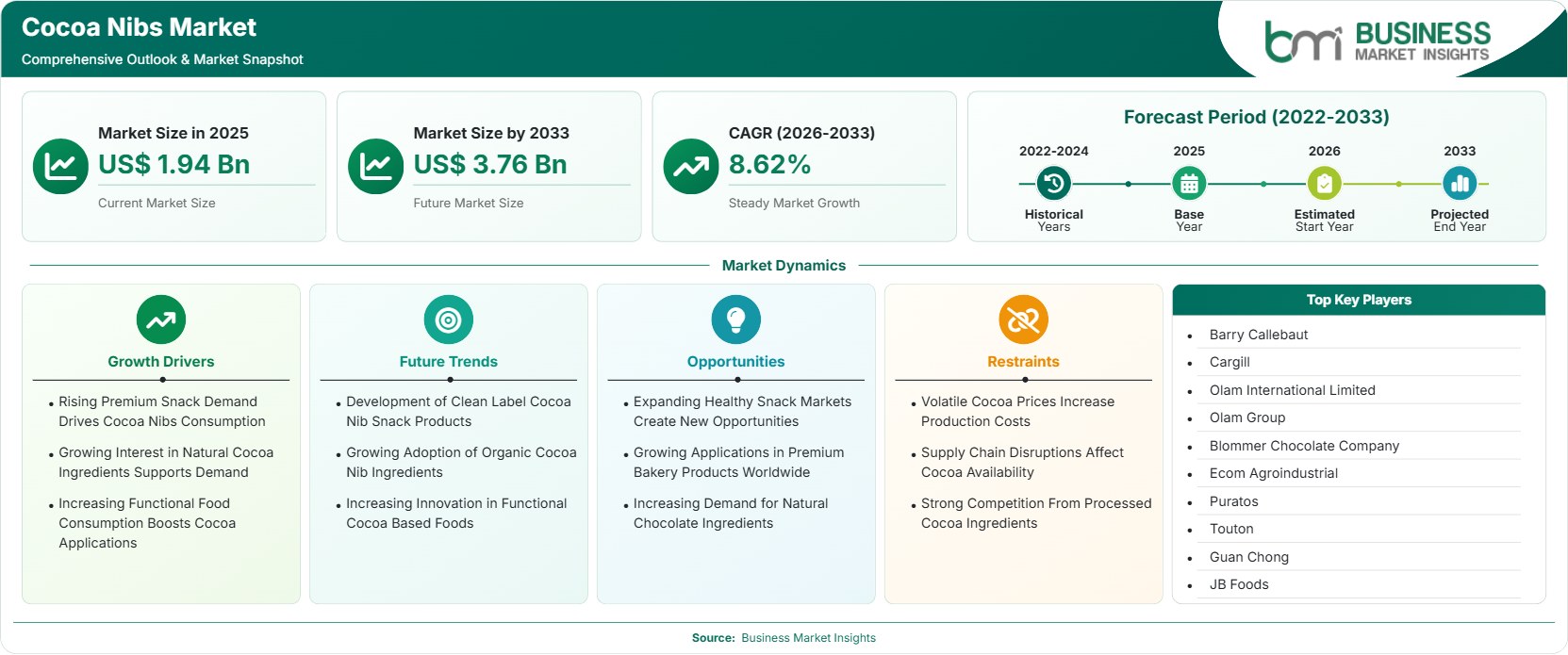
The Cocoa Nibs Market size was valued at US$ 1.94 billion in 2025 and is projected to reach US$ 3.76 billion by 2033, growing at a CAGR of 8.62% during 2026–2033, supported by premium snacking, natural ingredients, functional foods, specialty chocolate, and clean-label product development.

Report Coverage
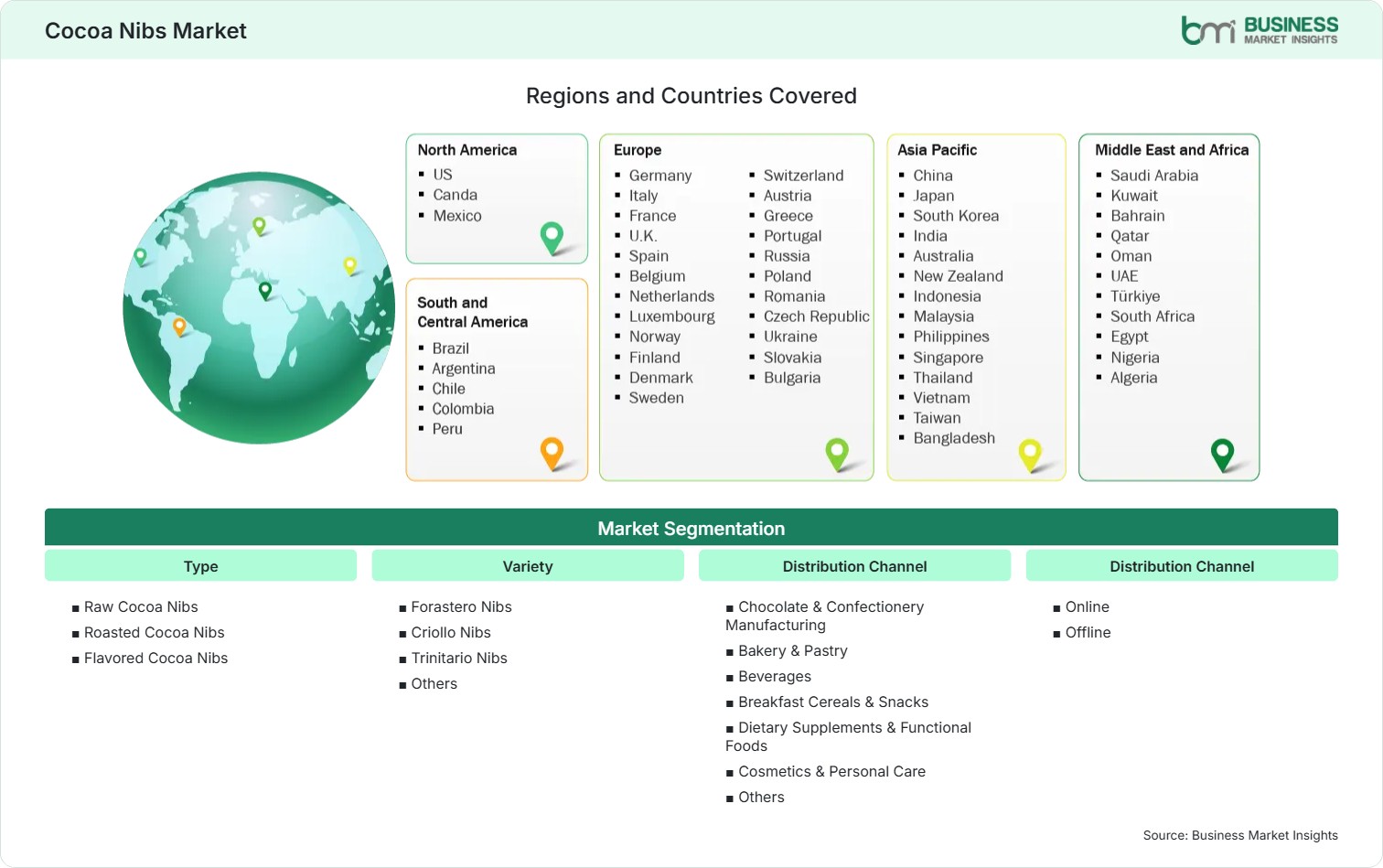
  • Type: Raw Cocoa Nibs, Roasted Cocoa Nibs, Flavored Cocoa Nibs
  • Variety: Forastero Nibs, Criollo Nibs, Trinitario Nibs, Others
  • Distribution Channel: Chocolate & Confectionery Manufacturing, Bakery & Pastry, Beverages, Breakfast Cereals & Snacks, Dietary Supplements & Functional Foods, Cosmetics & Personal Care, Others
  • Distribution Channel: Online, Offline
US$ 1.94 Bn Market size in 2025
US$ 3.76 Bn Market Size by 2033
8.62% CAGR, 2026 - 2033
2026-2033 Forecast Period

AI Overview

Cocoa Nibs Market Summary

  • North America: North America holds 28%-32% share in 2025, growing at a CAGR of 7.8%-8.7%, supported by premium chocolate consumption, clean-label formulations, specialty bakery applications, functional foods, and consumer interest in minimally processed cocoa ingredients. The U.S. accounts for 78%-83% of regional demand, supported by specialty chocolate, premium snacks, functional food innovation, and growing incorporation of cocoa-derived ingredients into differentiated food products.
  • Fastest Growing Region: Asia Pacific holds 22%-26% share in 2025 and expands at a CAGR of 9.4%-10.5%, driven by rising disposable incomes, premium confectionery demand, expanding bakery markets, growing awareness of cocoa ingredients, and increasing adoption of Western-style snack products.
  • Leading Segment: Roasted Cocoa Nibs hold 43%-47% share in 2025 and grow at a CAGR of 8.4%-9.2%, supported by stronger flavor profiles, ready-to-use formats, premium chocolate applications, bakery incorporation, and consumer preference for convenient natural ingredients.
  • High Growth Segment: Dietary Supplements & Functional Foods hold 12%-16% share in 2025 and grow at a CAGR of 10.2%-11.4%, supported by interest in cocoa polyphenols, antioxidant positioning, functional snacking, natural formulations, and nutrient-focused product development.
  • Key Market Opportunity: Premium snacks, specialty bakery, functional foods, natural chocolate formulations, and differentiated beverage applications provide attractive expansion opportunities as manufacturers seek recognizable cocoa ingredients with texture and flavor value.
  • Major Market Players: Barry Callebaut, Cargill, ofi, Olam Group, Blommer Chocolate Company, Ecom Agroindustrial, Puratos, Touton, Guan Chong, JB Foods.
Strategic Insights

Cocoa Nibs Market: Strategic Insights

Cocoa Nibs Market Strategic Framework
FREE PDF
Request your free sample
Request free sample
Stakeholder View

Key Takeaways

  • The value chain is becoming more differentiated as processors, chocolate manufacturers, specialty ingredient suppliers, bakeries, and functional food developers seek consistent nib quality, flavor characteristics, and reliable sourcing.
  • Premium snacks and specialty bakery products provide strong upside because cocoa nibs can add texture and recognizable cocoa flavor without requiring complete chocolate-based formulations.
  • Product innovation is moving toward roasted, flavored, organic-positioned, and application-specific nib formats that can serve confectionery, breakfast, beverage, and functional food developers.
  • Asia Pacific offers a compelling expansion case as confectionery and bakery consumption broadens while consumers increasingly experiment with premium cocoa-based products and Western-inspired snack formats.
  • Investment priorities are shifting toward cocoa processing efficiency, sourcing resilience, quality control, specialty product development, and supply-chain capabilities that can protect margins during commodity price volatility.
  • Companies with diversified sourcing, differentiated processing capabilities, strong food-industry relationships, and flexible product portfolios can capture opportunities across both established and emerging cocoa applications.
Geographic Outlook

Cocoa Nibs Market Regional Highlights

North America Cocoa Nibs Market

North America holds 28%-32% share in 2025 and grows at a CAGR of 7.8%-8.7%. The region benefits from premium confectionery, specialty bakery, functional foods, clean-label positioning, and growing consumer interest in cocoa ingredients with distinctive texture and flavor.

  • Premium chocolate manufacturers increasingly use cocoa nibs to differentiate products through stronger cocoa flavor, visible inclusions, textural contrast, and specialty product positioning.
  • U.S. demand is supported by specialty food development, functional snack innovation, bakery applications, and increasing experimentation with minimally processed cocoa ingredients.
  • Canada provides opportunities across premium confectionery, bakery, specialty beverages, and natural food categories where ingredient transparency can influence purchasing decisions.
  • Manufacturers are increasingly evaluating nib formats according to roast profile, particle size, flavor intensity, and application compatibility to achieve consistent finished-product characteristics.

US Cocoa Nibs Market

The U.S. represents 78%-83% of North American demand in 2025 and grows at a CAGR of 7.6%-8.5%. Strong specialty food development and premium snacking support demand across confectionery, bakery, beverages, and functional foods.

  • Specialty chocolate and snack developers use cocoa nibs to create differentiated products that combine cocoa intensity with crunchy texture and visible ingredient appeal.
  • Functional food developers can incorporate cocoa ingredients into nutrition-oriented products where natural positioning and familiar food formats support consumer acceptance.
  • Artisan and premium bakery applications provide additional opportunities through incorporation into cookies, granola, pastries, bars, and other texture-focused products.

Europe Cocoa Nibs Market

Europe holds 26%-30% Cocoa Nibs Market share in 2025 and grows at a CAGR of 7.9%-8.8%. Germany leads regional demand, while the United Kingdom, France, and Italy provide high-value opportunities across specialty chocolate, bakery, and premium foods.

  • Germany benefits from established chocolate and bakery industries alongside consumer interest in premium, natural, and differentiated food ingredients.
  • The United Kingdom offers opportunities across premium snacks, specialty chocolate, functional foods, and innovative bakery products targeting ingredient-conscious consumers.
  • France provides strong potential through premium confectionery, patisserie, gourmet foods, and products emphasizing distinctive cocoa flavor and artisanal positioning.
  • Italy supports demand through specialty bakery, confectionery, breakfast products, and premium food applications where texture and cocoa intensity can enhance product differentiation.

Asia Pacific Cocoa Nibs Market

Asia Pacific holds 22%-26% share in 2025 and grows at a CAGR of 9.4%-10.5%. China leads regional demand, while India, Japan, and Australia offer attractive growth opportunities from premiumization and expanding food applications.

  • China provides opportunities through expanding premium confectionery, bakery, beverages, snack products, and consumer experimentation with cocoa-based ingredients.
  • India benefits from expanding organized food manufacturing, bakery consumption, premium chocolate demand, and increasing awareness of specialty cocoa ingredients.
  • Japan offers opportunities through premium confectionery, functional foods, specialty beverages, and sophisticated product development emphasizing sensory differentiation.
  • Australia provides demand across natural foods, premium snacks, specialty chocolate, and health-oriented food categories where cocoa ingredients support differentiated formulations.

Rest of World Cocoa Nibs Market

Rest of World represents 20%-24% share in 2025 and grows at a CAGR of 7.6%-8.6%. Latin America provides strong opportunities through cocoa availability and processing capabilities, while Middle Eastern markets support premium food applications.

Middle Eastern and African Cocoa Nibs Markets present opportunities through expanding premium confectionery, bakery, foodservice, and specialty food categories. The United Arab Emirates, Saudi Arabia, and South Africa provide attractive commercial hubs for differentiated food ingredients and imported cocoa products.

  • Brazil combines cocoa-processing capabilities with a large domestic food industry, supporting opportunities in confectionery, bakery, beverages, and specialty snack formulations.
  • Mexico offers opportunities through confectionery manufacturing, bakery applications, premium snacks, and growing consumer interest in differentiated cocoa products.
  • The United Arab Emirates provides a premium food and hospitality ecosystem supporting specialty chocolate, bakery, dessert, and functional ingredient applications.
  • South Africa offers opportunities across confectionery, bakery, snack products, and food manufacturing while serving as a gateway to broader regional markets.
Global Market Geography
FREE PDF
Request your free sample
Request free sample
Segment Analysis

Cocoa Nibs Market Segmentation

Type

Roasted Cocoa Nibs hold 43%-47% share in 2025 and grow at a CAGR of 8.4%-9.2% through 2033, supported by ready-to-use formats, stronger flavor, and wider incorporation across chocolate, bakery, snacks, and beverages.

  • Raw Cocoa Nibs: Raw formats provide processing flexibility for manufacturers controlling roast profiles and flavor development, supporting customized applications across chocolate, bakery, and specialty foods.
  • Roasted Cocoa Nibs: Roasted nibs provide pronounced cocoa flavor and convenient incorporation, making them attractive for confectionery, bakery, snacks, cereals, and premium food products.
  • Flavored Cocoa Nibs: Flavored nibs support differentiated product development by combining cocoa texture with complementary flavors, enabling premium snack, dessert, beverage, and confectionery concepts.

Variety

Forastero Nibs hold 61%-65% share in 2025 and grow at a CAGR of 8.1%-8.9% through 2033, supported by availability, commercial scale, and broad processing applications. Criollo and Trinitario varieties command premium positioning where flavor complexity and specialty sourcing justify higher product differentiation across chocolate, gourmet foods, and artisanal applications.

  • Forastero Nibs: Forastero offers broad commercial availability and consistent cocoa characteristics, supporting mainstream chocolate, bakery, snack, beverage, and processed food applications.
  • Criollo Nibs: Criollo supports premium applications through distinctive flavor characteristics, specialty sourcing, artisanal chocolate development, and products emphasizing elevated sensory experiences.
  • Trinitario Nibs: Trinitario combines desirable flavor attributes with broader production potential, supporting premium chocolate, specialty foods, and differentiated cocoa ingredient applications.
  • Others: Other varieties serve specialized sourcing and formulation requirements, providing opportunities for regional flavor profiles, specialty products, and application-specific cocoa differentiation.

Distribution Channel

Chocolate & Confectionery Manufacturing holds 39%-43% Cocoa Nibs Market share in 2025 and grows at a CAGR of 8.2%-9.0% through 2033, reflecting cocoa nibs' strong compatibility with chocolate products and confectionery inclusions. Bakery and pastry, beverages, cereals, functional foods, cosmetics, and other applications broaden demand as manufacturers seek recognizable cocoa ingredients for differentiated product concepts.

  • Chocolate & Confectionery Manufacturing: Chocolate producers use nibs for inclusions, texture, cocoa intensity, specialty formulations, and premium product differentiation across confectionery categories.
  • Bakery & Pastry: Bakeries incorporate nibs into cookies, pastries, breads, cakes, and desserts to add crunch, cocoa flavor, and visual ingredient appeal.
  • Beverages: Beverage manufacturers use cocoa nibs in specialty drinks, infusions, and premium formulations seeking natural cocoa character and differentiated sensory profiles.
  • Breakfast Cereals & Snacks: Cereals and snacks use nibs as textural inclusions that support premium positioning, cocoa flavor, and natural ingredient communication.
  • Dietary Supplements & Functional Foods: Functional food developers use cocoa ingredients in nutrition-oriented products where antioxidant positioning, flavor, and recognizable natural ingredients support product differentiation.
  • Cosmetics & Personal Care: Personal care applications use cocoa-derived ingredients in specialty formulations where natural positioning, sensory characteristics, and consumer familiarity support premium product concepts.
  • Others: Other applications include specialty foods and emerging formulations that use cocoa nibs for flavor, texture, visual differentiation, and ingredient storytelling.

Distribution Channel

Offline channels hold 68%-72% share in 2025 and grow at a CAGR of 7.8%-8.6% through 2033, supported by established food manufacturing procurement, specialty ingredient distributors, and retail relationships. Online channels are expanding through direct-to-consumer specialty foods, ingredient marketplaces, premium snack brands, and smaller-batch product discovery.

  • Online: Online distribution supports specialty products, direct purchasing, smaller brands, ingredient discovery, subscription models, and consumer access to premium cocoa formats.
  • Offline: Offline channels remain dominant through food manufacturers, distributors, specialty retailers, supermarkets, foodservice operators, and established ingredient procurement networks.
Market Forces

Cocoa Nibs Market Dynamics

Key Market Drivers

Rising Premium Snack Demand Drives Cocoa Nibs Consumption

The premium snacking trend is creating new opportunities for cocoa nibs beyond regular chocolate production. Consumers desire products with identifiable ingredients, unique texture, and distinct taste, making snack producers leverage cocoa nibs as an easily recognizable ingredient in their product formulations. Indulgent and healthier options like premium bars, granola, trail mixes, baked snacks, and confections can use nibs, not having to depend on conventional chocolate coverings. The Cocoa Nibs Market growth is possible due to this flexibility since producers can market nib-based products within indulgent and healthy product portfolios.

Growing Interest in Natural Cocoa Ingredients Supports Demand

Natural ingredient positioning has led food companies to consider cocoa forms that maintain visual appearance. Cocoa nibs offer a visual texture as well as an authentic taste of cocoa, helping them in formulating products around ingredients and their stories. The versatility of these products allows them to be used for bakery, snack, cereal, beverage, confectionery, and specialty food applications. In addition to this, the cocoa nibs segment is getting a boost due to manufacturers looking at alternative ways to formulate products without using heavily processed inclusions. Quality remains an issue because different factors, like the origin of cocoa, fermentation process, roasting of nibs, particle size, and storage conditions, may affect the quality of the product.

Increasing Functional Food Consumption Boosts Cocoa Applications

Cocoa-based ingredient innovations are generating more applications as consumers look for products that offer a combination of nutritional positioning along with great taste. Cocoa nibs can be used to bring texture and cocoa flavor into cereals, snack bars, functional drinks, and unique food products. The Cocoa Nibs Market trend development involves more formulations involving indulgence properties combined with health-oriented positioning. Manufacturers can use nibs along with nuts, seeds, grains, fruits, and other identifiable ingredients in order to develop unique product formats. But successful positioning will depend on appropriate formulation, as flavor intensity, bitterness, particle size, and roast attributes of cocoa will play an important role in consumer acceptance.

Key Market Opportunities

Expanding Healthy Snack Markets Create New Opportunities

Good snacks provide chances for the use of cocoa nibs in items that revolve around natural ingredients, texture, and indulgence control. Companies making snacks have the chance to put nibs in items such as bars, granola, trail mix, roasted snacks, and cereal-based items without having to use chocolate in the conventional way. The Cocoa Nibs Market forecast can take advantage of the growth in the market of premium snacks, where people would prefer items with familiar ingredients and a distinct texture. Other chances include items that come in controlled portions, items that are positioned organically, and those that involve nuts, seeds, dried fruits, and whole grains. The supplier can add value through developing roast characteristics that remain constant, particle sizes that are application-specific, and unique flavor blends.

Growing Applications in Premium Bakery Products Worldwide

Cocoa nibs could be a good way to increase their consumption through premium bakery, as there is potential to add value through the use of nibs in relation to the texture, taste, and appearance of the product. Nibs could be used in cookies, pastries, bread, cake, frosting, and other breakfast items. Special roasting and size grading could be done in order to achieve good integration with doughs, batters, fillings and toppings. There is also potential to develop suitable formats for large-scale production while still retaining the sensory features of specialty cocoa. The growth of premium baker's in emerging urban markets opens up additional avenues due to increasing demand for differentiated products.

Increasing Demand for Natural Chocolate Ingredients

Chocolate manufacturers are seeking components that can help differentiate the products on the basis of texture, flavor, origin, and inclusions. The cocoa nibs are pure components of cocoa that can be used in the production of premium chocolate bars, coatings, truffles, pralines, and many other specialty candies. Ideas can be generated with regard to the use of single-origin chocolates based on particular regions, and the effect of roasting on chocolates. Value creation can be achieved from suppliers through sourcing, processing, and particular grading in accordance with each application. Besides this, chocolate manufacturers can make use of the cocoa nibs in order to create contrast between the smoothness of the chocolate and the crispness of the cocoa inclusions. This opportunity is feasible where the consumers are ready to buy such products, and also the manufacturer can provide information about the origin and processing of the product.

Market Restraints and Challenges

Volatile Cocoa Prices Increase Production Costs

Factor: the price of the commodity cocoa can change due to issues related to growing conditions, weather conditions, disease, availability of supply, stock levels, and shifts in demand. Impact: the volatility of the raw materials can drive up the cost of production of the nibs and reduce the margins of the processor and food manufacturer in the event that they are operating under a fixed pricing contract. The suppliers can require greater access to the markets and procurement plans to mitigate risk. It is difficult for smaller manufacturers to cope with the cost impacts as they do not have as much purchasing power. Firms with diverse beginnings, effective processing, and more capable purchasing will be better placed to ensure continuity of supply and deal with cost variations.

Supply Chain Disruptions Affect Cocoa Availability

Factor: Disruptions in transportation, congestion at ports, disruptions due to weather to crops, infrastructure constraints in regions, and changes in sourcing conditions may impact the transport of cocoa from production regions to processors and manufacturers. Effect: Inconsistency in the availability of supply may cause production delays, an increase in inventory needs, and decrease the ability of manufacturers to keep their formulations consistent. Proper storage and handling of cocoa nibs are necessary to maintain their quality, so the reliability of the supply chain becomes critical for their premium use cases. Diversified sourcing, inventories, relationships with suppliers, and logistics planning can be some of the ways firms reduce their risk.

Company Analysis

Competitive Landscape

The Cocoa Nibs Market analysis includes cocoa processors, ingredient suppliers, trading organizations, and specialty food manufacturers serving multiple downstream applications. Competitive positioning depends on sourcing breadth, processing consistency, product quality, geographic reach, application expertise, and the ability to provide reliable cocoa ingredients despite commodity and supply-chain volatility.

Company Name

Overview

Products and Services relevant to this market

Barry Callebaut

Global cocoa and chocolate supplier serving industrial, gourmet, and specialty food manufacturers.

Cocoa ingredients, chocolate products, cocoa processing, specialty ingredients, and customized food solutions.

Cargill

Diversified food and agricultural company with extensive cocoa sourcing and processing capabilities.

Cocoa beans, cocoa ingredients, chocolate products, cocoa powders, nib-related ingredients, and supply-chain services.

ofi

Global ingredient supplier with cocoa sourcing, processing, and specialty ingredient capabilities.

Cocoa ingredients, cocoa powders, cocoa butter, chocolate ingredients, sourcing services, and specialty cocoa solutions.

Olam Group

Global agricultural and food ingredient business with extensive cocoa sourcing and processing activities.

Cocoa products, processed cocoa ingredients, sourcing, supply-chain management, and specialty ingredient solutions.

Blommer Chocolate Company

Cocoa and chocolate ingredient supplier serving food manufacturers and specialty applications.

Cocoa products, chocolate ingredients, cocoa powders, cocoa butter, and customized chocolate solutions.

Ecom Agroindustrial

Agricultural commodity company involved in cocoa sourcing, processing, and supply-chain operations.

Cocoa sourcing, cocoa ingredients, processing, trading, sustainability programs, and supply-chain services.

Puratos

Food ingredient and bakery solutions provider serving professional and industrial food manufacturers.

Chocolate ingredients, cocoa-based products, bakery ingredients, fillings, coatings, and specialty food solutions.

Touton

Global agricultural commodity group with significant cocoa sourcing and trading activities.

Cocoa sourcing, cocoa beans, trading services, processing, supply-chain management, and sustainability initiatives.

Guan Chong

Cocoa processor and chocolate ingredient manufacturer with international production capabilities.

Cocoa liquor, cocoa butter, cocoa powder, chocolate ingredients, and cocoa processing solutions.

JB Foods

Cocoa processor supplying cocoa ingredients to food and chocolate manufacturers worldwide.

Cocoa ingredients, cocoa liquor, cocoa butter, cocoa powder, sourcing, processing, and related cocoa solutions.

Trust & Transparency

Research Methodology

The market analysis combines proprietary research with secondary data from government agencies, company disclosures, regulatory filings, industry databases and expert interviews. Market estimates are validated through data triangulation, cross-market benchmarking and analyst review.

View Full Research Methodology

Questions Answered

Frequently Asked Questions

What does the Cocoa Nibs Market report indicate about future competition?

The report indicates that competition will increasingly focus on cocoa sourcing resilience, processing consistency, specialty product development, quality control, application support, and supply-chain reliability. Companies combining diversified sourcing with differentiated cocoa formats can strengthen their competitive positioning.

Why are premium snacks creating new opportunities for cocoa nib suppliers?

Premium snacks increasingly emphasize recognizable ingredients, distinctive textures, and indulgent but differentiated flavor profiles. Cocoa nibs can provide visible cocoa inclusions and crunch across snack bars, granola, trail mixes, cereals, and specialty confectionery.

How are roasting and processing technologies influencing cocoa nib adoption?

Improved roasting and processing control enables manufacturers to manage flavor intensity, particle size, consistency, and application performance. These capabilities allow suppliers to develop cocoa nib formats tailored to specific confectionery, bakery, snack, beverage, and functional food requirements.

Which applications present the strongest opportunity in the market?

Premium chocolate, bakery and pastry, healthy snacks, breakfast cereals, functional foods, and specialty beverages present strong opportunities. These applications can use cocoa nibs to deliver distinctive texture, intense cocoa flavor, and recognizable ingredient positioning.

What factors are improving Cocoa Nibs Market return on investment?

Premium snacking, specialty chocolate, natural ingredient demand, functional foods, bakery innovation, and diversified cocoa applications are improving investment potential. Cocoa nibs provide manufacturers with flavor, texture, and visible ingredient differentiation across multiple product categories.

Access the Full Cocoa Nibs Market Report

Get segment-level forecasts, regional estimates, competitive benchmarking, company profiles and downloadable Excel datasets.

Access the full Cocoa Nibs Market Report
350 pages PDF & Excel | 2026-08-19
Similar Research

Related Market Reports