
Cocoa Butter Market Outlook: Size, Share, Trends, Growth Analysis, Competitive Landscape & Forecast, 2026–2033

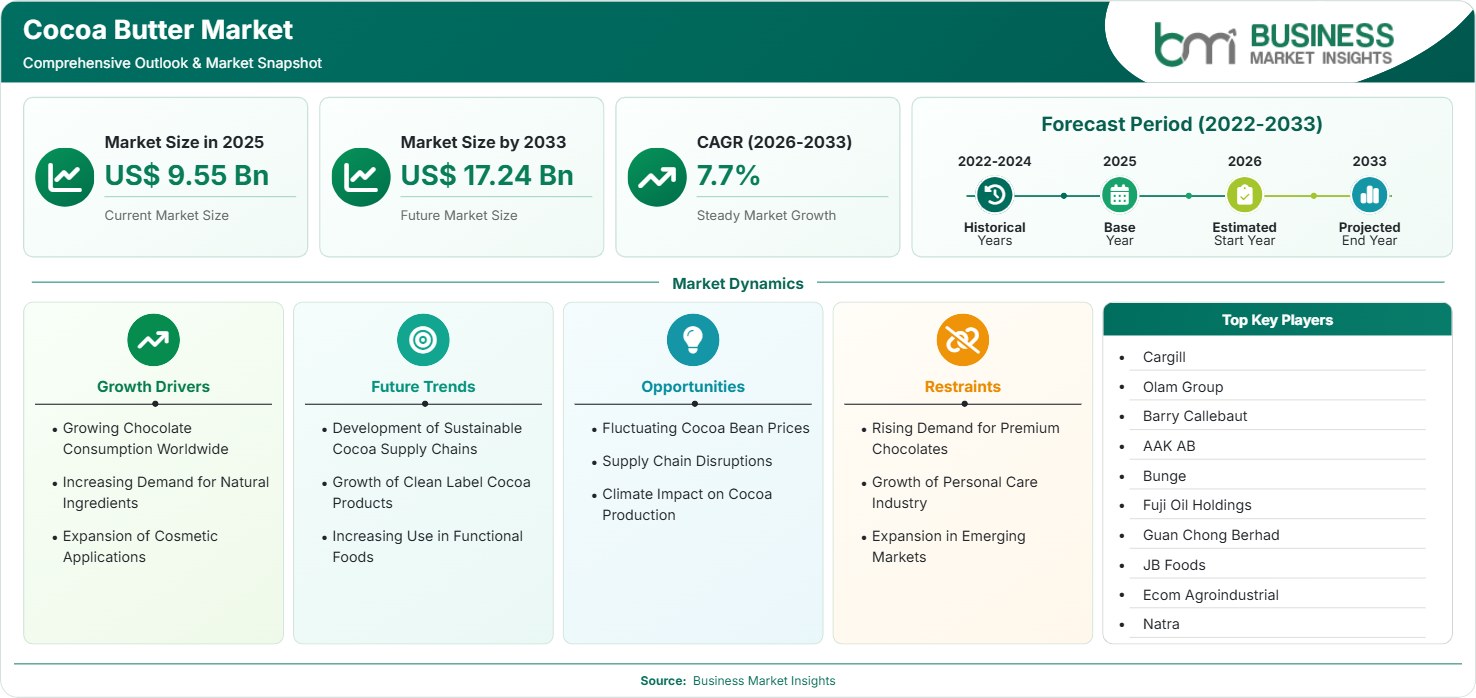
The Cocoa Butter Market size was valued at US$ 9.55 billion in 2025 and is projected to reach US$ 17.24 billion by 2033, growing at a CAGR of 7.7% during 2026–2033, driven by rising chocolate demand, increasing natural ingredient preferences, expanding cosmetic formulations, premium confectionery growth, and emerging market consumption trends.

Report Coverage
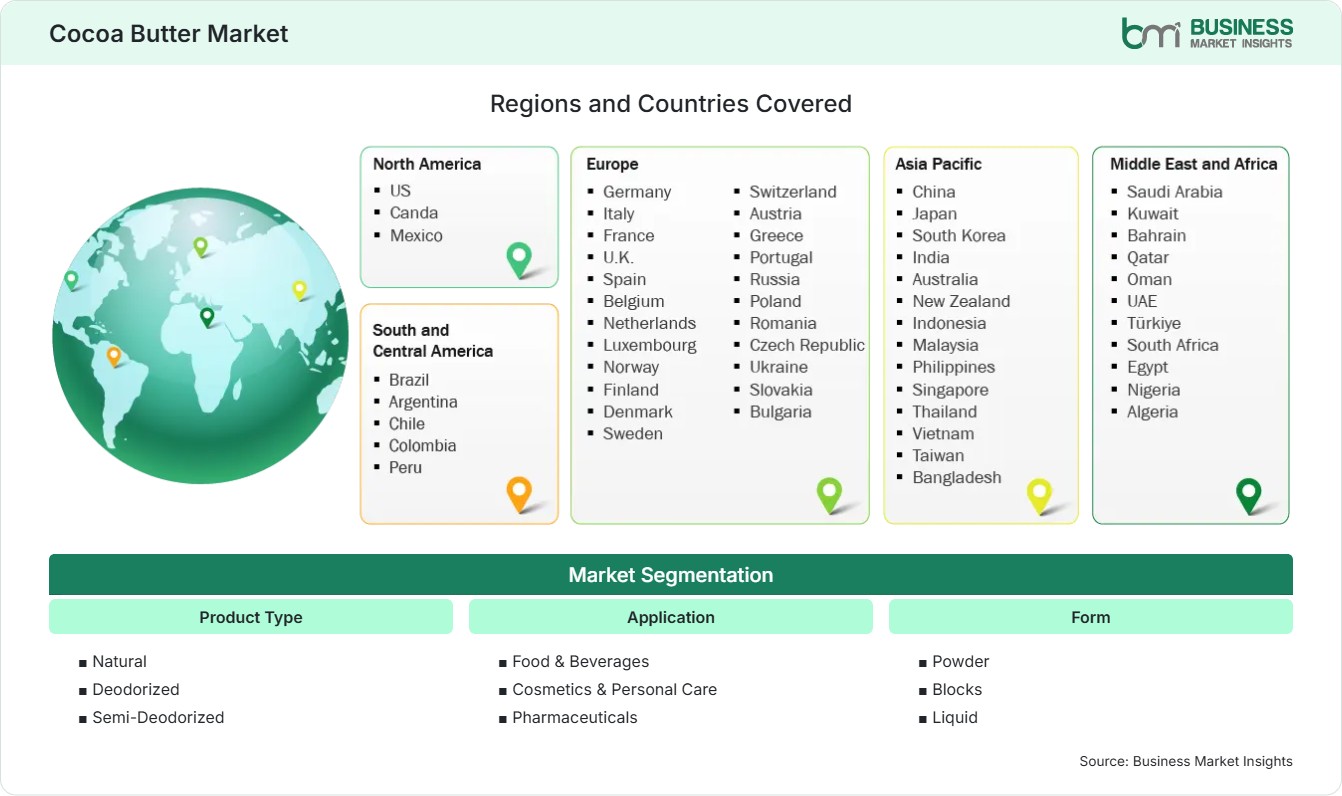
  • Product Type: Natural, Deodorized, Semi-Deodorized
  • Application: Food & Beverages, Cosmetics & Personal Care, Pharmaceuticals
  • Form: Powder, Blocks, Liquid
US$ 9.55 Bn Market size in 2025
US$ 17.24 Bn Market Size by 2033
7.7% CAGR, 2026 - 2033
2026-2033 Forecast Period

01 AI Overview

Cocoa Butter Market Summary

  • North America Region: North America holds a market share of 26%–29% in 2025, growing with a CAGR of 7%–9% influenced by premium chocolate demand, clean-label ingredients, cosmetic formulations, and functional food applications. The US market demonstrates steady expansion through confectionery innovation and personal care adoption, achieving a CAGR of 7%–8% during 2026–2033.
  • Fastest Growing Region: Asia Pacific maintains a market share of 32%–35% in 2025, expanding with a CAGR of 8%–10% supported by rising chocolate consumption, increasing disposable income, cosmetics growth, and expanding food processing industries.
  • Leading Segment: Food & Beverages represents a market share of 70%–73% in 2025, growing with a CAGR of 7%–9% due to chocolate manufacturing, bakery applications, dairy products, and increasing consumer preference for premium formulations.
  • High Growth Segment: Cosmetics & Personal Care represents a market share of 18%–21% in 2025, developing with a CAGR of 8%–10% driven by natural skincare trends, moisturizing formulations, clean beauty products, and ingredient innovation.
  • Key Market Opportunity: Premium chocolate products, natural beauty formulations, emerging market consumption, and sustainable cocoa sourcing initiatives are creating opportunities for cocoa butter producers and processors.
  • Major Market Players: Cargill, Olam Group, Barry Callebaut, AAK AB, Bunge, Fuji Oil Holdings, Guan Chong Berhad, JB Foods, Ecom Agroindustrial, and Natra.
02 Strategic Insights

Cocoa Butter Market: Strategic Insights

Cocoa Butter Market Strategic Framework
FREE PDF
Request your free sample
Request free sample
03 Stakeholder View

Key Takeaways

  • The cocoa butter value chain is becoming more integrated as processors focus on direct sourcing, traceability systems, and sustainable cocoa procurement strategies.
  • Food and beverage applications continue providing the largest demand base, while cosmetics and pharmaceutical formulations create additional growth avenues.
  • Product innovation is increasing through deodorized variants, clean-label ingredients, and improved processing techniques that enhance functionality across applications.
  • Asia Pacific offers strong investment potential due to rising chocolate consumption, expanding personal care markets, and increasing food processing capabilities.
  • Strategic partnerships and consolidation among cocoa processors are increasing as companies seek supply security and global market reach.
  • Sustainable sourcing practices and certification programs are becoming important competitive factors influencing supplier selection and consumer acceptance.
04 Geographic Outlook

Cocoa Butter Market Regional Highlights

North America Cocoa Butter Market

North America accounted for a market share of 26%–29% in 2025 and is projected to expand at a CAGR of 7%–9% during 2026–2033. The region benefits from established chocolate manufacturing, premium confectionery demand, and strong personal care industries. The Cocoa Butter Market share is supported by increasing clean-label product adoption and demand for natural cosmetic ingredients.

  • The US drives regional growth through chocolate and beauty product innovation.
  • Premium confectionery brands increase cocoa butter utilization in specialty products.
  • Cosmetic manufacturers adopt natural moisturizing ingredients for skincare formulations.
  • Food processors focus on sustainable cocoa sourcing and traceability.
  • Canada supports demand through expanding specialty chocolate consumption.

US Cocoa Butter Market

The US represented a market share of 23%–26% in 2025 and is expected to grow at a CAGR of 7%–8% during 2026–2033. Demand is supported by chocolate consumption, premium food products, and expanding natural skincare applications. Market growth is influenced by clean-label trends and increased adoption across food and personal care industries.

  • Chocolate manufacturers use cocoa butter for premium texture and flavor characteristics.
  • Beauty brands incorporate cocoa butter into moisturizing product formulations.
  • Consumers increasingly prefer natural and sustainable cosmetic ingredients.
  • Pharmaceutical applications support specialized cocoa butter demand.
  • Retail expansion improves availability of cocoa-based products.

Europe Cocoa Butter Market

Europe held a market share of 28%–31% in 2025 and is forecast to achieve a CAGR of 6%–8% between 2026–2033. The region remains a major chocolate production hub with strong demand for premium confectionery and natural personal care ingredients. Germany, Switzerland, France, and the United Kingdom contribute significantly to regional market development.

  • Germany supports demand through established chocolate manufacturing capabilities.
  • Switzerland maintains strong premium confectionery consumption patterns.
  • France expands cocoa butter usage in luxury cosmetics.
  • United Kingdom increases demand through specialty chocolate products.
  • Sustainability requirements influence cocoa sourcing strategies.

Asia Pacific Cocoa Butter Market

Asia Pacific generated a market share of 32%–35% in 2025 and is expected to register a CAGR of 8%–10% during 2026–2033. The region represents the fastest-growing market due to rising disposable income, increasing chocolate consumption, and expanding cosmetics industries. China, India, Japan, and Southeast Asian countries are key contributors.

  • China expands cocoa butter demand through growing confectionery consumption.
  • India supports market growth through increasing chocolate and beauty product adoption.
  • Japan develops premium chocolate and skincare applications.
  • Southeast Asia strengthens cocoa processing and manufacturing capabilities.
  • Rising urbanization increases demand for processed food products.

Rest of World Cocoa Butter Market

South America, the Middle East, and Africa accounted for a combined market share of 10%–13% in 2025. Growth is supported by cocoa production activities, increasing food processing investments, and expanding personal care consumption. Brazil, Ivory Coast, Ghana, UAE, and South Africa represent important markets across production and consumption segments.

  • Brazil supports cocoa processing and domestic chocolate production growth.
  • African countries strengthen cocoa value chain development initiatives.
  • Middle Eastern markets increase premium confectionery consumption.
  • UAE expands luxury cosmetics and personal care applications.
  • South Africa develops processed food and ingredient markets.
Global Market Geography
FREE PDF
Request your free sample
Request free sample
05 Segment Analysis

Cocoa Butter Market Segmentation

Product Type

Product Type segmentation reflects differences in processing methods, quality characteristics, and application suitability across food, cosmetic, and pharmaceutical industries. Natural cocoa butter remains widely preferred due to its authentic properties and clean-label appeal, while deodorized and semi-deodorized variants support applications requiring controlled aroma profiles. The Cocoa Butter Market scope is expanding as manufacturers seek functional ingredients with consistent quality, sustainable sourcing, and improved processing capabilities. Product innovation and increasing demand for premium formulations are supporting adoption across multiple industries.

  • Natural: Natural cocoa butter retains original cocoa characteristics and is widely used in chocolate, confectionery, and premium food applications requiring authentic flavor profiles.
  • Deodorized: Deodorized cocoa butter provides reduced aroma intensity and supports cosmetic, pharmaceutical, and specialized food formulations requiring neutral ingredient characteristics.
  • Semi-Deodorized: Semi-deodorized cocoa butter balances natural cocoa properties with controlled flavor, supporting confectionery and food applications requiring specific sensory attributes.

Application

Application segmentation highlights diverse utilization across food and beverages, cosmetics and personal care, and pharmaceutical industries. Food and beverage applications represent the largest demand area due to extensive chocolate and confectionery production. Cosmetics manufacturers increasingly use cocoa butter for moisturizing and skin conditioning properties, while pharmaceutical applications utilize its functional characteristics. The Cocoa Butter Market trends indicate rising adoption of natural ingredients across consumer industries, supported by premium product development and clean-label preferences.

  • Food & Beverages: Food and beverage applications dominate demand through chocolate manufacturing, bakery products, desserts, dairy products, and functional food formulations using cocoa butter.
  • Chocolate & Confectionery: Chocolate and confectionery manufacturers use cocoa butter for smooth texture, melting properties, premium quality, and product consistency across formulations.
  • Bakery & Desserts: Bakery and dessert applications utilize cocoa butter to enhance flavor, texture, stability, and premium positioning in specialty products.
  • Dairy & Frozen Desserts: Dairy and frozen dessert producers incorporate cocoa butter to improve mouthfeel, texture, and formulation quality in innovative products.
  • Functional Foods: Functional food applications utilize cocoa butter in products designed around nutritional positioning, premium ingredients, and consumer wellness preferences.
  • Cosmetics & Personal Care: Cosmetics and personal care applications use cocoa butter for moisturizing, skin protection, and natural ingredient-based beauty formulations.
  • Skin Care: Skin care products incorporate cocoa butter due to its emollient properties, supporting creams, lotions, balms, and moisturizing product development.
  • Hair Care: Hair care formulations use cocoa butter for conditioning benefits, nourishment, and natural ingredient positioning in premium personal care products.
  • Pharmaceuticals: Pharmaceutical applications utilize cocoa butter in specialized formulations requiring suitable base properties and controlled ingredient performance.

Form

Form segmentation evaluates adoption based on handling characteristics, processing requirements, and end-use suitability. Blocks remain widely used in industrial chocolate production due to storage efficiency and processing compatibility. Liquid cocoa butter supports manufacturing flexibility, while powder formats enable convenient incorporation into specialized applications. The Cocoa Butter Market analysis indicates increasing demand for versatile forms that support efficient production processes across food, cosmetics, and pharmaceutical industries.

  • Powder: Powdered cocoa butter supports convenient handling, blending efficiency, and specialized applications requiring improved processing flexibility and storage advantages.
  • Blocks: Block cocoa butter remains widely used in chocolate manufacturing due to easy transportation, storage benefits, and compatibility with industrial processing systems.
  • Liquid: Liquid cocoa butter enables efficient processing and mixing operations, supporting applications requiring smooth ingredient integration and production flexibility.
06 Market Forces

Cocoa Butter Market Dynamics

Key Market Drivers

Growing Chocolate Consumption Worldwide

The growing consumption of chocolates in developed and emerging countries is driving strong demand for cocoa butter used in confectionery production. Customers have started buying expensive chocolates, as well as other specialized products and novel foods made from cocoa. This is causing companies to increase their production capacity. The Cocoa Butter Market growth can be attributed to increased accessibility, dietary shifts, and premiumization in the chocolate industry. Based on the information provided by the trade associations of the industry, there is a growing demand for products made from cocoa in the global market.

Increasing Demand for Natural Ingredients

The growing consumer taste for natural ingredients is driving producers to incorporate cocoa butter into various applications, including food, cosmetics, and drugs. There has been increasing consumer interest in products with easily recognizable, natural ingredients, especially in the personal care and premium food segments. The market trends are driven by increased demand for sustainable plant-based ingredients, which have functionalities. Cosmetics companies are shifting from using synthetic ingredients to moving towards natural ingredients to meet consumer demands. There has been a move by food producers to position their products through cocoa-derived ingredients.

Expansion of Cosmetic Applications

The increased use of cosmetics is driving up the demand for cocoa butter because of its moisturizing, conditioning, and skin protection benefits. Beauty and personal care firms are using cocoa butter in lotions, creams, lip products, and hair care products aimed at people who prefer products with natural ingredients. There is more interest in clean beauty products and high-end skincare, which helps drive the increased demand. Producers are developing new formulations that blend cocoa butter with other plant extracts to boost effectiveness. Personal care markets in the Asia-Pacific region and emerging nations are creating new demand channels.

Key Market Opportunities

Rising Demand for Premium Chocolates

Opportunities for cocoa butter producers are emerging owing to rising consumer preference for premium quality chocolate products that have great taste and texture properties. Chocolate producers are increasing their range of premium products, which include artisan chocolates and luxury confectionery items. High-quality cocoa inputs are required for such chocolate products. Those cocoa butter producers who provide consistency in quality, sustainability, and traceability of cocoa butter could derive significant competitive advantages. Growth in premium retail segments and specialty food products is also contributing to investments in advanced cocoa processing facilities. This particular opportunity is especially pertinent to developed countries, owing to consumer preferences there, which support the cocoa butter market forecast.

Growth of Personal Care Industry

The expanding personal care industry is creating many opportunities as companies use natural oils and plant ingredients in beauty and hair care products. Cocoa butter is appreciated because of its moisturizing characteristics and its ability to be used in high-end cosmetic formulas. The growing trend of clean beauty and wellness products is leading to the increased use of cocoa butter. There are companies working on formulation innovations that use ethically sourced and functional cocoa butter. The expanding middle-class population in emerging economies is driving growth in personal care consumption.

Expansion in Emerging Markets

There are growth opportunities in emerging countries because of increased disposable incomes, urbanization, and an increasing usage of chocolate products and personal care items. There is a growing demand for food and beauty products across Asia Pacific, Latin America, and the Middle East. Expansion of local manufacturing and development of better retailing facilities have been helping to increase the consumption of cocoa butter. Suppliers that form regional alliances and develop their distribution channels can gain advantages from a larger customer base. This will also help make the market more lucrative for suppliers.

Market Restraints and Challenges

Fluctuating Cocoa Bean Prices

Factor: Cocoa bean prices are influenced by weather conditions, crop yields, geopolitical issues, and supply-demand fluctuations across major producing regions. Impact: Volatility in price may result in higher costs of production, profit margin erosion, and difficulties in negotiating long-term contracts in the manufacturing process. Cocoa processors will need to develop an efficient purchasing strategy and maintain supplier relationships to manage raw material uncertainties. Price hikes may affect product prices in both the cosmetics and chocolate sectors. Companies are looking into diversifying raw material sources, managing inventory, and cultivating sustainability partnerships to cushion against market volatility.

Supply Chain Disruptions

Factor: Cocoa supply chains depend on agricultural production networks, international transportation systems, and processing infrastructure, all of which can face operational disruptions. Impact: Supply chain issues could threaten the availability of raw materials, timely deliveries, and the flow of production at cocoa butter-producing companies. Weather-based problems, logistical challenges, and political uncertainties can also pose new threats to global supply chains. The industry is addressing these threats by building resilient supply chains through diverse supply sources, better inventory management, and direct links with suppliers. Traceability systems are now also becoming a crucial tool to deal with supply chain risks.

07 Company Analysis

Competitive Landscape

The Cocoa Butter Market analysis highlights competition among global cocoa processors, ingredient suppliers, and confectionery solution providers focused on quality improvement, sustainable sourcing, and expanded processing capabilities. Leading companies are strengthening cocoa supply networks, investing in traceability systems, and developing specialized cocoa butter variants for food, cosmetics, and pharmaceutical applications. Strategic partnerships with cocoa producers and expansion into emerging markets are shaping competitive positioning across the industry.

Company Name

Overview

Products and Services relevant to this market

Cargill

Global agricultural commodities company with extensive cocoa processing operations.

Cocoa butter, cocoa ingredients, chocolate solutions, sustainable cocoa sourcing, and processing services.

Olam Group

Agricultural supply chain company specializing in cocoa sourcing and processing.

Cocoa butter, cocoa ingredients, sustainable sourcing programs, and cocoa processing solutions.

Barry Callebaut

Leading chocolate and cocoa ingredient manufacturer serving global customers.

Cocoa butter, chocolate ingredients, cocoa products, and customized confectionery solutions.

AAK AB

Specialty oils and fats producer serving food and personal care industries.

Cocoa butter alternatives, specialty fats, confectionery ingredients, and formulation solutions.

Bunge

Global agribusiness company involved in food ingredient processing.

Cocoa products, specialty ingredients, cocoa butter solutions, and supply chain services.

Fuji Oil Holdings

Food ingredient manufacturer specializing in oils and fats.

Cocoa butter, chocolate ingredients, specialty fats, and food formulation technologies.

Guan Chong Berhad

Cocoa processing company supplying cocoa ingredients worldwide.

Cocoa butter, cocoa powder, cocoa liquor, and industrial cocoa processing solutions.

JB Foods

Cocoa ingredient producer with international processing capabilities.

Cocoa butter, cocoa powder, cocoa products, and confectionery ingredients.

Ecom Agroindustrial

Global agricultural commodities company focused on cocoa supply chains.

Cocoa sourcing, cocoa processing, cocoa butter, and sustainable cocoa programs.

Natra

Chocolate manufacturer providing cocoa-based food products globally.

Chocolate products, cocoa ingredients, confectionery solutions, and cocoa butter applications.

08 Industry Activity

Recent Developments

May 2026

AAK AB joined the Next Generation Pet Food Program as an industry collaborator alongside Mars Petcare, Big Idea Ventures, Bühler Group, Givaudan, and Ingredion to accelerate innovation in sustainable pet nutrition. The collaboration aims to advance sustainable ingredients and innovative solutions for the pet food industry.

April 2026

Cargill Inc. received the 2026 BIG Artificial Intelligence Excellence Award from the Business Intelligence Group for applying artificial intelligence across the global food and agriculture value chain. The recognition highlights Cargill’s use of AI to drive innovation and improve operational efficiency.

March 2026

Natra S.A. launched an R&D initiative focused on the development of cellulose-based packaging for chocolate tablets reinforced with microfibrillated cellulose (MFC) derived from cocoa husks. The initiative aims to develop more sustainable packaging solutions while valorizing cocoa by-products.

April 2025

Fuji Oil Holdings Inc. announced the acquisition of the remaining shares of PROVENCE HUILES S.A.S., making the French specialty oils and fats company a wholly owned subsidiary. The acquisition strengthens Fuji Oil’s presence in the European specialty oils and fats market.

10 Trust & Transparency

Research Methodology

The market analysis combines proprietary research with secondary data from government agencies, company disclosures, regulatory filings, industry databases and expert interviews. Market estimates are validated through data triangulation, cross-market benchmarking and analyst review.

View Full Research Methodology

11 Questions Answered

Frequently Asked Questions

What does the Cocoa Butter Market Report analyze?

The report analyzes market size, regional trends, segmentation patterns, competitive developments, growth drivers, opportunities, restraints, and factors influencing global cocoa butter demand.

What challenges affect cocoa butter production?

Raw material price volatility, cocoa supply disruptions, climate-related production risks, and transportation challenges can affect cocoa butter availability and production costs across global markets.

How is sustainability influencing the cocoa butter industry?

Sustainability is influencing sourcing strategies through traceability programs, responsible farming practices, certification initiatives, and partnerships between cocoa processors and agricultural producers to improve supply chain transparency.

Which application segment dominates cocoa butter consumption?

Food and beverages represent the largest application segment due to extensive cocoa butter usage in chocolate and confectionery manufacturing. Cosmetics and personal care applications are also expanding due to demand for natural moisturizing ingredients.

What factors are driving the market growth?

Increasing chocolate consumption, rising demand for natural ingredients, expanding cosmetic applications, premium confectionery growth, and growing adoption of clean-label formulations are key factors supporting cocoa butter demand globally.

Access the Full Cocoa Butter Market Report

Get segment-level forecasts, regional estimates, competitive benchmarking, company profiles and downloadable Excel datasets.

Access the full Cocoa Butter Market Report
350 pages PDF & Excel | 2026-07-31