
Ceiling Fan Market Outlook: Size, Share, Trends, Growth Analysis, Competitive Landscape & Forecast, 2026-2033

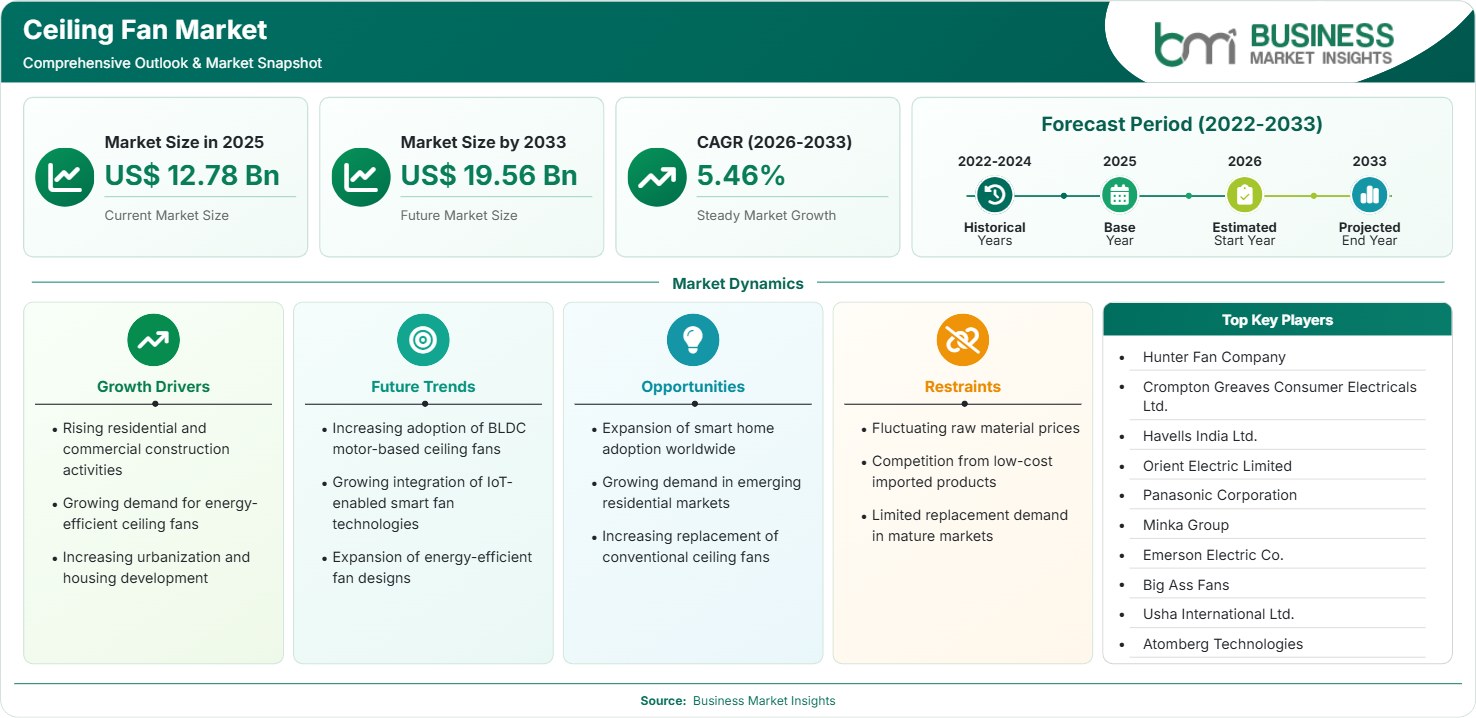
The Ceiling Fan Market size was valued at US$ 12.78 Billion in 2025 and is projected to reach US$ 19.56 Billion by 2033, growing at a CAGR of 5.46% during 2026–2033. Growth is driven by housing expansion, energy-efficient appliance adoption, replacement demand, and increasing smart home integration opportunities across residential and commercial spaces.

Report Coverage
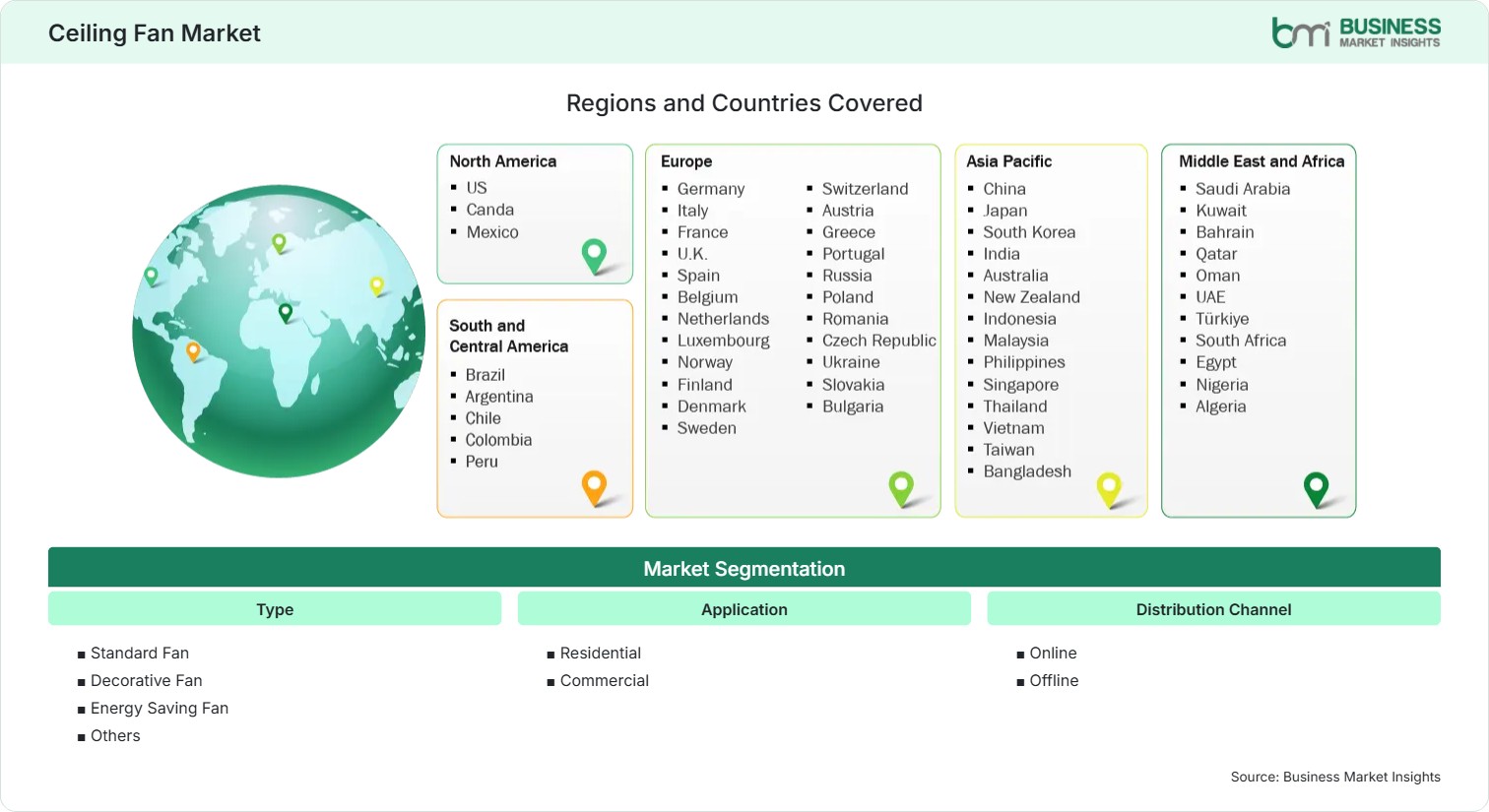
  • Type: Standard Fan, Decorative Fan, Energy Saving Fan, Others
  • Application: Residential, Commercial
  • Distribution Channel: Online, Offline
US$ 12.78 Bn Market size in 2025
US$ 19.56 Bn Market Size by 2033
5.46% CAGR, 2026 - 2033
2026-2033 Forecast Period

AI Overview

Ceiling Fan Market Summary

  • North America Region: North America holds 18%–22% share in 2025, growing at a CAGR of 4.8%–5.3% during 2026–2033, supported by remodeling activities, premium appliance adoption, energy efficiency standards, and smart home integration. The US market benefits from residential renovation demand, connected appliances, and replacement cycles, expanding at a CAGR of 4.7%–5.2% during 2026–2033.
  • Fastest Growing Region: Asia Pacific accounts for 42%–46% share in 2025, expanding at a CAGR of 5.8%–6.4% during 2026–2033, driven by urban housing development, rising disposable income, construction growth, and increasing adoption of efficient cooling solutions across emerging economies.
  • Leading Segment: Standard Fan represents 45%–50% share in 2025, growing at a CAGR of 4.9%–5.4% during 2026–2033, supported by affordability, widespread residential usage, replacement demand, and strong distribution networks across developing markets.
  • High Growth Segment: Energy Saving Fan accounts for 20%–25% share in 2025, advancing at a CAGR of 7.0%–7.6% during 2026–2033, supported by electricity cost concerns, efficiency regulations, BLDC motor adoption, and consumer preference for lower power consumption products.
  • Key Market Opportunity: Smart ceiling fans, connected home technologies, and premium energy-efficient products create growth opportunities as consumers increasingly prioritize automation, convenience, energy savings, and digitally controlled household appliances.
  • Major Market Players: Hunter Fan Company, Crompton Greaves Consumer Electricals Ltd., Havells India Ltd., Orient Electric Limited, Panasonic Corporation, Minka Group, Emerson Electric Co., Big Ass Fans, Usha International Ltd., and Atomberg Technologies.
Strategic Insights

Ceiling Fan Market: Strategic Insights

Ceiling Fan Market Strategic Framework
FREE PDF
Request your free sample
Request free sample
Stakeholder View

Key Takeaways

  • The market ecosystem is shifting from traditional manufacturing toward technology-focused product development, with companies competing through motor efficiency, smart controls, design innovation, and after-sales service capabilities.
  • Energy Saving Fan products represent the strongest growth opportunity as consumers and businesses seek reduced electricity consumption, improved efficiency ratings, and long-term operating cost benefits.
  • Smart connectivity is becoming a major innovation direction, with manufacturers integrating mobile applications, voice control compatibility, automation features, and energy monitoring capabilities.
  • Asia Pacific provides the strongest expansion opportunity due to urban housing development, rising appliance ownership, and increasing replacement of older cooling equipment.
  • Competitive activity is increasing through product launches, technology partnerships, and investments in premium appliance categories as established brands compete with emerging smart appliance companies.
  • Distribution transformation is reshaping purchasing behavior, with online channels gaining importance through wider product availability, customer reviews, and direct-to-consumer strategies.
Geographic Outlook

Ceiling Fan Market Regional Highlights

North America Ceiling Fan Market

North America represents 18%–22% share in 2025 and expands at a CAGR of 4.8%–5.3% during 2026–2033. Demand is influenced by residential renovation, commercial construction, and increasing preference for energy-efficient appliances. The Ceiling Fan Market share remains supported by premium product adoption and replacement purchases. The region benefits from established brands, advanced retail networks, and consumer interest in connected home technologies. The United States remains the largest contributor, supported by remodeling activity, smart home adoption, and demand for aesthetically designed cooling solutions.

  • Residential renovation projects are supporting replacement demand as homeowners upgrade older ceiling fans with efficient motors, improved designs, and smart connectivity features.
  • Energy efficiency standards are encouraging manufacturers to introduce advanced models that consume less electricity while maintaining airflow performance.
  • Commercial buildings are adopting ceiling fans to improve air circulation and optimize HVAC efficiency across offices, retail spaces, and hospitality facilities.
  • Premium decorative and smart ceiling fans are gaining traction among consumers seeking functional appliances with enhanced interior design value.

US Ceiling Fan Market

The US market accounts for 15%–18% share in 2025 and grows at a CAGR of 4.7%–5.2% during 2026–2033. Demand is shaped by residential remodeling, replacement cycles, and increasing adoption of smart appliances. The Ceiling Fan market benefits from strong brand presence, developed retail infrastructure, and consumer preference for technologically advanced products. Energy-saving models are gaining acceptance as households seek lower electricity expenses. Commercial applications are also expanding through demand from offices, hospitality properties, and public buildings requiring efficient air circulation solutions.

  • Smart ceiling fans are gaining popularity through integration with home automation platforms and voice-controlled systems.
  • Residential replacement demand remains stable due to aging installed products and consumer interest in upgraded designs.
  • Manufacturers are emphasizing energy-efficient motors and improved airflow technologies to meet changing customer expectations.
  • Online retail growth is improving access to premium and innovative ceiling fan products.

Europe Ceiling Fan Market

Europe holds 20%–24% share in 2025 and grows at a CAGR of 4.9%–5.5% during 2026–2033. Demand is supported by residential refurbishment, commercial infrastructure development, and increasing focus on energy-efficient household appliances. Countries including Germany, Italy, Spain, France, and the UK represent important markets. The region shows growing interest in smart appliances, sustainable products, and premium decorative designs in Ceiling Fan Market.

  • Germany and France are experiencing increased demand for efficient household appliances through renovation and sustainability initiatives.
  • Southern European countries are adopting ceiling fans due to warmer climates and increasing interest in energy-saving cooling solutions.
  • Commercial facilities are integrating ceiling fans with HVAC systems to improve indoor comfort and reduce energy usage.
  • Premium decorative fans are gaining demand among consumers prioritizing home aesthetics and functionality.
  • Smart controls and connected appliance features are supporting product differentiation among leading manufacturers.

Asia Pacific Ceiling Fan Market

Asia Pacific dominates with 42%–46% share in 2025 and records the fastest growth at a CAGR of 5.8%–6.4% during 2026–2033. The region benefits from rapid urbanization, residential construction, rising household incomes, and expanding appliance penetration. India, China, Southeast Asia, and Japan represent key markets. Growing electricity awareness is increasing demand for energy-saving fans, while online channels are improving consumer access to advanced products. The region remains central to both production capabilities and future consumption Ceiling Fan Market growth.

  • India remains a major growth market due to housing expansion, increasing appliance ownership, and demand for efficient cooling solutions.
  • China supports regional demand through large-scale manufacturing capabilities and strong domestic appliance consumption.
  • Southeast Asian markets are benefiting from urban development and rising adoption of modern household appliances.
  • Energy-efficient fan technologies are gaining acceptance as consumers focus on electricity savings and sustainability.
  • Online retail platforms are expanding product availability across emerging residential markets.

Rest of World Ceiling Fan Market

Rest of World markets account for 8%–12% share in 2025 and expand at a CAGR of 5.2%–5.8% during 2026–2033. Latin America, Middle East, and Africa markets are supported by climate conditions, housing development, and increasing appliance demand. Brazil, Mexico, UAE, Saudi Arabia, and South Africa represent emerging opportunities. Rising urban populations and infrastructure investments are encouraging adoption of affordable and energy-efficient cooling products in Ceiling Fan Market forecasts.

  • Latin American markets are expanding through residential construction and replacement of older household cooling appliances.
  • Middle Eastern countries are adopting efficient ceiling fans for commercial buildings and residential developments.
  • African markets present long-term potential due to urbanization, electrification improvements, and rising household appliance demand.
  • Manufacturers are developing cost-effective products to address price-sensitive consumer segments in developing economies.
  • Distribution partnerships are improving market penetration across emerging regional markets.
Global Market Geography
FREE PDF
Request your free sample
Request free sample
Segment Analysis

Ceiling Fan Market Segmentation

Type

Type segmentation highlights the shift from conventional cooling solutions toward efficient and technology-enabled products. Standard Fan held 45%–50% share in 2025 and is projected to grow at a CAGR of 4.9%–5.4% during 2026–2033. Demand is supported by affordability, broad residential usage, replacement cycles, and established distribution networks. Energy Saving Fan adoption is accelerating due to electricity cost concerns and efficiency awareness.

  • Standard Fan: Standard fans remain widely adopted due to competitive pricing, simple operation, and suitability across residential applications. Their demand is supported by replacement requirements and strong availability through offline retail channels.
  • Decorative Fan: Decorative fans are gaining popularity among premium consumers seeking improved interiors and functional designs. Demand is influenced by home renovation activities, aesthetic preferences, and increasing availability of designer models.
  • Energy Saving Fan: Energy saving fans are expanding rapidly due to BLDC motor technology, lower electricity consumption, and consumer focus on long-term savings. Smart features and efficiency ratings further support adoption.

Application

Application segmentation reflects strong demand from residential and commercial environments. Residential applications represented 68%–72% share in 2025 and are expected to expand at a CAGR of 5.2%–5.7% during 2026–2033. Household construction, renovation activity, and increasing appliance ownership remain major contributors. Commercial adoption is supported by offices, hospitality spaces, retail facilities, and institutional buildings requiring efficient air circulation solutions.

  • Residential: Residential demand remains dominant due to housing development, replacement of conventional fans, and rising consumer preference for energy-efficient household appliances. Smart and decorative models are gaining acceptance among urban households.
  • Commercial: Commercial applications are increasing through adoption in offices, hotels, restaurants, and retail spaces. Businesses are selecting efficient ceiling fans to improve comfort, reduce cooling costs, and optimize energy consumption.

Distribution Channel

Distribution channel analysis shows increasing competition between traditional retail networks and digital platforms. Offline channels accounted for 70%–75% share in 2025 and are expected to grow at a CAGR of 4.6%–5.1% during 2026–2033 due to established dealer networks and consumer preference for physical product evaluation in Ceiling Fan Market. Online channels are expanding faster as consumers increasingly compare specifications, pricing, and energy ratings digitally.

  • Online: Online distribution is gaining momentum through e-commerce platforms, direct-to-consumer models, and digital marketing strategies. Consumers benefit from wider product selection, reviews, and convenient purchasing experiences.
  • Offline: Offline channels continue leading through electrical retailers, distributors, and brand outlets. Strong after-sales support, installation services, and customer trust maintain the importance of physical sales networks. s
Market Forces

Ceiling Fan Market Dynamics

Key Market Drivers

Rising Residential and Commercial Construction Activities

Construction growth across residential complexes, commercial buildings, and infrastructure projects is supporting demand for ceiling fans worldwide. New housing developments require efficient and affordable cooling solutions, particularly in regions with warm climates. Commercial construction across offices, hotels, retail centers, and public facilities is also increasing demand for reliable air circulation products. The Ceiling Fan Market growth is supported by expanding urban housing projects, renovation activities, and increasing appliance installation requirements. Builders and developers are increasingly considering energy-efficient electrical appliances as part of modern building designs. This trend is strengthening opportunities for manufacturers offering diverse product portfolios across entry-level, premium, and smart categories.

Growing Demand for Energy-Efficient Ceiling Fans

Rising electricity costs and growing consumer awareness regarding energy conservation are accelerating adoption of energy-efficient ceiling fans. BLDC motor-based products are gaining traction due to lower power consumption, improved durability, and reduced operating costs compared with conventional models. The Ceiling Fan Market trends indicate increasing investment in efficient motor technologies, smart controls, and performance optimization. Government energy efficiency programs and changing consumer preferences are encouraging manufacturers to introduce products with improved ratings and advanced features. Residential users are increasingly replacing older fans with efficient models to reduce electricity expenses, while commercial users are adopting these solutions to improve building energy performance.

Increasing Urbanization and Housing Development

The increasing trend of urbanization has resulted in rising demands for household appliances as a result of migration to the newly built-up residential locations. An increase in population in emerging economies has led to the construction of apartments and other residential buildings, as well as infrastructure, increasing demand for inexpensive appliances that provide cooling. There is also a greater preference among urban residents for design, remote operation, and connectivity. The appliance manufacturers have come up with products that offer both efficiency and smartness. There are growing middle classes in the Asia Pacific, Latin America and other developing countries.

Key Market Opportunities

Expansion of Smart Home Adoption Worldwide

The growing popularity of smart home technologies is creating opportunities by incorporating connected appliances into household settings. Smart ceiling fans that are Wi-Fi-enabled, have voice control, automatically adjust fan speed, and use mobile applications have caught the eye of technology-savvy consumers. There are ongoing developments to integrate coolers with home automation systems. Such an opportunity exists especially in urban areas due to the demand for convenience, energy monitoring, and remote control of household appliances. Companies investing in smart product creation, software development, and digital experiences can improve their market positioning.

Growing Demand in Emerging Residential Markets

The new residential segments represent growth opportunities due to rising investment in housing construction, higher disposable incomes, and greater adoption of household appliances. The demand for cost-effective and energy-efficient cooling systems is growing in many Asian Pacific, Latin American, and African countries. Companies have an opportunity to produce products that would suit specific market needs related to the climate, customer preferences, and price level. Development of sales network and manufacturing in the region along with competitive pricing become key strategy of market penetration. Electrification and urbanization facilitate better access to household appliances.

Increasing Replacement of Conventional Ceiling Fans

Replacement demand is growing as more consumers upgrade their old ceiling fans to newer, more energy-efficient models that offer improved performance. The older generation of ceiling fans which have been fitted over the past decades, are usually less energy-efficient and do not have current technology. More consumers are now considering upgrading them for reasons such as energy savings, improved performance, remote-control capability, and aesthetics. Companies are tapping into the replacement demand by marketing their products, offering better warranties, and increasing their availability in retail stores.

Market Restraints and Challenges

Fluctuating Raw Material Prices

Factor: Volatility in prices of metals, plastics, electronic components, and other manufacturing inputs increases production costs for ceiling fan manufacturers. Impact: Higher material expenses can reduce profit margins, increase product prices, and create challenges in maintaining competitive pricing. Manufacturers are adapting by using diversification of suppliers, managing their inventories, and becoming more efficient at producing goods. But still, the prices of commodities keep impacting cost structures. Manufacturers that have better supply chain management and manufacturing capacity are more capable of dealing with the pressure on pricing. The main issue is keeping the products affordable while implementing sophisticated technology.

Competition from Low-Cost Imported Products

Factor: Increasing availability of low-cost imported ceiling fans creates pricing pressure, especially in developing markets with high price sensitivity. Impact: Domestic manufacturers may experience reduced margins and intensified competition from lower-priced alternatives. While imported goods may entice cost-conscious buyers, there is always the risk that these could raise worries about quality, durability, warranty, and energy efficiency. However, well-known brands are solving this problem through more advanced logistics systems, product differentiation, and customer care. Technology and production investments remain important for companies wishing to maintain competitive advantages.

Company Analysis

Competitive Landscape

The Ceiling Fan Market analysis indicates a competitive environment shaped by product innovation, energy efficiency improvements, distribution expansion, and increasing demand for smart appliances. Leading manufacturers are focusing on BLDC motor technology, connected solutions, premium designs, and regional market expansion to strengthen their competitive positions.

Company Name

Overview

Products and Services relevant to this market

Hunter Fan Company

Hunter Fan Company is a leading US-based ceiling fan manufacturer known for residential, premium, and smart fan solutions.

Offers traditional, decorative, and smart ceiling fans with connected controls, energy-efficient motors, and home automation compatibility.

Crompton Greaves Consumer Electricals Ltd.

Crompton Greaves Consumer Electricals Ltd. is a major Indian electrical appliance company with strong consumer reach.

Provides residential and commercial ceiling fans including energy-efficient, decorative, and BLDC motor-based products.

Havells India Ltd.

Havells India Ltd. is a diversified electrical equipment manufacturer with a strong presence in consumer appliances.

Manufactures ceiling fans featuring advanced motors, premium designs, energy-saving technologies, and smart control capabilities.

Orient Electric Limited

Orient Electric Limited is an established Indian appliance brand offering a broad ceiling fan portfolio.

Provides standard, decorative, premium, and energy-efficient ceiling fans for residential and commercial applications.

Panasonic Corporation

Panasonic Corporation is a global electronics company offering consumer and building solutions across multiple regions.

Develops ceiling fans with efficient motors, durable designs, and advanced electrical appliance technologies.

Minka Group

Minka Group is a US-based lighting and ceiling fan company focused on decorative and premium products.

Offers designer ceiling fans combining aesthetic designs, performance features, and residential application solutions.

Emerson Electric Co.

Emerson Electric Co. provides technology solutions across residential, commercial, and industrial markets.

Supplies ceiling fan products through its appliance and airflow technology capabilities with efficient performance solutions.

Big Ass Fans

Big Ass Fans specializes in large-scale airflow solutions for commercial, industrial, and residential environments.

Provides high-volume low-speed fans, smart controls, and advanced airflow management solutions.

Usha International Ltd.

Usha International Ltd. is an Indian consumer durable company with a significant ceiling fan portfolio.

Manufactures residential ceiling fans including efficient motors, decorative models, and smart appliance products.

Atomberg Technologies

Atomberg Technologies is an emerging Indian technology-focused fan manufacturer specializing in efficient smart fans.

Offers BLDC motor ceiling fans with remote controls, energy-saving features, and connected appliance capabilities.

Trust & Transparency

Research Methodology

The market analysis combines proprietary research with secondary data from government agencies, company disclosures, regulatory filings, industry databases and expert interviews. Market estimates are validated through data triangulation, cross-market benchmarking and analyst review.

View Full Research Methodology

Questions Answered

Frequently Asked Questions

What factors influence ceiling fan purchasing decisions?

Consumers evaluate price, energy efficiency, design, airflow performance, durability, warranty support, and smart features when selecting ceiling fans for residential or commercial use.

How are online channels changing ceiling fan sales?

Online channels are improving product accessibility by allowing customers to compare specifications, prices, energy ratings, and reviews while enabling brands to reach broader consumer segments.

Which region offers the strongest growth opportunity in Ceiling Fan Market?

Asia Pacific provides strong growth potential due to rapid urbanization, housing development, increasing appliance ownership, and rising consumer demand for efficient cooling solutions.

Why are smart ceiling fans gaining popularity?

Smart ceiling fans are gaining traction because they provide remote control, automation, voice assistant compatibility, and integration with connected home ecosystems, improving convenience and energy management.

What is driving demand for energy-efficient ceiling fan market report?

Demand is increasing due to rising electricity costs, consumer awareness, and adoption of BLDC motor technology. Energy-efficient fans help households and businesses reduce operating expenses while maintaining effective air circulation.

Access the Full Ceiling Fan Market Report

Get segment-level forecasts, regional estimates, competitive benchmarking, company profiles and downloadable Excel datasets.

Access the full Ceiling Fan Market Report
350 pages PDF & Excel | 2026-08-07
Similar Research

Related Market Reports