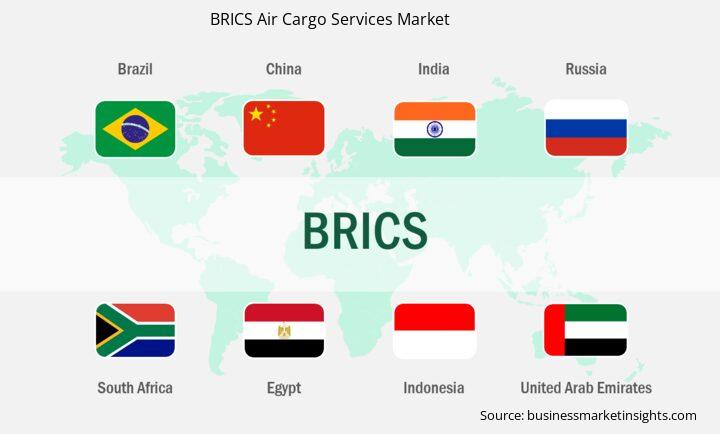
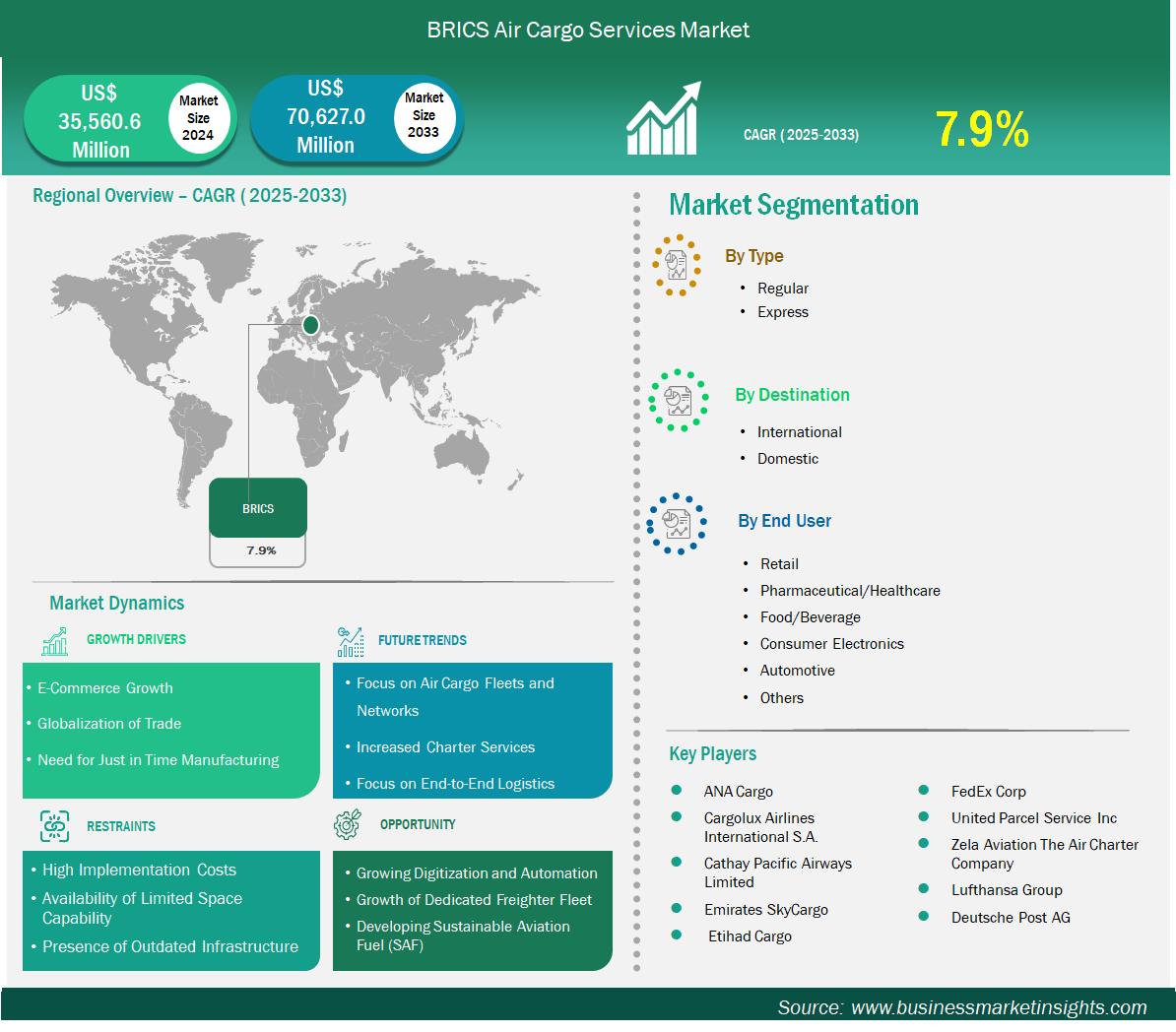
The BRICS air cargo services market size is expected to reach US$ 70,627.0 million by 2033 from US$ 35,560.6 million in 2024. The market is estimated to record a CAGR of 7.9% from 2025 to 2033.
Executive Summary and BRICS Air Cargo Services Market Analysis:
The BRICS air cargo services market is rapidly developing into a critical global logistics ecosystem, fueled by robust infrastructure investments, regional trade integration, and digital transformation. Member countries such as the Russian Federation, Brazil, South Africa, India, China, Egypt, Indonesia, and the United Arab Emirates are contributing unique strengths to the sector—ranging from smart logistics infrastructure and AI-enabled cargo handling to trade zone liberalization and bonded logistics networks.
China continues to lead in air cargo volume, supported by its expansive airport network, integrated customs systems, and leadership in cross-border e-commerce. Strategic hubs like Shanghai Pudong and Guangzhou Baiyun airports are investing in smart cargo platforms and green aviation technologies to improve operational efficiency and environmental sustainability.
India is expanding its air cargo footprint with dedicated freight corridors and investments in airport modernization under initiatives like Gati Shakti and the UDAN scheme. Major airports such as Delhi, Mumbai, and Hyderabad are focusing on increasing capacity for pharmaceutical and express cargo, alongside improved logistics zoning and automation.
Brazil is strengthening its role as a logistics gateway in South America, with São Paulo and Viracopos International Airports leading investments in cargo terminal upgrades, bonded warehousing, and customs digitization to facilitate growing trade volumes with Asia and Africa.
The Russian Federation is positioning its cargo sector as a strategic bridge between Europe and Asia, leveraging the Trans-Siberian corridor and major airports like Sheremetyevo. The government is focusing on infrastructure development, cold chain systems, and improved freight corridors for perishables and high-value goods.
United Arab Emirates, particularly Dubai and Abu Dhabi, is reinforcing its position as a global logistics hub with world-class multimodal infrastructure, free zones, and express cargo services. Dubai’s Al Maktoum International Airport is emerging as a key mega-hub in the BRICS air freight network.
Egypt is expanding its air cargo sector through infrastructure modernization at Cairo International Airport and cold chain investment for pharmaceuticals and perishables. Customs digitization and smart logistics solutions are driving efficiency in cargo operations.
Indonesia continues to grow its air cargo capabilities through airport modernization, cold chain development, and smart logistics platforms. Soekarno-Hatta International Airport is enhancing cargo throughput and regional connectivity.
South Africa is emerging as a pivotal logistics hub in the BRICS network, with Johannesburg’s OR Tambo International Airport acting as a gateway for intra-African and global cargo flows. The country is investing in digital freight systems, bonded logistics zones, and green aviation initiatives to support e-commerce and industrial goods trade.
Together, these BRICS nations are strengthening the region’s air cargo ecosystem by embracing digital transformation, infrastructure modernization, and sustainable freight initiatives—positioning BRICS as a global hub for fast, reliable, and cost-efficient air cargo services.
BRICS Air Cargo Services Market Segmentation Analysis:
Key segments that contributed to the derivation of the air cargo services market analysis are type, destination and end user.
- By type, the air cargo services market is bifurcated into regular and express. The regular segment dominated the market in 2024.
- By destination, the market is bifurcated into international and domestic. The international segment held the largest share of the market in 2024.
- By end user, the market is segmented into retail, pharmaceutical/healthcare, food/beverage, consumer electronics, automotive, and others. The pharmaceutical/healthcare segment held the largest share of the market in 2024.
BRICS Air Cargo Services Market Outlook
The BRICS air cargo services market is rapidly emerging as a vital logistics hub in Asia and beyond, underpinned by strong intra-regional trade, advanced logistics infrastructure, and multimodal connectivity. Countries, including the Russian Federation, Brazil, South Africa, India, China, Egypt, Indonesia, Saudi Arabia, and the United Arab Emirates, are playing pivotal roles in shaping the region’s cargo landscape through strategic investments in smart cargo systems, airport modernization, and digital freight platforms. The region’s central geographic location between major global economies positions it as a critical node in international air freight corridors.
A key growth driver in the region is the surge in demand for time-critical, high-value shipments, including electronics, pharmaceuticals, and perishables. Governments and logistics providers across BRICS are adopting automation, AI-powered cargo platforms, and green aviation technologies to reduce emissions and improve cargo efficiency. Ongoing modernization efforts include capacity expansion, green aviation initiatives, and partnerships with global logistics firms to strengthen the role of BRICS as a major hub for transcontinental freight.
BRICS Air Cargo Services Market Country Insights
Based on country, the BRICS air cargo services market is experiencing robust growth, driven by strategic infrastructure investments, rapid e-commerce expansion, and strong trade integration across member economies such as Russian Federation, Brazil, South Africa, India, China, Egypt, Indonesia, and the United Arab Emirates. These countries are strengthening their position in the global air cargo network through digital transformation, cold chain infrastructure, and improved regulatory frameworks.
Russian Federation is enhancing its air cargo capabilities by investing in airport modernization, expanding cargo handling capacity, and improving logistics infrastructure to support growing domestic and international trade.
Brazil is developing its air cargo sector through upgrades to key airports such as São Paulo-Guarulhos International Airport, with a focus on improving cold chain logistics and increasing capacity for perishable and pharmaceutical shipments.
South Africa is scaling up its air freight network by modernizing major airports like OR Tambo International Airport, investing in digital customs clearance, and expanding cargo terminals to meet rising demand from e-commerce and industrial exports.
India is rapidly growing as a regional cargo hub with major airports including Indira Gandhi International Airport and Chhatrapati Shivaji Maharaj International Airport undergoing infrastructure upgrades. The government is promoting automation, bonded logistics zones, and cold chain facilities to boost high-value shipments.
China continues to lead the region with its extensive airport network and advanced logistics infrastructure. Investments in digital freight solutions, AI-enabled tracking systems, and green aviation technologies are enhancing cargo throughput and efficiency.
Egypt is strengthening its position as a logistics hub with modernization projects at Cairo International Airport and expansion of cold chain capabilities, supporting growing exports in pharmaceuticals, perishables, and electronics.
Indonesia is improving its air cargo infrastructure through airport modernization programs, particularly at Soekarno-Hatta International Airport, enhancing handling capacity for time-sensitive goods and e-commerce shipments.
The United Arab Emirates serves as a critical logistics gateway between Asia, Africa, and Europe. Dubai International Airport and Abu Dhabi International Airport are investing heavily in automation, digital freight platforms, and cargo terminal expansions to support increasing trade volumes.
The BRICS air cargo services market is expected to continue evolving rapidly driven by rising consumer expectations, trade growth, and sustainability-focused innovation. These country-level efforts are collectively reinforcing the region’s role as a global air logistics powerhouse.
BRICS Air Cargo Services Market Company Profiles
ANA Cargo, Cargolux Airlines International S.A., Cathay Pacific Airways Limited, Emirates SkyCargo, Etihad Cargo, FedEx Corp, United Parcel Service Inc, Zela Aviation The Air Charter Company, Lufthansa Group, and Deutsche Post AG are among the key players operating in the market. These players adopt strategies such as expansion, product innovation, and mergers and acquisitions to stay competitive in the market and offer innovative products to their consumers.
BRICS Air Cargo Services Market Research Methodology:
The following methodology has been followed for the collection and analysis of data presented in this report:
Secondary Research
The research process begins with comprehensive secondary research, utilizing both internal and external sources to gather qualitative and quantitative data for each market. Commonly referenced secondary research sources include, but are not limited to:
- Company websites, annual reports, financial statements, broker analyses, and investor presentations
- Industry trade journals and other relevant publications
- Government documents, statistical databases, and market reports
- News articles, press releases, and webcasts specific to companies operating in the market
Note: All financial data included in the Company Profiles section has been standardized to US$. For companies reporting in other currencies, figures have been converted to US$ using the relevant exchange rates for the corresponding year.
Primary Research
Business Market Insights conducts a significant number of primary interviews each year with industry stakeholders and experts to validate and analyze the data and gain valuable insights. These research interviews are designed to:
- Refine findings from secondary research
- Enhance the expertise and market understanding of the analysis team
- Gain insights into market size, trends, growth patterns, competitive dynamics, and future prospects
Primary research is conducted via email interactions and telephone interviews with industry experts across various markets, categories, segments, and sub-segments in different regions. Participants typically include:
- Industry stakeholders: Vice Presidents, business development managers, market intelligence managers, and national sales managers
- External experts: Valuation specialists, research analysts, and key opinion leaders with industry-specific expertise
Key Sources Referred:
- The International Air Transport Association (IATA)
- The International Civil Aviation Organization (ICAO)
- World Bank – BRICS Trade and Logistics Performance Index
- World Trade Organization (WTO)
- Airports Council International (ACI) – European Region
- BRICS Secretariat – Trade & Transport Statistics
- Company website
- Company annual reports
- Company investor presentations
BRICS Air Cargo Services Market Strategic Insights
BRICS Air Cargo ServicesMarket Report Highlights
| Report Attribute | Details |
| Market size in 2024 | US$ 35,560.6 Million |
| Market Size by 2033 | US$ 70,627.0 Million |
| CAGR (2025 - 2033) | 7.9% |
| Historical Data | 2022-2023 |
| Forecast period | 2025-2033 |
| Segments Covered |
By Type
|
|
Regions and Countries Covered
|
|
| BRICS | Brazil, Russia, India, China, South Africa, Egypt, Indonesia, United Arab Emirates, Saudi Arabia |
| Market leaders and key company profiles |
|
BRICS Air Cargo Services Market Country and Regional Insights