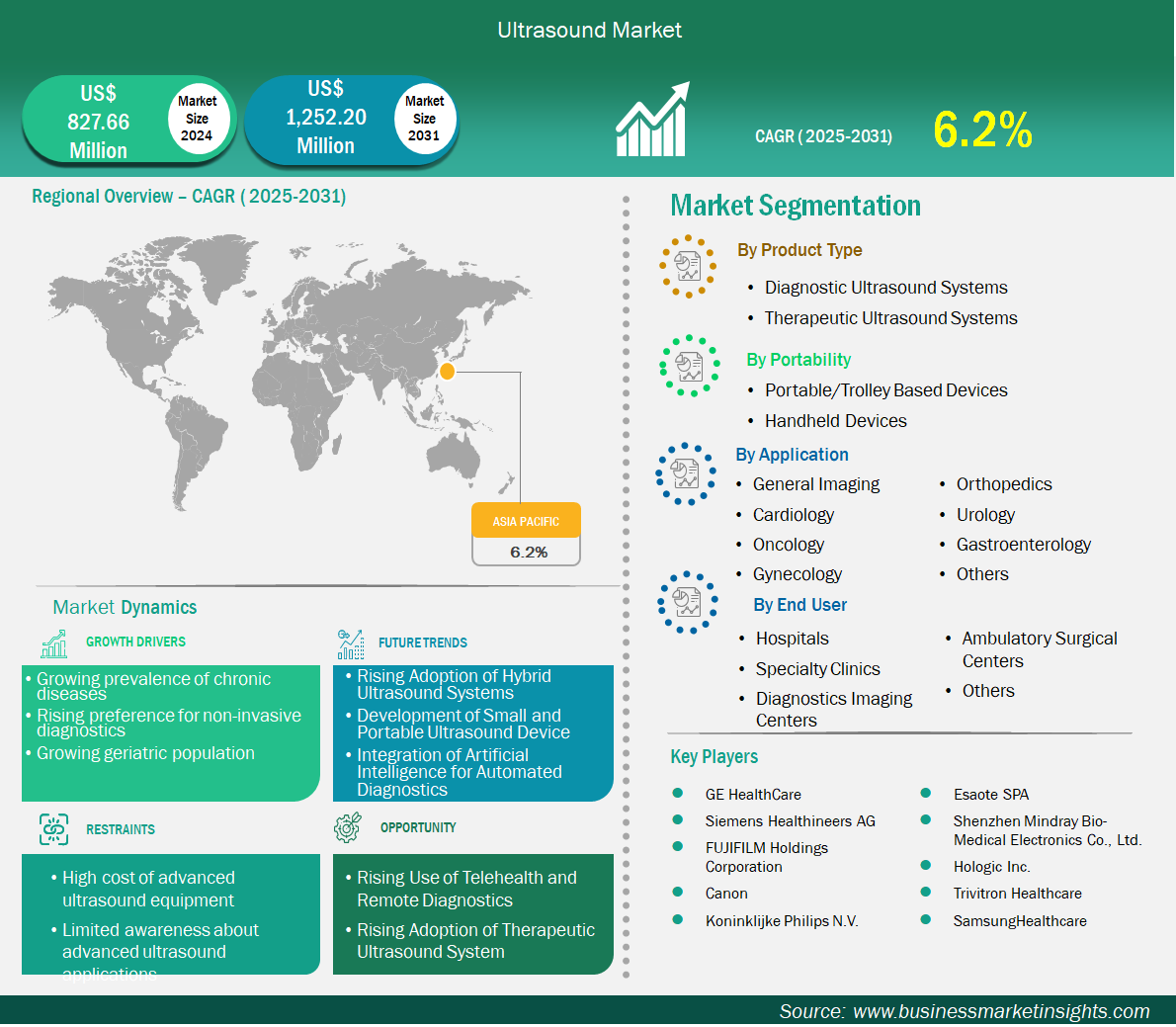
The Asia Pacific ultrasound market size is expected to reach US$ 1,252.20 million by 2031 from US$ 827.66 million in 2024. The market is estimated to record a CAGR of 6.2% from 2025 to 2031.
Executive Summary and Asia Pacific Ultrasound Market Analysis:
Asia Pacific is one of the most dynamic and rapidly growing regions in the global ultrasound market, characterized by both advanced economies and burgeoning healthcare systems. Growth is further boosted by rising demand for less invasive diagnostic imaging, growth in healthcare investments, and rising chronic disease burden. China is the market leader due largescale infrastructure expansion, strong domestic manufacturing and broad application in clinical settings.
Japan, South Korea, and Australia also have a critical contribution, equipped with sophisticated imaging, and are under well-constructed regulations. Emerging markets such as India and Vietnam are witnessing increased uptake of portable and point-of-care ultrasound systems. The diversity of health access and policies within this region produces a variety of constraints and opportunities. Nevertheless, ultrasound emerges as a common modality throughout the range of clinical specialties. Since the Asia Pacific region is currently placing increasingly focus on early detection as a method of preventive care, the use of ultrasound and its imaging capabilities will benefit many through improved diagnostic access and clinical outcomes.
Asia Pacific Ultrasound Market Segmentation Analysis:
Key segments that contributed to the derivation of the ultrasound market analysis are product type, portability, application, and end user.
- By product type, the ultrasound market is segmented into diagnostic ultrasound systems and therapeutic ultrasound systems. The diagnostic ultrasound systems segment dominated the market in 2024.
- By portability, the ultrasound market is segmented into portable/trolley-based devices and handheld devices. The portable/trolley-based devices segment dominated the market in 2024.
- By application, the ultrasound market is segmented into general imaging, cardiology, oncology, gynecology, orthopedics, urology, gastroenterology, and other. The general imaging segment dominated the market in 2024.
- By end user, the market is segmented into hospitals, specialty clinics, diagnostics imaging centers, ambulatory surgical centers, and others. The hospitals segment held the largest share of the market in 2024.
Asia Pacific Ultrasound Market Outlook
The ultrasound market in Asia Pacific is influenced by demographic trends, rapid technological progress, and shifting healthcare priorities. Its broad use across areas such as obstetrics, cardiology, emergency care, and oncology makes it an essential tool for both advanced hospitals and resource-limited clinics. A major factor driving growth is the increasing localization of ultrasound manufacturing, particularly in China.
Domestic companies are now manufacturing imaging systems that meet or exceed international standards for quality, in a shorter time frame, for a fraction of the expense, and as such, they are facilitating access to technological advances across the public and private healthcare sectors within the region. Furthermore, supportive government policies are encouraging indigenous innovation and reduced dependence on imported goods. The addition of artificial intelligence integrated into ultrasound platforms is also increasing the diagnostic ability of ultrasound and improving workflow. With further expansion and modernization of healthcare systems throughout the Asia Pacific, ultrasound continues to be a scalable and affordable option for new diagnostic reach and patient care.
Asia Pacific Ultrasound Market Country Insights
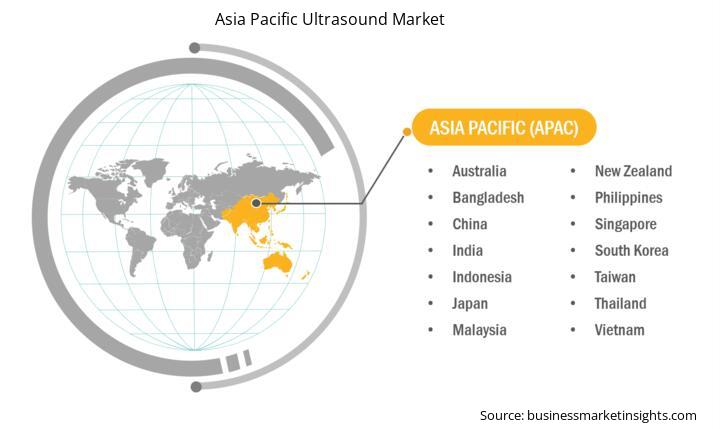
Based on country, the Asia Pacific ultrasound Market is further segmented into China, Japan, South Korea, India, Australia, New Zealand, Indonesia, Malaysia, the Philippines, Singapore, Thailand, Vietnam, Taiwan, Bangladesh, and the Rest of Asia. China held the largest share in 2024.
China leads the Asia Pacific ultrasound market, due to its large healthcare network, strong domestic manufacturing, and supportive government policies. Ultrasound imaging is widely used in hospitals, specialty centers, and rural clinics for everything from maternal health to cancer, heart conditions, and emergency care. The country's focus on making healthcare more accessible has led to a major increase in the use of portable ultrasound systems, especially in areas that do not have enough medical services. Chinese manufacturers like Mindray and others are key to this effort. They create affordable, high-quality devices that meet the needs of the local market.
China's regulations also help new technologies, like AI-powered imaging and tele-ultrasound, get adopted quickly. The use of ultrasound in national health programs and the growth of private healthcare providers are also boosting the market. With its combination of a large market, new technology, and government support, China continues to be a leader in ultrasound development in the Asia Pacific.
Asia Pacific Ultrasound Market Company Profiles
GE HealthCare, Siemens Healthineers AG, FUJIFILM Holdings Corporation, Canon Inc., Koninklijke Philips N.V., Esaote SPA, Shenzhen Mindray Bio-Medical Electronics Co., Ltd., Hologic Inc., Trivitron Healthcare, and Samsung Healthcare are among the key players operating in the market. These players adopt strategies such as expansion, product innovation, and mergers and acquisitions to stay competitive in the market and offer innovative products to their consumers.
Asia Pacific Ultrasound Market Research Methodology:
The following methodology has been followed for the collection and analysis of data presented in this report:
- Secondary Research
The research process begins with comprehensive secondary research, utilizing both internal and external sources to gather qualitative and quantitative data for each market. Commonly referenced secondary research sources include, but are not limited to:
- Company websites, annual reports, financial statements, broker analyses, and investor presentations
- Industry trade journals and other relevant publications
- Government documents, statistical databases, and market reports
- News articles, press releases, and webcasts specific to companies operating in the market
Note: All financial data included in the Company Profiles section has been standardized to US$. For companies reporting in other currencies, figures have been converted to US$ using the relevant exchange rates for the corresponding year.
- Primary Research
Business Market Insights conducts a significant number of primary interviews each year with industry stakeholders and experts to validate and analyze the data and gain valuable insights. These research interviews are designed to:
- Refine findings from secondary research
- Enhance the expertise and market understanding of the analysis team
- Gain insights into market size, trends, growth patterns, competitive dynamics, and future prospects
Primary research is conducted via email interactions and telephone interviews with industry experts across various markets, categories, segments, and sub-segments in different regions. Participants typically include:
- Industry stakeholders: Vice Presidents, business development managers, market intelligence managers, and national sales managers
- External experts: Valuation specialists, research analysts, and key opinion leaders with industry-specific expertise
Key Sources Referred:
- The World Bank World Development Indicators
- World Health Organization (WHO)
- Center for Disease Control and Prevention (CDC)
- International Society of Ultrasound in Obstetrics and Gynecology (ISUOG)
- Radiological Society of North America (RSNA)
- American Institute of Ultrasound in Medicine (AIUM)
- National Institutes of Health (NIH)
- Global Cancer Observatory
- Company website
- Company annual reports
- Company investor presentations
Asia Pacific Ultrasound Market Strategic Insights
Asia Pacific UltrasoundMarket Report Highlights
| Report Attribute | Details |
| Market size in 2024 | US$ 827.66 Million |
| Market Size by 2031 | US$ 1,252.20 Million |
| CAGR (2025 - 2031) | 6.2% |
| Historical Data | 2021-2023 |
| Forecast period | 2025-2031 |
| Segments Covered |
By Product Type
|
|
Regions and Countries Covered
|
|
| Asia Pacific | China, Japan, South Korea, India, Australia, New Zealand, Indonesia, Malaysia, Philippines, Singapore, Thailand, Vietnam, Taiwan, Bangladesh |
| Market leaders and key company profiles |
|
Asia Pacific Ultrasound Market Country and Regional Insights