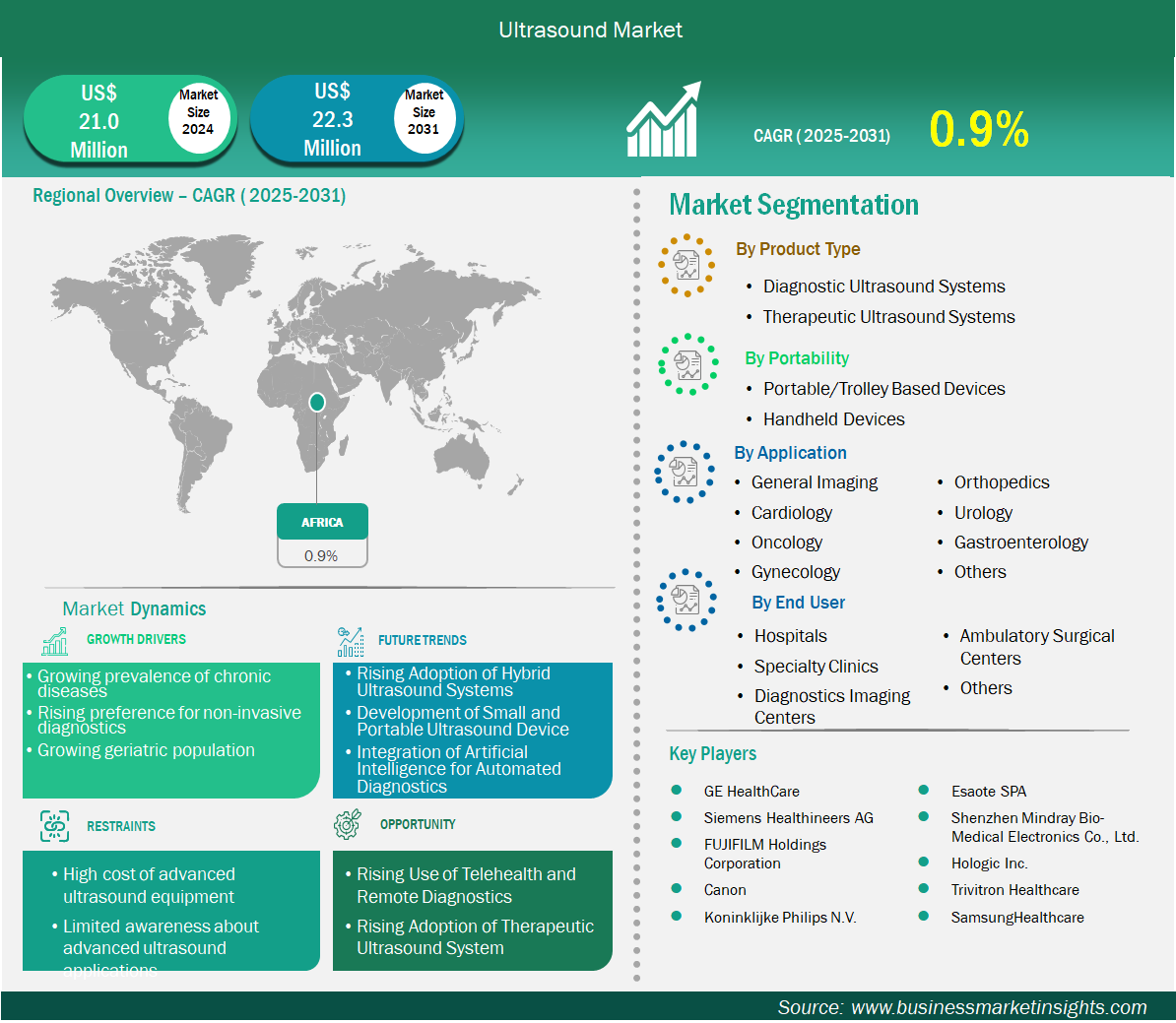
The Africa ultrasound market size is expected to reach US$ 22.3 million by 2031 from US$ 21.0 million in 2024. The market is estimated to record a CAGR of 0.9% from 2025 to 2031.
Executive Summary and Africa Ultrasound Market Analysis:
The ultrasound market in Africa remains underdeveloped, constrained by limited healthcare infrastructure, uneven access to diagnostic services, and budgetary challenges across many nations. Although the region offers strong potential, growth is slowed by fragmented healthcare systems, low use of advanced imaging technologies, and a shortage of trained staff.
Portable and point-of-care ultrasound devices are seeing wider adoption, especially in maternal health and infectious disease screening, where timely diagnosis is essential. Countries such as South Africa, and Nigeria are showing signs of advancement, supported by targeted government programs and international aid. The expansion of mobile health units and telemedicine platforms is also creating new opportunities, as these services depend on ultrasound for remote diagnostics. As public health remains a priority and access to basic medical services expands, ultrasound is set to become a key tool in closing diagnostic gaps, particularly in rural and underserved areas.
Africa Ultrasound Market Segmentation Analysis:
Key segments that contributed to the derivation of the ultrasound market analysis are product type, portability, application, and end user.
- By product type, the ultrasound market is segmented into diagnostic ultrasound systems and therapeutic ultrasound systems. The diagnostic ultrasound systems segment dominated the market in 2024.
- By portability, the ultrasound market is segmented into portable/trolley-based devices and handheld devices. The portable/trolley-based devices segment dominated the market in 2024.
- By application, the ultrasound market is segmented into general imaging, cardiology, oncology, gynecology, orthopedics, urology, gastroenterology, and other. The general imaging segment dominated the market in 2024.
- By end user, the market is segmented into hospitals, specialty clinics, diagnostics imaging centers, ambulatory surgical centers, and others. The hospitals segment held the largest share of the market in 2024.
Africa Ultrasound Market Outlook
The ultrasound market in Africa is developing rapidly, driven by the need for affordable and accessible diagnostic imaging. Its wide use across areas such as obstetrics, gynecology, cardiology, and urology makes it an important tool in settings with limited resources. A key factor supporting growth is the wider use of portable and point-of-care systems. These devices are especially valuable in rural and underserved regions, as they allow clinicians to perform real-time assessments without relying on centralized imaging facilities, leading to faster diagnoses and better patient care.
The market is also gaining from rising investments in telemedicine and mobile health services, which depend on ultrasound for remote diagnostics. Training programs and public health initiatives are further supporting adoption, particularly in maternal health and infectious disease management. With healthcare systems across Africa continuing to expand and modernize, ultrasound is becoming a central technology for providing efficient and equitable diagnostic services.
Africa Ultrasound Market Country Insights
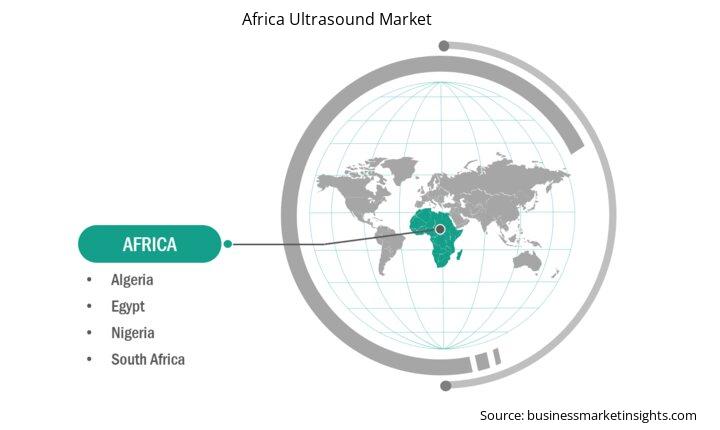
Based on country, the Africa ultrasound Market is further segmented into Nigeria, Egypt, South Africa, and Algeria. South Africa held the largest share in 2024.
South Africa is a major market for ultrasound imaging in Africa. This is because of its advanced healthcare system and strong network of both public and private hospitals. The country has successfully made ultrasound part of routine medical care, especially for maternal health, emergency cases, and cancer treatment.
In major cities like Johannesburg and Cape Town, hospitals have modern, high-tech diagnostic equipment. At the same time, rural clinics are starting to use portable ultrasound units. This helps them bring medical care to people in remote areas. The government has also been working on programs to improve outcomes for mothers and newborns by deploying ultrasound in the country. These efforts have led to a wider use of ultrasound in prenatal care. Furthermore, having local distributors and partnerships with global manufacturers makes it easier to procure new imaging technology.
Africa Ultrasound Market Company Profiles
GE HealthCare, Siemens Healthineers AG, FUJIFILM Holdings Corporation, Canon Inc., Koninklijke Philips N.V., Esaote SPA, Shenzhen Mindray Bio-Medical Electronics Co., Ltd., Hologic Inc., Trivitron Healthcare, and Samsung Healthcare are among the key players operating in the market. These players adopt strategies such as expansion, product innovation, and mergers and acquisitions to stay competitive in the market and offer innovative products to their consumers.
Africa Ultrasound Market Research Methodology:
The following methodology has been followed for the collection and analysis of data presented in this report:
- Secondary Research
The research process begins with comprehensive secondary research, utilizing both internal and external sources to gather qualitative and quantitative data for each market. Commonly referenced secondary research sources include, but are not limited to:
- Company websites, annual reports, financial statements, broker analyses, and investor presentations
- Industry trade journals and other relevant publications
- Government documents, statistical databases, and market reports
- News articles, press releases, and webcasts specific to companies operating in the market
Note: All financial data included in the Company Profiles section has been standardized to US$. For companies reporting in other currencies, figures have been converted to US$ using the relevant exchange rates for the corresponding year.
- Primary Research
Business Market Insights conducts a significant number of primary interviews each year with industry stakeholders and experts to validate and analyze the data and gain valuable insights. These research interviews are designed to:
- Refine findings from secondary research
- Enhance the expertise and market understanding of the analysis team
- Gain insights into market size, trends, growth patterns, competitive dynamics, and future prospects
Primary research is conducted via email interactions and telephone interviews with industry experts across various markets, categories, segments, and sub-segments in different regions. Participants typically include:
- Industry stakeholders: Vice Presidents, business development managers, market intelligence managers, and national sales managers
- External experts: Valuation specialists, research analysts, and key opinion leaders with industry-specific expertise
Key Sources Referred:
- The World Bank World Development Indicators
- World Health Organization (WHO)
- Center for Disease Control and Prevention (CDC)
- International Society of Ultrasound in Obstetrics and Gynecology (ISUOG)
- Radiological Society of North America (RSNA)
- American Institute of Ultrasound in Medicine (AIUM)
- National Institutes of Health (NIH)
- Global Cancer Observatory
- Company website
- Company annual reports
- Company investor presentations
Africa Ultrasound Market Strategic Insights
Africa UltrasoundMarket Report Highlights
| Report Attribute | Details |
| Market size in 2024 | US$ 21.0 Million |
| Market Size by 2031 | US$ 22.3 Million |
| CAGR (2025 - 2031) | 0.9% |
| Historical Data | 2021-2023 |
| Forecast period | 2025-2031 |
| Segments Covered |
By Product Type
|
|
Regions and Countries Covered
|
|
| Africa | Egypt, South Africa, Nigeria, Algeria |
| Market leaders and key company profiles |
|
Africa Ultrasound Market Country and Regional Insights