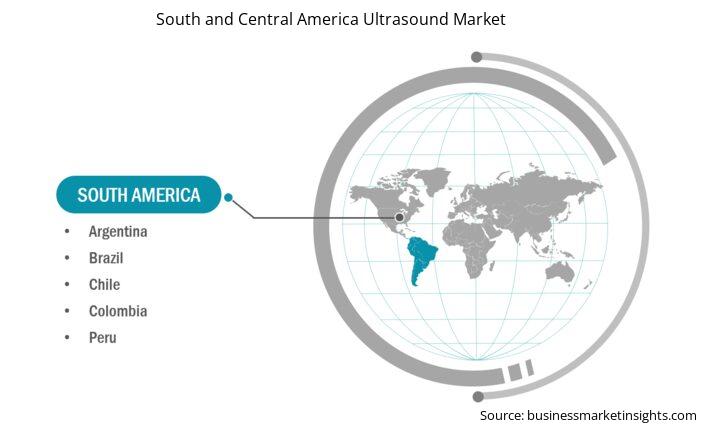
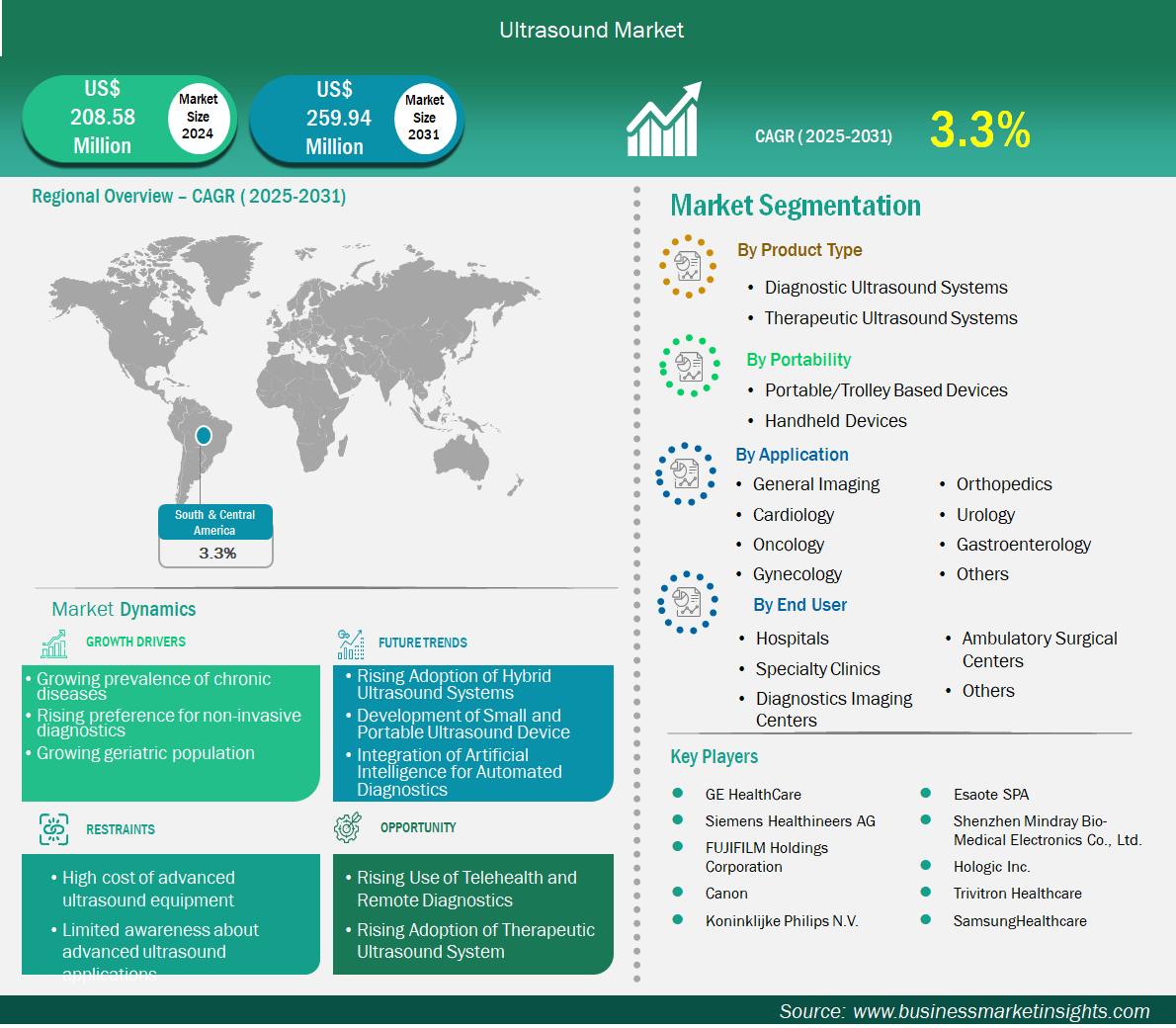
The South and Central America ultrasound market size is expected to reach US$ 259.94 million by 2031 from US$ 208.58 million in 2024. The market is estimated to record a CAGR of 3.3% from 2025 to 2031.
Executive Summary and South and Central America Ultrasound Market Analysis:
The ultrasound market in South and Central America is gradually growing due to increased access to healthcare services, greater education on preventive diagnostics, and demand for non-invasive imaging. Brazil has the fastest-growing market overall because of its large population, diverse healthcare systems, and developments in public health policies. Regionally, ultrasound applications are utilized best in a wide range of diagnostic fields, but the highest usage trends are mostly in maternal-fetal medicine, cardiology, and emergency. Brazil and other countries in the region are experiencing changes related to the increased use of portable and point-of-care systems, among hospitals, clinics, urgent cares, and home.
The ultrasound market is steadily shifting toward advanced imaging technologies like 3D and 4D, along with AI-based interpretation tools, especially in urban areas where access and infrastructure are stronger. Each year, growth is fueled by public health initiatives and private sector investments. Despite regional disparities, such as income gaps and unequal access to private healthcare, ultrasound usage remains affected.
South and Central America Ultrasound Market Segmentation Analysis:
Key segments that contributed to the derivation of the ultrasound market analysis are product type, portability, application, and end user.
- By product type, the ultrasound market is segmented into diagnostic ultrasound systems and therapeutic ultrasound systems. The diagnostic ultrasound systems segment dominated the market in 2024.
- By portability, the ultrasound market is segmented into portable/trolley-based devices and handheld devices. The portable/trolley-based devices segment dominated the market in 2024.
- By application, the ultrasound market is segmented into general imaging, cardiology, oncology, gynecology, orthopedics, urology, gastroenterology, and other. The general imaging segment dominated the market in 2024.
- By end user, the market is segmented into hospitals, specialty clinics, diagnostics imaging centers, ambulatory surgical centers, and others. The hospitals segment held the largest share of the market in 2024.
South and Central America Ultrasound Market Outlook
The ultrasound market in South and Central America is steadily moving toward more inclusive and community-based models of care. Brazil plays a central role in this transition, supported by its large public health network and continued investment in modern imaging technologies. Across the region, portable and handheld ultrasound systems are becoming more common, helping extend diagnostic services to rural and underserved populations.
Simultaneously, major Urban Hospitals are adopting AI-enabled imaging resources to enhance workflow efficiency and improve accuracy in disciplines with high patient volumes such as obstetrics and radiology. While devices with advanced cart-based systems are prevalent in leading tertiary hospitals, demand is increasing for smaller devices that can be used at bedside and within new telehealth programs. Regional health priorities like maternal care and chronic illness management enhance the relevance of ultrasound. Though barriers still exist to equitable access to healthcare and limited budgets, there is an assurance that the continued commitment to bolstering diagnostic capacity will support growth of ultrasound market across the region.
South and Central America Ultrasound Market Country Insights
Based on country, the South and Central America ultrasound market is further segmented into Brazil, Argentina, Chile, Colombia, Peru and the Rest of South and Central America. Brazil held the largest share in 2024.
In South and Central America, Brazil is the largest and most well-established market for ultrasound technology. The country has an extensive healthcare system, including public, supplemental, and private facilities, along with several governmental programs to support healthcare. The Brazilian public health system (SUS) is a critical component of the emphasis on gaining access to ultrasound services in both large cities and rural areas, and in specific areas of care, like maternal health and chronic disease monitoring. Larger urban hospitals are using advanced imaging technologies in clinical practice, such as 3D and 4D ultrasound, and artificial intelligence platforms for advanced diagnostic capabilities. Mobile, handheld, and point-of-care ultrasound technologies are being introduced into the diagnostic workflow in rural and remote areas. Governmental investments in mobile ultrasound imaging solutions and telehealth support are improving access and helping to bridge regional gaps in care. Brazil remains ahead of all other countries in the uptake of ultrasound in the region, and continues to develop and evolve as the largest market in the region for ultrasound.
South and Central America Ultrasound Market Company Profiles
GE HealthCare, Siemens Healthineers AG, FUJIFILM Holdings Corporation, Canon Inc., Koninklijke Philips N.V., Esaote SPA, Shenzhen Mindray Bio-Medical Electronics Co., Ltd., Hologic Inc., Trivitron Healthcare, and Samsung Healthcare are among the key players operating in the market. These players adopt strategies such as expansion, product innovation, and mergers and acquisitions to stay competitive in the market and offer innovative products to their consumers.
South and Central America Ultrasound Market Research Methodology:
The following methodology has been followed for the collection and analysis of data presented in this report:
- Secondary Research
The research process begins with comprehensive secondary research, utilizing both internal and external sources to gather qualitative and quantitative data for each market. Commonly referenced secondary research sources include, but are not limited to:
- Company websites, annual reports, financial statements, broker analyses, and investor presentations
- Industry trade journals and other relevant publications
- Government documents, statistical databases, and market reports
- News articles, press releases, and webcasts specific to companies operating in the market
Note: All financial data included in the Company Profiles section has been standardized to US$. For companies reporting in other currencies, figures have been converted to US$ using the relevant exchange rates for the corresponding year.
- Primary Research
Business Market Insights conducts a significant number of primary interviews each year with industry stakeholders and experts to validate and analyze the data and gain valuable insights. These research interviews are designed to:
- Refine findings from secondary research
- Enhance the expertise and market understanding of the analysis team
- Gain insights into market size, trends, growth patterns, competitive dynamics, and future prospects
Primary research is conducted via email interactions and telephone interviews with industry experts across various markets, categories, segments, and sub-segments in different regions. Participants typically include:
- Industry stakeholders: Vice Presidents, business development managers, market intelligence managers, and national sales managers
- External experts: Valuation specialists, research analysts, and key opinion leaders with industry-specific expertise
Key Sources Referred:
- The World Bank World Development Indicators
- World Health Organization (WHO)
- Center for Disease Control and Prevention (CDC)
- International Society of Ultrasound in Obstetrics and Gynecology (ISUOG)
- Radiological Society of North America (RSNA)
- American Institute of Ultrasound in Medicine (AIUM)
- National Institutes of Health (NIH)
- Global Cancer Observatory
- Company website
- Company annual reports
- Company investor presentations
South and Central America Ultrasound Market Strategic Insights
South and Central America UltrasoundMarket Report Highlights
| Report Attribute | Details |
| Market size in 2024 | US$ 208.58 Million |
| Market Size by 2031 | US$ 259.94 Million |
| CAGR (2025 - 2031) | 3.3% |
| Historical Data | 2021-2023 |
| Forecast period | 2025-2031 |
| Segments Covered |
By Product Type
|
|
Regions and Countries Covered
|
|
| South and Central America | Brazil, Argentina, Chile, Colombia, Peru |
| Market leaders and key company profiles |
|
South and Central America Ultrasound Market Country and Regional Insights