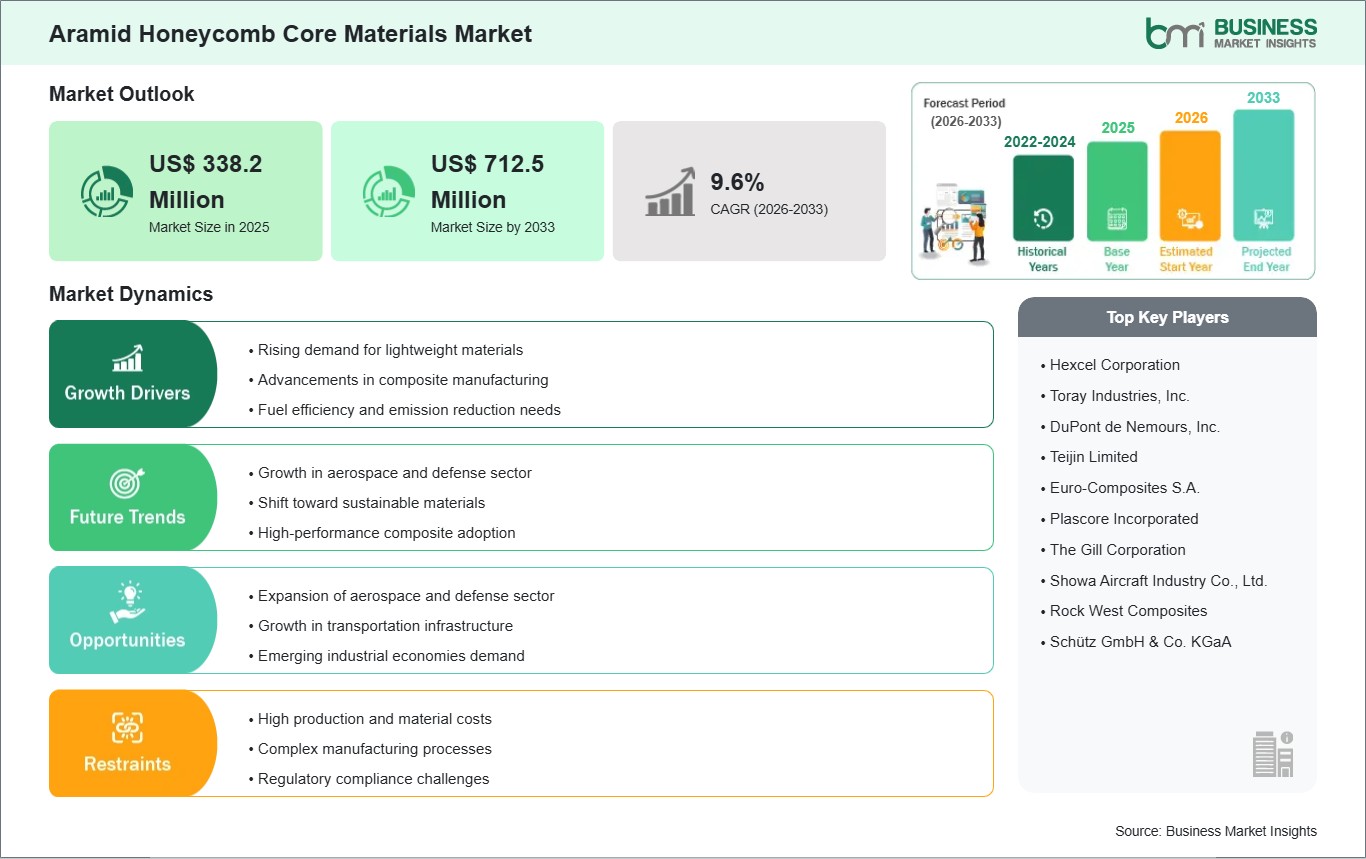
The Aramid Honeycomb Core Materials Market size is expected to reach US$ 712.5 Million by 2033 from US$ 338.2 Million in 2025 .The market is estimated to record a CAGR of 9.6% from 2026 to 2033.
The global aramid honeycomb core materials market is defined by the increasing demand for lightweight, high-strength materials across aerospace, transportation, and industrial applications. Aramid honeycomb cores—primarily composed of meta-aramid and para-aramid fibers—are widely recognized for their superior strength-to-weight ratio, thermal stability, and resistance to corrosion and fatigue. These properties make them essential in structural applications where weight reduction and performance optimization are critical.
The market is experiencing sustained growth due to the rising emphasis on fuel efficiency and emissions reduction, particularly in the aerospace and automotive industries. Lightweight composite materials incorporating aramid honeycomb cores enable manufacturers to meet stringent regulatory requirements while enhancing operational efficiency. Additionally, advancements in manufacturing technologies are improving material consistency, durability, and customization capabilities, further expanding application potential.
Competitive dynamics in the market are increasingly centered on material innovation, cost optimization, and sustainability. Manufacturers are investing in advanced processing techniques to enhance mechanical properties and reduce production costs. Furthermore, the integration of recyclable and eco-friendly materials is gaining traction as environmental concerns and regulatory pressures intensify. Strategic collaborations with OEMs and component manufacturers are also shaping the competitive landscape, enabling tailored solutions for specific end-use requirements.

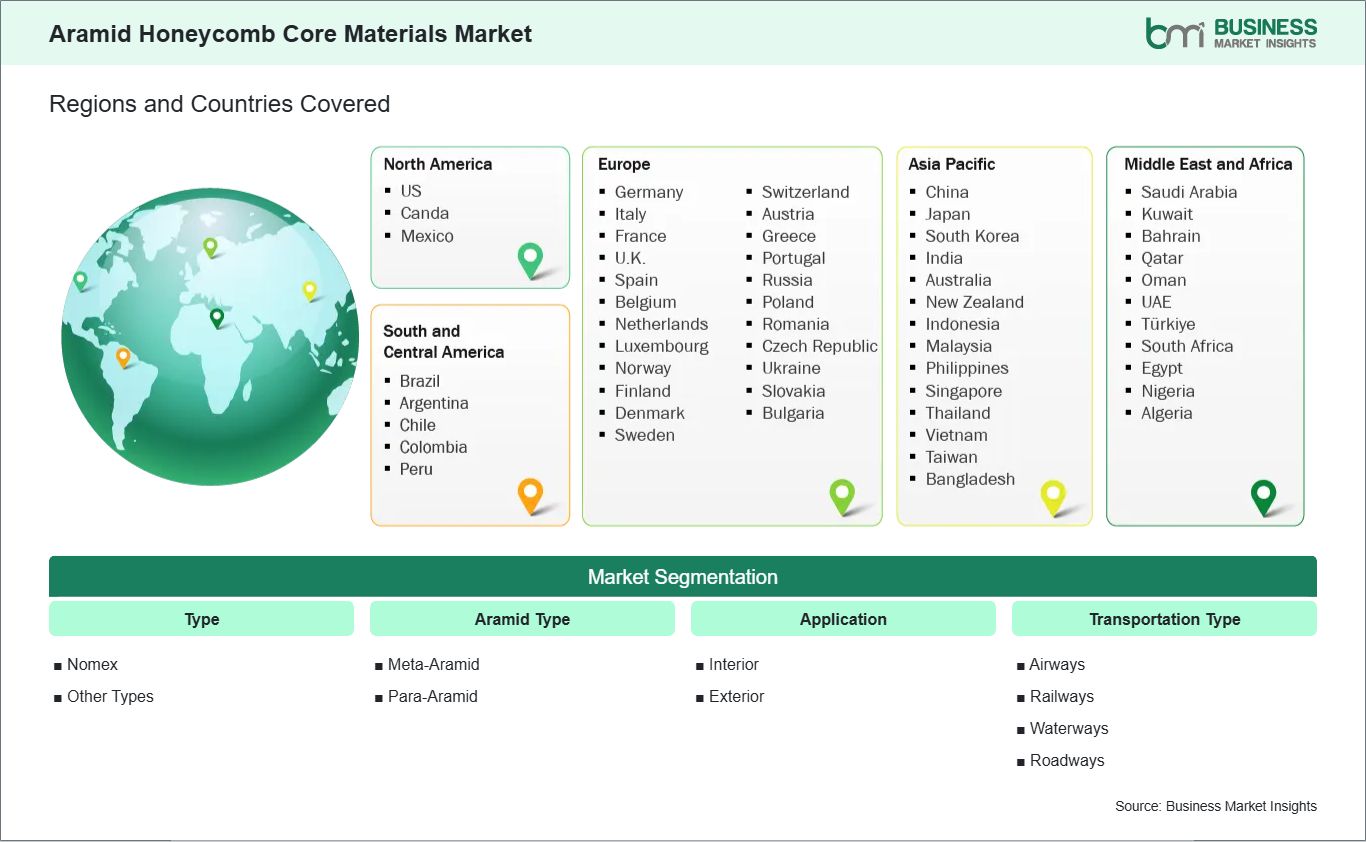
Key segments that contributed to the derivation of the aramid honeycomb core materials market analysis are type, aramid type, application, and transportation type.
Growth in the Aramid Honeycomb Core Materials Market is mainly attributed to the increasing use of lightweight materials in the aerospace, automotive and railway industries. The lightweight materials are engineered to provide a lower structural weight and higher mechanical strength, and therefore are essential in applications that require efficiency and performance. In aerospace, every kilogram saved can mean better fuel economy, lower emissions and less operating costs. Because Aramid honeycomb cores exhibit superior strength-to-weight ratios and inherent fire resistance, they are commonly used in the construction of various aircraft interior parts, flooring, panels, structural components etc.
In both the automotive and railway industries, seeking to develop energy efficient, high performance vehicles has led to an increase in the use of lightweight composite materials… Aramid honeycomb cores allow manufacturers to produce durable and fuel efficient vehicles in line with global sustainability objectives. Continued technological advancements associated with composite manufacture (i.e., new bonding techniques and improved processing methodologies) are also facilitating further adoption by providing greater flexibility and durability within design. As sustainability, efficiency and innovation become higher priority for the industries, the demand for lightweight, high-performance materials including aramid honeycomb cores is anticipated to continue to grow steadily, resulting in continued significant expansion of the market over the next few years.
The aerospace and defense industry is a leading product category for the aramid honeycomb core materials market. Significant investment related to both commercial aviation and defense modernization programs, along with various initiatives related to space exploration drive substantial demand for advanced composite materials. Because aramid honeycomb cores have been shown to provide structural integrity while being able to withstand extreme environmental conditions, aramid honeycomb core materials are used nearly everywhere in aerospace: aircraft structures, radomes, and interior components, as well as for safety and reliability requirements in critical aerospace applications. Likewise, aramid-based materials are being incorporated into armored vehicles, naval vessels, and a wide range of protective structures worldwide to increase durability and performance characteristics in defense applications.
As the focus worldwide on next-generation aircraft and next-generation defense systems continues to grow, the demand for manufacturers of aramid honeycomb core materials will also increase. Additionally, ongoing R&D will likely create improvements in material properties, decrease production costs associated with aramid honeycomb core materials, and increase the number of applications for aramid honeycomb core manufacturers. With increasing investment in U.S. and global aerospace and defense infrastructure, the demand for aramid honeycomb core materials is expected to continue to increase rapidly. Collectively, this represents the strategic importance of lightweight, high-strength composites in shaping the future of the aerospace and defense industries around the world.

The Aramid Honeycomb Core Materials Market demonstrates steady growth, with size and share analysis highlighting evolving trends and competitive dynamics among key players. The report examines subsegments categorized within type, aramid type, application, and transportation type, offering insights into their contribution to overall market performance.
By type, the Nomex subsegment dominated the market in 2025, driven by its superior thermal resistance and mechanical strength.
Based on aramid type, the meta-aramid subsegment dominated the market in 2025, driven by its widespread use in aerospace and industrial applications.
In terms of application, the interior subsegment dominated the market in 2025, driven by extensive use in aircraft cabins and structural panels.
By transportation type, the airways subsegment dominated the market in 2025, driven by increasing aircraft production and demand for lightweight materials.
| Report Attribute | Details |
|---|---|
| Market size in 2025 | US$ 338.2 Million |
| Market Size by 2033 | US$ 712.5 Million |
| Global CAGR (2026 - 2033) | 9.6% |
| Historical Data | 2022-2024 |
| Forecast period | 2026-2033 |
| Segments Covered | By Type
|
|
Regions and Countries Covered
| |
| North America | US, Canada, Mexico |
| Europe | Belgium, Austria, Finland, Denmark, Greece, Poland, Romania, Russia, Ukraine, Czech Republic, Slovakia, Bulgaria, Italy, Luxembourg, Germany, Switzerland, France, Netherlands, Norway, Portugal, Spain, Sweden, United Kingdom |
| Asia-Pacific | Australia, China, India, Japan, South Korea, Indonesia, Malaysia, Philippines, Singapore, Thailand, Vietnam, Bangladesh, New Zealand, Taiwan |
| South and Central America | Brazil, Argentina, Peru, Chile, Colombia |
| Middle East and Africa | Bahrain, Kuwait, Oman, Qatar, Saudi Arabia, United Arab Emirates, Turkiye, South Africa, Egypt, Algeria, Nigeria |
| Market leaders and key company profiles |
|
The "Aramid Honeycomb Core Materials Market Size and Forecast (2022 - 2033)" report provides a detailed analysis of the market covering below areas:
The geographical scope of the Aramid Honeycomb Core Materials Market report is divided into North America, Asia Pacific, Europe, Middle East & Africa, and South & Central America. North America held the largest share in 2025.
The adoption and maturity of aramid honeycomb core materials vary significantly across regions, influenced by industrial development, manufacturing capabilities, and demand from end-use industries. In North America, the presence of a well-established aerospace and defense sector drives strong demand for high-performance composite materials. The region benefits from advanced manufacturing infrastructure and significant investments in research and development, supporting continuous innovation in aramid-based materials.
In Europe, stringent environmental regulations and a strong focus on sustainability are encouraging the adoption of lightweight materials in automotive and aerospace applications. Countries such as Germany, France, and the UK are leading in the integration of advanced composites, supported by robust industrial ecosystems and technological expertise.
Asia Pacific is emerging as a key growth region, driven by rapid industrialization, expanding aerospace manufacturing, and increasing investments in transportation infrastructure. Countries such as China, India, and Japan are witnessing rising demand for lightweight materials across multiple industries. However, cost sensitivity and varying regulatory frameworks remain important considerations.
Latin America and the Middle East & Africa are experiencing gradual growth, supported by infrastructure development and increasing adoption of advanced materials in transportation and construction sectors. Across all regions, local industry dynamics, regulatory environments, and economic conditions play a crucial role in shaping market strategies and growth trajectories.

The Aramid Honeycomb Core Materials Market is evaluated by gathering qualitative and quantitative data post primary and secondary research, which includes important corporate publications, association data, and databases. A few of the key developments in the aramid honeycomb core materials market are:
The Aramid Honeycomb Core Materials Market is valued at US$ 338.2 Million in 2025, it is projected to reach US$ 712.5 Million by 2033.
As per our report Aramid Honeycomb Core Materials Market, the market size is valued at US$ 338.2 Million in 2025, projecting it to reach US$ 712.5 Million by 2033. This translates to a CAGR of approximately 9.6% during the forecast period.
The Aramid Honeycomb Core Materials Market report typically cover these key segments-
The historic period, base year, and forecast period can vary slightly depending on the specific market research report. However, for the Aramid Honeycomb Core Materials Market report:
The Aramid Honeycomb Core Materials Market is populated by several key players, each contributing to its growth and innovation. Some of the major players include:
The Aramid Honeycomb Core Materials Market report is valuable for diverse stakeholders, including:
Essentially, anyone involved in or considering involvement in the Aramid Honeycomb Core Materials Market value chain can benefit from the information contained in a comprehensive market report.
Please tell us your area of interest
(Market Segments/ Regions and Countries/ Companies)