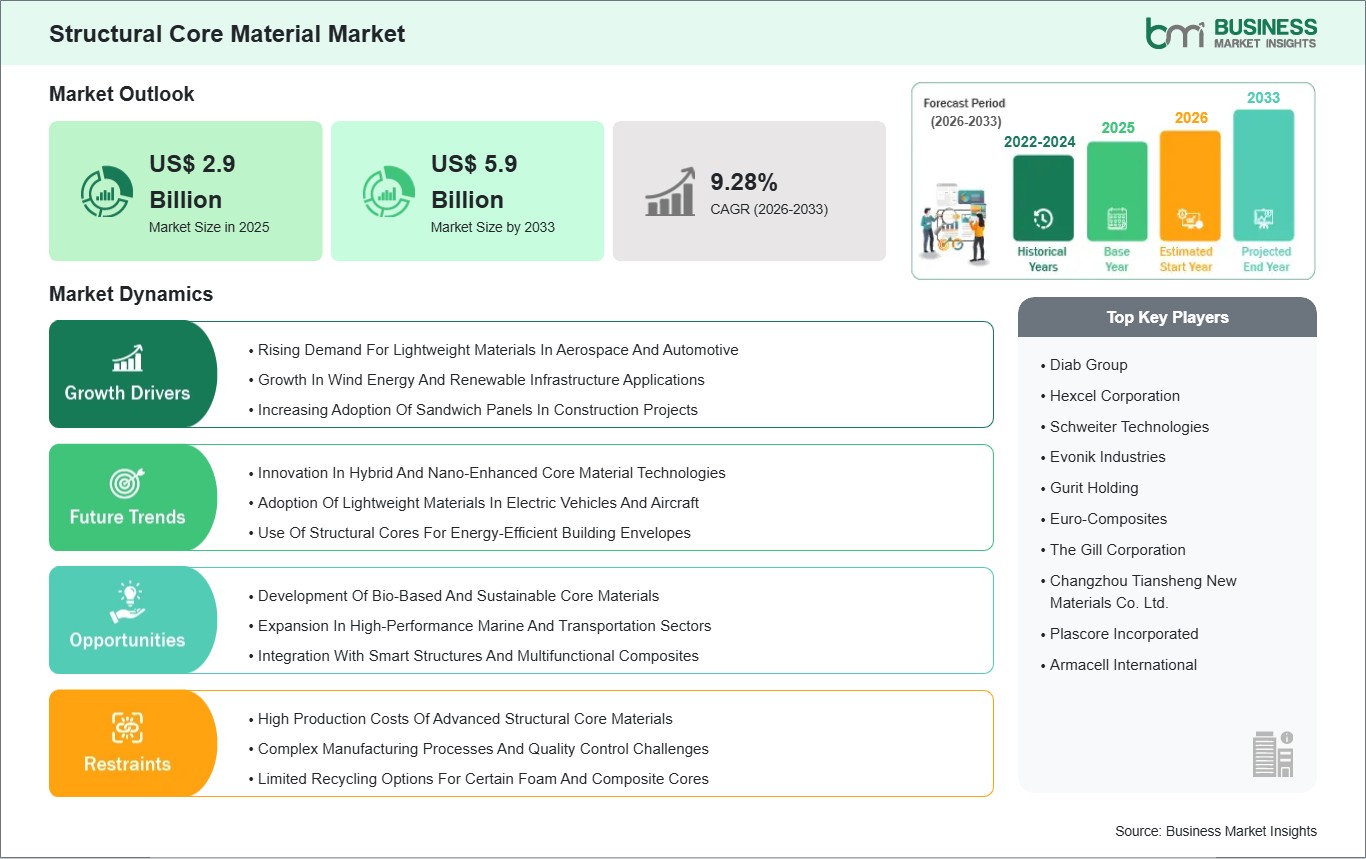
The Structural Core Material Market size is expected to reach US$ 5.9 billion by 2033 from US$ 2.9 billion in 2025. The market is estimated to record a CAGR of 9.28% from 2026 to 2033.
The global structural core material market experiences rapid growth because industries require engineered products that maintain lightweight design optimal performance, and sustainable environmental practices. Structural core materials—such as foam cores, honeycomb cores, balsa wood, and other engineered core solutions—are essential components in composite structures that require high strength-to-weight ratios. The materials function as the internal framework of sandwich constructions to deliver rigidity and impact resistance together with full structural stability while reducing total weight. The materials serve crucial functions in multiple industries, which include aerospace and automotive, marine and wind energy and construction because they provide necessary performance and durability. The market experiences its primary growth driver because global markets are shifting towards using lightweight composite materials.
The aerospace industry demands advanced core materials for wings, floor panels and interior components because customers want better fuel economy and operational efficiency. Automotive manufacturers utilize structural core materials for body panels, battery enclosures and chassis components because these materials enhance energy efficiency and crash protection without reducing vehicle safety.
The renewable energy sector especially wind turbine blade manufacturing, drives high market demand for strong yet lightweight core materials, which rotor blades need to endure mechanical forces throughout their extended service periods. Construction professionals increasingly select sandwich panels that contain strong core materials for their facade and roofing system and modular building needs because these panels maintain both structural integrity and thermal insulation functions. The market encounters specific limitations that exist despite strong demand factors that drive market growth. The high-performance core materials industry faces production cost challenges that restrict their use in budget-restricted markets.
Manufacturers face difficulties in producing advanced honeycomb and high-performance foam cores because these materials need exact manufacturing methods and complete production control. The choice of materials is being affected by sustainability issues, which research into environmentally friendly material options because traditional core materials contain non-renewable materials and create recycling problems after their useful life ends. The market will experience growth through ongoing development of core design and manufacturing technologies and hybrid material integration methods.
The next generation of structural core materials is being developed through the rising need for multifunctional cores that combine thermal management with vibration damping and embedded sensor capabilities. The global structural core material market will continue to expand because industries across the world are now focusing on performance, sustainability and weight reduction.

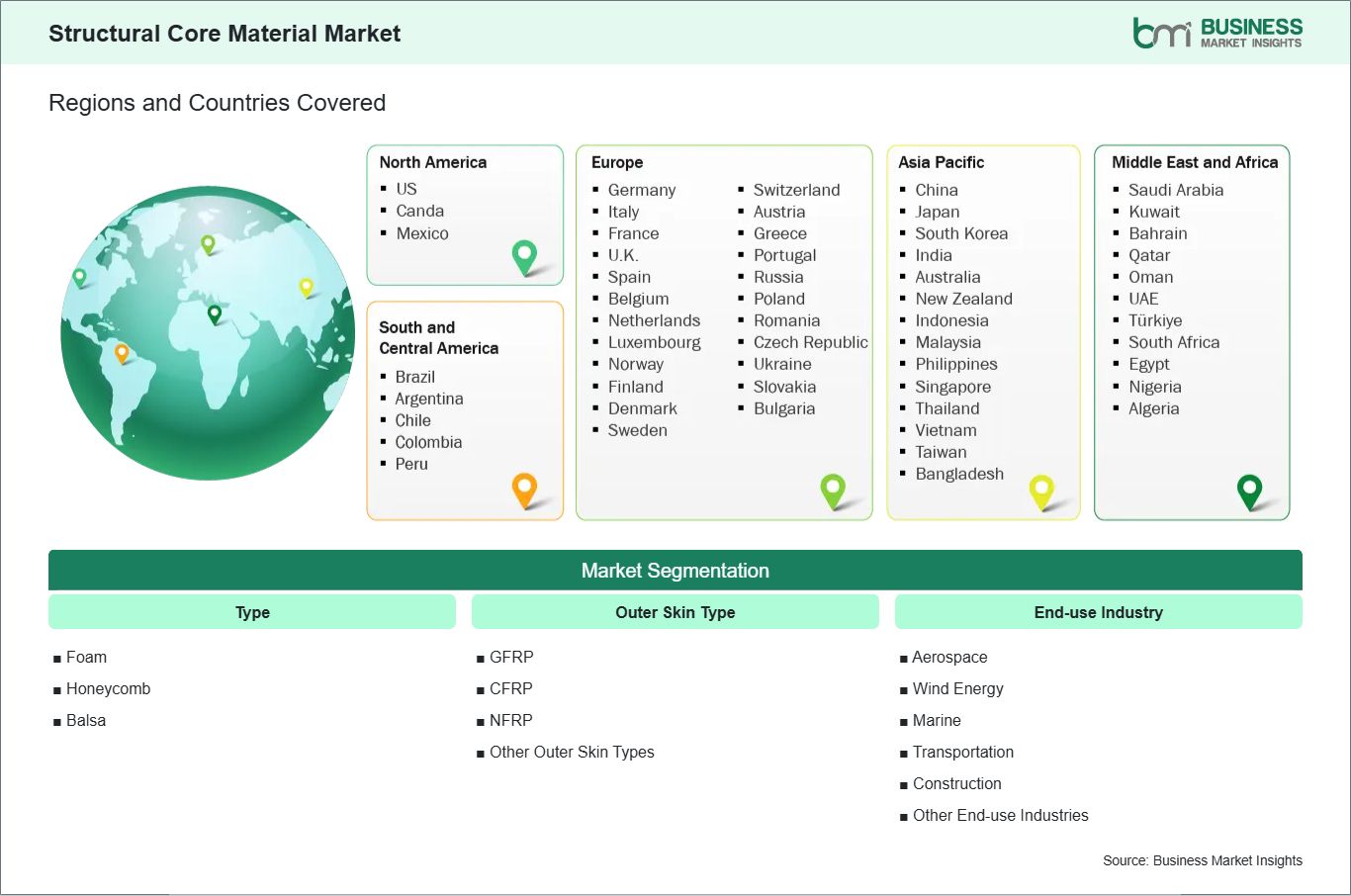
Key segments that contributed to the derivation of the structural core material market analysis are type, outer skin type, and end‑use industry.
The structural core material market is growing because aerospace and automotive industries need lightweight materials. Manufacturers are using honeycomb cores and foam cores, and balsa wood to create aircraft components, automotive body panels and battery enclosures which need lightweight materials that still offer structural strength. Lightweight cores make aerospace operations more efficient by reducing fuel consumption, and they also improve electric vehicles energy use and driving range, which makes them crucial for environmentally friendly transportation projects.
Advanced composites, which use high-performance cores serve aerospace applications through their use in fuselage panels, interior partitions and wing structures. The aerospace industry needs materials that create strong aircraft components that must remain lightweight while withstanding high-stress situations. The automotive industry uses structural cores to create electric and hybrid vehicle systems, which include crash structures and floor panels, and energy storage enclosures that provide both safety and operational efficiency.
Core material producers, aerospace OEMs and automotive manufacturers work together to create partnerships that help their technologies gain wider acceptance. North America and Europe lead in using advanced cores because their aerospace and automotive sectors have reached maturity while Asia-Pacific accelerates production to fulfill increasing market requirements. The ongoing development of technological solutions and material enhancements establishes structural cores as essential elements for achieving lightweight design throughout worldwide transportation systems.
Sustainability is increasingly influencing the structural core material market, prompting the development of bio-based and environmentally friendly cores. Manufacturers are exploring renewable resources, such as balsa wood, natural fiber composites, and bio-derived foams, to replace traditional petroleum-based cores. These materials provide similar mechanical properties while reducing environmental impact, appealing to industries prioritizing eco-friendly practices.
The construction sector has been a major driver for sustainable core materials, with sandwich panels, roofing, and facades integrating bio-based cores to enhance energy efficiency and reduce carbon footprint. In aerospace and automotive, manufacturers are testing hybrid cores combining natural fibers with lightweight polymers, aiming to balance performance, weight reduction, and sustainability. These innovations address end-of-life disposal challenges and align with growing regulatory pressure for greener material usage in manufacturing.
Collaborations between material scientists, research institutes, and industrial manufacturers are crucial to commercializing these sustainable cores. North America and Europe are at the forefront of research and adoption due to advanced R&D infrastructure and stringent environmental standards, while Asia-Pacific is gradually integrating bio-based cores in automotive and construction projects. The shift toward sustainable cores is set to redefine structural core material selection across global industries.
The structural core material market demonstrates steady growth, with size and share analysis highlighting evolving trends and competitive dynamics among key players. The report examines subsegments categorized within type, outer skin type, and end‑use industry, offering insights into their contribution to overall market performance.
By type, the foam subsegment dominated the market in 2025, driven by its lightweight nature, cost-effectiveness, and versatility for use in various composite structural applications.
Based on outer skin type, the GFRP (Glass Fiber Reinforced Polymer) subsegment dominated the market in 2025, driven by its durability, low cost, and widespread adoption across multiple industries.
On the basis of end‑use industry, the aerospace subsegment dominated the market in 2025, driven by the high demand for lightweight, high-strength materials to improve fuel efficiency and performance in aircraft and spacecraft.
| Report Attribute | Details |
|---|---|
| Market size in 2025 | US$ 2.9 Billion |
| Market Size by 2033 | US$ 5.9 Billion |
| Global CAGR (2026 - 2033) | 9.28% |
| Historical Data | 2022-2024 |
| Forecast period | 2026-2033 |
| Segments Covered | By Type
|
|
Regions and Countries Covered
| |
| North America | US, Canada, Mexico |
| Europe | Belgium, Austria, Finland, Denmark, Greece, Poland, Romania, Russia, Ukraine, Czech Republic, Slovakia, Bulgaria, Italy, Luxembourg, Germany, Switzerland, France, Netherlands, Norway, Portugal, Spain, Sweden, United Kingdom |
| Asia-Pacific | Australia, China, India, Japan, South Korea, Indonesia, Malaysia, Philippines, Singapore, Thailand, Vietnam, Bangladesh, New Zealand, Taiwan |
| South and Central America | Brazil, Argentina, Peru, Chile, Colombia |
| Middle East and Africa | Bahrain, Kuwait, Oman, Qatar, Saudi Arabia, United Arab Emirates, Turkiye, South Africa, Egypt, Algeria, Nigeria |
| Market leaders and key company profiles |
|
The "Structural Core Material Market Size and Forecast (2022 - 2033)" report provides a detailed analysis of the market covering below areas:
The geographical scope of the Structural Core Material Market report is divided into North America, Asia Pacific, Europe, Middle East & Africa, and South & Central America. North America held the largest share in 2025.
The global structural core material market demonstrates distinct regional characteristics, with North America emerging as the dominant region due to its advanced aerospace, automotive, and renewable energy sectors, as well as its well-established R&D ecosystem for lightweight and high-performance composites. North American manufacturers lead in the adoption of honeycomb, foam, and hybrid core materials for aircraft interiors, automotive battery enclosures, wind turbine blades, and construction sandwich panels, benefiting from strong collaboration between industry, academia, and research institutes that drives innovation and rapid commercialization.
The market in Asia Pacific shows rapid expansion because large-scale industrialization, urbanization and infrastructure growth take place in China, Japan and South Korea. The aerospace, automotive, and renewable energy sectors in this region are increasingly adopting structural core materials in lightweight vehicles, wind turbine blades, and high-performance composites for railway and marine applications.
The European aerospace, automotive and building construction industries drive structural core material usage through established regulations and strict quality requirements and their commitment to sustainable practices especially in Germany and France and the Nordic countries, which are beginning to adopt energy-efficient building panels and lightweight vehicle components.
The Middle East and Africa region now shows increasing use of structural cores for renewable energy projects, aerospace maintenance operations and industrial construction work with United Arab Emirates and South Africa investing in infrastructure development and advanced manufacturing systems.
The South and Central American market develops through infrastructure development and construction industry adoption of sandwich panels and new automotive and marine technology projects in Brazil and Argentina.
The growth of all regions proceeds through lightweighting programs and industrial energy use, and fresh developments in advanced structural core material technology.

The Structural Core Material Market is evaluated by gathering qualitative and quantitative data post primary and secondary research, which includes important corporate publications, association data, and databases. A few of the key developments in the structural core material market are:
The Structural Core Material Market is valued at US$ 2.9 Billion in 2025, it is projected to reach US$ 5.9 Billion by 2033.
As per our report Structural Core Material Market, the market size is valued at US$ 2.9 Billion in 2025, projecting it to reach US$ 5.9 Billion by 2033. This translates to a CAGR of approximately 9.28% during the forecast period.
The Structural Core Material Market report typically cover these key segments-
The historic period, base year, and forecast period can vary slightly depending on the specific market research report. However, for the Structural Core Material Market report:
The Structural Core Material Market is populated by several key players, each contributing to its growth and innovation. Some of the major players include:
The Structural Core Material Market report is valuable for diverse stakeholders, including:
Essentially, anyone involved in or considering involvement in the Structural Core Material Market value chain can benefit from the information contained in a comprehensive market report.
Please tell us your area of interest
(Market Segments/ Regions and Countries/ Companies)