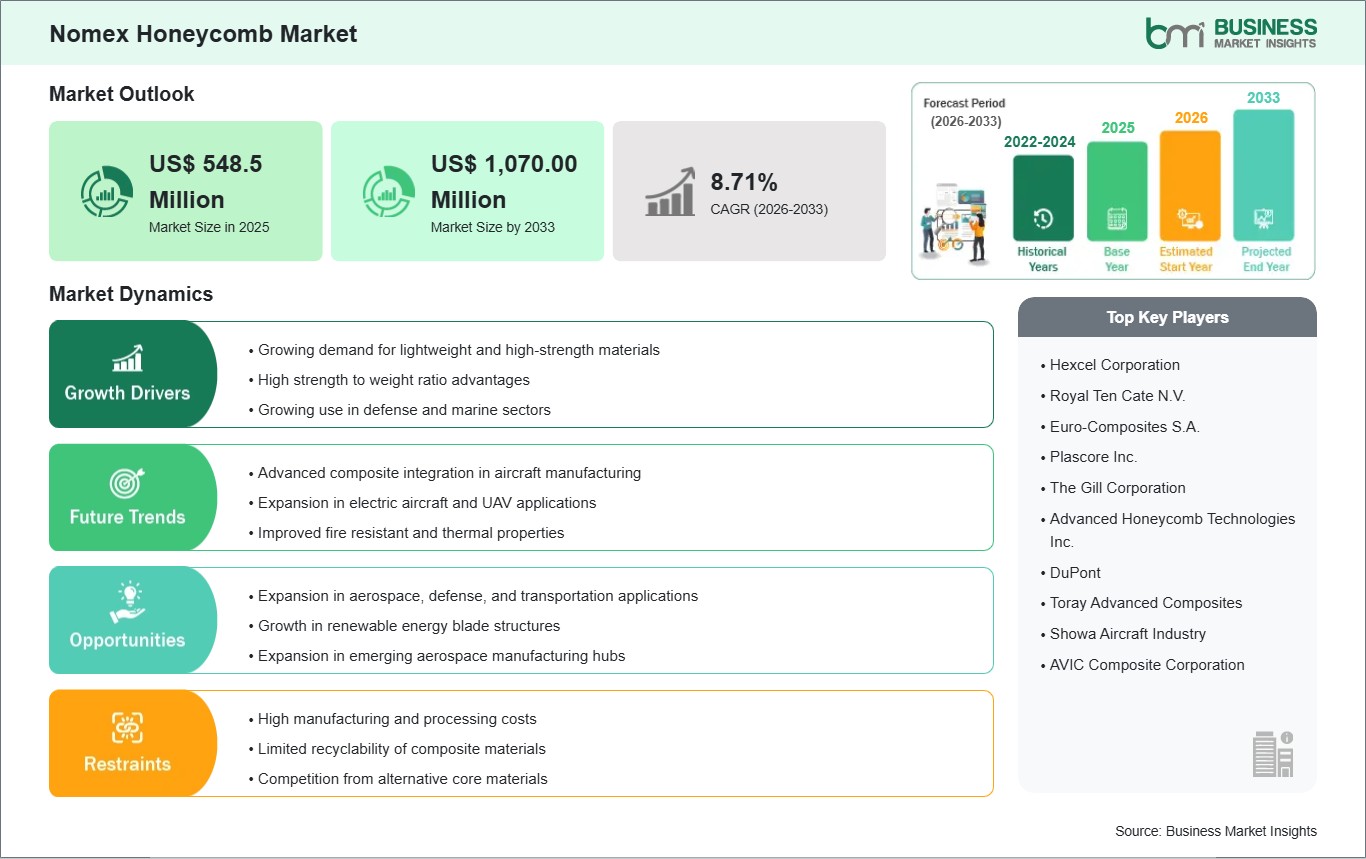
The Nomex Honeycomb Market size is expected to reach US$ 1,070.00 Million by 2033 from US$ 548.5 Million in 2025. The market is estimated to record a CAGR of 8.71% from 2026 to 2033.
The Nomex honeycomb market is growing steadily, and this growth can be attributed to the critical nature of the applications of Nomex in the aerospace, defense, transportation, and industrial industries. Nomex, being composed of aramid paper coated with phenolic resin, has excellent properties that make it suitable for use in the aforementioned industries, including its high strength-to-weight ratio, thermal insulation, and fire retardancy. These properties are essential in the production of lightweight composite materials, which are essential in the production of aircraft, trains, and industrial machinery, as the world moves towards the production of fuel-efficient, environmentally friendly, and high-performance materials.
The increasing demand for aircraft, trains, and industrial machinery is also contributing to the growth of the Nomex industry, as manufacturers are looking for materials that have excellent properties and are lightweight at the same time. The Nomex industry is also affected by the developments that are taking place in the production of the material, including the production of the honeycomb itself. Major players are focusing on customizing cell size, density, and panel thickness to meet specific application demands, especially in the aerospace and defense industry. Strategic partnerships with OEMs and composites players help in integrating products quickly and securing long-term contracts. However, the market is constrained by factors like high raw material costs, complex manufacturing process, and quality and safety concerns. This creates an entry barrier for new players. Nevertheless, with increased investments in light materials, high-speed infrastructure development, and energy-efficient aerospace products, the market is expected to grow.

Key segments that contributed to the derivation of the Nomex honeycomb market analysis is application.
The growing need for lightweight and strong materials is a major factor that contributes to the growth of the Nomex honeycomb market. This is due to the fact that the strength-to-weight ratio of the Nomex honeycomb material is exceptionally high, which enables different industries to reduce the overall weight of the structures without compromising the overall strength of the material. This has led to the increased use of this material in different sectors, including aerospace, defense, and transportation, where the overall weight of the structures is a major factor for fuel efficiency.
Moreover, the thermal stability and fire-resistant properties of the Nomex honeycomb material make it a highly sought-after material for different applications, where safety is a critical factor. The thermal stability and fire-resistant properties of this material make it highly reliable for different applications, where the overall temperature is a critical factor. This has led to the increased use of this material in different sectors, where safety is a critical factor.
Advancements in manufacturing techniques have also contributed to the growing adoption of Nomex honeycomb. Precision fabrication, customizable cell sizes, and the ability to bond with various composite materials allow designers and engineers to create tailored solutions for complex structures. As demand for high-performance, lightweight, and safe materials continues to rise, the Nomex honeycomb market is expected to maintain steady growth.
The market for Nomex honeycomb is growing, driven by increased use in aerospace, defense, and transportation sectors. In aerospace, Nomex honeycomb is used for aircraft interior parts, flooring panels, and structural components, providing strength without adding weight. This provides fuel efficiency, maneuverability, and cost savings, making it an essential material for aircraft design. It also provides excellent fire resistance and thermal insulation.
In defense, Nomex honeycomb is used for protective panels, interior parts, and structural components. It is durable, strong, and has fire-resistant properties, which make it suitable for military equipment that needs to withstand harsh conditions and extreme weather. This provides safety advantages for the end user.
Therefore, the market for Nomex honeycomb is growing, driven by increased use in aerospace, defense, and transportation sectors. It is used for aircraft interior parts, flooring panels, and structural components, providing strength without adding weight. It is also used for protective panels, interior parts, and structural components, providing safety advantages for the end user.
Transportation sectors, including rail and automotive, are increasingly adopting Nomex honeycomb to reduce weight while maintaining performance and safety standards. Its compatibility with composite materials allows for flexible design and efficient assembly of components. Continuous innovation in material processing and fabrication techniques has enabled the production of tailored honeycomb structures for specialized applications. As industries prioritize lightweight, safe, and high-strength materials, the demand for Nomex honeycomb is expected to continue growing steadily worldwide.

The Nomex honeycomb market demonstrates steady growth, with size and share analysis highlighting evolving trends and competitive dynamics among key players. The report examines subsegments categorized within application, offering insights into their contribution to overall market performance.
By Application, the Aerospace & Defense subsegment dominated the market in 2025, driven by high demand for lightweight, strong, and fire-resistant materials in aircraft and defense applications.
| Report Attribute | Details |
|---|---|
| Market size in 2025 | US$ 548.5 Million |
| Market Size by 2033 | US$ 1,070.00 Million |
| Global CAGR (2026 - 2033) | 8.71% |
| Historical Data | 2022-2024 |
| Forecast period | 2026-2033 |
| Segments Covered | By Application
|
|
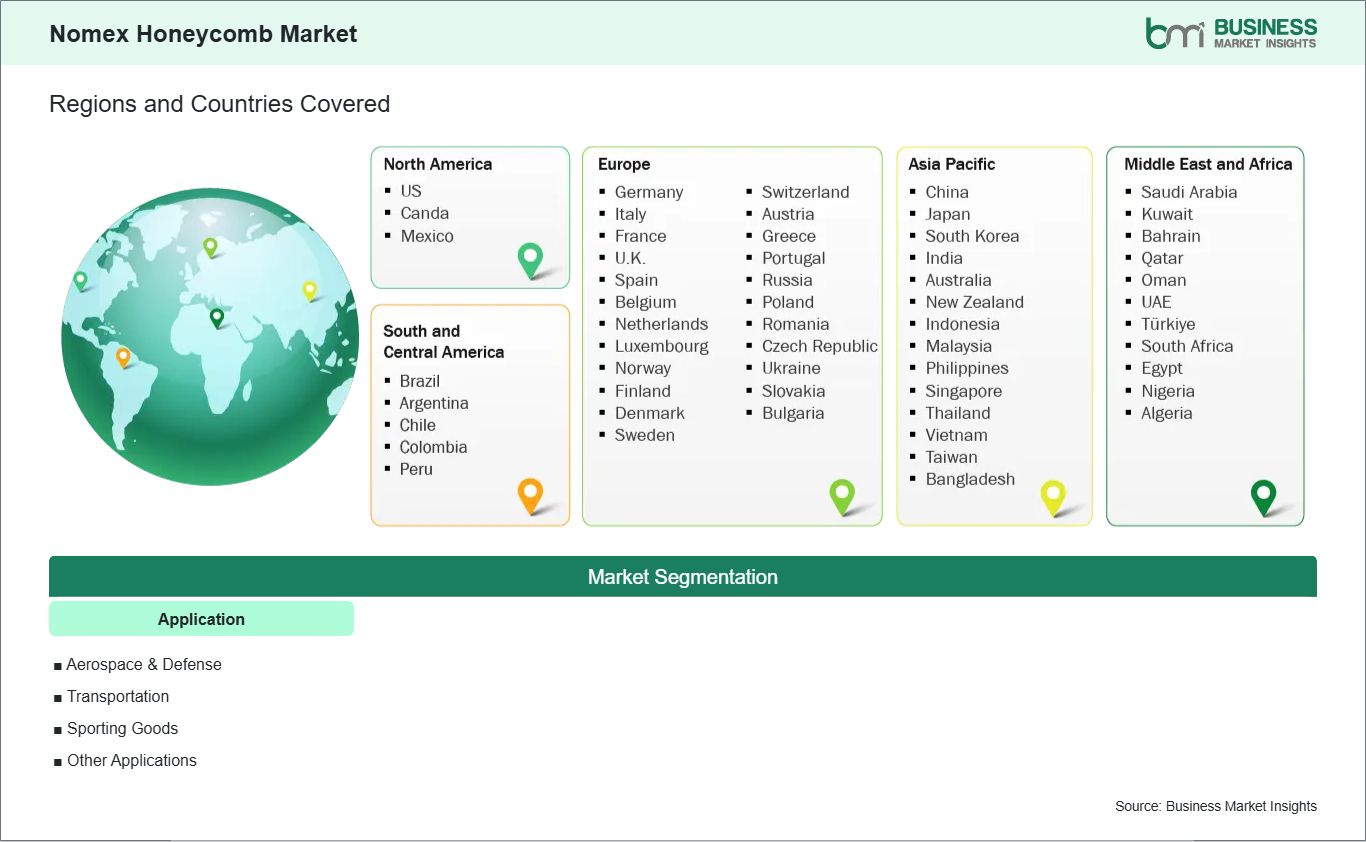
Regions and Countries Covered
| |
| North America | US, Canada, Mexico |
| Europe | Belgium, Austria, Finland, Denmark, Greece, Poland, Romania, Russia, Ukraine, Czech Republic, Slovakia, Bulgaria, Italy, Luxembourg, Germany, Switzerland, France, Netherlands, Norway, Portugal, Spain, Sweden, United Kingdom |
| Asia-Pacific | Australia, China, India, Japan, South Korea, Indonesia, Malaysia, Philippines, Singapore, Thailand, Vietnam, Bangladesh, New Zealand, Taiwan |
| South and Central America | Brazil, Argentina, Peru, Chile, Colombia |
| Middle East and Africa | Bahrain, Kuwait, Oman, Qatar, Saudi Arabia, United Arab Emirates, Turkiye, South Africa, Egypt, Algeria, Nigeria |
| Market leaders and key company profiles |
|
The "Nomex Honeycomb Market Size and Forecast (2022 - 2033)" report provides a detailed analysis of the market covering below areas:
The geographical scope of the Nomex Honeycomb Market report is divided into North America, Asia Pacific, Europe, Middle East & Africa, and South & Central America. North America held the largest share in 2025.
The Nomex honeycomb market exhibits varied growth trajectories shaped by industrial demand, aerospace and defense expenditure, and infrastructure development. North America dominates the market, driven by the U.S. and Canada`s advanced aerospace, defense, and industrial sectors. Strong adoption of Nomex honeycomb in aircraft interiors, military vehicles, and industrial panels, combined with well-established supply chains and stringent regulatory compliance, reinforces the region`s leadership.
Europe shows steady growth, particularly in Germany, France, and the U.K., where aerospace manufacturing, high-speed rail development, and defense projects demand lightweight, flame-retardant core materials. Environmental regulations and high industry standards support the adoption of high-performance Nomex honeycomb solutions.
Asia Pacific is the fastest-growing region due to expanding aerospace, defense, and rail infrastructure in China, India, and Japan. Rising investments in energy-efficient transport, urbanization, and industrial modernization are increasing the demand for lightweight composite materials.
Middle East & Africa shows moderate growth, led by defense and aviation sectors in Gulf countries, where military vehicle and aircraft production requires flame-retardant and structurally reliable core materials.
South & Central America demonstrates gradual expansion, with Brazil and Argentina leading demand due to aerospace and rail infrastructure investments. Growing awareness of the benefits of lightweight, high-strength materials is supporting increased adoption in industrial and transportation applications.

The Nomex Honeycomb Market is evaluated by gathering qualitative and quantitative data post primary and secondary research, which includes important corporate publications, association data, and databases. A few of the key developments in the nomex honeycomb Market are:
The Nomex Honeycomb Market is valued at US$ 548.5 Million in 2025, it is projected to reach US$ 1,070.00 Million by 2033.
As per our report Nomex Honeycomb Market, the market size is valued at US$ 548.5 Million in 2025, projecting it to reach US$ 1,070.00 Million by 2033. This translates to a CAGR of approximately 8.71% during the forecast period.
The Nomex Honeycomb Market report typically cover these key segments-
The historic period, base year, and forecast period can vary slightly depending on the specific market research report. However, for the Nomex Honeycomb Market report:
The Nomex Honeycomb Market is populated by several key players, each contributing to its growth and innovation. Some of the major players include:
The Nomex Honeycomb Market report is valuable for diverse stakeholders, including:
Essentially, anyone involved in or considering involvement in the Nomex Honeycomb Market value chain can benefit from the information contained in a comprehensive market report.
Please tell us your area of interest
(Market Segments/ Regions and Countries/ Companies)