
Air Fryer Market Outlook: Size, Share, Trends, Growth Analysis, Competitive Landscape & Forecast, 2026-2033

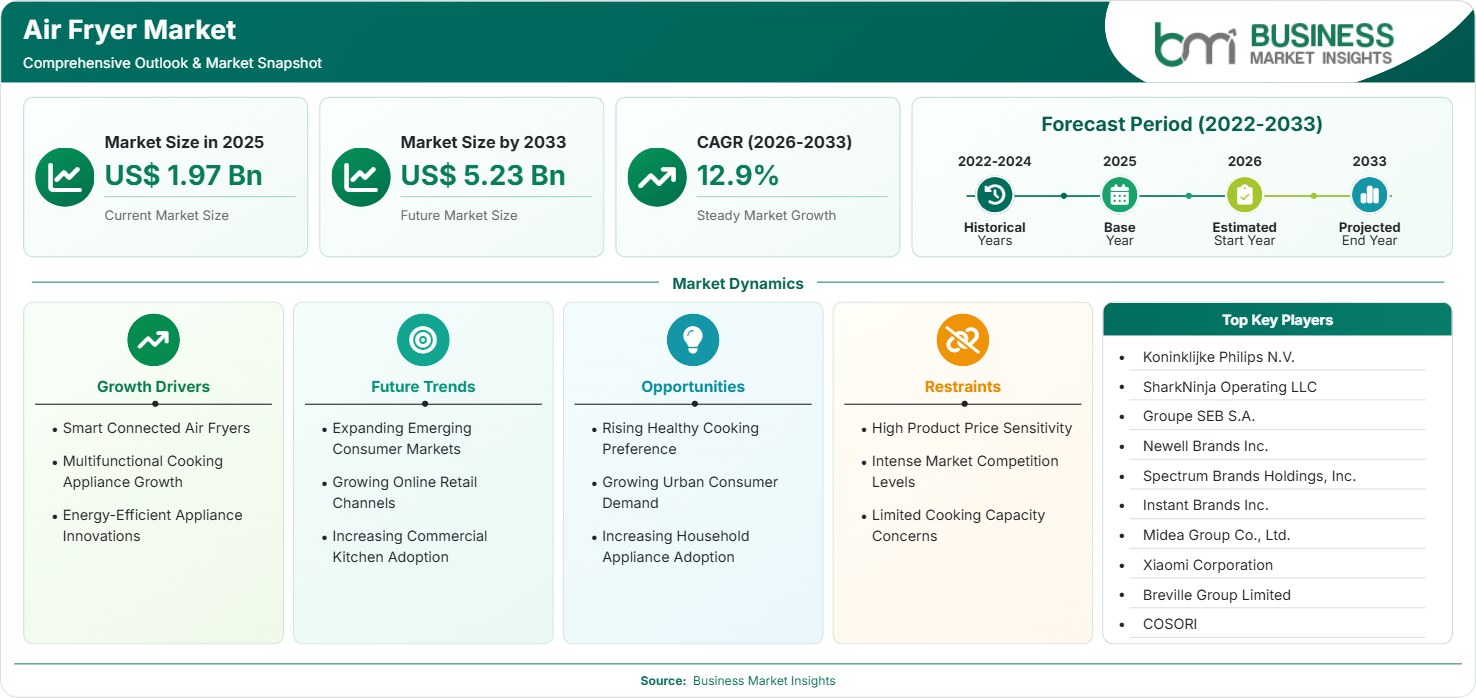
The Air Fryer Market size was valued at US$ 1.97 Billion in 2025 and is projected to reach US$ 5.23 Billion by 2033, growing at a CAGR of 12.9% during 2026–2033. Rising preference for healthier cooking methods, increasing adoption of smart kitchen appliances, and expanding urban lifestyles are accelerating demand, while multifunctional appliance innovation and connected home technologies are creating new growth opportunities.

Report Coverage
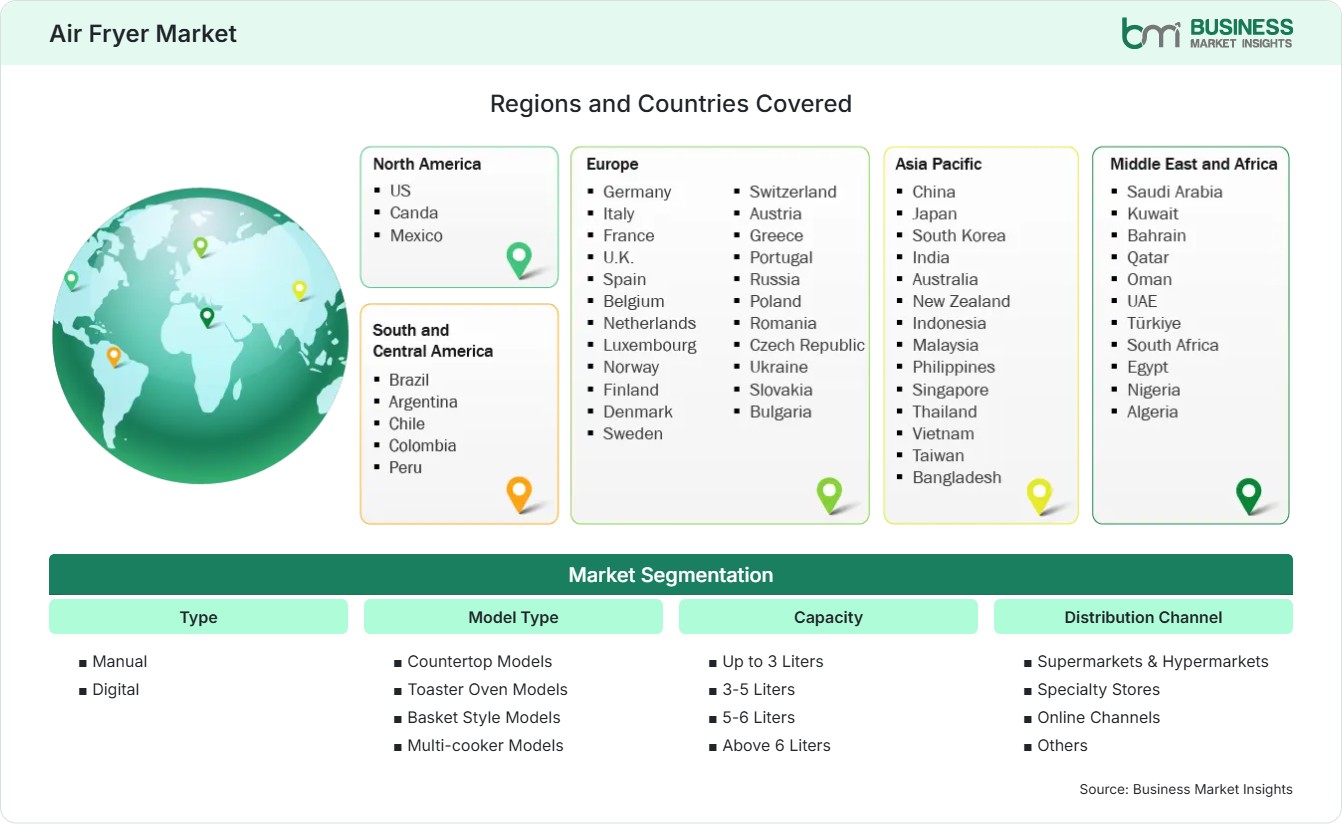
  • Type: Manual, Digital
  • Model Type: Countertop Models, Toaster Oven Models, Basket Style Models, Multi-cooker Models
  • Capacity: Up to 3 Liters, 3-5 Liters, 5-6 Liters, Above 6 Liters
  • Distribution Channel: Supermarkets & Hypermarkets, Specialty Stores, Online Channels, Others
  • End-User: Household, Foodservice Facilities, Others
US$ 1.97 Bn Market size in 2025
US$ 5.23 Bn Market Size by 2033
12.9% CAGR, 2026 - 2033
2026-2033 Forecast Period

01 AI Overview

Air Fryer Market Summary

  • North America Region: North America holds a market share of 32%–35% in 2025, growing at a CAGR of 12.0%–12.6% during 2026–2033. Strong consumer awareness of healthier cooking, premium appliance adoption, and smart kitchen integration support regional expansion. The U.S. market leads through high household penetration, online appliance sales, and connected kitchen adoption, growing at a CAGR of 12.1%–12.7%.
  • Fastest Growing Region: Asia Pacific represents 30%–33% share in 2025 and is projected to expand at a CAGR of 13.8%–14.4% during 2026–2033. Growth is supported by rising disposable income, urbanization, expanding middle-class households, increasing e-commerce penetration, and growing interest in convenient cooking appliances.
  • Leading Segment: Basket Style Models account for 45%–48% share in 2025, expanding at a CAGR of 12.7%–13.3%. Consumer preference for compact designs, ease of operation, affordability, and suitability for everyday household cooking supports segment leadership across major markets.
  • High Growth Segment: Digital air fryers represent 55%–58% share in 2025 and are expected to grow at a CAGR of 13.5%–14.1%. Increasing demand for smart controls, preset cooking functions, connectivity features, and improved user convenience is accelerating adoption.
  • Key Market Opportunity: Integration of artificial intelligence, smart home connectivity, energy-efficient heating technologies, and multifunctional cooking capabilities is creating opportunities for manufacturers targeting health-conscious and technology-oriented consumers.
  • Major Market Players: Koninklijke Philips N.V., SharkNinja Operating LLC, Groupe SEB S.A., Newell Brands Inc., Spectrum Brands Holdings, Inc., Instant Brands Inc., Midea Group Co., Ltd., Xiaomi Corporation, Breville Group Limited, and COSORI.
02 Strategic Insights

Air Fryer Market: Strategic Insights

air-fryer-market-market-strategic-framework
FREE PDF
Request your free sample
Request free sample
03 Stakeholder View

Key Takeaways

  • Consumer behaviour is moving towards healthier convenience cooking solutions. Consumers are adopting cooking equipment that helps minimize the use of oil without compromising on the taste and texture, thus fueling demand for air frying technologies.
  • Smart functionalities are turning out to be crucial from the perspective of competitiveness. The companies have started incorporating functionalities such as Wi-Fi connectivity, digitized controls, automatic cooking programs, and apps to allure technology-conscious customers.
  • Multifunctional and compact designs are gaining market acceptance. Consumers are gradually preferring appliances that integrate multiple cooking capabilities while encouraging innovation in hybrid cooking platforms.
  • Asia Pacific offers significant expansion potential. Rising urban populations, increasing middle-class spending, and rapid online retail growth are creating favorable conditions for air fryer adoption across emerging economies.
  • Brand competition is driving product innovation. Established appliance manufacturers and emerging brands are investing in pricing strategies, feature improvements, and distribution expansion to capture growing consumer demand.
  • Energy efficiency is influencing purchase decisions. Consumers are increasingly considering electricity consumption, cooking speed, and appliance efficiency, encouraging manufacturers to develop optimized heating systems and sustainable product designs.
04 Geographic Outlook

Air Fryer Market Regional Highlights

North America Air Fryer Market

North America accounted for 32%–35% of the global market in 2025 and is projected to expand at a 12.0%–12.6% CAGR during 2026–2033. Regional growth is supported by strong household appliance adoption, health-focused consumer behavior, premium product demand, and advanced retail infrastructure. The Air Fryer Market share remains significant due to widespread brand availability, online shopping penetration, and increasing adoption of smart kitchen technologies.

  • The United States dominates regional demand due to high appliance ownership, strong e-commerce adoption, and consumer preference for convenient healthy cooking solutions.
  • Canada is experiencing increasing adoption through rising awareness of healthier food preparation methods and expanding availability of premium kitchen appliances.
  • Smart connected appliances are gaining popularity as households integrate kitchen devices with broader home automation systems.
  • Retailers are expanding product selections across price ranges, improving accessibility for budget-conscious and premium consumers.

US Air Fryer Market

The United States represented 27%–29% of the global Air Fryer Market in 2025 and is expected to grow at a 12.1%–12.7% CAGR through 2033. Strong consumer demand for convenient meal preparation, increasing health awareness, and rapid adoption of smart appliances are supporting market expansion.

  • Consumers are increasingly adopting air fryers as alternatives to conventional frying appliances due to lower oil usage and convenience.
  • Online platforms are strengthening product discovery through reviews, promotions, and direct-to-consumer sales strategies.
  • Premium models with digital displays, preset programs, and connectivity features are gaining traction among technology-focused households.

Europe Air Fryer Market

Europe held 25%–28% of the market in 2025 and is Europe air fryer market forecast to grow at a 12.4%–13.0% CAGR between 2026 and 2033. Germany, the United Kingdom, France, and Italy represent major markets due to strong appliance adoption and increasing demand for energy-efficient cooking solutions.

  • Germany leads regional adoption through strong consumer purchasing power and demand for innovative household appliances.
  • The United Kingdom is experiencing rapid growth due to increasing interest in healthier cooking methods and online appliance purchases.
  • France and Italy are expanding demand through premium kitchen appliance adoption and changing household cooking habits.
  • European consumers are increasingly evaluating energy efficiency and product durability when purchasing kitchen appliances.

Asia Pacific Air Fryer Market

Asia Pacific accounted for 30%–33% of the global Air Fryer Market in 2025 and is projected to register the fastest growth at a 13.8%–14.4% CAGR during 2026–2033. Regional expansion is supported by rising disposable incomes, urban household growth, increasing e-commerce penetration, and growing preference for convenient cooking appliances.

  • China represents the largest regional market due to extensive appliance manufacturing capabilities, expanding middle-class consumers, and strong online retail infrastructure.
  • India is emerging as a high-growth market supported by urbanization, rising household incomes, changing food preferences, and increasing adoption of modern kitchen appliances.
  • Japan and South Korea continue driving demand through advanced consumer electronics ecosystems, smart home adoption, and preference for premium kitchen technologies.
  • Southeast Asian countries are experiencing increased air fryer adoption due to growing digital commerce, young consumers, and expanding residential appliance demand.

Rest of World Air Fryer Market

The Rest of World region accounted for 5%–8% of the global Air Fryer Market in 2025 and is expected to grow at a 10.8%–11.4% CAGR from 2026–2033. Growth is supported by increasing household appliance adoption, expanding retail networks, rising consumer awareness of healthier cooking methods, and improving economic conditions across Latin America, the Middle East, and Africa. Regional markets are gradually adopting convenient cooking technologies.

Latin America is witnessing rising demand due to increasing urban lifestyles, expanding middle-class households, and growing availability of international appliance brands. Brazil and Mexico remain key contributors due to established retail channels and increasing consumer interest in modern kitchen equipment.

The Middle East and Africa are creating opportunities through improving living standards, residential development, and expanding consumer appliance distribution networks. Countries investing in modern retail infrastructure and smart household technologies are supporting greater adoption of advanced cooking appliances.

  • Brazil leads Latin American demand due to increasing household appliance purchases, urban consumer growth, and expanding online shopping platforms.
  • Mexico is strengthening adoption through retail expansion, rising disposable income, and increasing consumer preference for convenient cooking solutions.
  • Saudi Arabia and the UAE are supporting regional growth through premium household appliance demand and modern residential development.
  • South Africa is increasing market participation through improving retail accessibility and growing interest in healthier food preparation methods.
  • International brands are expanding distribution partnerships across emerging markets to improve product availability and strengthen consumer awareness.
global-market-geography
FREE PDF
Request your free sample
Request free sample
05 Segment Analysis

Air Fryer Market Segmentation

Type

The type segment plays a major role in shaping consumer purchasing decisions as manufacturers introduce products with improved functionality, convenience, and cooking control. Digital air fryers represented 55%–58% share in 2025 and are projected to grow at a 13.5%–14.1% CAGR during 2026–2033 due to smart controls, preset programs, touchscreen interfaces, and enhanced user convenience. The Air Fryer Market scope continues expanding as consumers shift toward technologically advanced appliances that simplify meal preparation while supporting healthier cooking preferences.

  • Manual: Manual air fryers remain popular among price-sensitive consumers due to simple operation, lower costs, mechanical controls, and suitability for basic household cooking requirements.
  • Digital: Digital air fryers are gaining adoption through touchscreen controls, automated cooking settings, smart connectivity features, and improved precision for modern households.

Model Type

The model type segment reflects diverse consumer needs across household sizes, cooking preferences, and kitchen space availability. Basket Style Models dominated with 45%–48% share in 2025 and are expected to grow at a 12.7%–13.3% CAGR during 2026–2033 due to compact designs, affordability, and convenience. Increasing demand for multifunctional and space-saving appliances is encouraging manufacturers to introduce innovative models across residential and commercial applications.

  • Countertop Models: Countertop air fryers are widely adopted due to compact dimensions, easy placement, and suitability for households seeking convenient everyday cooking solutions.
  • Toaster Oven Models: Toaster oven models attract consumers requiring larger cooking capacity, multifunctional operations, and combined baking, roasting, and air frying capabilities.
  • Basket Style Models: Basket style models remain highly preferred because of quick cooking performance, simple cleaning, compact design, and strong availability across retail channels.
  • Multi-cooker Models: Multi-cooker models are gaining interest among consumers seeking appliances that combine air frying, pressure cooking, steaming, and multiple meal preparation functions.

Capacity

Capacity selection influences purchasing decisions based on household size, cooking frequency, and meal preparation requirements. The 3–5 Liters category represented the leading capacity range with 38%–41% of the Air Fryer Market share in 2025 and is projected to grow at a 12.8%–13.4% CAGR during 2026–2033. Consumers increasingly prefer medium-capacity appliances that balance cooking volume, energy efficiency, and kitchen space utilization.

  • Up to 3 Liters: Compact air fryers are preferred by single-person households and small kitchens due to affordability, portability, and efficient cooking performance.
  • 3–5 Liters: Medium-capacity models are widely adopted by families seeking balanced cooking capacity, practical design, and versatile meal preparation options.
  • 5–6 Liters: Larger models are gaining demand among households requiring greater food quantities and improved convenience for family cooking.
  • Above 6 Liters: High-capacity appliances attract larger families and food enthusiasts requiring increased cooking volume and multifunctional preparation capabilities.

Distribution Channel

Distribution channels are becoming increasingly important as consumers combine online research with physical retail experiences before purchasing kitchen appliances. Online Channels accounted for 35%–38% share in 2025 and are projected to grow at a 14.2%–14.8% CAGR during 2026–2033. Digital platforms support wider product availability, competitive pricing, customer reviews, and direct brand engagement.

  • Supermarkets & Hypermarkets: These channels provide consumers with product demonstrations, brand visibility, promotional offers, and convenient access to household appliances.
  • Specialty Stores: Specialty retailers support premium appliance sales through expert guidance, product comparisons, and personalized customer assistance.
  • Online Channels: Online platforms are expanding rapidly through e-commerce growth, digital marketing campaigns, customer reviews, and direct-to-consumer purchasing models.
  • Others: Other distribution channels include brand outlets and independent retailers offering additional purchasing options for diverse consumer groups.

End-User

The end-user segment demonstrates broad adoption across residential and commercial environments. Household users represented the dominant segment with 75%–78% share in 2025 and are expected to grow at a 12.7%–13.3% CAGR during 2026–2033. Increasing health awareness, busy lifestyles, and demand for convenient cooking solutions continue supporting household adoption globally.

  • Household: Household adoption is increasing due to demand for healthier cooking alternatives, compact appliances, time-saving preparation methods, and convenient meal solutions.
  • Foodservice Facilities: Restaurants and foodservice operators are adopting air fryers for efficient preparation, menu diversification, and reduced oil consumption in commercial kitchens.
06 Market Forces

Air Fryer Market Dynamics

Key Market Drivers

Smart Connected Air Fryers

The rising prevalence of smart and connected air fryers is enabling conventional kitchen appliances to become digitally connected cookware solutions. The incorporation of Wi-Fi functionality, mobile apps, voice command capability, and automatic cooking modes is helping enhance the user experience. Digital functionality will enable users to keep track of their cooking operations, access recipes, and customize settings from a distance. Increasing adoption of smart homes and consumer interest in technology-enabled appliances are driving this trend. Air Fryer Market growth is attributed to increasing investments in connected appliance systems, while the Market trends suggest that artificial intelligence and energy monitoring will play an important role.

Multifunctional Cooking Appliance Growth

Increasing desire for multi-purpose kitchen gadgets is prompting manufacturers to integrate air frying with other functions like baking, roasting, grilling, and steaming. Multiple consumers are opting for kitchen devices that help in minimizing the number of cooking equipment available in their kitchen while at the same time offering several different cooking choices. This air fryer market trend is most prevalent in urban homes with small kitchens and tight schedules due to their hectic nature that demands more cooking efficiency. Manufacturers are addressing this trend through innovative designs which include better temperature management, increased capacities, and cooking programs.

Energy-Efficient Appliance Innovations

The aspect of energy consumption efficiency is now becoming an essential consideration when people buy their appliances, taking into account the cost and environmental issues involved. Air fryers take less time to cook food items than regular ovens do, thus arousing the interest of people who are concerned about energy efficiency. Improvements in the areas of heating technology, ventilation, and insulation make air fryers more energy-efficient without sacrificing their effectiveness at all. Awareness of the issues of energy consumption and environmental protection fosters technological advancements.

Key Market Opportunities

Rising Healthy Cooking Preference

Consumer preference for healthy diets is presenting substantial growth prospects for air fryer producers. There is an increasing need for healthy cooking techniques that cut down the use of oil without compromising on the quality and taste of food. The growing consumer awareness regarding health, nutrition, and the changing tastes and preferences of consumers for convenience cooking have prompted consumers to embrace the air frying technique. Further, there are chances for companies to capitalize more through innovations such as cooking precision, nutrition, and recipe capabilities among others.

Growing Urban Consumer Demand

Rising urbanization is creating opportunities for the production of small and convenient kitchen gadgets suited to modern ways of living. Urban consumers need products that take less time to prepare food, have minimal kitchen space requirements, and can cater to variable cooking demands. Air fryers fulfill such requirements by offering fast cooking, ease of use, and variable cooking capabilities. Increasing numbers of apartments, changes in family composition, and growing disposable incomes are fueling demand among urban consumers in the coming year.

Increasing Household Appliance Adoption

Increasing use of household appliances in developing countries is presenting fresh avenues of growth for air fryer manufacturers. Higher standards of living, rising disposable incomes, and increased availability of retail stores are prompting people to purchase advanced kitchen appliances. Foreign companies are launching localized versions with different capacities and pricing levels to cater to varied market needs. Increased penetration of e-commerce is also boosting access in developing nations. Companies that expand their distribution channels and develop consumer-oriented product ranges will gain from the increasing trend towards easy-to-use cooking appliances.

Market Restraints and Challenges

High Product Price Sensitivity

Factor: Air frying machines such as digital air frying machines, which are more expensive, have greater purchase costs due to their advanced technology and better material use. Cost is an important factor for consumers when purchasing appliances because of the expense involved in doing so. Impact: High price sensitivity may limit consumption among cost-sensitive consumers.

Intense Market Competition Levels

Factor: The Air Fryer Market has many global brands as well as new emerging brands participating in the competition through price, features, marketing initiatives, and distribution. Impact: Greater availability of products has increased competition in both online and physical stores. Healthy competition may lower profit margins and make it difficult for brands to differentiate themselves from others.

07 Company Analysis

Competitive Landscape

The competitive landscape of the Air Fryer Market analysis reveals that there is stiff competition within the industry between global appliance brands, intelligent kitchen tech brands, and emerging consumer appliance brands. The companies have been differentiating themselves based on connectivity, multifunctionality, capacity, pricing, and omnichannel distribution expansion.

Company Name

Overview

Products and Services relevant to this market

Koninklijke Philips N.V.

Global consumer technology company offering healthcare, lighting, and household appliance solutions worldwide.

Provides Philips Airfryer products with rapid air technology, digital controls, connected cooking features, and multiple capacity options.

SharkNinja Operating LLC

Consumer appliance company specializing in innovative kitchen, cleaning, and home technology products.

Offers Ninja air fryers featuring dual baskets, smart controls, multifunction cooking modes, and high-capacity models.

Groupe SEB S.A.

French consumer appliance manufacturer with extensive small kitchen appliance product portfolios.

Provides Tefal and Moulinex air fryers with advanced cooking programs and household-focused designs.

Newell Brands Inc.

Global consumer goods company operating across kitchen, home, and lifestyle categories.

Offers kitchen appliances including air fryers designed for convenient cooking and consumer applications.

Spectrum Brands Holdings, Inc.

Consumer products company providing household, personal care, and appliance solutions.

Develops small kitchen appliances with air frying capabilities and value-focused product offerings.

Instant Brands Inc.

Kitchen appliance company known for multifunction cooking products and innovative food preparation solutions.

Provides Instant Vortex air fryers with digital controls, preset programs, and multifunction cooking capabilities.

Midea Group Co., Ltd.

Global appliance manufacturer producing residential and commercial household equipment.

Offers air fryers with smart functions, energy-efficient technologies, and diverse capacity configurations.

Xiaomi Corporation

Technology company providing smart consumer electronics and connected home products.

Provides smart air fryers integrated with IoT platforms, app controls, and intelligent cooking features.

Breville Group Limited

Premium kitchen appliance company focused on advanced cooking technologies and consumer experience.

Offers Breville air fryers and countertop cooking appliances with premium designs and performance features.

COSORI

Kitchen appliance brand specializing in smart cooking products and connected appliance solutions.

Provides digital air fryers with smart controls, recipe integration, multiple cooking functions, and consumer-focused designs.

08 Industry Activity

Recent Developments

October 2025

SharkNinja Operating LLC introduced the Ninja CRISPi PRO Countertop Glass Air Fryer. This is the next-generation upgrade of the Ninja CRISPi Portable Cooking System.

February 2025

Versuni (Philips Home Appliances) expanded its air fryer portfolio with the launch of the Philips Airfryer 3000 Series Single Basket, designed with RapidAir technology and intuitive cooking presets to enhance convenience and healthier cooking for consumers.

September 2024

SharkNinja Operating LLC redefined the air fryer category with the launch of the Ninja CRISPi Portable Cooking System. The Ninja CRISPi is a fully portable system with a handheld air fryer Power Pod.

September 2024

Versuni (Philips Home Appliances) launched the Philips Airfryer 2000 Series Single Basket and 3000 Series Dual Basket in North America, featuring RapidAir technology and synchronized dual-basket cooking.

10 Trust & Transparency

Research Methodology

The market analysis combines proprietary research with secondary data from government agencies, company disclosures, regulatory filings, industry databases and expert interviews. Market estimates are validated through data triangulation, cross-market benchmarking and analyst review.

View Full Research Methodology

11 Questions Answered

Frequently Asked Questions

How does the market Report assess future industry developments?

The Air Fryer Market Report evaluates growth through analysis of technology innovation, consumer behavior shifts, regional adoption patterns, competitive strategies, and distribution trends.

What role does e-commerce play in air fryer sales?

E-commerce platforms are expanding market reach through wider product availability, consumer reviews, competitive pricing, promotional campaigns, and direct brand engagement, making air fryers more accessible globally.

How are manufacturers addressing changing consumer preferences?

Manufacturers are developing appliances with advanced heating systems, connected features, customized cooking programs, improved designs, and varied capacity options to meet different household sizes and cooking requirements.

Which air fryer features are gaining popularity?

Smart connectivity, touchscreen controls, preset cooking programs, larger capacities, dual baskets, energy efficiency, and multifunction capabilities are becoming important purchasing factors as consumers seek improved convenience and flexibility.

Why are consumers increasingly adopting air fryers?

Consumers are adopting air fryers due to growing interest in healthier cooking methods, reduced oil usage, faster meal preparation, compact designs, and convenient operation.

Access the Full Air Fryer Market Report

Get segment-level forecasts, regional estimates, competitive benchmarking, company profiles and downloadable Excel datasets.

Access the full Air Fryer Market Report
350 pages PDF & Excel | 2026-07-30