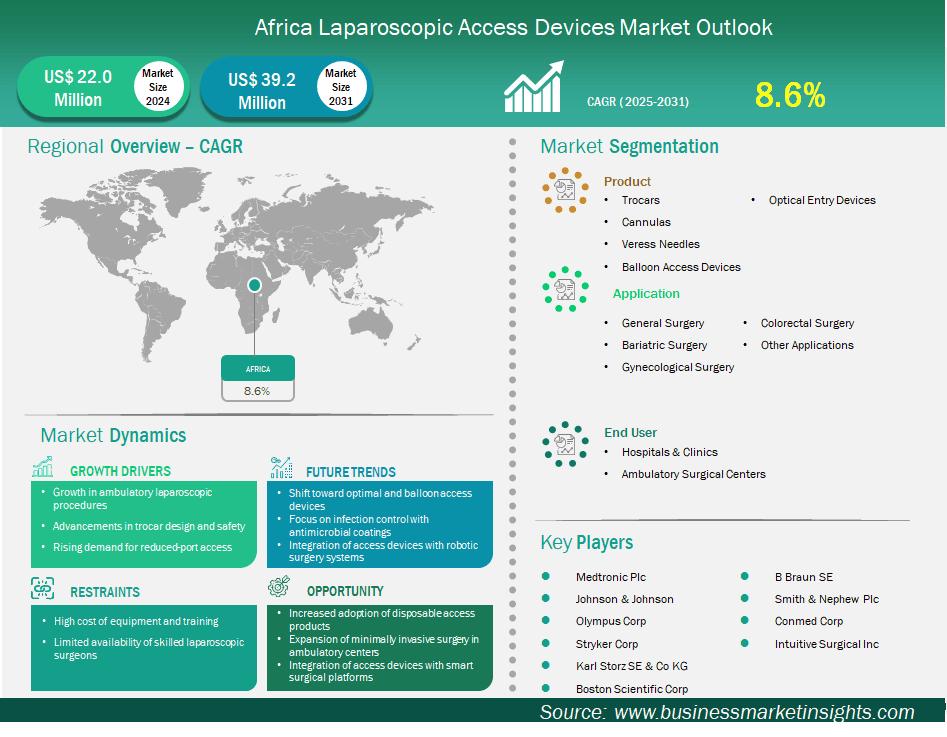
The Africa laparoscopic access devices market size is expected to reach US$ 39.2 million by 2031 from US$ 22.0 million in 2024. The market is estimated to record a CAGR of 8.6% from 2025 to 2031.
Executive Summary Africa Laparoscopic Access Devices Market Analysis:
The laparoscopic access devices market in Africa is experiencing significant growth, driven by growth in ambulatory laparoscopic procedures, advancements in trocar design and safety, and rising demand for reduced-port access. The market for laparoscopic access devices in Africa is slowly changing as a result of the continent's changing healthcare infrastructure and the increasing demand for minimally invasive surgical procedures. Due to the limited surgical capacity and resource constraints, it was a market that had hardly been penetrated. Now, it is witnessing a shift as public and private investments target surgical modernization. Penetration of trocars, cannulas, and balloon access devices, which are key product categories can be determined by examining the spread of these products mainly in urban hospitals and teaching institutions. There is a mix of global manufacturers from whom devices are imported and regional distributors who supply products tailored to local procurement budgets, thus the market remains fragmented. The pricing sensitivity, regulatory variability, and need for robust training programs to facilitate device adoption are some of the factors that have an impact on the competitive dynamics. Although high-end optical entry devices are a small market segment, their use in tertiary care centers is increasing. The market growth will be driven by the increased surgical volume of general surgery, gynecology, and urology. However, there is still a problem with access to these services in rural areas as compared to urban regions. In general, the African laparoscopic access devices market is going through a slow process of expansion whereby affordability and infrastructure readiness limit the level of innovation that can be achieved.
Africa Laparoscopic Access Devices Market Segmentation Analysis:
Key segments that contributed to the derivation of the laparoscopic access devices market analysis are product, application, and end user.
- By product, the laparoscopic access devices market is segmented into trocars, cannulas, veress needles, balloon access devices, and optical entry devices. The trocars segment dominated the market in 2024. Trocars are the largest product segment due to their essential role in nearly all laparoscopic procedures and widespread availability across surgical settings.
- In terms of application, the market is segmented into general surgery, bariatric surgery, gynecological surgery, colorectal surgery, and other applications. The general surgery segment held the largest market share in 2024. General surgery is the largest application segment due to its broad procedural scope and increasing adoption of minimally invasive techniques for abdominal and gastrointestinal conditions.
- By end user, the market is segmented into hospitals and clinics, and ambulatory surgical centers. The hospitals and clinics segment held the largest market share in 2024. Hospitals and clinics are the largest end user segment due to their dominance in surgical infrastructure, skilled personnel, and access to advanced laparoscopic equipment across urban centers.
Africa Laparoscopic Access Devices Market Outlook
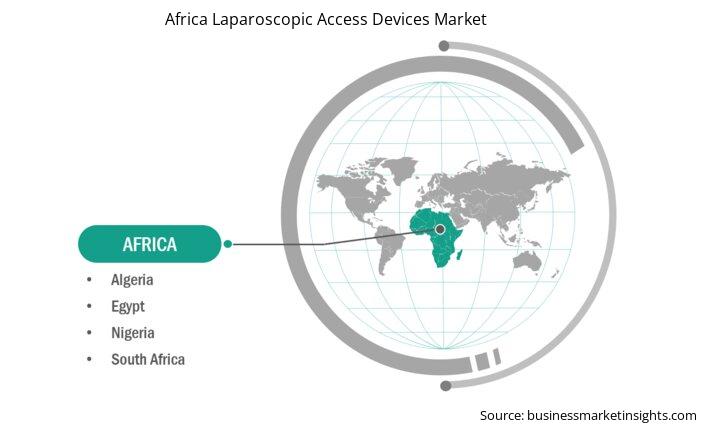
The Africa laparoscopic access devices market is segmented into Egypt, South Africa, Nigeria, and Algeria. The future of laparoscopic access devices in Africa is positive but still cautious, as the region is expected to experience several structural and policy-level changes that will accelerate their use within the upcoming years. Surgical care is becoming a priority of governments in sub-Saharan Africa as part of their universal health coverage goals, thus creating opportunities for device manufacturers to participate in public-private partnerships. Advanced laparoscopy systems are also in demand due to medical tourism that is flourishing in North African countries such as Egypt. As a result, hospitals are increasingly willing to invest in reusable and hybrid access devices. In the meantime, donor-funded surgical programs and NGO-led initiatives are supplying basic laparoscopic kits to district-level hospitals, thus widening the market beyond the availability of capital cities.
Additionally, there are innovations such as affordable optical trocars and portable insufflation devices that aim to meet the requirements of African operating rooms where power supply and sterilization capacity are not always stable. Moreover, the market will be able to attract more customers due to the increasing number of regional distributors who provide bundled solutions and local training. With the improvement of surgical education and the standardization of laparoscopic procedures, Africa’s access device market will be able to transition from opportunistic procurement to strategic integration within national surgical plans.
Africa Laparoscopic Access Devices Market Country Insights
Based on region, the Africa laparoscopic access devices market is further segmented into Egypt, South Africa, Nigeria, and Algeria. Egypt held the largest share in 2024.
At a country level, the dynamics of Africa illustrate a very segmented market for laparoscopic access devices that have been influenced by differences in healthcare investment, surgical workforce density, and procurement models. Egypt is leading in the case of laparoscopic adoption being facilitated by a strong private healthcare sector and well-established surgical training programmes. South Africa is becoming a center for laparoscopic innovation largely because medical tourism and regional manufacturing capabilities are driving it. Nigeria, consequently, is confronted with problems of surgical infrastructure and device affordability even though it has a large population. However, in response to public health reforms, the government has started to close these gaps. Each of these countries offers different sets of regulatory and logistical challenges that compel manufacturers to implement adaptable distribution and pricing strategies. It is necessary for stakeholders to comprehend these local details if they intend to scale up operations and establish a lasting market presence in Africa's extensive healthcare sector.
Africa Laparoscopic Access Devices Market Company Profiles
Medtronic Plc; Johnson & Johnson; Olympus Corp; Stryker Corp; Karl Storz SE & Co KG, Boston Scientific Corp, B Braun SE, Smith & Nephew Plc, Conmed Corp, and Intuitive Surgical Inc, are among the key players operating in the market. These players adopt strategies such as expansion, product innovation, and mergers and acquisitions to stay competitive in the market and offer innovative products to their consumers.
Africa Laparoscopic Access Devices Market Research Methodology:
The following methodology has been followed for the collection and analysis of data presented in this report:
Secondary Research
The research process begins with comprehensive secondary research, utilizing both internal and external sources to gather qualitative and quantitative data for each market. Commonly referenced secondary research sources include, but are not limited to:
- Company websites, annual reports, financial statements, broker analyses, and investor presentations
- Industry trade journals and other relevant publications
- Government documents, statistical databases, and market reports
- News articles, press releases, and webcasts specific to companies operating in the market
Note: All financial data included in the Company Profiles section has been standardized to US$. For companies reporting in other currencies, figures have been converted to US$ using the relevant exchange rates for the corresponding year.
Primary Research
Business Market Insights conducts a significant number of primary interviews each year with industry stakeholders and experts to validate and analyze the data and gain valuable insights. These research interviews are designed to:
- Refine findings from secondary research
- Enhance the expertise and market understanding of the analysis team
- Gain insights into market size, trends, growth patterns, competitive dynamics, and future prospects
Primary research is conducted via email interactions and telephone interviews with industry experts across various markets, categories, segments, and sub-segments in different regions. Participants typically include:
- Industry stakeholders: Vice Presidents, business development managers, market intelligence managers, and national sales managers
- External experts: Valuation specialists, research analysts, and key opinion leaders with industry-specific expertise
Key Sources Referred:
- World Health Organization (WHO)
- The World Bank Group
- Worldometer
- The Lancet
- BMC Medical Education
- Eurostat
Africa Laparoscopic Access Devices Market Strategic Insights
Africa Laparoscopic Access DevicesMarket Report Highlights
| Report Attribute | Details |
| Market size in 2024 | US$ 22.0 Million |
| Market Size by 2031 | US$ 39.2 Million |
| CAGR (2025 - 2031) | 8.6% |
| Historical Data | 2021-2023 |
| Forecast period | 2025-2031 |
| Segments Covered |
By Product
|
|
Regions and Countries Covered
|
|
| Africa | Egypt, South Africa, Nigeria, Algeria |
| Market leaders and key company profiles |
|
Africa Laparoscopic Access Devices Market Country and Regional Insights