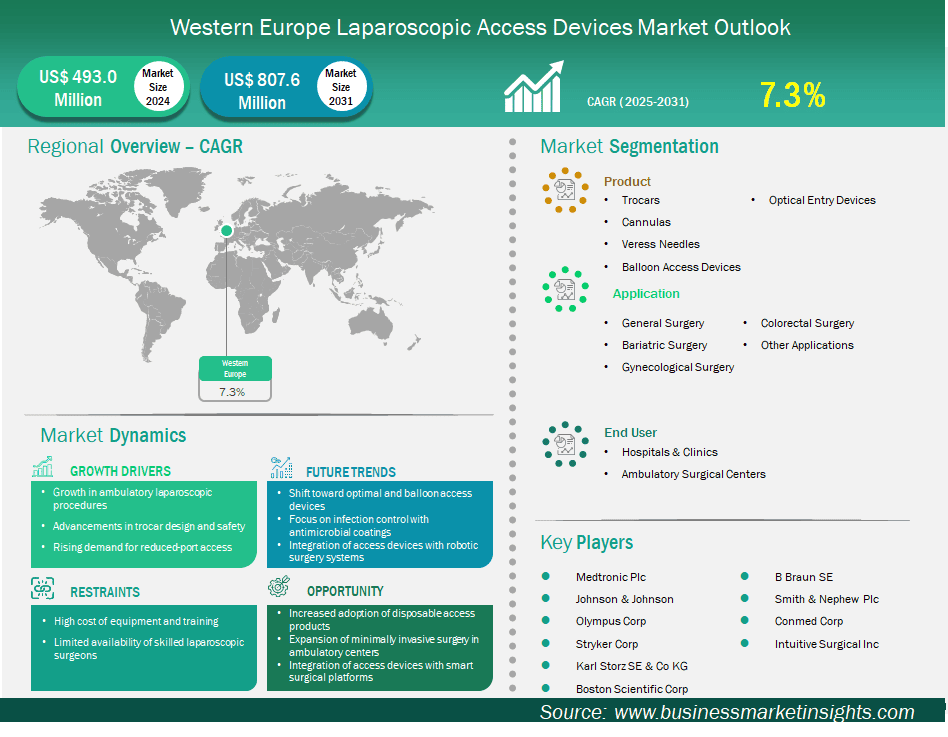
The Western Europe laparoscopic access devices market size is expected to reach US$ 807.6 million by 2031 from US$ 493.0 million in 2024. The market is estimated to record a CAGR of 7.3% from 2025 to 2031.
Executive Summary and Western Europe Laparoscopic Access Devices Market Analysis:
The laparoscopic access devices market in Western Europe is experiencing significant growth, driven by growth in ambulatory laparoscopic procedures, advancements in trocar design and safety, and rising demand for reduced-port access. The Western Europe laparoscopic access devices market is a typical example of a clinically mature sector characterized by strict regulations and a high rate of adoption of minimally invasive surgical techniques. Laparoscopic practices in countries like Germany, France, Italy, and the United Kingdom are well developed and have been supported for a long time by an advanced healthcare infrastructure and a strong focus on patient safety and procedural efficiency. Trocars, due to their fundamental role in laparoscopic entry and the fact that they can be used in a wide range of surgical procedures, are the main product by which the market is dominated. The market is mainly serviced by global MedTech leaders who offer CE-certified, technologically advanced devices with features such as optical visualization, bladeless entry, and ergonomic design. Most of the procurement is done centrally through public health systems and group purchasing organizations, while the purchasing decisions are mainly influenced by clinical outcomes, cost-effectiveness, and sustainability metrics. Disposable devices are commonly used to prevent infection; however, there is a rising trend towards reusable systems to be in line with environmental objectives. The market is indicative of a compromise between innovation, compliance, and value-based care, with the growth being led by procedural expansion and continuous investment in surgical training.
Western Europe Laparoscopic Access Devices Market Segmentation Analysis:
Key segments that contributed to the derivation of the laparoscopic access devices market analysis are product, application, and end user.
- By product, the laparoscopic access devices market is segmented into trocars, cannulas, veress needles, balloon access devices, and optical entry devices. The trocars segment dominated the market in 2024. Trocars are the largest product segment due to their standardized use across laparoscopic procedures and strong demand for high-precision, safety-enhanced entry systems in advanced surgical environments.
- In terms of application, the market is segmented into general surgery, bariatric surgery, gynecological surgery, colorectal surgery, and other applications. The general surgery segment held the largest market share in 2024. General surgery is the largest application segment due to its broad procedural scope and deep integration of minimally invasive techniques into national healthcare protocols across Western Europe.
- By end user, the market is segmented into hospitals and clinics, and ambulatory surgical centers. The hospitals and clinics segment held the largest market share in 2024. Hospitals and clinics are the largest end user segment due to their centralized role in surgical care delivery, robust public health funding, and emphasis on quality-driven laparoscopic services.
Western Europe Laparoscopic Access Devices Market Outlook
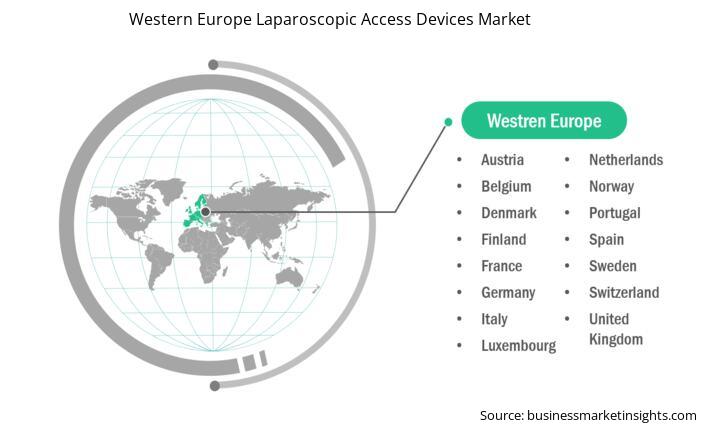
The Western Europe laparoscopic access devices market is segmented into Belgium, the Netherlands, Luxembourg, Germany, France, Italy, Spain, Switzerland, Sweden, Austria, the United Kingdom, Denmark, Portugal, Norway, and Finland. The prospect for laparoscopic access devices in Western Europe remains very positive, being largely influenced by healthcare digitization, demographic changes, and sustainability initiatives driven by policies. The aging populations and increasing prevalence of chronic diseases are the main reasons why the demand for minimally invasive procedures is rapidly growing, which, in turn, results in the extension of their applications in general surgery, gynecology, and bariatrics. As governments invest in surgical modernization and outpatient care models, they create a demand for compact, efficient access devices that allow for a high procedural throughput. In response to this demand, the pace of technological innovation is quickening, and manufacturers are coming up with smart access systems, hybrid trocars, and devices compatible with robotic platforms. The implementation of sustainability as the main procurement criterion has made hospitals consider the costs during a product's lifetime and the environmental impact. Moreover, the adoption of digital surgery platforms and AI-assisted tools is fundamentally changing surgical workflows, and therefore, access devices are expected to be compatible with these ecosystems. As Western Europe maintains its leadership in healthcare innovation and regulatory precision, the market is likely to favour precision-engineered, eco-friendly, and digitally integrated laparoscopic access solutions.
Western Europe Laparoscopic Access Devices Market Country Insights
Based on region, the Western Europe laparoscopic access devices market is further segmented into Belgium, the Netherlands, Luxembourg, Germany, France, Italy, Spain, Switzerland, Sweden, Austria, the United Kingdom, Denmark, Portugal, Norway, and Finland. Germany held the largest share in 2024.
Country-level dynamics across Western Europe illustrate a varied yet interrelated laparoscopic access devices market that is influenced by national healthcare policies, procurement structures, and clinical priorities. Germany is at the forefront in terms of surgical volume and innovation, which is facilitated by a strong MedTech manufacturing base and a decentralized healthcare system that promotes hospital-level decision-making. France is standardizing procedures and investing in the public sector, with the main emphasis being on providing fair access to advanced surgical care. The United Kingdom, post-Brexit, is in the process of dealing with regulatory divergence, however, it is still committing to NHS modernization and digital health integration. Italy and Spain are enhancing their laparoscopic capabilities through local health initiatives and EU-funded infrastructure projects. The Netherlands and Austria are two countries that are primarily recognized for their sustainability-oriented procurement strategies, whereby they prefer reusable access systems and environmentally friendly surgical practices. Every country has different regulatory frameworks, reimbursement models, and clinical adoption rates, hence manufacturers need to adjust their market entry and expansion strategies accordingly. Knowing these local factors is vital for matching product offerings with national surgical goals and securing long-term commercial success in the region.
Western Europe Laparoscopic Access Devices Market Company Profiles
Medtronic Plc; Johnson & Johnson; Olympus Corp; Stryker Corp; Karl Storz SE & Co KG, Boston Scientific Corp, B Braun SE, Smith & Nephew Plc, Conmed Corp, and Intuitive Surgical Inc, are among the key players operating in the market. These players adopt strategies such as expansion, product innovation, and mergers and acquisitions to stay competitive in the market and offer innovative products to their consumers.
Western Europe Laparoscopic Access Devices Market Research Methodology:
The following methodology has been followed for the collection and analysis of data presented in this report:
Secondary Research
The research process begins with comprehensive secondary research, utilizing both internal and external sources to gather qualitative and quantitative data for each market. Commonly referenced secondary research sources include, but are not limited to:
- Company websites, annual reports, financial statements, broker analyses, and investor presentations
- Industry trade journals and other relevant publications
- Government documents, statistical databases, and market reports
- News articles, press releases, and webcasts specific to companies operating in the market
Note: All financial data included in the Company Profiles section has been standardized to US$. For companies reporting in other currencies, figures have been converted to US$ using the relevant exchange rates for the corresponding year.
Primary Research
Business Market Insights conducts a significant number of primary interviews each year with industry stakeholders and experts to validate and analyze the data and gain valuable insights. These research interviews are designed to:
- Refine findings from secondary research
- Enhance the expertise and market understanding of the analysis team
- Gain insights into market size, trends, growth patterns, competitive dynamics, and future prospects
Primary research is conducted via email interactions and telephone interviews with industry experts across various markets, categories, segments, and sub-segments in different regions. Participants typically include:
- Industry stakeholders: Vice Presidents, business development managers, market intelligence managers, and national sales managers
- External experts: Valuation specialists, research analysts, and key opinion leaders with industry-specific expertise
Key Sources Referred:
- World Health Organization (WHO)
- The World Bank Group
- Worldometer
- The Lancet
- BMC Medical Education
- Eurostat
Western Europe Laparoscopic Access Devices Market Strategic Insights
Western Europe Laparoscopic Access DevicesMarket Report Highlights
| Report Attribute | Details |
| Market size in 2024 | US$ 493.0 Million |
| Market Size by 2031 | US$ 807.6 Million |
| CAGR (2025 - 2031) | 7.3% |
| Historical Data | 2021-2023 |
| Forecast period | 2025-2031 |
| Segments Covered |
By Product
|
|
Regions and Countries Covered
|
|
| Western Europe | Belgium, Netherlands, Luxembourg, Germany, France, Italy, Spain, Switzerland, Sweden, Austria, United Kingdom, Denmark, Portugal, Norway, Finland |
| Market leaders and key company profiles |
|
Western Europe Laparoscopic Access Devices Market Country and Regional Insights