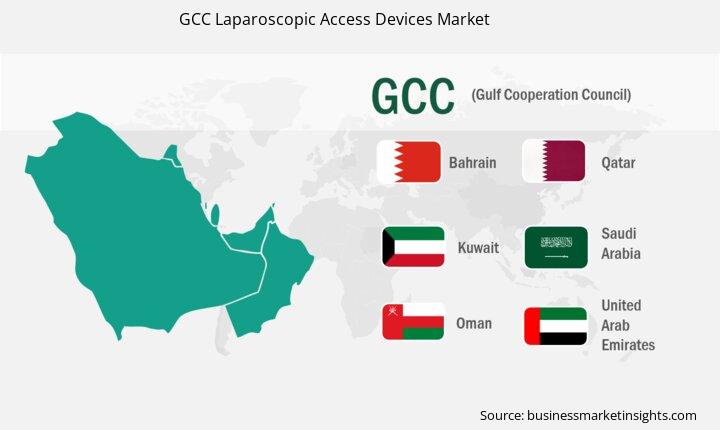
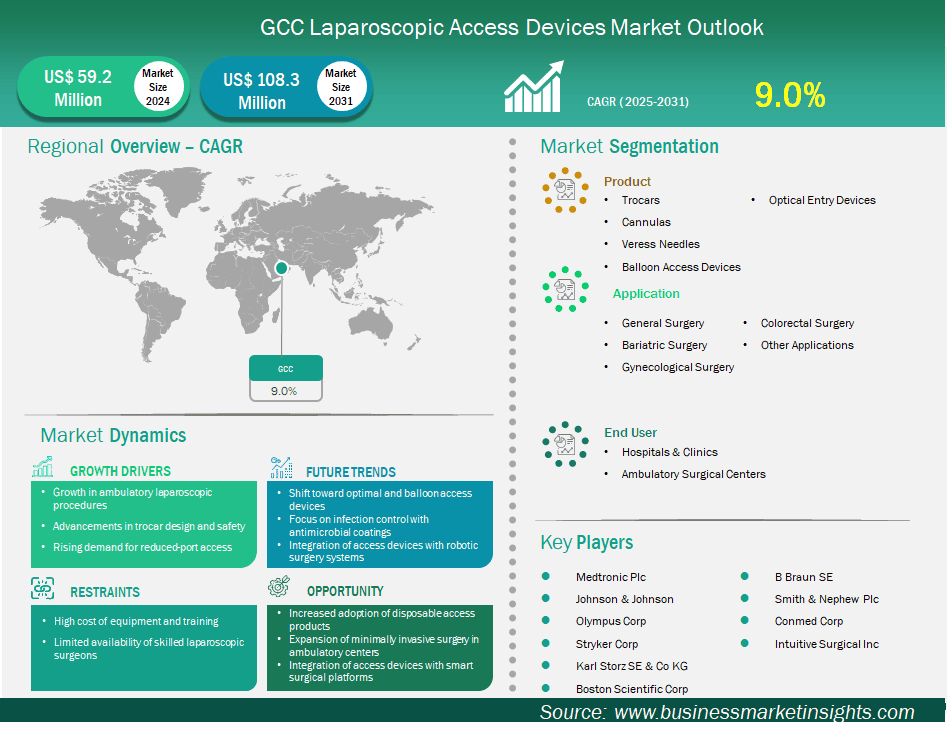
The GCC laparoscopic access devices market size is expected to reach US$ 108.3 million by 2031 from US$ 59.2 million in 2024. The market is estimated to record a CAGR of 9.0% from 2025 to 2031.
Executive Summary and GCC Laparoscopic Access Devices Market Analysis:
The laparoscopic access devices market in GCC is experiencing significant growth, driven by growth in ambulatory laparoscopic procedures, advancements in trocar design and safety, and rising demand for reduced-port access. The GCC laparoscopic access devices market is characterized by a focus on cutting-edge technology, centralized investments in healthcare, and the uptake of minimally invasive surgical solutions. Since laparoscopic interventions are commonly practiced in general surgery, gynecology, and bariatrics, the area shows a tendency towards using sophisticated access devices such as optical trocars, balloon entry systems, and integrated kits. Government subsidized hospitals and private medical groups mainly drive procurement, as they put safety, accuracy, and robot-assisted compatibility at the forefront of their priorities. Although the market is occupied by global manufacturers, regional distributors, which are instrumental in facilitating regulatory approvals and providing local support . Device purchase depends on the preferences of surgeons, clinical outcomes data, and hospital accreditation standards. The training capacity is strong with simulation labs and continuing education programs available in leading healthcare institutions. Even though single-use devices are chosen for infection control, sustainability objectives are leading to the adoption of reusable systems. In general, the GCC market is a combination of clinical sophistication and strategic procurement.
GCC Laparoscopic Access Devices Market Segmentation Analysis:
Key segments that contributed to the derivation of the laparoscopic access devices market analysis are product, application, and end user.
- By product, the laparoscopic access devices market is segmented into trocars, cannulas, veress needles, balloon access devices, and optical entry devices. The trocars segment dominated the market in 2024. Trocars are the largest product segment due to their standardized use across laparoscopic procedures and strong demand from technologically advanced surgical centers in the region.
- In terms of application, the market is segmented into general surgery, bariatric surgery, gynecological surgery, colorectal surgery, and other applications. The general surgery segment held the largest market share in 2024. General surgery is the largest application segment due to its high procedural volume and widespread adoption of minimally invasive techniques in both public and private healthcare systems.
- By end user, the market is segmented into hospitals and clinics, and ambulatory surgical centers. The hospitals and clinics segment held the largest market share in 2024. Hospitals and clinics are the largest end user segment due to their dominance in surgical service delivery, and government-backed infrastructure investments.
GCC Laparoscopic Access Devices Market Outlook
The GCC laparoscopic access devices market is segmented into United Arab Emirates, Bahrain, Saudi Arabia, Oman, Qatar, and Kuwait. The demand for laparoscopic access devices in the Gulf Cooperation Council countries looks very promising and is mainly driven by national healthcare transformation agendas, increasing procedural volumes, and expanding surgical infrastructure. For example, Saudi Arabia, United Arab Emirates, and Qatar are upgrading and modernizing hospitals with medical cities, smart hospitals, and robotic surgery programs, which in turn creates demand for next-generation access technologies. Hospitals are responding to the rapid shift towards outpatient and day-case surgery by adopting compact and efficient devices that enable high turnover and minimal invasiveness. Manufacturers find it easier to get their products approved as a result of regulatory harmonization across GCC states, which also reduce market entry barriers. There is also a growing concern for the environment as procurement teams begin to take into consideration the lifecycle costs and environmental impact of the devices. The rise of medical tourism is another factor which is driving the demand for advanced laparoscopic capabilities and bundled surgical solutions. The market is thus expected to adopt such access devices as the healthcare systems move towards digital integration and precision medicine and also devices which offer enhanced control, reduced trauma, and are seamlessly compatible with advanced imaging and navigation platforms.
GCC Laparoscopic Access Devices Market Country Insights
Based on region, the GCC laparoscopic access devices market is further segmented into United Arab Emirates, Bahrain, Saudi Arabia, Oman, Qatar, and Kuwait. Saudi Arabia held the largest share in 2024.
Within the GCC, the dynamics at the country level unveil a segmented market for laparoscopic access devices that has been influenced by healthcare policy, investment priorities, and surgical capacity. Saudi Arabia is leading in terms of infrastructure scale, supported by the widespread adoption of robotic-assisted surgery and Vision 2030 initiatives. Private hospitals in the UAE, the innovation-driven healthcare ecosystem, are providing advanced laparoscopic services and attracting international patients. There is expansion of surgical capabilities in Qatar and Kuwait by means of strategic partnerships and the investment in tertiary care centers, while Bahrain and Oman are upgrading their public health systems with a focus on minimally invasive techniques. Each country has different procurement models—such as centralized government tenders or private hospital networks—manufacturers have to adjust their commercial strategies accordingly. The regulatory frameworks differ in terms of complexity; however, regional alignment efforts are in progress to make device approvals less complicated. It is vital to comprehend these localized nuances for the creation of a sustainable market presence and the alignment of product offerings with national surgical priorities and clinical standards.
GCC Laparoscopic Access Devices Market Company Profiles
Medtronic Plc; Johnson & Johnson; Olympus Corp; Stryker Corp; Karl Storz SE & Co KG, Boston Scientific Corp, B Braun SE, Smith & Nephew Plc, Conmed Corp, and Intuitive Surgical Inc, are among the key players operating in the market. These players adopt strategies such as expansion, product innovation, and mergers and acquisitions to stay competitive in the market and offer innovative products to their consumers.
GCC Laparoscopic Access Devices Market Research Methodology:
The following methodology has been followed for the collection and analysis of data presented in this report:
Secondary Research
The research process begins with comprehensive secondary research, utilizing both internal and external sources to gather qualitative and quantitative data for each market. Commonly referenced secondary research sources include, but are not limited to:
- Company websites, annual reports, financial statements, broker analyses, and investor presentations
- Industry trade journals and other relevant publications
- Government documents, statistical databases, and market reports
- News articles, press releases, and webcasts specific to companies operating in the market
Note: All financial data included in the Company Profiles section has been standardized to US$. For companies reporting in other currencies, figures have been converted to US$ using the relevant exchange rates for the corresponding year.
Primary Research
Business Market Insights conducts a significant number of primary interviews each year with industry stakeholders and experts to validate and analyze the data and gain valuable insights. These research interviews are designed to:
- Refine findings from secondary research
- Enhance the expertise and market understanding of the analysis team
- Gain insights into market size, trends, growth patterns, competitive dynamics, and future prospects
Primary research is conducted via email interactions and telephone interviews with industry experts across various markets, categories, segments, and sub-segments in different regions. Participants typically include:
- Industry stakeholders: Vice Presidents, business development managers, market intelligence managers, and national sales managers
- External experts: Valuation specialists, research analysts, and key opinion leaders with industry-specific expertise
Key Sources Referred:
- World Health Organization (WHO)
- The World Bank Group
- Worldometer
- The Lancet
- BMC Medical Education
- Eurostat
GCC Laparoscopic Access Devices Market Strategic Insights
GCC Laparoscopic Access DevicesMarket Report Highlights
| Report Attribute | Details |
| Market size in 2024 | US$ 59.2 Million |
| Market Size by 2031 | US$ 108.3 Million |
| CAGR (2025 - 2031) | 9.0% |
| Historical Data | 2021-2023 |
| Forecast period | 2025-2031 |
| Segments Covered |
By Product
|
|
Regions and Countries Covered
|
|
| GCC | United Arab Emirates, Bahrain, Saudi Arabia, Oman, Qatar, Kuwait |
| Market leaders and key company profiles |
|
GCC Laparoscopic Access Devices Market Country and Regional Insights