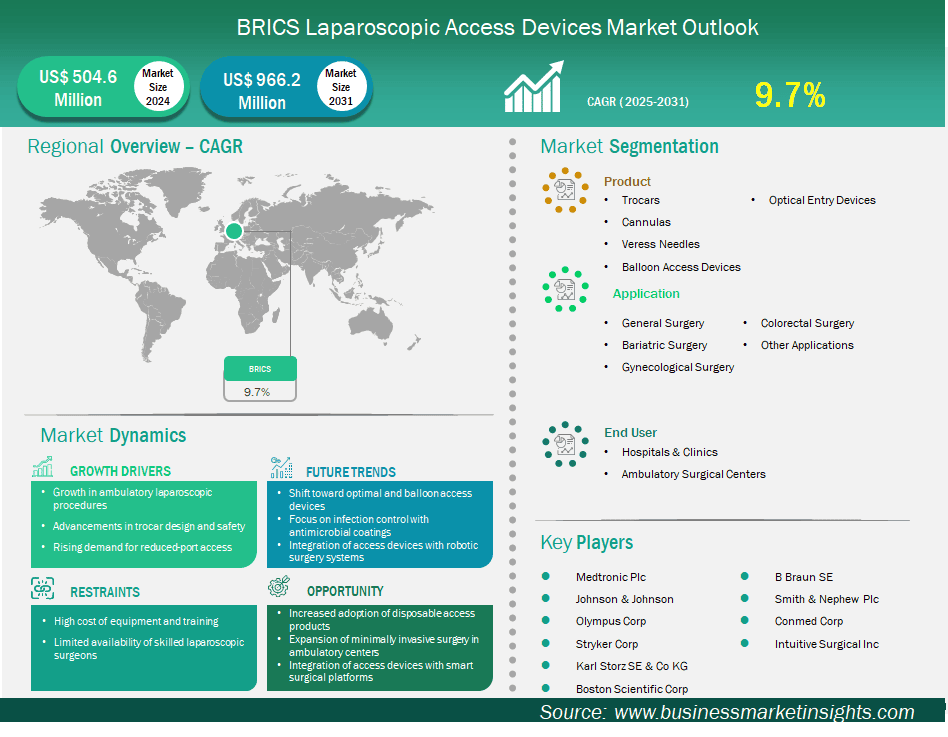
The BRICS laparoscopic access devices market size is expected to reach US$ 966.2 million by 2031 from US$ 504.6 million in 2024. The market is estimated to record a CAGR of 9.7% from 2025 to 2031.
Executive Summary and BRICS Laparoscopic Access Devices Market Analysis:
The laparoscopic access devices market in BRICS is experiencing significant growth, driven by growth in ambulatory laparoscopic procedures, advancements in trocar design and safety, and rising demand for reduced-port access. The BRICS laparoscopic access devices market is characterized by the plethora of the surgical setups that are continuously growing and upgrading in Brazil, Russia, India, China, and South Africa. These nations are a combination of sophisticated and developing healthcare systems, all of which are the main promoters of the demand for minimally invasive procedures. The product landscape is trocars heavy since they are the most indispensable instruments in laparoscopic entry and can be used in both reusable and disposable systems. The market dynamics are influenced by the mixture of domestic production and import of technologies, with the global players competing in the market together with the regional companies that offer the cheaper products. Procurement decisions are different from country to country Public hospitals usually prioritize affordability and durability when purchasing, whereas private ones are more inclined towards advanced features and integration with robotic platforms. There are still some issues with the doctors' training, the surgical expertise distribution is not even, and there are limitations of the infrastructure in the rural and semi-urban areas, which are the main reasons for the lack of access to surgery. Nevertheless, the urban areas and tertiary care hospitals are the ones that are leading in adoption through the investments in laparoscopic suites and the surgeon education. The market reflects the very complicated interaction that exists between the affordability, innovation, and policy-driven healthcare expansion.
BRICS Laparoscopic Access Devices Market Segmentation Analysis:
Key segments that contributed to the derivation of the laparoscopic access devices market analysis are product, application, and end user.
- By product, the laparoscopic access devices market is segmented into trocars, cannulas, veress needles, balloon access devices, and optical entry devices. The trocars segment dominated the market in 2024. Trocars are the largest product segment due to their critical role in laparoscopic entry and widespread use across diverse surgical settings in both public and private sectors.
- In terms of application, the market is segmented into general surgery, bariatric surgery, gynecological surgery, colorectal surgery, and other applications. The general surgery segment held the largest market share in 2024. General surgery is the largest application segment due to its broad procedural scope and increasing adoption of minimally invasive techniques across rapidly expanding healthcare systems.
- By end user, the market is segmented into hospitals and clinics, and ambulatory surgical centers. The hospitals and clinics segment held the largest market share in 2024. Hospitals and clinics are the largest end user segment due to their dominance in surgical service delivery, infrastructure development, and rising investment in laparoscopic capabilities across BRICS nations.
BRICS Laparoscopic Access Devices Market Outlook
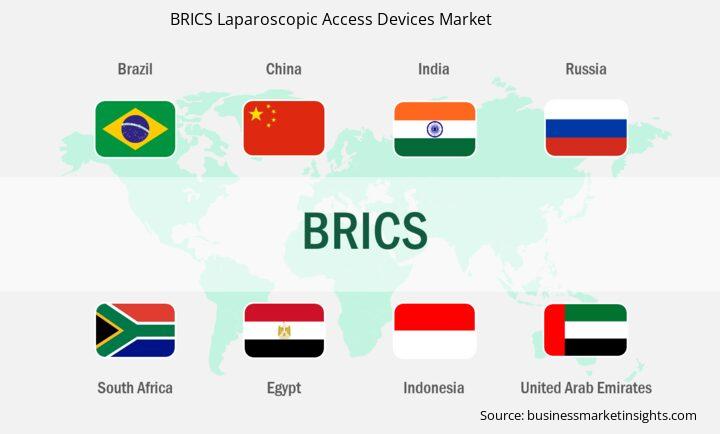
The BRICS laparoscopic access devices market is segmented into Brazil, Russia, India, China, South Africa, Egypt, Indonesia, the United Arab Emirates, and Saudi Arabia. The forecast for laparoscopic access devices in BRICS countries is getting optimistic. Reforms in healthcare, demographic changes, and increased number of surgeries are the main factors behind this trend. Surgical modernization is one of the ways through which governments are implementing public health initiatives, thus creating the opportunities for device manufacturers to engage in long-term partnerships. The growth of private healthcare networks and medical tourism – mainly in India, China, and Brazil – is speeding up the demand for the advanced access systems. Manufacturers are bringing inexpensive optical trocars, hybrid cannulas, and portable insufflation systems to market that are specially designed for resource-limited settings to address the technological challenges. The regulatory framework is being put in place to support the quick approvals and local production, particularly in China and Russia. As sustainability becomes a procurement priority, there is a growing interest in reusable and recyclable devices. Moreover, the inclusion of laparoscopic training in medical curricula and the popularity of simulation-based education are leading to an increased number of surgeons with the necessary skills. With BRICS countries on their way to expanding surgical infrastructure, the market is set for continued growth that will be driven by both public and private sectors.
BRICS Laparoscopic Access Devices Market Country Insights
Based on region, the BRICS laparoscopic access devices market is further segmented into Brazil, Russia, India, China, South Africa, Egypt, Indonesia, the United Arab Emirates, and Saudi Arabia. China held the largest share in 2024.
The dynamics at a country level within the BRICS bloc in the context of a highly segmented laparoscopic access devices market reveals that the market has been significantly influenced by healthcare policy, economic capacity, and surgical readiness. China is at the forefront in both manufacturing and adoption, which is supported by its capable domestic production and aggressive investment in hospital infrastructure. India is quickly increasing its laparoscopic reach by means of public-private partnerships, medical tourism, and the availability of surgical training. Brazil's market is mainly fuelled by a strong private healthcare sector and local innovation hubs while public hospitals are experiencing difficulties in procurement and budgetary constraints. Russia is concentrating on surgical modernization through centralized health programs and local device development whereas South Africa has a dual-market structure—advanced laparoscopic services in private hospitals and basic access kits in public institutions. The regulatory environment, reimbursement model, and clinical priorities of each country determine the unique market path of that country. Manufacturers' success in BRICS necessitates local strategies that tackle the issues of procurement complexity, training requirements, and regional distribution challenges while being in line with national healthcare goals.
BRICS Laparoscopic Access Devices Market Company Profiles
Medtronic Plc; Johnson & Johnson; Olympus Corp; Stryker Corp; Karl Storz SE & Co KG, Boston Scientific Corp, B Braun SE, Smith & Nephew Plc, Conmed Corp, and Intuitive Surgical Inc, are among the key players operating in the market. These players adopt strategies such as expansion, product innovation, and mergers and acquisitions to stay competitive in the market and offer innovative products to their consumers.
BRICS Laparoscopic Access Devices Market Research Methodology:
The following methodology has been followed for the collection and analysis of data presented in this report:
Secondary Research
The research process begins with comprehensive secondary research, utilizing both internal and external sources to gather qualitative and quantitative data for each market. Commonly referenced secondary research sources include, but are not limited to:
- Company websites, annual reports, financial statements, broker analyses, and investor presentations
- Industry trade journals and other relevant publications
- Government documents, statistical databases, and market reports
- News articles, press releases, and webcasts specific to companies operating in the market
Note: All financial data included in the Company Profiles section has been standardized to US$. For companies reporting in other currencies, figures have been converted to US$ using the relevant exchange rates for the corresponding year.
Primary Research
Business Market Insights conducts a significant number of primary interviews each year with industry stakeholders and experts to validate and analyze the data and gain valuable insights. These research interviews are designed to:
- Refine findings from secondary research
- Enhance the expertise and market understanding of the analysis team
- Gain insights into market size, trends, growth patterns, competitive dynamics, and future prospects
Primary research is conducted via email interactions and telephone interviews with industry experts across various markets, categories, segments, and sub-segments in different regions. Participants typically include:
- Industry stakeholders: Vice Presidents, business development managers, market intelligence managers, and national sales managers
- External experts: Valuation specialists, research analysts, and key opinion leaders with industry-specific expertise
Key Sources Referred:
- World Health Organization (WHO)
- The World Bank Group
- Worldometer
- The Lancet
- BMC Medical Education
- Eurostat
BRICS Laparoscopic Access Devices Market Strategic Insights
BRICS Laparoscopic Access DevicesMarket Report Highlights
| Report Attribute | Details |
| Market size in 2024 | US$ 504.6 Million |
| Market Size by 2031 | US$ 966.2 Million |
| CAGR (2025 - 2031) | 9.7% |
| Historical Data | 2021-2023 |
| Forecast period | 2025-2031 |
| Segments Covered |
By Product
|
|
Regions and Countries Covered
|
|
| BRICS | Russia, Brazil, South Africa, India, China, Egypt, Indonesia, United Arab Emirates, Saudi Arabia |
| Market leaders and key company profiles |
|
BRICS Laparoscopic Access Devices Market Country and Regional Insights