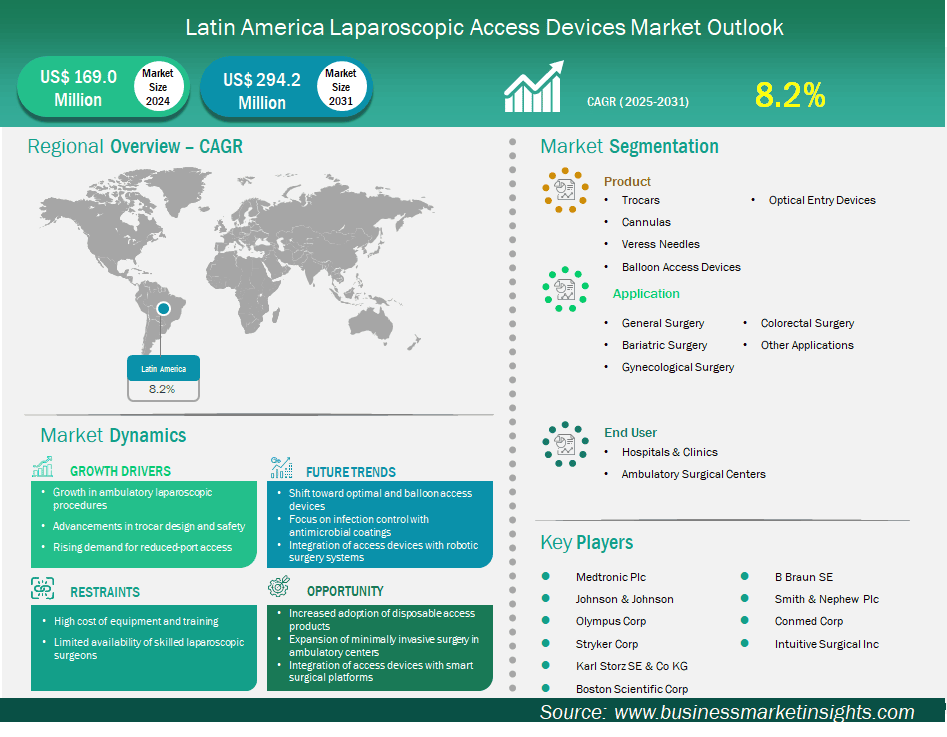
The Latin America laparoscopic access devices market size is expected to reach US$ 294.2 million by 2031 from US$ 169.0 million in 2024. The market is estimated to record a CAGR of 8.2% from 2025 to 2031.
Executive Summary and Latin America Laparoscopic Access Devices Market Analysis:
The laparoscopic access devices market in Latin America is experiencing significant growth, driven by growth in ambulatory laparoscopic procedures, advancements in trocar design and safety, and rising demand for reduced-port access. The Latin America laparoscopic access devices market presents a scenario where the demand for minimally invasive surgical solutions is on the rise, a trend mainly propelled by the increasing prevalence of chronic diseases and the growing surgical infrastructure. As a result, the trocars continue to represent the largest product segment because of their indispensable function in laparoscopic access and the broad compatibility with various procedures. The market is predominantly reliant on imports, as worldwide manufacturers are providing high-performance devices to private hospitals, whereas public institutions are more likely to be priced for less expensive alternatives. Surgeons' preferences, clinical outcomes, and budgetary considerations, especially in government-funded facilities, are the main factors influencing procurement decisions. The deficiency in training and the uneven distribution of laparoscopic skills between urban and rural areas still hamper the growth of adoption rates. Nevertheless, local medical associations and academic institutions are becoming more active in promoting laparoscopic education and certification programs. The competitive environment is made up of numerous small players and local distributors who are instrumental in facilitating regulatory approvals and providing bundled solutions. In general, the market reflects a compromise between affordability, clinical efficacy, and infrastructure readiness, with the growth being driven by procedural expansion and healthcare modernization.
Latin America Laparoscopic Access Devices Market Segmentation Analysis:
Key segments that contributed to the derivation of the laparoscopic access devices market analysis are product, application, and end user.
- By product, the laparoscopic access devices market is segmented into trocars, cannulas, veress needles, balloon access devices, and optical entry devices. The trocars segment dominated the market in 2024. Trocars are the largest product segment due to their essential role in laparoscopic entry and widespread use across both public and private surgical facilities in the region.
- In terms of application, the market is segmented into general surgery, bariatric surgery, gynecological surgery, colorectal surgery, and other applications. The general surgery segment held the largest market share in 2024. General surgery is the largest application segment due to its procedural diversity and increasing adoption of minimally invasive techniques for abdominal and gastrointestinal conditions.
- By end user, the market is segmented into hospitals and clinics, and ambulatory surgical centers. The hospitals and clinics segment held the largest market share in 2024. Hospitals and clinics are the largest end user segment due to their central role in surgical care delivery, expanding infrastructure, and growing investment in laparoscopic capabilities across urban and semi-urban areas.
Latin America Laparoscopic Access Devices Market Outlook
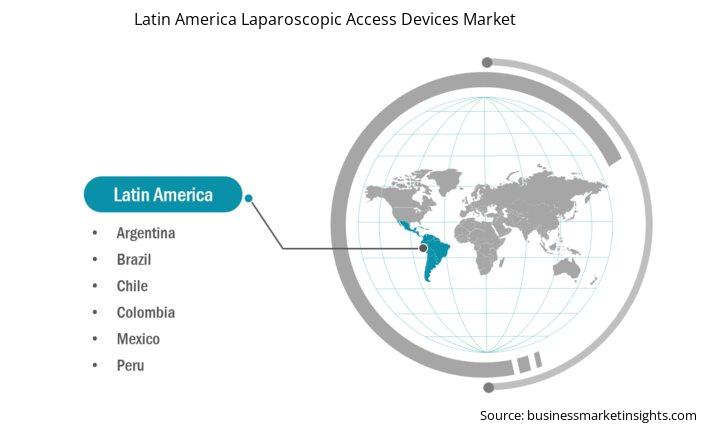
The Latin America laparoscopic access devices market is segmented into Mexico, Brazil, Argentina, Peru, Chile, and Colombia. Latin America market for laparoscopic access devices is expected to remain positive in the next years, also, technological innovation, rising surgical volumes, and healthcare reforms are some of the main factors that contribute to this trend. As part of public health initiatives, governments in the area are investing in surgical capacity that, in turn, is creating great possibilities for suppliers to start long-term partnerships with local customers. The private healthcare networks' expansion as well as medical tourism, which is mostly happening in Brazil, Mexico, and Colombia, are attracting demand for modern access systems. The importance of sustainability in the procurement process is one of the reasons for reusable and recyclable devices to become a topic of interest among the buyers. Changes in the regulatory frameworks are allowing faster approvals and local production, especially in those countries with a rising MedTech ecosystem. Moreover, the inclusion of laparoscopic training in medical curricula and the popularity of simulation-based education are resulting in a greater number of surgeons with advanced skills. While healthcare systems are looking for efficiency and quality outcomes, the demand for access devices with features such as enhanced control, reduced trauma, and ability to connect with digital surgical platforms is likely to increase in the market.
Latin America Laparoscopic Access Devices Market Country Insights
Based on region, the Latin America laparoscopic access devices market is further segmented into Mexico, Brazil, Argentina, Peru, Chile, and Colombia. Mexico held the largest share in 2024.
The dynamics at the country level in Latin America depict a segmented market for laparoscopic access devices that is influenced by healthcare policy, economic conditions, and surgical infrastructure. Mexico shows a dual-market structure, where expensive devices are used in private hospitals and simple kits are used in public institutions. Mexico is the leader in laparoscopic adoption and is followed by Brazil, a situation that is supported by a strong private sector and regional innovation hubs. Argentina and Chile are increasing their laparoscopic capacity through the modernization of surgical infrastructure and regional health initiatives. Colombia is becoming a medical tourism destination, thus creating demand for advanced laparoscopic procedures. Peru is improving access through public-private collaborations and the increased investment in surgical education. The countries in Central America are benefiting from international partnerships to upgrade their laparoscopic capabilities, while some are dependent on donor-supported programs. Each nation has its own set of regulatory, logistical, and clinical issues; thus, manufacturers need to adjust their strategies according to local procurement models and surgical priorities.
Latin America Laparoscopic Access Devices Market Company Profiles
Medtronic Plc; Johnson & Johnson; Olympus Corp; Stryker Corp; Karl Storz SE & Co KG, Boston Scientific Corp, B Braun SE, Smith & Nephew Plc, Conmed Corp, and Intuitive Surgical Inc, are among the key players operating in the market. These players adopt strategies such as expansion, product innovation, and mergers and acquisitions to stay competitive in the market and offer innovative products to their consumers.
Latin America Laparoscopic Access Devices Market Research Methodology:
The following methodology has been followed for the collection and analysis of data presented in this report:
Secondary Research
The research process begins with comprehensive secondary research, utilizing both internal and external sources to gather qualitative and quantitative data for each market. Commonly referenced secondary research sources include, but are not limited to:
- Company websites, annual reports, financial statements, broker analyses, and investor presentations
- Industry trade journals and other relevant publications
- Government documents, statistical databases, and market reports
- News articles, press releases, and webcasts specific to companies operating in the market
Note: All financial data included in the Company Profiles section has been standardized to US$. For companies reporting in other currencies, figures have been converted to US$ using the relevant exchange rates for the corresponding year.
Primary Research
Business Market Insights conducts a significant number of primary interviews each year with industry stakeholders and experts to validate and analyze the data and gain valuable insights. These research interviews are designed to:
- Refine findings from secondary research
- Enhance the expertise and market understanding of the analysis team
- Gain insights into market size, trends, growth patterns, competitive dynamics, and future prospects
Primary research is conducted via email interactions and telephone interviews with industry experts across various markets, categories, segments, and sub-segments in different regions. Participants typically include:
- Industry stakeholders: Vice Presidents, business development managers, market intelligence managers, and national sales managers
- External experts: Valuation specialists, research analysts, and key opinion leaders with industry-specific expertise
Key Sources Referred:
- World Health Organization (WHO)
- The World Bank Group
- Worldometer
- The Lancet
- BMC Medical Education
- Eurostat
Latin America Laparoscopic Access Devices Market Strategic Insights
Latin America Laparoscopic Access DevicesMarket Report Highlights
| Report Attribute | Details |
| Market size in 2024 | US$ 169.0 Million |
| Market Size by 2031 | US$ 294.2 Million |
| CAGR (2025 - 2031) | 8.2% |
| Historical Data | 2021-2023 |
| Forecast period | 2025-2031 |
| Segments Covered |
By Product
|
|
Regions and Countries Covered
|
|
| Latin America | Mexico, Brazil, Argentina, Peru, Chile, Colombia |
| Market leaders and key company profiles |
|
Latin America Laparoscopic Access Devices Market Country and Regional Insights