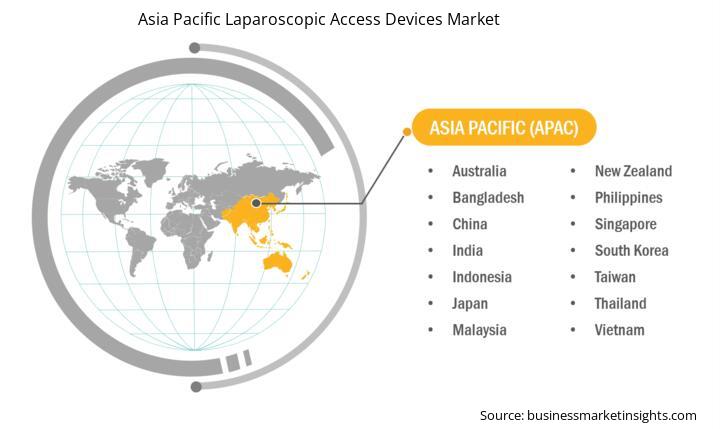
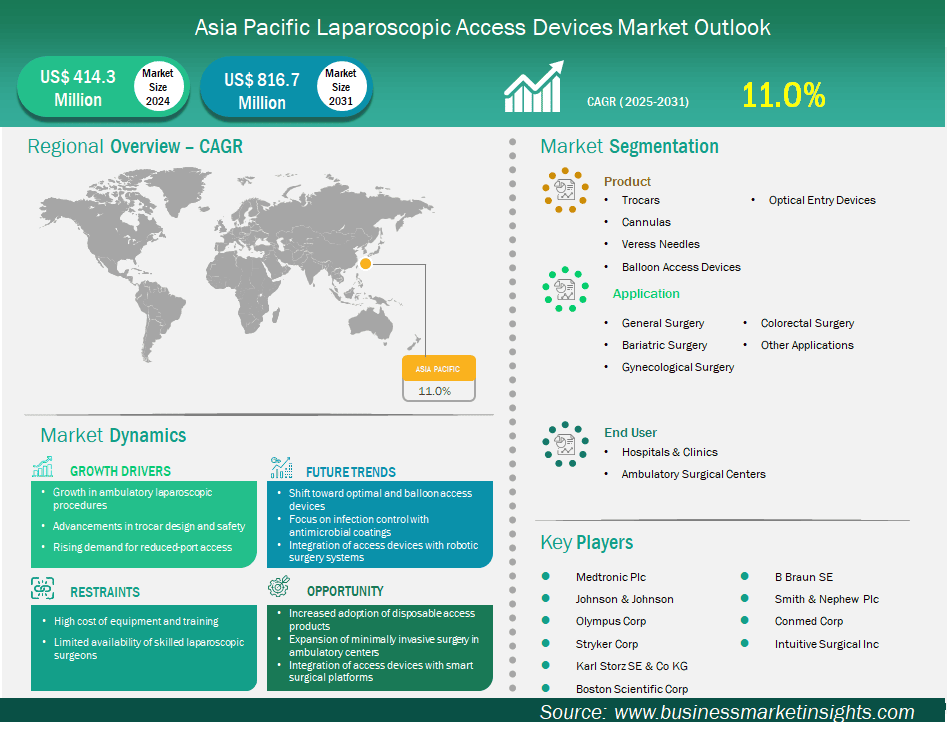
The Asia Pacific laparoscopic access devices market size is expected to reach US$ 816.7 million by 2031 from US$ 414.3 million in 2024. The market is estimated to record a CAGR of 11.0% from 2025 to 2031.
Executive Summary and Asia Pacific Laparoscopic Access Devices Market Analysis:
The laparoscopic access devices market in Asia Pacific is experiencing significant growth, driven by growth in ambulatory laparoscopic procedures, advancements in trocar design and safety, and rising demand for reduced-port access. Asia Pacific laparoscopic access devices market is a region with significant growth. The market is fuelled by the increasing use of minimally invasive surgery in general surgery, gynecology, and urology, where trocars and cannulas account for most of the purchases because they are the most necessary instruments for laparoscopic entry. Domestic producers in the China and India are becoming more powerful by providing cheaper alternatives to the devices that are imported, whereas international companies continue to dominate the premium segments by offering advanced optical entry systems and integrated access kits. The competition landscape is a fragmented one, and hospital budgets, surgeon preferences, and regional regulatory frameworks impact procurement decisions. Training and awareness will always be barriers to surgical capacity in developing markets, which is still in the process of development. On the other hand, well-established markets like Japan, South Korea, and Australia are characterized by a high level of laparoscopic techniques and devices for precision-engineered access devices. The market reflects the interaction that is dynamic between affordability, innovation, and infrastructure readiness, thus far, there is a significant amount of space for growth in mid-tier and rural segments.
Asia Pacific Laparoscopic Access Devices Market Segmentation Analysis:
Key segments that contributed to the derivation of the laparoscopic access devices market analysis are product, application, and end user.
- By product, the laparoscopic access devices market is segmented into trocars, cannulas, veress needles, balloon access devices, and optical entry devices. The trocars segment dominated the market in 2024. Trocars are the largest product segment due to their essential role in laparoscopic entry and widespread availability across both public and private surgical centers.
- In terms of application, the market is segmented into general surgery, bariatric surgery, gynecological surgery, colorectal surgery, and other applications. The general surgery segment held the largest market share in 2024. General surgery is the largest application segment due to its procedural diversity and increasing adoption of minimally invasive techniques for abdominal and gastrointestinal conditions.
- By end user, the market is segmented into hospitals and clinics, and ambulatory surgical centers. The hospitals and clinics segment held the largest market share in 2024. Hospitals and clinics are the largest end user segment due to their expanding surgical infrastructure, government-backed healthcare investments, and rising patient volumes across urban and semi-urban regions.
Asia Pacific Laparoscopic Access Devices Market Outlook
The Asia Pacific laparoscopic access devices market is segmented into China, India, Japan, Australia, Bangladesh, Indonesia, Malaysia, New Zealand, the Philippines, Singapore, South Korea, Taiwan, Thailand, and Vietnam. The laparoscopic access devices outlook in the Asia Pacific region is a result of changes in healthcare, the population, and surgical education. The middle-class populations in general and the expenditures of the governments on the healthcare infrastructures are expected to drive demand for minimally invasive procedures that will mainly be India, Indonesia, and Vietnam. The growth of private hospitals and ambulatories is creating new opportunities for device manufacturers to provide scalable, modular access solutions customized to high-volume environments.
The pace of innovation is faster than ever, with companies launching slimline trocars, multi-use cannulas, and hybrid access systems for cost-sensitive markets. The regional medical device regulatory harmonization, particularly through the ASEAN initiatives, is expected to facilitate market entry and lessen the compliance. Moreover, laparoscopic training integration into medical curricula and the popularity of simulation-based education are the factors that increase the number of skilled surgeons which in turn raise the procedural volumes. As Asia Pacific is moving from just basic laparoscopic adoption to the advanced surgical ecosystems, the market will be able to realize a sustained growth that will be fuelled by the public and private sectors.
Asia Pacific Laparoscopic Access Devices Market Country Insights
Based on region, the Asia Pacific laparoscopic access devices market is further segmented into China, India, Japan, Australia, Bangladesh, Indonesia, Malaysia, New Zealand, the Philippines, Singapore, South Korea, Taiwan, Thailand, and Vietnam. China held the largest share in 2024.
Regional-level data shows that the laparoscopic access devices market is highly segmented across countries in the Asia Pacific region. The segmentation of the market is determined by factors such as the economic diversity of the region, healthcare policies and the surgical infrastructure. The situation in China is such that there are two separate markets operating, one for public sector and another for private sector, where domestic manufacturers have a monopoly in the public sector while internationally branded products are being sold to private hospitals and tier-one cities. Both Japan and South Korea are at the forefront when it comes to technological advancement and standardization of procedures, thus, hospitals are inclining towards the use of sophisticated systems. The demand for reusable and environmentally friendly instruments remains consistent in Australia and New Zealand. This is possible through centralized procurement and the implementation of sustainability mandates. The Indian market is growing very fast and this growth is mainly due to Indian surgical volume increase, medical tourism and investments in laparoscopic training. The countries of Southeast Asia such as Thailand, Malaysia, and the Philippines are increasing their capacity for laparoscopy surgery through the collaboration between the public and private sectors and regional health initiatives. On the other hand, frontier markets such as Bangladesh are only now starting to introduce basic access devices in facilities that have been equipped through programs led by NGOs and surgical kits provided by donors. Regulatory environment, reimbursement model and clinical priorities of each country determine their unique market trajectory and thus manufacturers have to take local strategies into consideration when planning their distribution, pricing and surgeon engagement activities.
Asia Pacific Laparoscopic Access Devices Market Company Profiles
Medtronic Plc; Johnson & Johnson; Olympus Corp; Stryker Corp; Karl Storz SE & Co KG, Boston Scientific Corp, B Braun SE, Smith & Nephew Plc, Conmed Corp, and Intuitive Surgical Inc, are among the key players operating in the market. These players adopt strategies such as expansion, product innovation, and mergers and acquisitions to stay competitive in the market and offer innovative products to their consumers.
Asia Pacific Laparoscopic Access Devices Market Research Methodology:
The following methodology has been followed for the collection and analysis of data presented in this report:
Secondary Research
The research process begins with comprehensive secondary research, utilizing both internal and external sources to gather qualitative and quantitative data for each market. Commonly referenced secondary research sources include, but are not limited to:
- Company websites, annual reports, financial statements, broker analyses, and investor presentations
- Industry trade journals and other relevant publications
- Government documents, statistical databases, and market reports
- News articles, press releases, and webcasts specific to companies operating in the market
Note: All financial data included in the Company Profiles section has been standardized to US$. For companies reporting in other currencies, figures have been converted to US$ using the relevant exchange rates for the corresponding year.
Primary Research
Business Market Insights conducts a significant number of primary interviews each year with industry stakeholders and experts to validate and analyze the data and gain valuable insights. These research interviews are designed to:
- Refine findings from secondary research
- Enhance the expertise and market understanding of the analysis team
- Gain insights into market size, trends, growth patterns, competitive dynamics, and future prospects
Primary research is conducted via email interactions and telephone interviews with industry experts across various markets, categories, segments, and sub-segments in different regions. Participants typically include:
- Industry stakeholders: Vice Presidents, business development managers, market intelligence managers, and national sales managers
- External experts: Valuation specialists, research analysts, and key opinion leaders with industry-specific expertise
Key Sources Referred:
- World Health Organization (WHO)
- The World Bank Group
- Worldometer
- The Lancet
- BMC Medical Education
- Eurostat
Asia Pacific Laparoscopic Access Devices Market Strategic Insights
Asia Pacific Laparoscopic Access DevicesMarket Report Highlights
| Report Attribute | Details |
| Market size in 2024 | US$ 414.3 Million |
| Market Size by 2031 | US$ 816.7 Million |
| CAGR (2025 - 2031) | 11.0% |
| Historical Data | 2021-2023 |
| Forecast period | 2025-2031 |
| Segments Covered |
By Product
|
|
Regions and Countries Covered
|
|
| Asia Pacific | China, Japan, South Korea, India, Australia, New Zealand, Indonesia, Malaysia, Philippines, Singapore, Thailand, Vietnam, Taiwan, Bangladesh |
| Market leaders and key company profiles |
|
Asia Pacific Laparoscopic Access Devices Market Country and Regional Insights