Market Summary
Executive Summary and Global Market Analysis
Air quality control systems have emerged as an essential element in industrial, commercial, and residential settings worldwide for ensuring safe and healthy air environments. Air quality control systems, including flue gas desulfurization units, electrostatic precipitators, fabric filters, scrubbers, NOx control systems, mercury control systems, and indoor air quality monitoring solutions, are being increasingly deployed in power plants, manufacturing facilities, commercial buildings, and smart cities, and these solutions have also gained immense popularity in residential and healthcare settings. Air quality control solutions help organizations achieve various benefits, including reduction of harmful emissions, improved monitoring of air pollutants, enhanced protection for human health and assets, and compliance with stringent environmental regulations. Rising industrialization, urban air pollution, government regulations, and increased public awareness have generated strong focus on implementing effective air quality control systems.
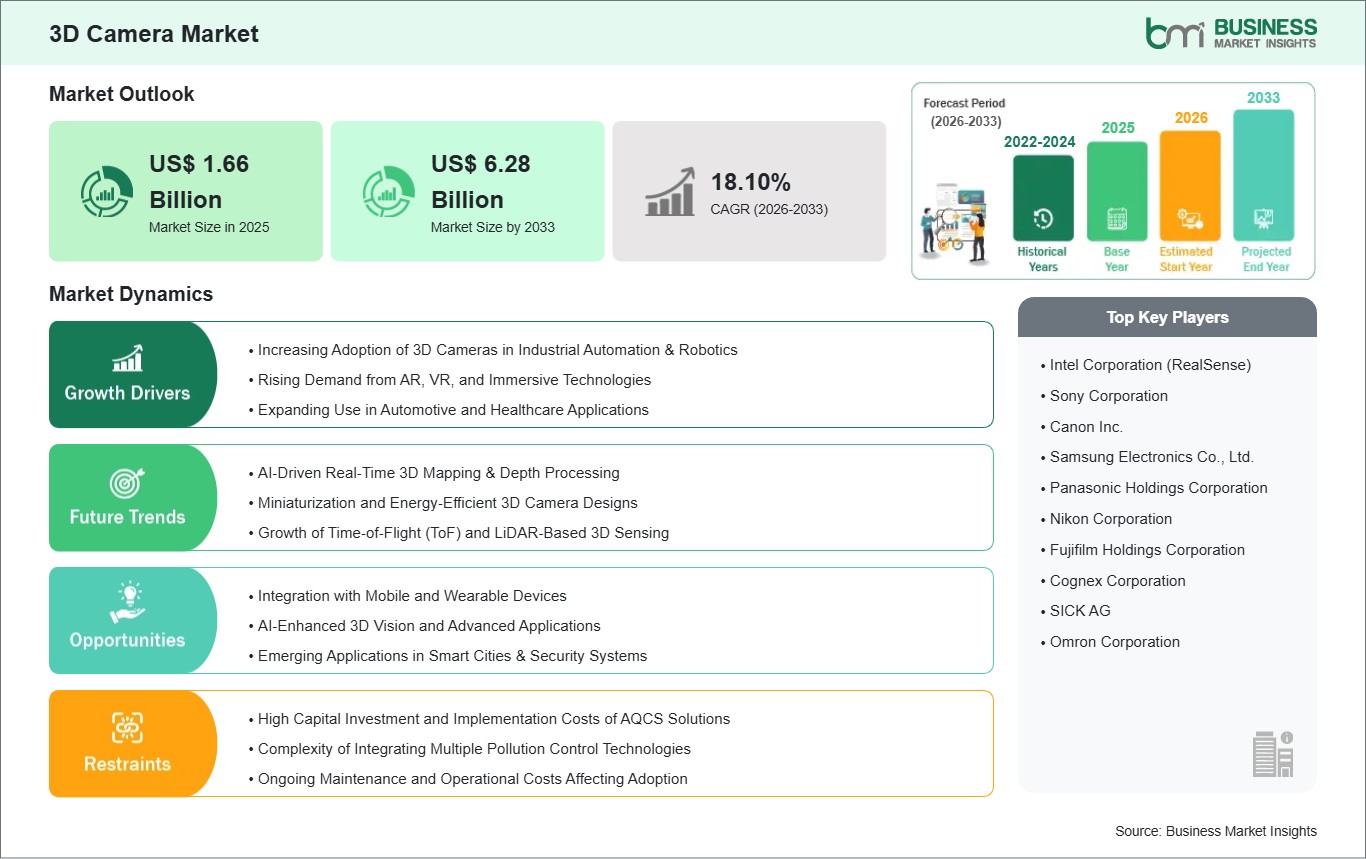
A 3D camera is an advanced imaging device designed to capture depth information in addition to standard two-dimensional visual data, enabling accurate representation of objects, environments, and movements in three dimensions. At its core, a 3D camera utilizes technologies such as time-of-flight (ToF), structured light, or stereo vision to measure distance and spatial relationships between objects. These cameras are often integrated with software, sensors, and artificial intelligence algorithms to process depth data and generate precise 3D models or real-time spatial maps.
Demand for 3D cameras is growing steadily across the globe, driven by the rising adoption of advanced sensing technologies and the increasing need for accurate spatial data in both consumer and industrial applications. The proliferation of smartphones with facial recognition features, the expansion of autonomous and semi-autonomous vehicles, and the rapid growth of augmented reality (AR) and virtual reality (VR) technologies are major factors contributing to market growth. Additionally, increasing automation in manufacturing and logistics has boosted the demand for 3D vision systems capable of precise inspection, measurement, and robotic guidance. Key drivers in the 3D camera market include rapid advancements in artificial intelligence and machine vision, growing investments in smart factories and Industry 4.0 initiatives, and the rising importance of security and biometric authentication. The healthcare sector also plays a significant role, as 3D cameras are increasingly used in medical imaging, patient monitoring, and surgical planning. However, the market faces certain restraints, such as high development and integration costs, technical complexity, and challenges related to data processing and power consumption.
Segment Analysis
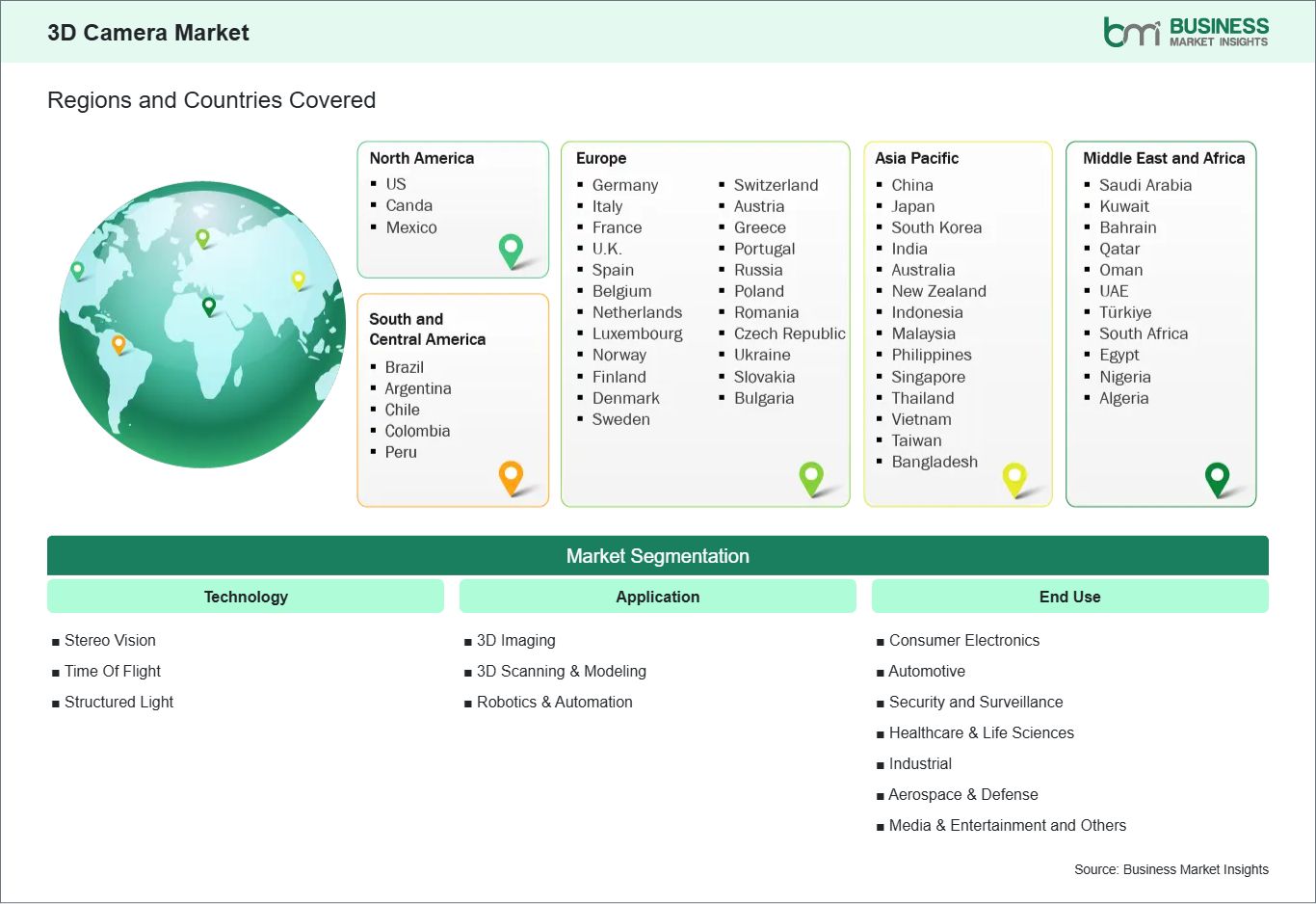
3D Camera Market Segmentation
By technology, the market is segmented into stereo vision, time of flight, and structured light. The time of flight segment held the largest share of the market in 2025.
By application, the market is segmented into 3D imaging, 3D scanning & modeling, robotics & automation. The 3D imaging segment held the largest share of the market in 2025.
By end-use, the market is segmented into consumer electronics, automotive, security and surveillance, healthcare & life sciences, industrial, aerospace & defense, media & entertainment and others. The consumer electronics segment held the largest share of the market in 2025.
Market Forces
3D Camera Market Drivers and Opportunities
Integration with Advanced Imaging and Smart Device Ecosystems
The integration of 3D cameras with advanced imaging systems and smart device ecosystems is a key driver propelling market growth. As industries and consumers increasingly adopt connected and intelligent technologies, 3D cameras are evolving from standalone imaging components into critical enablers of smart systems. In consumer electronics, 3D cameras are being seamlessly embedded into smartphones, tablets, laptops, and gaming consoles to support features such as facial recognition, gesture control, augmented reality (AR), and immersive gaming experiences. This integration enhances user interaction, security, and personalization, making devices more intuitive and engaging.
Expansion in Smart Cities and Urban Air Quality Monitoring
The rapid development of smart cities and urban infrastructure presents a significant growth opportunity for the air quality control system market. Cities are increasingly deploying air quality monitoring networks, IoT-enabled sensors, and indoor/outdoor purification systems to ensure cleaner air for citizens. Integration of AQCS solutions with data analytics and real-time monitoring platforms allows municipalities and building managers to track pollution levels, optimize ventilation, and respond proactively to air quality issues. The focus on sustainable urban living, coupled with public awareness about health impacts of pollution, offers opportunities for vendors to introduce innovative, technology-driven air quality control solutions in residential, commercial, and public spaces.
Size and Share Analysis
3D Camera Market Size and Share Analysis
By technology, the market is segmented into stereo vision, time of flight, and structured light. The time of flight segment held the largest share of the market in 2025. Time-of-flight 3D cameras measure depth by calculating the time taken by emitted light to reflect back from objects, enabling highly accurate real-time depth sensing. The strong demand for this technology is driven by its superior performance in low-light conditions, high accuracy over longer distances, and faster processing capabilities. Its widespread adoption across consumer electronics, automotive driver monitoring systems, industrial automation, and security applications continues to propel the growth of the time-of-flight segment in the 3D camera market.
By application, the market is segmented into 3D imaging, 3D scanning & modeling, and robotics & automation. The 3D imaging segment held the largest share of the market in 2025. 3D imaging enables accurate depth perception and spatial analysis, making it a critical technology for facial recognition, augmented reality (AR), virtual reality (VR), and medical imaging applications. The growing use of 3D cameras in smartphones, gaming devices, healthcare diagnostics, and security systems is driving demand for advanced 3D imaging solutions. Increasing investments in immersive technologies and real-time visualization further support the dominance of this segment.
By end use, the market is segmented into consumer electronics, automotive, security and surveillance, healthcare & life sciences, industrial, aerospace & defense, media & entertainment, and others. The consumer electronics segment held the largest share of the market in 2025. The rising integration of 3D cameras in smartphones, tablets, laptops, and gaming consoles for applications such as facial authentication, gesture recognition, and enhanced photography is fueling market growth. Consumer demand for advanced user interfaces, improved security features, and immersive digital experiences continues to drive the adoption of 3D cameras across the consumer electronics sector.
Report Coverage
3D Camera Market Report Coverage and Deliverables
The "3D Camera Market Size and Forecast (2022–2033)" report provides a detailed analysis of the market covering below areas:
- 3D camera market size and forecast at global, regional, and country levels for all the key market segments covered under the scope
- 3D camera market trends, as well as market dynamics such as drivers, restraints, and key opportunities
- 3D camera market analysis covering key market trends, global and regional framework, major players, regulations, and recent market developments
- Industry landscape and competition analysis covering market concentration, heat map analysis, prominent players, and recent developments for the 3D camera market
- Detailed company profiles, including SWOT analysis
Geographic Insights
3D Camera Market Geographic Insights
The geographical scope of the 3D camera market report is divided into five regions: North America, Asia Pacific, Europe, Middle East & Africa, and South & Central America. The 3D camera market in Asia Pacific is expected to grow significantly during the forecast period.
The Asia Pacific region has emerged as a leading and fastest-growing market for 3D cameras, driven by strong electronics manufacturing ecosystem, rapid adoption of advanced imaging technologies, and robust demand across multiple end-user industries. Countries such as China, Japan, South Korea, and India are at the forefront of this growth, supported by high smartphone penetration, increasing use of 3D sensing in consumer electronics, and expanding applications in industrial automation, automotive, and security systems.
In addition, the region benefits from a large base of tech-savvy consumers and escalating investments in emerging technologies such as augmented reality (AR), artificial intelligence (AI), robotics, and machine vision. Government initiatives promoting smart manufacturing, AI integration, and digital transformation further bolster the adoption of 3D cameras across commercial and industrial segments.
Industry Activity
Recent Developments
The 3D camera market is evaluated by gathering qualitative and quantitative data post primary and secondary research, which includes important corporate publications, association data, and databases. A few of the key developments in the 3D camera market are:
- In January 2026, Innoviz Technologies Ltd. announced the first fully colored long range LiDAR with camera in its recently announced InnovizThree LiDAR, creating a compact sensor-fusion module designed to significantly reduce OEM integration complexity. The solution combines LiDAR and RGB sensing in a single compact perception module, purpose-built for behind-the-windshield installations, drones, micro-robotics and humanoids.
- In December 2025, meerecompany, the leading brand of ToF 3D camera announced that it has signed a memorandum of understanding (MOU) with ToF(Time-of-Flight) sensor technology company, pmdtechnologies, to cooperate mutually for the Edge AI based 3D camera business into global markets. meerecompany announced that it has signed a memorandum of understanding (MOU) with pmd.
Trust & Transparency
Research Methodology
The market analysis combines proprietary research with secondary data from government agencies, company disclosures, regulatory filings, industry databases and expert interviews. Market estimates are validated through data triangulation, cross-market benchmarking and analyst
review.
View Full Research Methodology
Key Sources Referred:
World Bank – Global Trade IndicatorsWorld Trade Organization (WTO)International Monetary Fund (IMF)International Trade Administration (ITA)Company websiteCompany annual reportsCompany investor presentations