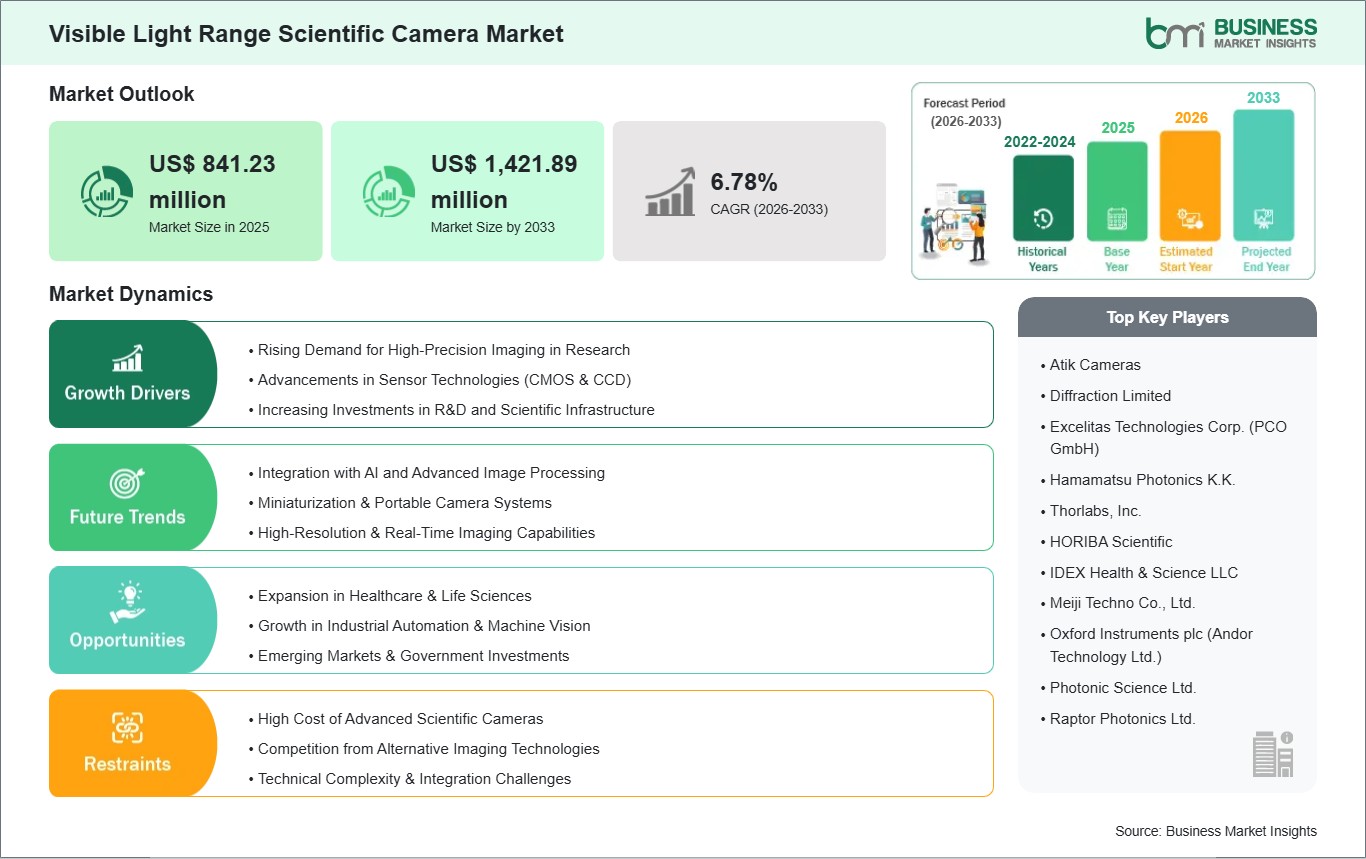
The Visible Light Range Scientific Camera Market size is expected to reach US$ 1,421.89 million by 2033 from US$ 841.23 million in 2025. The market is estimated to record a CAGR of 6.78% from 2026 to 2033.
Visible light range scientific cameras refer to high-precision imaging instruments engineered to capture and quantify photons within the 400 nm to 700 nm spectral band. Unlike consumer-grade sensors, these cameras prioritize quantitative accuracy, high quantum efficiency (QE), and ultra-low noise floors, making them fundamental to demanding applications in life sciences, astronomy, and semiconductor metrology. Market expansion is being propelled by the rapid digitalization of microscopy, particularly live-cell imaging and super-resolution techniques, and the rising institutional demand for high-throughput sensors to support AI-driven image analysis in pharmaceutical research and space-based observation.
However, several factors may restrain market progression. The high capital intensity associated with premium sensor architectures, such as back-illuminated sCMOS and Electron-Multiplying CCD (EMCCD) units, remains a significant barrier for smaller academic laboratories and research institutions. The industry also faces technical challenges regarding the data bottleneck, as modern high-resolution sensors generating vast datasets at high frame rates necessitate expensive, high-bandwidth storage and specialized computational infrastructure. Additionally, the availability of high-quality refurbished medical and scientific cameras at lower price points introduces significant competitive pressure for new hardware sales. These hurdles, compounded by the physical susceptibility of sensitive 3D and 4K sensors to environmental contaminants like dust and microparticles, increase the total cost of ownership and operational complexity.
Despite these hurdles, the market outlook remains favorable. Opportunities are emerging through the adoption of smart scientific cameras that integrate on-chip AI for real-time feature extraction and autonomous anomaly detection, reducing the need for post-processing. The expansion of the semiconductor industry is gaining traction, with a surge in demand for sub-nanometer precision optical overlay metrology to support the next generation of AI chips. Furthermore, the growth of SF6-free and energy-efficient imaging solutions aligns with global institutional goals for sustainable laboratory practices. Collectively, these innovations position the visible light range scientific camera industry for sustained long-term development as a cornerstone of the global data-driven research and precision manufacturing ecosystem.

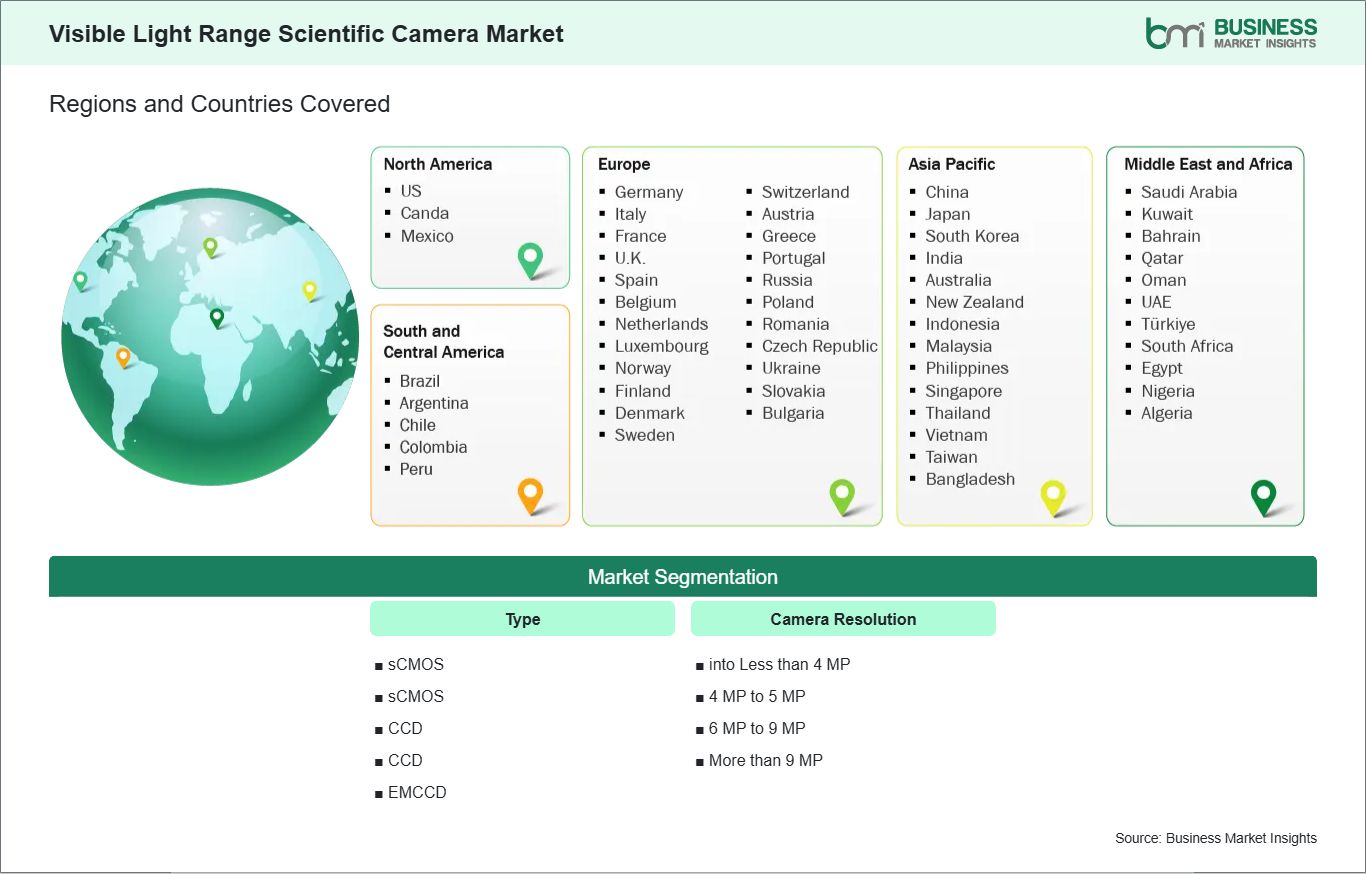
Key segments that contributed to the derivation of the Visible Light Range Scientific Camera market analysis are type and camera resolution.
The visible light range scientific camera market is being driven by the growing need for high‑resolution imaging in scientific research, industrial inspection, and medical diagnostics. These cameras provide precise visualization of phenomena within the visible spectrum, making them essential for applications such as microscopy, spectroscopy, and material analysis. With research institutions and laboratories increasingly focused on advanced imaging techniques, demand for cameras that deliver superior sensitivity, dynamic range, and accuracy is rising. The expansion of life sciences and healthcare is amplifying adoption, as visible light cameras are critical for cell imaging, pathology, and surgical visualization. Industrial sectors such as semiconductor manufacturing, aerospace, and automotive are also reinforcing demand, using these cameras for quality control and defect detection. Additionally, the growing emphasis on sustainability and smart manufacturing is driving adoption of imaging solutions that optimize resource utilization and reduce waste. Collectively, scientific innovation, industrial modernization, and healthcare advancements are propelling sustained growth in the global visible light range scientific camera market.
Opportunities in the visible light range scientific camera market are expanding through the integration of artificial intelligence, IoT connectivity, and cross‑disciplinary applications. AI‑enabled cameras can deliver automated image analysis, pattern recognition, and predictive insights, creating new pathways for efficiency in research and industrial workflows. IoT‑connected systems are gaining traction, enabling real‑time data sharing across laboratories, manufacturing plants, and healthcare facilities. The growing emphasis on interdisciplinary research is opening lucrative opportunities, as visible light cameras are increasingly used in fields such as environmental monitoring, agriculture, and nanotechnology.
Emerging applications in smart cities and autonomous vehicles are also driving innovation, where these cameras support traffic monitoring, safety systems, and infrastructure inspection. Additionally, the expansion of digital healthcare and telemedicine is fueling demand for advanced imaging solutions that enhance diagnostic accuracy. Vendors who focus on cost‑effective, AI‑driven, and interoperable camera systems are well‑positioned to capture growth. The convergence of smart functionality, cross‑disciplinary adoption, and sustainability underscores a transformative trajectory for the global visible light range scientific camera market

The Visible Light Range Scientific Camera market demonstrates steady growth, with size and share analysis revealing evolving trends and competitive positioning among key players. The report examines subsegments categorized within type and camera resolution, offering insights into their contribution to overall market performance.
Based on Type, the sCMOS (scientific CMOS) subsegment holds a strong presence in the market. These cameras are indispensable for high‑speed imaging with low noise, widely adopted in life sciences, astronomy, and materials research. The CCD (Charge‑Coupled Device) subsegment is essential for applications requiring high sensitivity and precision, particularly in spectroscopy and fluorescence imaging. The EMCCD (Electron Multiplying CCD) subsegment anchors demand in ultra‑low light imaging, enabling researchers to capture faint signals in single‑molecule studies and astrophysics. Together, these camera types provide a spectrum of solutions balancing speed, sensitivity, and resolution for scientific applications.
| Report Attribute | Details |
|---|---|
| Market size in 2025 | US$ 841.23 million |
| Market Size by 2033 | US$ 1,421.89 million |
| Global CAGR (2026 - 2033) | 6.78% |
| Historical Data | 2022-2024 |
| Forecast period | 2026-2033 |
| Segments Covered | By Type
|
|
Regions and Countries Covered
| |
| North America | US, Canada, Mexico |
| Europe | Belgium, Austria, Finland, Denmark, Greece, Poland, Romania, Russia, Ukraine, Czech Republic, Slovakia, Bulgaria, Italy, Luxembourg, Germany, Switzerland, France, Netherlands, Norway, Portugal, Spain, Sweden, United Kingdom |
| Asia-Pacific | Australia, China, India, Japan, South Korea, Indonesia, Malaysia, Philippines, Singapore, Thailand, Vietnam, Bangladesh, New Zealand, Taiwan |
| South and Central America | Brazil, Argentina, Peru, Chile, Colombia |
| Middle East and Africa | Bahrain, Kuwait, Oman, Qatar, Saudi Arabia, United Arab Emirates, Turkiye, South Africa, Egypt, Algeria, Nigeria |
| Market leaders and key company profiles |
|
The "Visible Light Range Scientific Camera Market Size and Forecast (2022 - 2033)" report provides a detailed analysis of the market covering below areas:
The geographical scope of the Visible Light Range Scientific Camera market report is divided into five regions: North America, Asia Pacific, Europe, Middle East & Africa, and South & Central America.
North America maintains a preeminent position within the global industry, characterized by a sophisticated research ecosystem and the early, large-scale adoption of next-generation imaging sensors. The regional landscape is defined by high-density investments in the United States and Canada, where the transition toward sCMOS (Scientific Complementary Metal-Oxide-Semiconductor) Technology has become a strategic priority for academic and industrial laboratories. This market leadership is further supported by substantial federal funding for space exploration and life sciences, which facilitates the integration of high-sensitivity cameras into national telescopes, genomics research facilities, and pharmaceutical development hubs.
A decisive shift toward High-Throughput and Low-Noise Imaging Solutions largely drives technological progression in the United States and Canada. These advanced systems utilize back-thinned sensor architectures and deep-cooling mechanisms to achieve superior quantum efficiency, enabling the detection of weak signals in applications such as fluorescence microscopy and quantum physics. Furthermore, the region is witnessing an increasing utilization of AI-Integrated Image Processing, as researchers seek to automate data extraction and enhance the resolution of complex biological samples. This focus on Precision Analytical Imaging allows North American institutions to maintain a competitive edge in material science and medical diagnostics.

The Visible Light Range Scientific Camera market is evaluated by gathering qualitative and quantitative data post primary and secondary research, which includes important corporate publications, association data, and databases. A few of the key developments in the Visible Light Range Scientific Camera market are:
The Visible Light Range Scientific Camera Market is valued at US$ 841.23 million in 2025, it is projected to reach US$ 1,421.89 million by 2033.
As per our report Visible Light Range Scientific Camera Market, the market size is valued at US$ 841.23 million in 2025, projecting it to reach US$ 1,421.89 million by 2033. This translates to a CAGR of approximately 6.78% during the forecast period.
The Visible Light Range Scientific Camera Market report typically cover these key segments-
The historic period, base year, and forecast period can vary slightly depending on the specific market research report. However, for the Visible Light Range Scientific Camera Market report:
The Visible Light Range Scientific Camera Market is populated by several key players, each contributing to its growth and innovation. Some of the major players include:
The Visible Light Range Scientific Camera Market report is valuable for diverse stakeholders, including:
Essentially, anyone involved in or considering involvement in the Visible Light Range Scientific Camera Market value chain can benefit from the information contained in a comprehensive market report.
Please tell us your area of interest
(Market Segments/ Regions and Countries/ Companies)