Market Summary
Executive Summary and Global Market Analysis
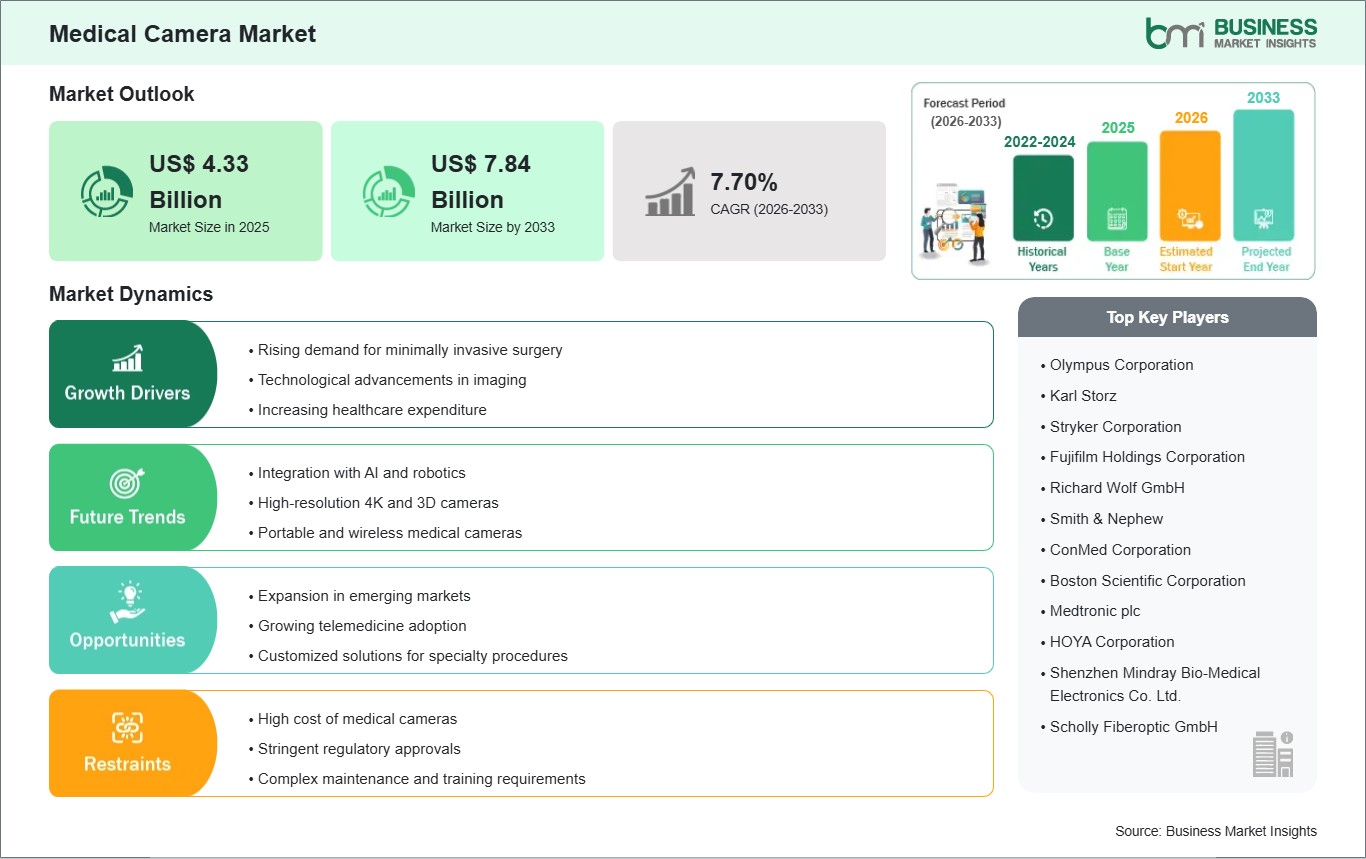
Medical cameras are high-resolution imaging devices designed for clinical environments to capture both internal and external physiological data with high precision. These devices provide significant strategic value by supplying visual evidence essential for definitive diagnosis and precise intervention in hospitals, ambulatory surgical centers (ASCs), and specialty clinics. Market growth is primarily driven by the global increase in geriatric populations and chronic diseases, the rapid adoption of 4K and 8K ultra-high-definition visualization standards, and the expanded use of disposable and single-use imaging modules to reduce cross-contamination risks. In addition, the adoption of AI-enhanced image processing, which can highlight suspicious lesions or vascular patterns in real time, is significantly improving diagnostic accuracy and surgeon confidence.
Several challenges may restrain market growth. High capital expenditures for premium imaging systems, which can reach several hundred thousand dollars, deter adoption in budget-constrained public healthcare systems. The limited availability of trained specialists capable of performing complex endoscopic and microscopic procedures can also restrict equipment utilization. Furthermore, the industry faces constraints related to cybersecurity vulnerabilities in network-connected devices, requiring robust data protection measures to safeguard sensitive patient imaging data from unauthorized access.
Despite these challenges, the market presents substantial opportunities through the global expansion of telehealth and remote diagnostics, as well as the increasing adoption of integrated surgical robotics. The proliferation of portable, smartphone-connected diagnostic cameras and advancements in hyperspectral imaging, which enable visualization of tissue oxygenation and molecular composition, are anticipated to drive significant long-term market growth.
Segment Analysis
Medical Camera Market Segmentation
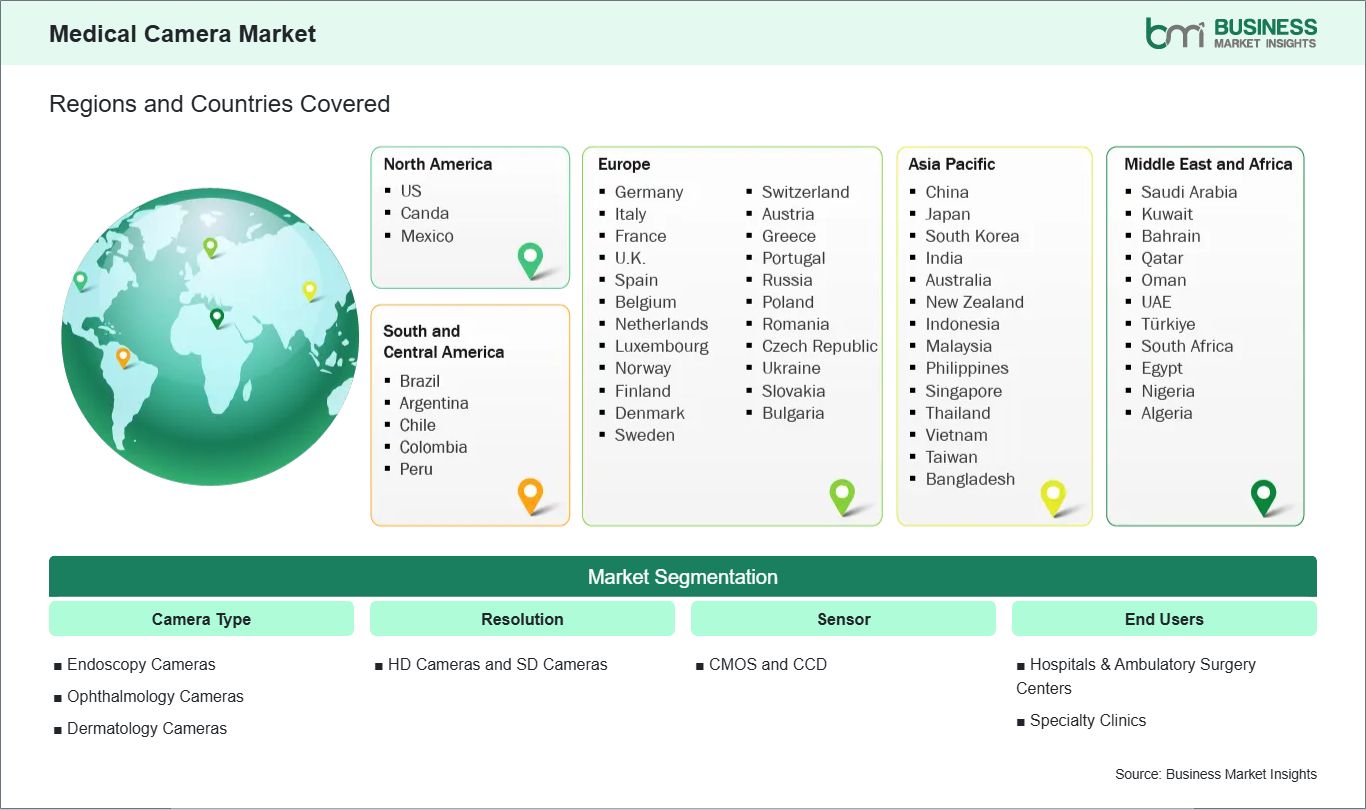
Key segments that contributed to the derivation of the Medical Camera market analysis are camera type, resolution, sensor, and end users.
- By Camera Type, the market is segmented into Endoscopy Cameras, Ophthalmology Cameras, and Dermatology Cameras.
- By Resolution, the market is divided into HD Cameras and SD Cameras.
- By Sensor, the market is categorized into CMOS and CCD.
- By End Users, the market is segmented into Hospitals & Ambulatory Surgery Centers, and Specialty Clinics.
Market Forces
Medical Camera Market Drivers and Opportunities
Advancing Minimally Invasive Procedures and AI-Enhanced Diagnostics
A key driver of the medical camera market is the global transition toward minimally invasive surgeries (MIS), which depend on high-fidelity camera systems to facilitate interventions through small incisions. Increasing procedural volumes for endoscopy and laparoscopy further strengthen this trend, particularly as aging populations require more diagnostic screenings for gastrointestinal and cardiovascular conditions. Additionally, the integration of artificial intelligence (AI) and machine learning has transformed medical cameras from passive recording devices into intelligent sensors capable of real-time anomaly detection, automated contrast optimization, and microvascular pattern recognition. In the context of digital health, the widespread adoption of telemedicine and remote consultation has also accelerated demand for high-resolution cameras, enabling specialists to assess patients or guide surgeries remotely using zero-latency 5G connectivity.
Furthermore, the Trend toward 4K/3D Visualization has become a clinical standard in premium hospitals, as enhanced depth perception directly correlates with reduced operating times and improved patient outcomes. Together, these factors, the MIS revolution, AI-driven intelligence, and the demand for ultra-clear diagnostics, ensure a robust growth path for medical camera market.
Single-Use Modules and Upgradable Camera Systems
A major opportunity exists in combining medical cameras with single-use disposable technology. As healthcare facilities seek to reduce cross-contamination and reprocessing costs, manufacturers can address a growing demand for high-quality, cost-effective disposable camera modules for endoscopy and dental applications. Additionally, developing modular, software-upgradable camera platforms allows manufacturers to provide hospitals with systems that can be updated with new AI diagnostic features or higher resolution capabilities, eliminating the need to replace entire consoles.
The growth of robotic-assisted surgical systems also creates demand for specialized, vibration-resistant cameras that integrate with robotic arms and 3D headsets. Outside the hospital, point-of-care handheld diagnostics, including high-resolution smartphone attachments for dermatology and ophthalmology, are expanding access to medical-grade imaging in home and rural settings. Manufacturers focusing on miniaturized chip-on-tip sensor architectures and quantum-enhanced imaging for sub-tissue visualization are well positioned to lead innovative, high-margin segments of the global medical technology market.
Size and Share Analysis
Medical Camera Market Size and Share Analysis
The Medical Camera market demonstrates steady growth, with size and share analysis revealing evolving trends and competitive positioning among key players. The report further examines subsegments categorized within camera type, resolution, sensor, and end users, offering insights into their contribution to overall market performance.
Based on camera type, the Endoscopy Cameras and Ophthalmology Cameras subsegments hold a significant market presence, representing the core drivers of high-precision diagnostic imaging. Endoscopy Cameras are indispensable for the General Surgery and Gastroenterology sectors, providing the essential visual navigation required for laparoscopic and arthroscopic procedures. A notable trend is the surge in the Dermatology Cameras subsegment, which is registering higher interest in the era of teledermatology. These specialized cameras are becoming essential for Specialty Clinics, where they enable high-resolution mapping of skin lesions for remote analysis and AI-based early detection of malignancies, marking a strategic pivot toward proactive, non-invasive screening.
Report Coverage
Medical Camera Market Report Coverage and Deliverables
The "Medical Camera Market Size and Forecast (2022–2033)" report provides a detailed analysis of the market covering below areas:
- Medical Camera market size and forecast at global, regional, and country levels for all the key market segments covered under the scope
- Medical Camera market trends, as well as market dynamics such as drivers, restraints, and key opportunities
- Medical Camera market analysis covering key market trends, global and regional framework, major players, regulations, and recent market developments
- Industry landscape and competition analysis covering market concentration, heat map analysis, prominent players, and recent developments for the Medical Camera market
- Detailed company profiles, including SWOT analysis
Geographic Insights
Medical Camera Market Geographic Insights
The geographical scope of the Medical Camera market report is divided into five regions: North America, Asia Pacific, Europe, Middle East & Africa, and South & Central America.
The Asia-Pacific Medical Camera Market comprises China, Japan, South Korea, India, Australia, and the Rest of Asia Pacific. China serves as a primary center for both production and consumption, driven by an increasing number of domestic manufacturers supplying advanced imaging solutions to local healthcare facilities. In India, demand for high-resolution cameras is rising within private hospital networks to support complex laparoscopic and orthopedic procedures. Japan continues to lead in technological innovation, especially in the development of ultra-high-definition sensors for ophthalmology and microscopy applications. Growth is driven by the shift to integrated digital imaging and wireless connectivity, which enables seamless medical documentation and real-time remote consultations. Increased use of single-use endoscopy cameras to reduce cross-contamination, along with the move to ultra-high-definition visualization, positions the Asia-Pacific region as a key center for innovation and future expansion in the Medical Camera Market.
Industry Activity
Recent Developments
The Medical Camera market is evaluated by gathering qualitative and quantitative data post primary and secondary research, which includes important corporate publications, association data, and databases. A few of the key developments in the Medical Camera market are:
- In July 2025, FUJIFILM India launched ENDOVEDA™, a locally developed endoscopy reporting system with Full HD and UHD 4K image capture, intelligent enhancement, and seamless hospital integration. The product aims to improve clinical workflows, diagnostic accuracy, and data management, reinforcing FUJIFILM`s presence in the medical camera and endoscopy market.
- In January 2025, TAGARNO upgraded its FHD microscope line, originally launched in 2016 with the STARVIS 2 camera, enhancing dynamic range, image clarity, color accuracy, and operational speed. The upgrade also allows simultaneous zoom and focus, improving workflow efficiency and user productivity, strengthening TAGARNO`s presence in the medical and industrial imaging market.
Trust & Transparency
Research Methodology
The market analysis combines proprietary research with secondary data from government agencies, company disclosures, regulatory filings, industry databases and expert interviews. Market estimates are validated through data triangulation, cross-market benchmarking and analyst
review.
View Full Research Methodology
Key Sources Referred:
World Bank – Global Trade IndicatorsWorld Trade Organization (WTO)(International Monetary Fund )IMFInternational Trade Administration (ITA)Company websiteCompany annual reportsCompany investor presentations