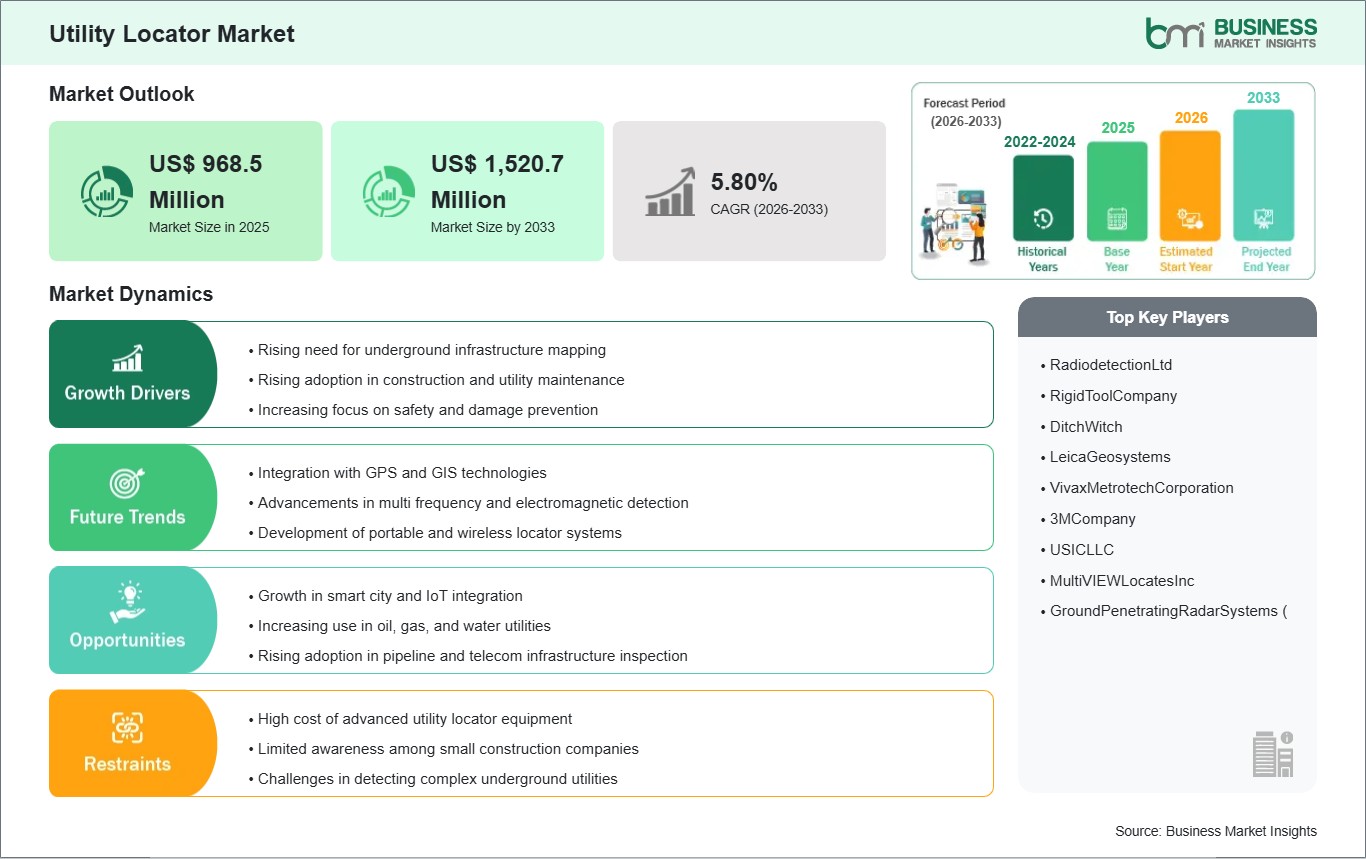
The Utility Locator Market size is expected to reach US$ 1,520.7 million by 2033 from US$ 968.5 million in 2025. The market is estimated to record a CAGR of 5.80% from 2026 to 2033.
The global utility locator industry is growing rapidly due to urbanization, expanding infrastructure, and increased regulations regarding the detection of underground utility facilities. Accurate utility locator Devices are required to identify buried pipelines, cables and similar infrastructure in order to prevent damage when excavating for construction or maintaining these utilities. Major innovations in technology like ground penetrating radar (GPR), electromagnetic (EM) detection and GPS-based mapping systems are improving the accuracy, speed and safety of utility locators and associated surveys. Real-time data recording and reporting capabilities via integration with Geographic Information Systems (GIS) and cloud-based asset management platforms provide for faster and more efficient data coordination across multiple customers.
Utility locator devices also play an important role in ensuring safety and reducing construction-related accidents through the accurate detection of underground facilities. In densely populated areas, the need to locate subsurface utilities has increased in response to increased construction activity, as improperly locating them can result in costly accidents, service disruptions and potential regulatory penalties. Investments in renewable energy projects and the smart grid are also driving demand for Utility locators, since accurate mapping of utilities is critical to their successful implementation and ongoing maintenance. Companies in this industry are putting a focus on developing locators that are small, incorporate multiple frequencies, and have multi-sensor capabilities, thus being able to support multiple application areas across various terrains and subsurface conditions worldwide. T
he combination of innovation through technology, compliance with regulatory requirements, and improved operational efficiencies make utility locators a necessary part of the global construction/utility industry today.

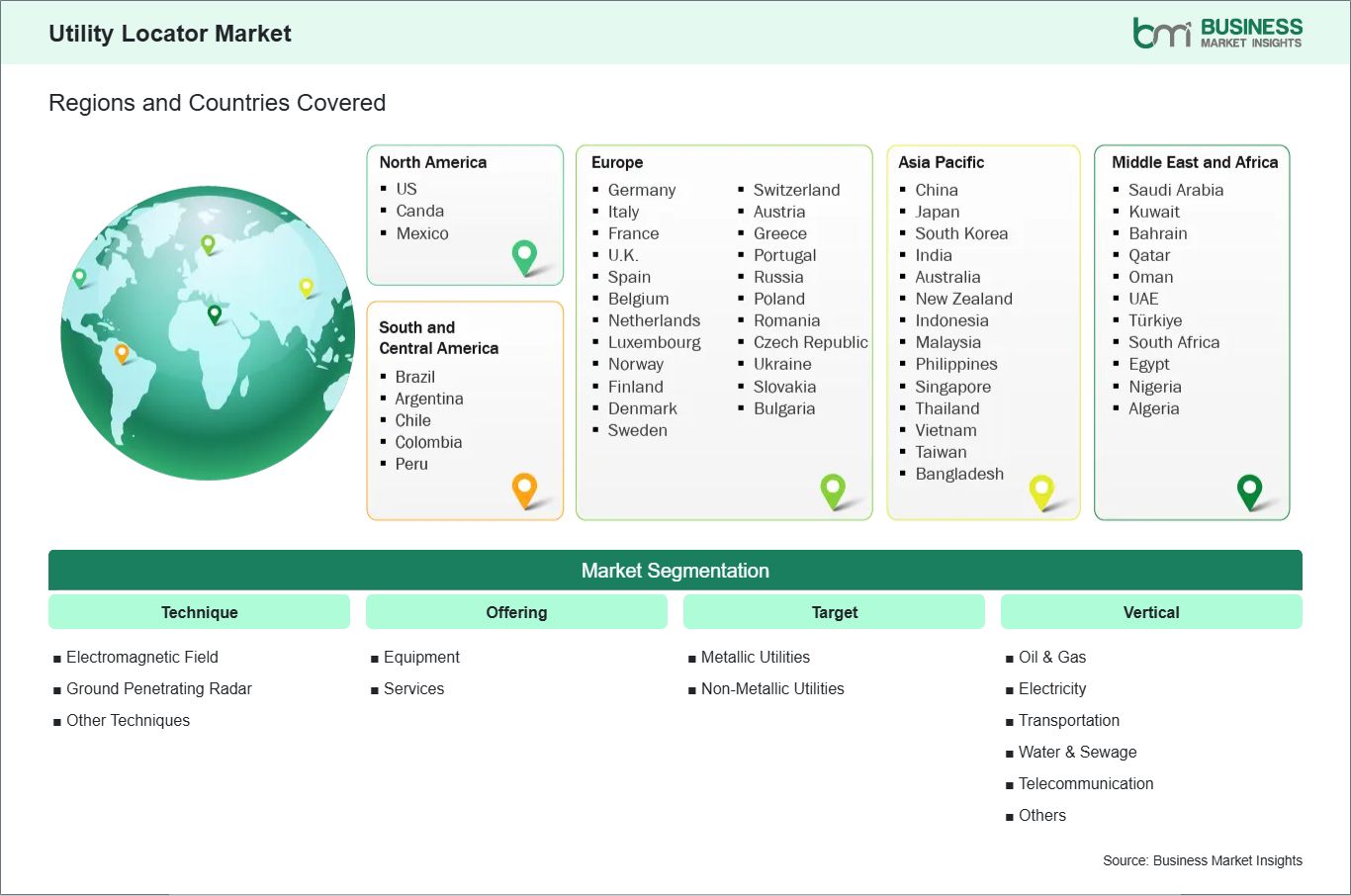
Key segments that contributed to the derivation of the utility locator market analysis are technique, offering, target, and vertical.
The global utility location market is accelerating significantly due to demand for precise mapping of underground infrastructure. Urban growth, along with new networks of vital infrastructure, has created a need for organizations to reliably find pipelines of gas, water, electricity and telecommunications underground. Utility locators keep contractors from damaging utilities while constructing or maintaining a property, thereby preventing interruptions of service (for the utility, the customer or both), as well as avoiding harm and regulatory issues.
Rapid urbanization and large-scale infrastructure construction further increase demand for utility locators. Determining where utilities are located underground is necessary for constructing, renovating or maintaining facilities in urban areas and industrial zones that continue to expand. Utilities can be more accurately mapped using technologies, such as electromagnetic or ground penetrating radar (GPR) (and most importantly, from new developments, GPR and electromagnetic locating technology), so that utilities are accurately identified and documented when construction, renovation or maintenance takes place. Technological innovations within the locator system also contribute to increased growth of the utility location market by producing clearer signals, allowing for better measurement of depth and creating a more complete record of the utility's existence in Geographic Information Systems (GIS). These innovations have also improved the overall efficiency of operational processes for construction, utility and municipal organizations, further strengthening the utility locator market as a global leader in the management of safe, efficient and cost-effective underground infrastructures.
Smart city initiatives combined with the rollout of Internet of Things (IoT) technologies are driving increased demand for utilities locator systems and solutions. With more cities embracing connected systems driven by ambient intelligence and real-time monitoring, the importance of digitally managing underground utilities grows. When utility locators are developed as IoT-enabled solutions, the data can be utilized to perform predictive maintenance, optimize the utility network, and manage assets to make cities more efficient, less likely to experience interruption of service and enhance safety within the community. When developing smart city projects, the precise mapping and continuous monitoring of water, natural gas, and electrical networks must be done to support the automation and analytics platforms. The integration of advanced sensors and cloud-connected utility locators will enable the transmission of real-time data to municipal authorities and utility companies to identify anomaly detection, schedule preventive maintenance and quickly respond to potential hazards. The traditional utility location technology, working with the new smart infrastructure solutions, is opening up new opportunities for adoption in utility location technology around the world.
Furthermore, the combination of artificial intelligence (AI) and machine learning (ML) with IoT-enabled utility locators will help to enhance the predictive capability of the technology, while also providing workflow automation. By utilizing improved data analytics, the utility operator will be able to maximize the use of its network, plan for future expansion and minimize the cost of doing business. The convergence of digital transformation, smart infrastructure and connected technologies will position utility locators as a foundational technology supporting the development and operational functionalities of modern cities throughout the world.
The utility locator market demonstrates steady growth, with size and share analysis highlighting evolving trends and competitive dynamics among key players. The report examines subsegments categorized within technique, offering, target, and vertical, offering insights into their contribution to overall market performance.
By Technique, the electromagnetic field subsegment dominated the market in 2025, driven by its widespread use in detecting underground metallic utilities quickly and accurately.
Based on Offering, the equipment subsegment dominated the market in 2025, owing to growing demand for advanced locator devices and detection technologies.
On the Basis of Target, the metallic utilities subsegment dominated the market in 2025, due to the high prevalence of metallic underground infrastructure like pipes and cables.
By Vertical, the electricity subsegment dominated the market in 2025, supported by continuous expansion and maintenance of electrical distribution networks.
| Report Attribute | Details |
|---|---|
| Market size in 2025 | US$ 968.5 Million |
| Market Size by 2033 | US$ 1,520.7 Million |
| Global CAGR (2026 - 2033) | 5.80% |
| Historical Data | 2022-2024 |
| Forecast period | 2026-2033 |
| Segments Covered | By Technique
|
|
Regions and Countries Covered
| |
| North America | US, Canada, Mexico |
| Europe | Belgium, Austria, Finland, Denmark, Greece, Poland, Romania, Russia, Ukraine, Czech Republic, Slovakia, Bulgaria, Italy, Luxembourg, Germany, Switzerland, France, Netherlands, Norway, Portugal, Spain, Sweden, United Kingdom |
| Asia-Pacific | Australia, China, India, Japan, South Korea, Indonesia, Malaysia, Philippines, Singapore, Thailand, Vietnam, Bangladesh, New Zealand, Taiwan |
| South and Central America | Brazil, Argentina, Peru, Chile, Colombia |
| Middle East and Africa | Bahrain, Kuwait, Oman, Qatar, Saudi Arabia, United Arab Emirates, Turkiye, South Africa, Egypt, Algeria, Nigeria |
| Market leaders and key company profiles |
|
The "Utility Locator Market Size and Forecast (2022 - 2033)" report provides a detailed analysis of the market covering below areas:
The geographical scope of the Utility Locator Market report is divided into North America, Asia Pacific, Europe, Middle East & Africa, and South & Central America. North America held the largest share in 2025.
North America dominates the utility locator market, driven by extensive urban infrastructure, high construction activity, and strict regulatory frameworks for underground safety. The United States and Canada lead in adopting advanced GPR and EM locators integrated with GIS platforms for utilities mapping, pipeline management, and construction site safety.
Asia Pacific is a rapidly growing market, with China, India, Japan, and South Korea investing in infrastructure modernization, smart city initiatives, and energy distribution networks. The demand for utility locators is increasing due to urban expansion, high-density construction, and the need to safeguard underground utilities in complex city layouts.
Europe focuses on regulatory compliance, environmental safety, and urban planning efficiency, with Germany, the UK, and France emphasizing advanced locator technology to support smart grids, transportation projects, and energy networks. Emphasis on renewable energy installations and pipeline safety drives market adoption.
The Middle East and Africa are emerging markets, particularly in the Gulf and Southern Africa, where rapid urbanization, oil and gas projects, and infrastructure development require precise underground mapping solutions.
South and Central America, including Brazil, Mexico, and Argentina, are increasingly adopting utility locators to mitigate construction risks, enhance safety, and ensure continuity of critical infrastructure services. Regional growth is shaped by modernization initiatives and international safety standards for underground utilities.

The Utility Locator Market is evaluated by gathering qualitative and quantitative data post primary and secondary research, which includes important corporate publications, association data, and databases. A few of the key developments in the spatial light Modulator market are:
The Utility Locator Market is valued at US$ 968.5 Million in 2025, it is projected to reach US$ 1,520.7 Million by 2033.
As per our report Utility Locator Market, the market size is valued at US$ 968.5 Million in 2025, projecting it to reach US$ 1,520.7 Million by 2033. This translates to a CAGR of approximately 5.80% during the forecast period.
The Utility Locator Market report typically cover these key segments-
The historic period, base year, and forecast period can vary slightly depending on the specific market research report. However, for the Utility Locator Market report:
The Utility Locator Market is populated by several key players, each contributing to its growth and innovation. Some of the major players include:
The Utility Locator Market report is valuable for diverse stakeholders, including:
Essentially, anyone involved in or considering involvement in the Utility Locator Market value chain can benefit from the information contained in a comprehensive market report.
Please tell us your area of interest
(Market Segments/ Regions and Countries/ Companies)