Market Summary
Executive Summary and Global Market Analysis
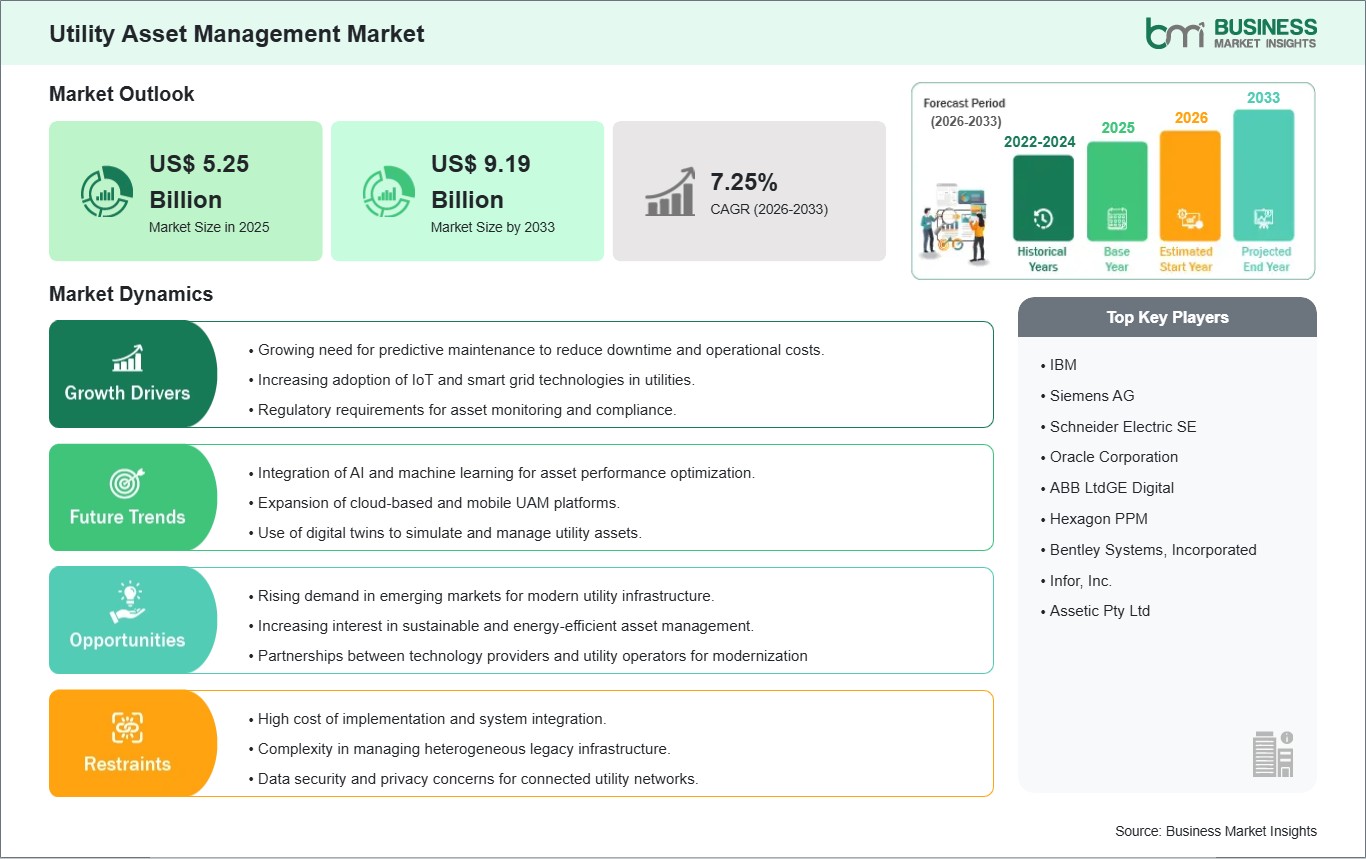
Utility Asset Management (UAM) refers to a systematic process of operating, maintaining, upgrading, and cost-effectively disposing of physical assets. It encompasses a broad range of solutions—integrating hardware sensors, advanced software analytics, and strategic services—designed to maximize the lifecycle of critical infrastructure such as transformers, substations, and transmission lines. In an era of increasing energy demand and the rapid transition toward renewable energy, UAM serves as the technological backbone for utilities seeking to ensure grid reliability and operational efficiency. By leveraging real-time data and predictive diagnostics, these systems allow utility providers to transition from reactive maintenance to proactive asset health management, thereby minimizing the risk of catastrophic failures and optimizing capital expenditure.
However, several challenges can restrain market growth, primarily the high initial capital requirements and the technical complexity of integrating advanced digital solutions with aging legacy infrastructure. The industry also faces a significant shortage of technically skilled personnel capable of managing complex AI-driven platforms, alongside mounting concerns regarding the cybersecurity of interconnected grid assets.
Despite these hurdles, the market holds significant opportunities driven by the global push for grid modernization and the aggressive deployment of "Smart Grid" initiatives. The surging demand for AI-driven predictive maintenance and the necessity of integrating distributed energy resources (DERs) into existing frameworks are expected to open new avenues for market expansion, ensuring long-term resilience for the global utility sector.
Segment Analysis
Utility Asset Management Market Segmentation
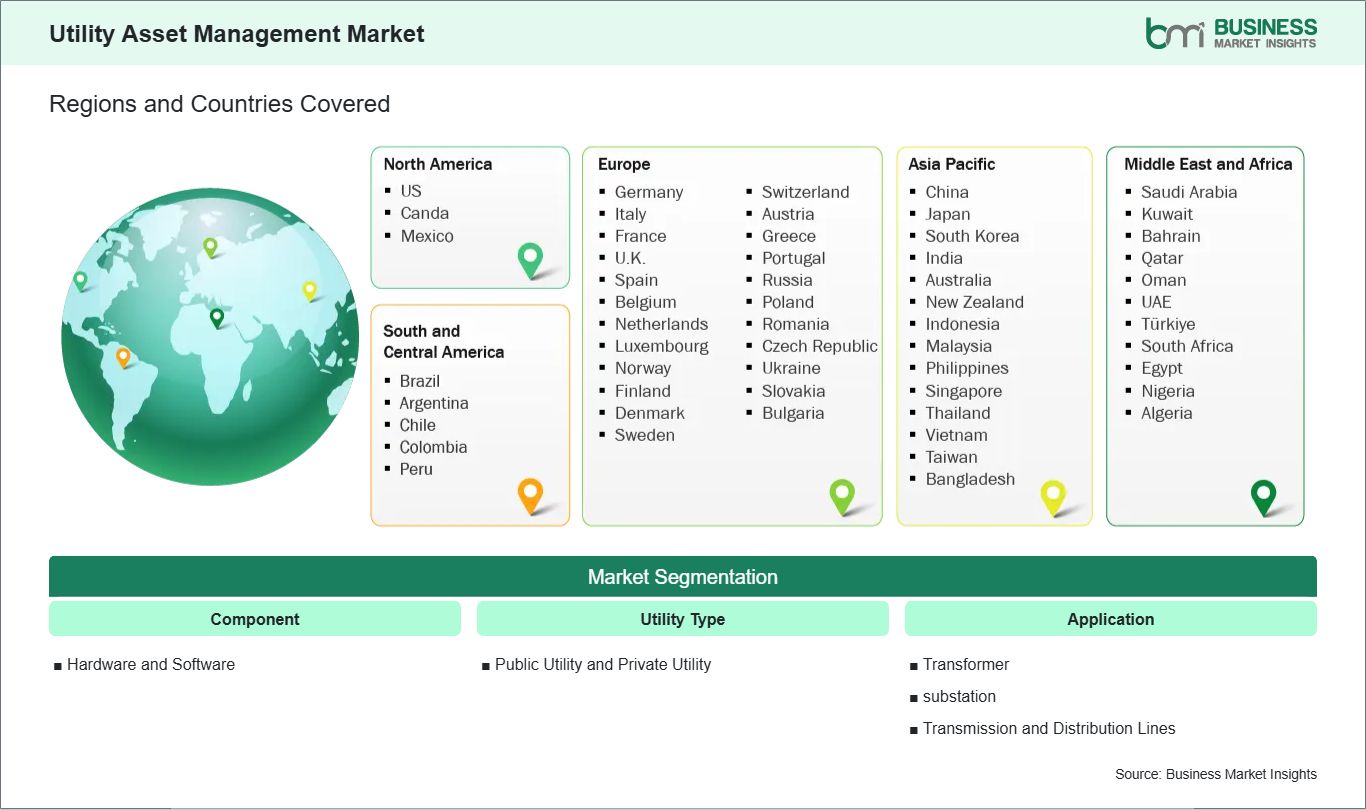
Key segments that contributed to the derivation of the Utility Asset Management market analysis are component, utility, and application.
- By Component, the market is segmented into Hardware and Software.
- By Utility Type, the market is divided into Public Utility and Private Utility.
- By Application, the market is categorized into Transformer, substation, and Transmission and Distribution Lines.
Market Forces
Utility Asset Management Market Drivers and Opportunities
Aging Infrastructure and the Imperative for Grid Modernization
The global utility sector is currently grappling with a critical structural challenge: a significant portion of the primary electricity and water distribution network was installed decades ago and is now operating well beyond its intended engineering lifespan. This aging infrastructure acts as the primary catalyst for the growth of the asset management market. As transformers, substations, and transmission lines reach the end of their functional utility, they become increasingly prone to equipment fatigue, insulation degradation, and mechanical failure. These vulnerabilities lead to frequent unplanned outages and significant operational inefficiencies that the modern digital economy can no longer tolerate.
To address these risks, utility providers are transitioning away from the traditional "run-to-failure" model in favor of comprehensive grid modernization initiatives. This shift involves the widespread integration of digital monitoring hardware and intelligent sensors that provide granular visibility into the physical state of the grid. By modernizing these legacy systems, utilities can effectively extend the operational life of their existing high-value assets while simultaneously preparing the network for the complexities of decentralized energy generation. This large-scale overhaul is not merely about replacing physical components; it is a fundamental reimagining of the grid as a communicative, cyber-physical system. Consequently, the necessity to maintain service reliability and public safety in the face of deteriorating physical assets continues to propel the demand for sophisticated, integrated management solutions that can stabilize and secure the global energy framework.
Emergence of AI-Driven Predictive Maintenance and Digital Twins
The rapid maturation of Artificial Intelligence (AI) and the Industrial Internet of Things (IIoT) presents a transformative opportunity for the utility asset management market to move toward a proactive operational paradigm. Historically, maintenance was performed on a fixed calendar schedule, often leading to unnecessary labor costs or, conversely, failing to prevent sudden breakdowns. The integration of AI-driven predictive maintenance changes this dynamic by utilizing machine learning algorithms to analyze vast streams of real-time data from across the utility network. By identifying subtle patterns—such as abnormal thermal signatures or slight variations in vibrational frequency—these systems can forecast potential equipment failures long before they manifest as physical breakdowns.
Furthermore, the emergence of "Digital Twin" technology represents a lucrative frontier for utility providers. A digital twin is a high-fidelity virtual replica of a physical asset that allows operators to simulate various "what-if" scenarios, such as the impact of extreme weather events or sudden surges in demand from electric vehicle charging networks. This virtual environment enables utilities to test stress-response strategies and optimize maintenance workflows without any risk to the physical grid. As these AI-powered platforms become more sophisticated, they allow for a "sensing-to-inference" pipeline where the software not only detects an anomaly but also automatically generates a maintenance ticket and identifies the specific parts required for repair. This shift toward intelligent, self-diagnostic infrastructure offers a significant opportunity for manufacturers to develop specialized software that emphasizes long-term asset health and operational agility in an increasingly volatile energy landscape.
Size and Share Analysis
Utility Asset Management Market Size and Share Analysis
The Utility Asset Management market demonstrates steady growth, with size and share analysis revealing evolving trends and competitive positioning among key players. The report further examines subsegments categorized within component, utility, and application, offering insights into their contribution to overall market performance.
Within the component segment, the Software sub-segment commands a significant portion of the market share, driven by the mounting requirement for remote diagnostic tools and cloud-based analytics platforms.
Regarding utility types, the Public sub-segment remains a dominant force due to large-scale government-led infrastructure mandates aimed at national grid stability.
In terms of application, the Transformer sub-segment accounts for the highest share as these assets are the most critical and capital-intensive components of the signal chain, necessitating constant real-time monitoring to prevent cascading grid failures.
Report Coverage
Utility Asset Management Market Report Coverage and Deliverables
The "Utility Asset Management Market Size and Forecast (2022–2033)" report provides a detailed analysis of the market covering below areas:
- Utility Asset Management market size and forecast at global, regional, and country levels for all the key market segments covered under the scope
- Utility Asset Management market trends, as well as market dynamics such as drivers, restraints, and key opportunities
- Utility Asset Management market analysis covering key market trends, global and regional framework, major players, regulations, and recent market developments
- Industry landscape and competition analysis covering market concentration, heat map analysis, prominent players, and recent developments for the Utility Asset Management market
- Detailed company profiles, including SWOT analysis
Geographic Insights
Utility Asset Management Market Geographic Insights
The geographical scope of the Utility Asset Management market report is divided into five regions: North America, Asia Pacific, Europe, the Middle East & Africa, and South & Central America.
The geographical landscape of the utility asset management market is characterized by a diverse array of regional priorities, each shaped by the specific maturity of local infrastructure and varying degrees of digital transformation. In North America, the market is primarily propelled by a rigorous focus on grid resiliency and the integration of sophisticated monitoring systems to protect against extreme weather events and cybersecurity threats.
European nations are increasingly prioritizing the alignment of asset management strategies with ambitious sustainability targets, fostering a specialized market for software capable of managing complex, decentralized renewable energy inputs.
The Asia-Pacific region stands as a significant center for both infrastructure expansion and technological adoption, where rapid urbanization and the construction of massive new power grids necessitate the deployment of scalable, high-capacity management solutions from the outset.
In the Middle East and Africa, market activity is increasingly defined by the modernization of legacy utility frameworks and the foundational development of smart city infrastructures that require integrated, real-time asset visibility. Meanwhile, South and Central America are experiencing a steady evolution as regional utilities transition toward more automated processes to improve service reliability and support industrial growth.
Collectively, these regions contribute to a resilient global ecosystem where the demand for advanced utility management is driven by a universal need to balance operational efficiency with the long-term sustainability of critical public resources, ensuring that utility providers can meet the evolving energy demands of a modern, hyper-connected society without compromising on safety or reliability.
Industry Activity
Recent Developments
The Utility Asset Management market is evaluated by gathering qualitative and quantitative data post primary and secondary research, which includes important corporate publications, association data, and databases. A few of the key developments in the Utility Asset Management market are:
- In November 2025, Siemens launched its latest Gridscale X offering, the "Gridscale X Flexibility Manager," which empowered distribution system operators (DSOs) to maximize the use of existing grid capacity. This advanced software solution significantly enhanced Utility Asset Management by providing a digital framework to accelerate grid connections for distributed energy resources (DERs) and data centers through a more flexible, data-driven approach, by enabling operators to forecast congestion and proactively manage flexible resources, the tool allowed for a potential increase in grid capacity utilization of up to 20 percent without the need for immediate physical infrastructure expansion.
- In April 2024, ABB completed a minority investment in GridBeyond, a leading technology provider specializing in artificial intelligence and data science-driven energy management. Executed through ABB Ventures, this strategic transaction was designed to bolster the company's Utility Asset Management capabilities by enabling customers to optimize distributed energy resources and industrial loads precisely. By integrating GridBeyond's AI platform, ABB sought to transform how utilities and industrial operators control their asset consumption profiles, thereby increasing grid resilience and predicting potential system failures before they occur.
Trust & Transparency
Research Methodology
The market analysis combines proprietary research with secondary data from government agencies, company disclosures, regulatory filings, industry databases and expert interviews. Market estimates are validated through data triangulation, cross-market benchmarking and analyst
review.
View Full Research Methodology
Key Sources Referred:
World Bank – Global Trade Indicators World Trade Organization (WTO) (International Monetary Fund )IMF International Trade Administration (ITA) Company website Company annual reports Company investor presentations