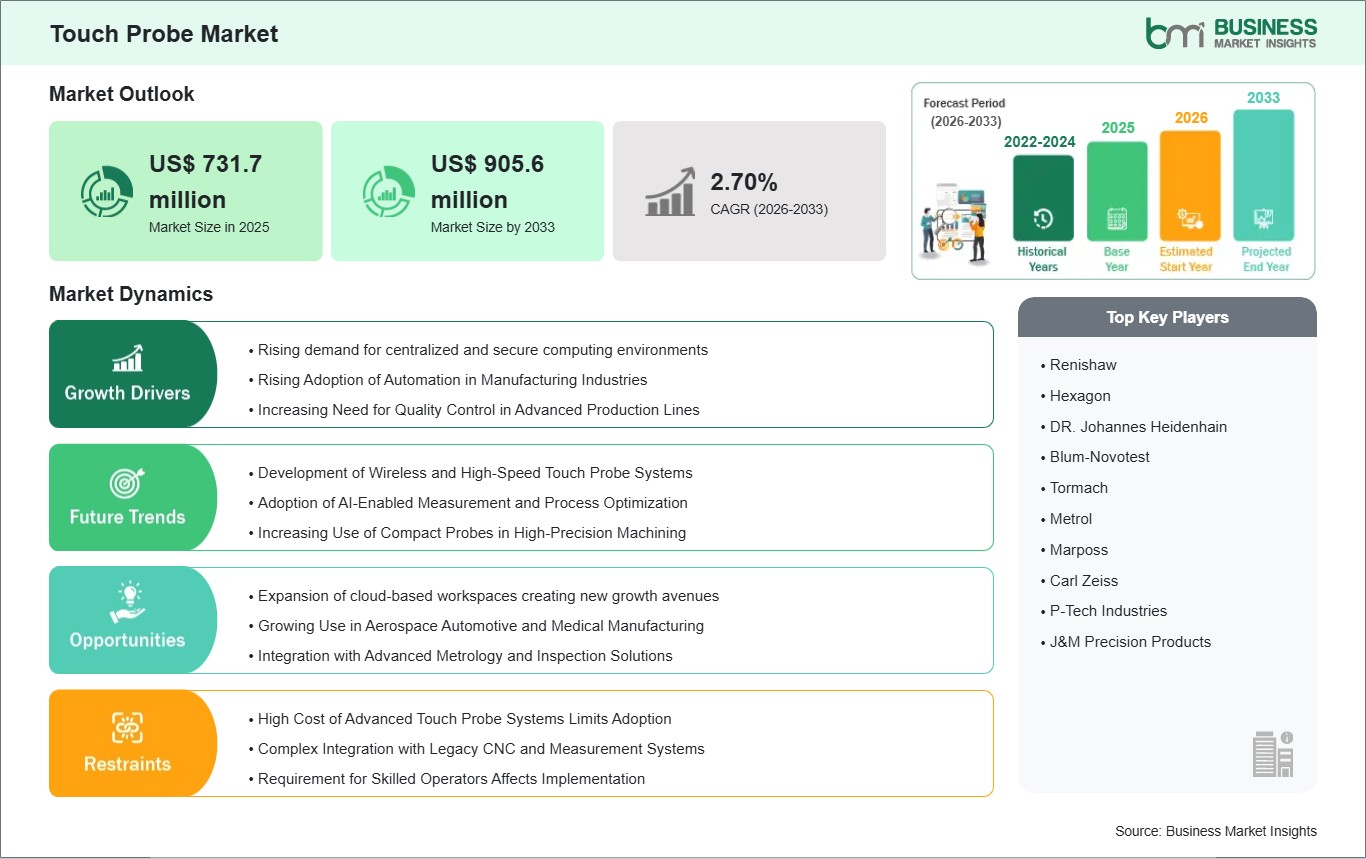
The Touch Probe Market size is expected to reach US$ 905.6 million by 2033 from US$ 731.7 million in 2025. The market is estimated to record a CAGR of 2.70% from 2026 to 2033.
The touch probe market, in general, plays a vital role in the precision metrology and CNC world. It helps in the measurement, alignment, and setting of different parts of objects in the manufacturing process. Touch probes play a vital role in CNC machines and coordinate measuring machines. They help in the inspection process. In the present scenario, where precision plays a major role in different industries like the automotive industry, the aerospace industry, the electronics industry, and the medical device industry, touch probes play a vital role in the manufacturing process.
Most manufacturers use touch probes in their machining centers to carry out the process of in-process measurement and verification. This helps in reducing scrap rates. In the present scenario, where digital manufacturing and smart factories play a major role, touch probes play a vital role in the manufacturing process. Advances in communication for wireless probes, miniaturized probe designs, and integration with multi-axis machining centers are also opening up new possibilities in complex components.
However, there are some challenges in the growth of this market. The high cost of advanced probing systems is a deterrent for small and medium-scale manufacturers. In some emerging markets in developing countries, lack of awareness and the need for skilled technicians to effectively use probe technology could limit market penetration.

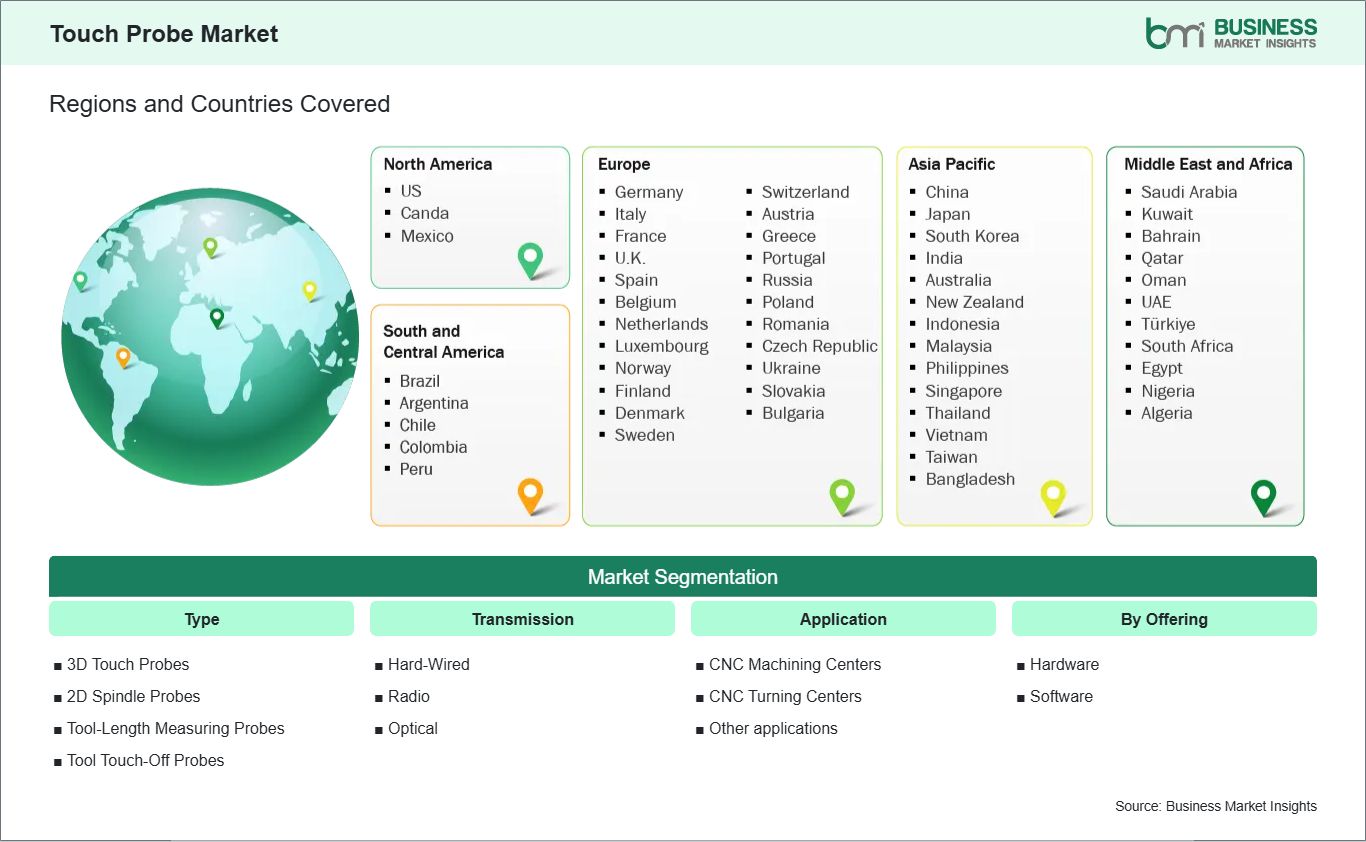
Key segments that contributed to the derivation of the touch probe market analysis are type, transmission, application, offering and industry.
Manufacturers worldwide are increasingly adopting centralized production monitoring and quality management systems to improve operational control and maintain consistent machining accuracy. In modern manufacturing facilities, multiple CNC machines operate simultaneously, producing high-precision components that require strict dimensional verification. Touch probes support this environment by enabling automated workpiece alignment, tool setting, and part measurement directly inside the machine tool. By integrating probes into machining workflows, manufacturers can standardize inspection procedures and minimize dependence on manual measurement methods, which often introduce variability and delays in production.
Centralized inspection systems also allow production data from multiple machines to be collected and analyzed through manufacturing execution systems and quality management platforms. Touch probes generate accurate measurement data during machining operations, allowing engineers to monitor dimensional accuracy and detect deviations in real time. This capability helps manufacturers maintain consistent product quality while reducing scrap rates and production downtime. As global manufacturing moves toward digitally connected factories, centralized monitoring and process transparency have become essential. Touch probes play a key role in enabling this transformation by providing reliable in-process measurement data that can be integrated with broader production control systems, strengthening quality assurance and operational efficiency.
The rapid adoption of cloud-enabled manufacturing platforms is creating new opportunities for the global touch probe market. Many manufacturing companies are integrating machine tools, inspection systems, and production monitoring software with cloud infrastructure to enable remote visibility of manufacturing processes. Touch probes contribute to these systems by generating precise measurement data during machining operations, which can be transmitted to centralized cloud platforms for analysis and documentation. This capability allows production managers and engineers to access machining data from multiple facilities in real time.
Cloud integration also supports collaborative manufacturing environments where design teams, production engineers, and quality specialists work together across different geographic locations. By connecting probing systems to cloud-based analytics tools, manufacturers can analyze dimensional measurement trends, optimize machining parameters, and ensure consistent quality standards across global production networks. In addition, cloud-based manufacturing environments are enabling advanced technologies such as digital twins, predictive maintenance, and intelligent process optimization. Measurement data collected from touch probes can be integrated into these systems to create feedback loops that improve machining precision and operational efficiency. As Industry 4.0 adoption continues to expand globally, the connection between probing technologies and cloud-driven manufacturing platforms is expected to create significant growth opportunities for the market.
The touch probe market demonstrates steady growth, with size and share analysis highlighting evolving trends and competitive dynamics among key players. The report examines subsegments categorized within type, transmission, application, offering and industry, offering insights into their contribution to overall market performance.
By type, the 3D touch probes subsegment dominated the market in 2025, driven by its ability to measure complex geometries across multiple axes with high precision, making it ideal for CNC machining centers and coordinate measuring systems in high-accuracy industries like automotive and aerospace.
Based on transmission, the hard-wired subsegment dominated the market in 2025, driven by its reliable and consistent data transfer, ensuring minimal signal interference and precise communication between the probe and machine, essential for high-precision manufacturing.
Based on application, the CNC machining centers subsegment dominated the market in 2025, driven by by extensive use of touch probes for automated setup, tool measurement, and in-process inspection, improving efficiency, reducing human error, and supporting high-volume precision production.
Based on offering, the hardware subsegment dominated the market in 2025, driven by the widespread requirement for physical touch probe devices and sensors, which perform critical functions like workpiece alignment, tool setting, and in-process inspection.
In terms of industry, the automotive subsegment dominated the market in 2025, driven by the need for high-precision machining of complex components such as engine parts, chassis elements, and transmission systems, where touch probes ensure strict quality standards and repeatability.
| Report Attribute | Details |
|---|---|
| Market size in 2025 | US$ 731.7 million |
| Market Size by 2033 | US$ 905.6 million |
| Global CAGR (2026 - 2033) | 2.70% |
| Historical Data | 2022-2024 |
| Forecast period | 2026-2033 |
| Segments Covered | By Type
|
|
Regions and Countries Covered
| |
| North America | US, Canada, Mexico |
| Europe | Belgium, Austria, Finland, Denmark, Greece, Poland, Romania, Russia, Ukraine, Czech Republic, Slovakia, Bulgaria, Italy, Luxembourg, Germany, Switzerland, France, Netherlands, Norway, Portugal, Spain, Sweden, United Kingdom |
| Asia-Pacific | Australia, China, India, Japan, South Korea, Indonesia, Malaysia, Philippines, Singapore, Thailand, Vietnam, Bangladesh, New Zealand, Taiwan |
| South and Central America | Brazil, Argentina, Peru, Chile, Colombia |
| Middle East and Africa | Bahrain, Kuwait, Oman, Qatar, Saudi Arabia, United Arab Emirates, Turkiye, South Africa, Egypt, Algeria, Nigeria |
| Market leaders and key company profiles |
|
The "Touch Probe Market Size and Forecast (2022 - 2033)" report provides a detailed analysis of the market covering below areas:
The geographical scope of the Touch Probe Market report is divided into North America, Asia Pacific, Europe, Middle East & Africa, and South & Central America. North America held the largest share in 2025.
The market for touch probes in the region of North America is the highest in the world due to its highly advanced manufacturing industry, which was the first to adopt technology in the world. In addition, the region also houses some of the world's leading industries in the fields of aerospace, automobiles, and defense, where precise measurements play a key role.
In the region of Europe, the market for touch probes is also significant, given its high precision engineering industry and quality standards. In this region, countries like Germany, France, Italy, and the UK have highly adopted advanced inspection technology.
In the region of Asia Pacific, the market for touch probes is also growing at a high rate due to the rapid growth in the region's industries. In this region, countries like China, Japan, India, and Korea have highly expanded their electronics and automobile industries. In addition, the region's governments have also initiated many programs to promote automation technology. The Middle East & Africa market is growing moderately with investments in industrial infrastructure, oil & gas, and aerospace segments, especially in the UAE, Saudi Arabia, and South Africa, where touch probes are slowly being implemented in precision machining applications.
South & Central America represents an emerging market with moderate growth, mainly due to the modernization of automotive and precision manufacturing facilities in Brazil and Mexico, as well as the gradual acceptance of automated quality control systems. In conclusion, regional variations in terms of industrialization, automation, and industry-specific requirements drive the global touch probe market, with North America clearly in the lead, while the Asia Pacific market holds great potential for future growth.

The Touch Probe Market is evaluated by gathering qualitative and quantitative data post primary and secondary research, which includes important corporate publications, association data, and databases. A few of the key developments in the touch probe market are:
The Touch Probe Market is valued at US$ 731.7 million in 2025, it is projected to reach US$ 905.6 million by 2033.
As per our report Touch Probe Market, the market size is valued at US$ 731.7 million in 2025, projecting it to reach US$ 905.6 million by 2033. This translates to a CAGR of approximately 2.70% during the forecast period.
The Touch Probe Market report typically cover these key segments-
The historic period, base year, and forecast period can vary slightly depending on the specific market research report. However, for the Touch Probe Market report:
The Touch Probe Market is populated by several key players, each contributing to its growth and innovation. Some of the major players include:
The Touch Probe Market report is valuable for diverse stakeholders, including:
Essentially, anyone involved in or considering involvement in the Touch Probe Market value chain can benefit from the information contained in a comprehensive market report.
Please tell us your area of interest
(Market Segments/ Regions and Countries/ Companies)