Market Summary
Executive Summary and Global Market Analysis
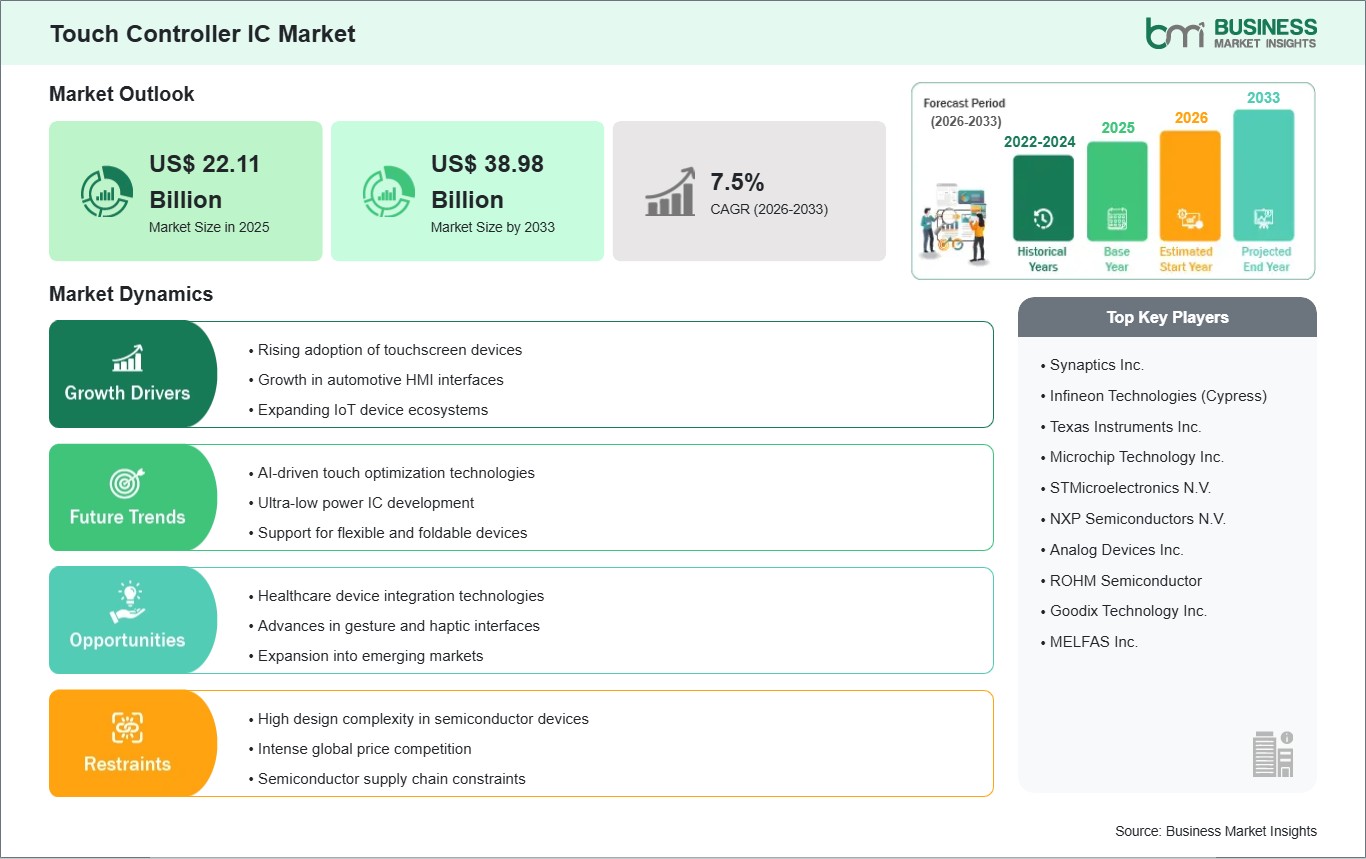
A Touch Controller IC (Integrated Circuit) is a specialized semiconductor device that acts as the "brain" of a touchscreen system. It sits between the physical touch sensor (capacitive or resistive) and the device’s main processor, translating analog electrical signals caused by a finger or stylus into digital X-Y coordinates. Modern touch ICs handle complex tasks like noise filtering, palm rejection (ignoring accidental hand placement), and multi-touch gesture processing, ensuring that the user interface remains responsive and accurate even in challenging conditions like moisture or extreme temperatures. Market expansion is primarily attributed to the rising global demand for flexible and foldable OLED displays, the rapid acceleration of large-format automotive screens (Hyperscreens), and the increasing adoption of stylus-enabled educational tablets. Furthermore, the integration of on-cell and in-cell touch technologies, which eliminate the need for a separate touch layer to make devices thinner and lighter, is substantially improving procedural efficiency for device manufacturers.
However, several challenges can restrain market growth: supply chain tightness at the 55nm and 40nm mixed-signal nodes can lead to longer lead times and increased procurement costs for OEMs. Intense pricing pressure, particularly in the high-volume smartphone segment, forces IC designers to constantly innovate on cost-reduction while maintaining performance. Additionally, the industry faces constraints due to complex signal interference issues in thinner OLED panels and the technical difficulty of maintaining touch accuracy on increasingly larger, curved automotive displays, which require high-voltage drive capabilities and advanced EMI shielding.
Despite these hurdles, the market holds immense opportunities in the universal mandate for digitalized cockpits and the accelerating deployment of ultra-low-power always-on AI sensing. The expansion of AR/VR smart glasses requiring tiny, efficient touch interfaces and the development of pressure-sensitive (Force Touch) ICs for professional creative tools are expected to create significant opportunities for market growth.
Segment Analysis
Touch Controller IC Market Segmentation
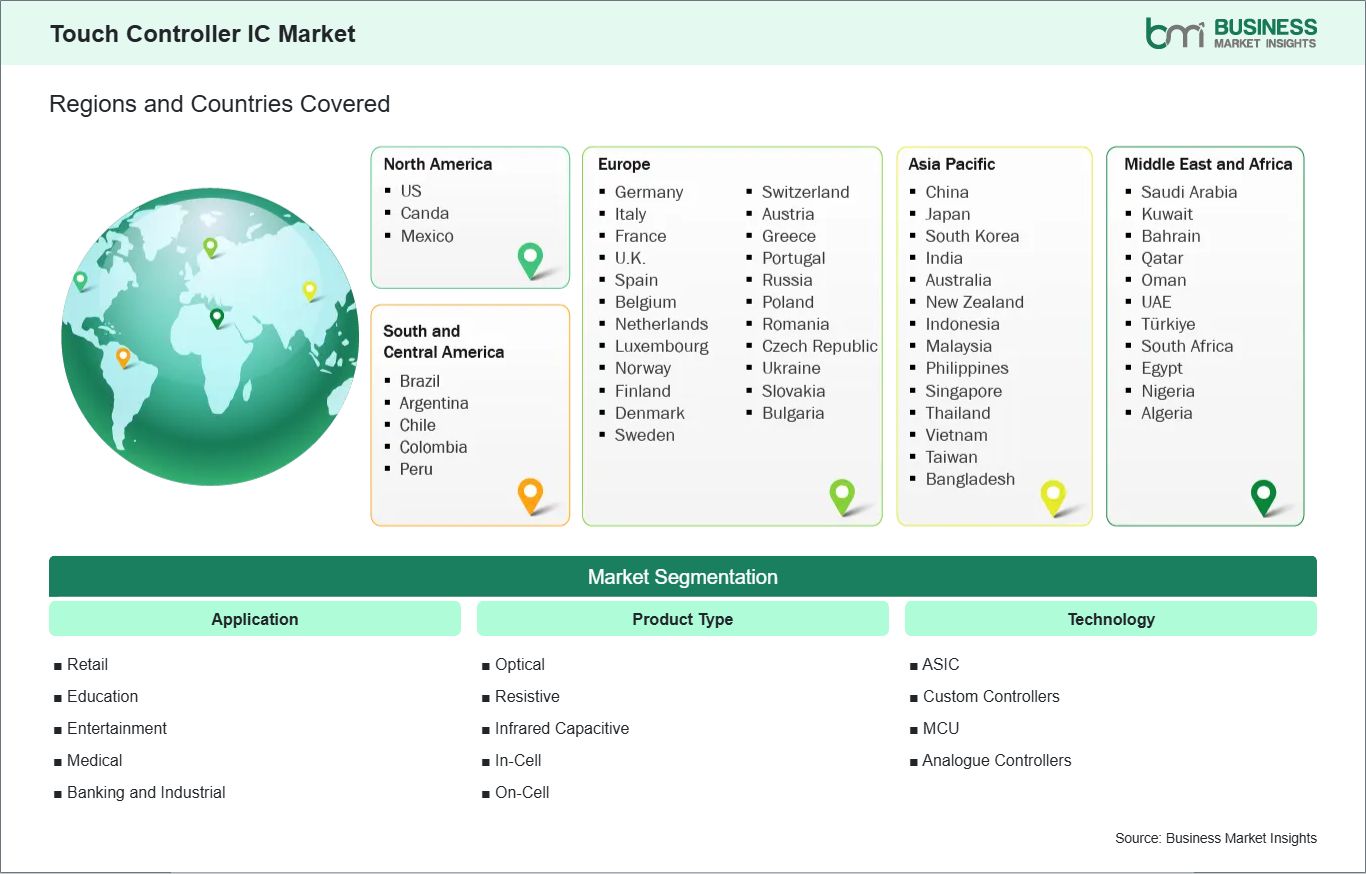
Key segments that contributed to the derivation of the Touch Controller IC market analysis are application, product type, and technology.
- By Application, the market is segmented into Retail, Education, Entertainment, Medical, Banking and Industrial.
- By Product Type, the market is divided into Optical, Resistive, Infrared Capacitive, In-Cell, and On-Cell.
- By Technology, the market is categorized into ASIC, Custom Controllers, MCU, and Analogue Controllers.
Market Forces
Touch Controller IC Market Drivers and Opportunities
Advancing Intuitive Human-Machine Interaction and Device Miniaturization
The primary driver for the Touch Controller IC Market is the accelerating global demand for sophisticated, multi-touch interfaces across consumer and industrial electronics. Market growth is fueled by the rising adoption of high-performance smartphones, tablets, and wearable devices that require increasingly responsive, low-latency, and power-efficient touch capabilities. This momentum is further amplified by the automotive industry's shift toward "digital cockpits," where traditional physical buttons are being replaced by large, curved, and integrated touch displays for infotainment and climate control. These applications demand specialized controller ICs with high signal-to-noise ratios (SNR) to operate reliably amidst electromagnetic interference from vehicle powertrains. Additionally, the proliferation of "smart home" appliances and industrial Human-Machine Interfaces (HMIs) has made touch interaction a non-discretionary standard. As users expect seamless gesture recognition and palm rejection even in challenging environments, such as with gloves or moisture, the necessity for advanced capacitive sensing ICs continues to grow at a high velocity.
AI-Driven Touch Processing and Foldable OLED Integration
A significant high-value opportunity lies in the convergence of Touch Controller ICs with Artificial Intelligence (AI) and Machine Learning. Next-generation "AI-native" controllers can autonomously filter out false touches, predict user intent through gesture trajectory analysis, and adapt sensitivity levels based on environmental noise or temperature. There is also a major growth frontier in the development of ICs specifically designed for Foldable and Flexible OLED displays. As manufacturers stretch screens over hinges and curved edges, a lucrative market is emerging for controllers that can manage variable pressure inputs and complex channel routing without compromising device thickness. Furthermore, the rise of In-Cell and On-Cell touch technologies presents an opportunity for higher integration, where the touch functionality is embedded directly into the display driver (TDDI), reducing the bill-of-materials and enabling "bezel-less" designs. Manufacturers who focus on ultra-low-power architectures for the burgeoning AR/VR headset market and those pioneering "touchless" proximity sensing are positioned to lead the most innovative and high-margin segments of the global semiconductor landscape.
Size and Share Analysis
Touch Controller IC Market Size and Share Analysis
The Touch Controller IC market demonstrates steady growth, with size and share analysis revealing evolving trends and competitive positioning among key players. The report further examines subsegments categorized within application, product type, and technology, offering insights into their contribution to overall market performance.
Based on application subsegment, the Entertainment and Industrial sectors hold a significant market presence, while the Medical, Banking, and Retail sectors are emerging as high-value priorities. The Banking and Retail sectors are serving as primary drivers for self-service technologies, where the adoption of touch-enabled ATMs and interactive point-of-sale (POS) systems is accelerating to facilitate contactless transactions. In the Medical and Industrial fields, the market is seeing a push for high-reliability ICs; medical applications are adopting controllers for diagnostic monitors that require "hygiene compatibility" or glove-touch support, while the industrial sector continues to prioritize ruggedized ICs capable of operating in high-interference environments. Furthermore, the Education and Entertainment sectors are fueling demand for large-format and high-refresh-rate controllers, essential for interactive whiteboards and immersive gaming experiences that require precise multi-touch accuracy across expansive surfaces.
Report Coverage
Touch Controller IC Market Report Coverage and Deliverables
The "Touch Controller IC Market Size and Forecast (2022 - 2033)" report provides a detailed analysis of the market covering below areas:
- Touch Controller IC market size and forecast at global, regional, and country levels for all the key market segments covered under the scope
- Touch Controller IC market trends, as well as market dynamics such as drivers, restraints, and key opportunities
- Touch Controller IC market analysis covering key market trends, global and regional framework, major players, regulations, and recent market developments
- Industry landscape and competition analysis covering market concentration, heat map analysis, prominent players, and recent developments for the Touch Controller IC market
- Detailed company profiles, including SWOT analysis
Geographic Insights
Touch Controller IC Market Geographic Insights
The geographical scope of the Touch Controller IC market report is divided into five regions: North America, Asia Pacific, Europe, Middle East & Africa, and South & Central America.
The Asia-Pacific Touch Controller IC Market is segmented into China, Japan, South Korea, India, Australia, New Zealand, Indonesia, Malaysia, the Philippines, Singapore, Thailand, Vietnam, Taiwan, Bangladesh, and the Rest of Asia. In 2026, this region will be the fastest-growing market globally. The expansion is primarily fueled by the rapid rollout of 5G-enabled smartphones and the massive transition toward digital cockpits in the regional automotive industry. China remains the single largest contributor, supported by government initiatives to boost domestic chip self-sufficiency. Meanwhile, India and Vietnam are emerging as critical secondary manufacturing hubs as global OEMs diversify their supply chains to enhance resilience against geopolitical shifts.
Growth is further bolstered by a significant shift toward multi-touch and gesture-recognition ICs among manufacturers looking to provide more intuitive user experiences in wearables and smart home devices. The integration of high-sensitivity capacitive sensors that support "wet-finger" and "glove-touch" capabilities, alongside the rising demand for low-power ICs for extended battery life in portable electronics, solidifies Asia-Pacific as a critical hub for innovation and the future scaling of the Touch Controller IC industry.
Industry Activity
Recent Developments
Touch Controller IC Market News and Key Development:
The Touch Controller IC market is evaluated by gathering qualitative and quantitative data post primary and secondary research, which includes important corporate publications, association data, and databases. A few of the key developments in the Touch Controller IC market are:
- In February 2026, Himax Technologies announced the mass production of its HX85200 series OLED touch controller IC for high-end laptops and tablets. The IC integrates advanced signal processing and algorithms to deliver precise multi-finger touch with minimal display interference across various OLED panel types. This launch underscores ongoing innovation in Touch Controller IC solutions, enhancing display-touch integration and performance for next-generation IT devices.
In November 2025,Synaptics and Qualcomm Technologies entered a strategiccollaboration to advance touch and fingerprint sensor technologies across mobile and PC platforms. The partnership aims to enable AI-enhanced, secure, and seamless user experiences while simplifying integration for OEMs. By combining their strengths, the companies are expected to shape the future of Touch Controller IC solutions and support the broader adoption of advanced human-interface technologies.
Trust & Transparency
Research Methodology
The market analysis combines proprietary research with secondary data from government agencies, company disclosures, regulatory filings, industry databases and expert interviews. Market estimates are validated through data triangulation, cross-market benchmarking and analyst
review.
View Full Research Methodology
Key Sources Referred:
World Bank - Global Trade IndicatorsWorld Trade Organization (WTO)International Monetary Fund (IMF)International Trade Administration (ITA)Company websiteCompany annual reportsCompany investor presentations