Market Summary
Executive Summary and Global Market Analysis
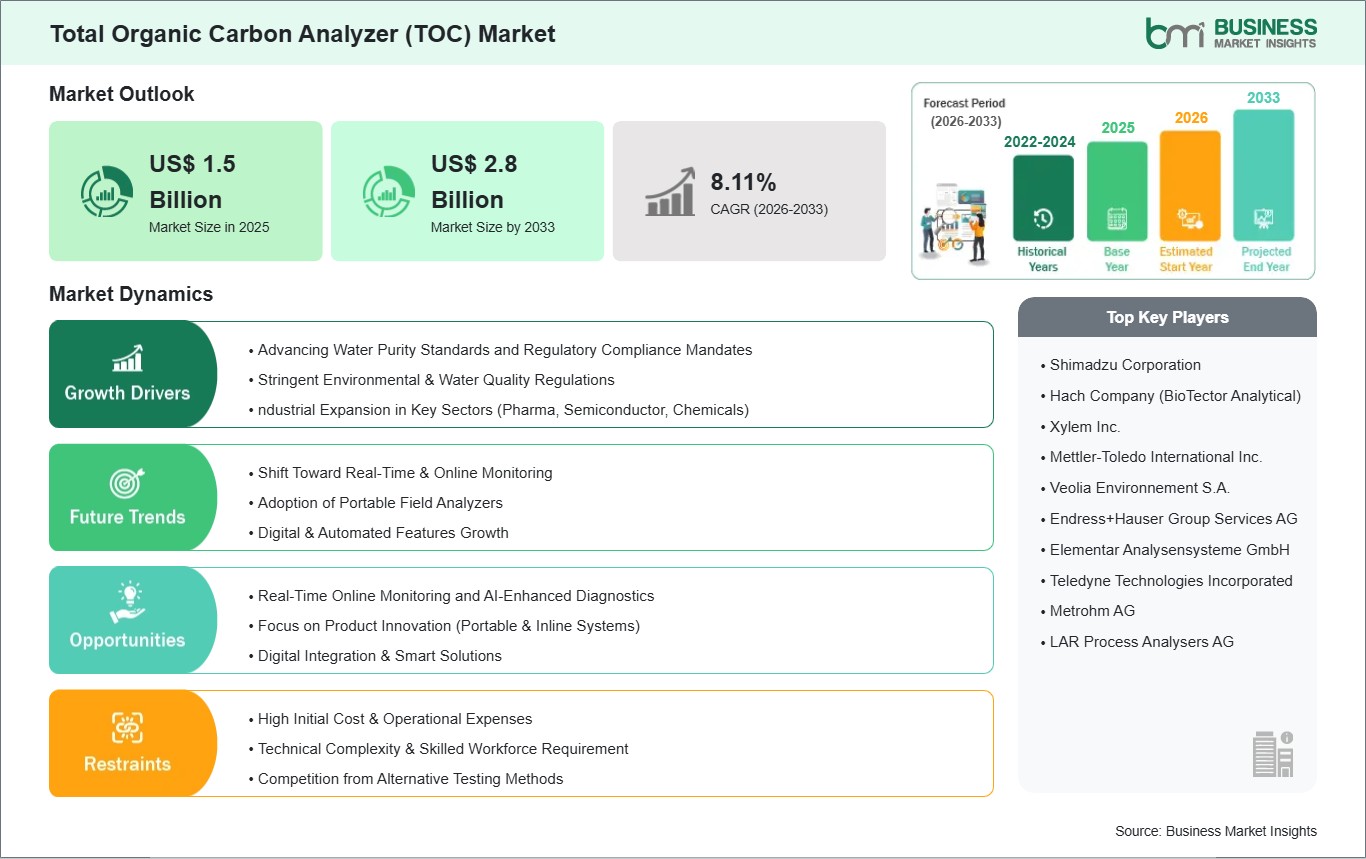
A total organic carbon (TOC) analyzer is a high-precision instrument that measures the total carbon in organic compounds within liquid or solid samples. It oxidizes organic molecules into carbon dioxide (CO₂), typically using high-temperature combustion, UV radiation, or chemical persulfate oxidation. The resulting gas is then quantified with Non-Dispersive Infrared (NDIR) sensors or conductivity detectors. Market growth is driven by increased semiconductor manufacturing, rising demand for real-time water quality monitoring in smart cities, and stricter environmental discharge regulations in emerging economies. The adoption of automated validation protocols and IoT-enabled remote diagnostics is also improving ROI for industrial facilities by reducing human error and downtime.
However, several challenges may restrain market growth. High initial capital expenditure for advanced online systems can limit adoption among small and medium-sized enterprises (SMEs). Technical complexities in handling high-salt or high-particulate industrial effluents require specialized oxidation technologies, increasing operational costs. The industry also faces constraints from strict calibration and maintenance requirements, as the need for high-purity reagents and skilled technicians creates significant financial and logistical burdens for decentralized testing facilities.
Despite these challenges, the market offers significant opportunities due to the universal mandate for circular water management and the growing use of automated cleaning validation in bioprocessing. The expansion of portable analyzers for environmental field testing and the development of reagent-free electrochemical oxidation methods are also expected to drive market growth.
Segment Analysis
Total Organic Carbon Analyzer (TOC) Market Segmentation
Key segments that contributed to the derivation of the Total Organic Carbon Analyzer (TOC) market analysis are analyzer type, application, and component.
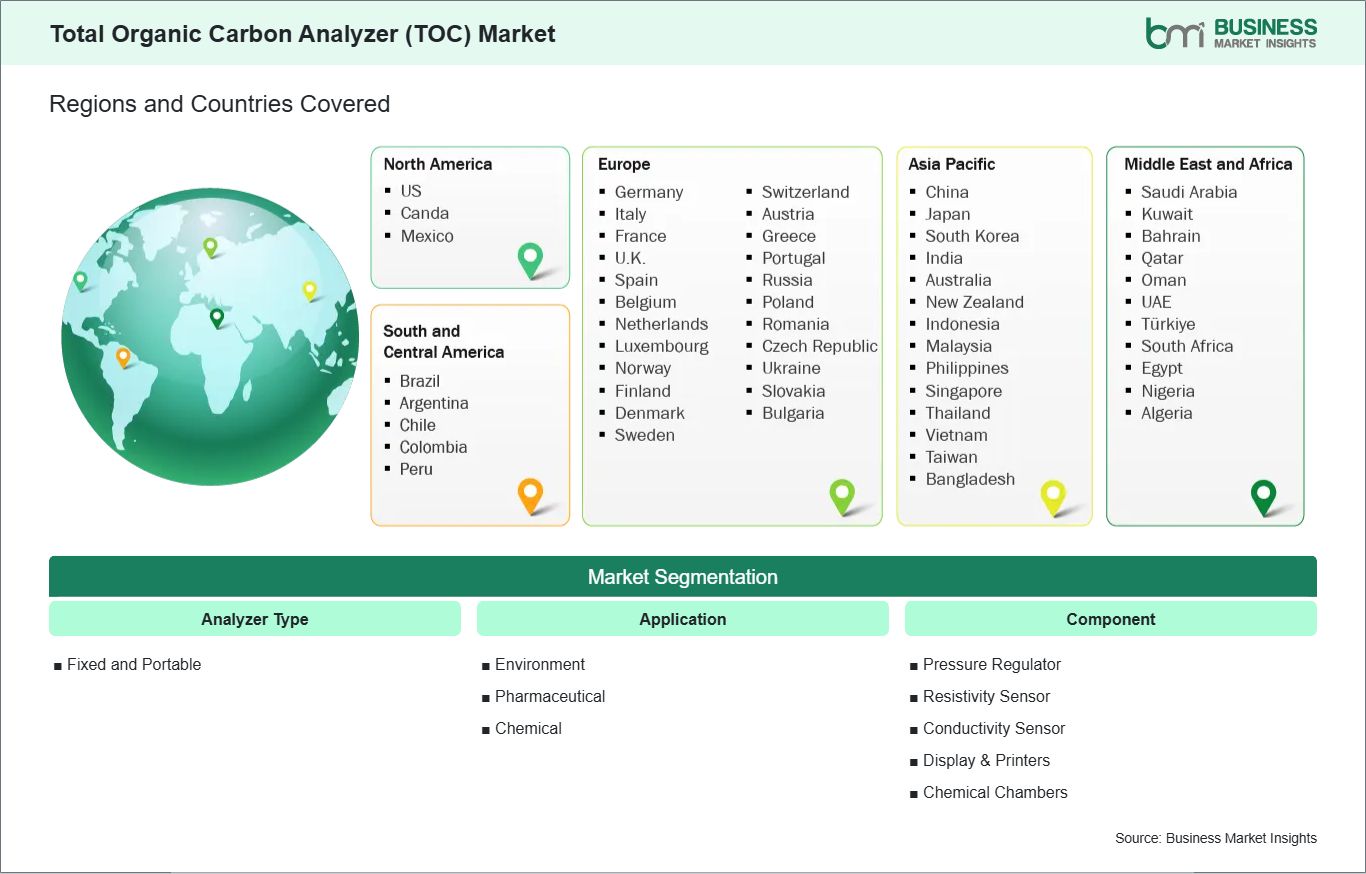
- By Analyzer Type, the market is segmented into Fixed and Portable.
- By Application, the market is divided into Environment, Pharmaceutical, and Chemical.
- By Component, the market is categorized into Pressure Regulator, Resistivity Sensor, Conductivity Sensor, Display and Printers, and Chemical Chambers.
Market Forces
Total Organic Carbon Analyzer (TOC) Market Drivers and Opportunities
Advancing Water Purity Standards and Regulatory Compliance Mandates
The primary driver for the Total Organic Carbon (TOC) Analyzer Market is the intensifying global requirement for high-purity water across regulated industries and the tightening of environmental discharge standards. The pharmaceutical and biotechnology sectors remain the dominant catalysts, where measuring organic contaminants is a non-discretionary step in validating Water for Injection (WFI) and cleaning protocols to meet stringent pharmacopeia standards. This momentum is further amplified by the semiconductor and microelectronics industries, which require ultrapure water (UPW) to prevent microscopic organic residues from causing defects in increasingly dense integrated circuits.
Furthermore, municipal water authorities are facing stricter mandates from environmental agencies to monitor Natural Organic Matter (NOM) to prevent the formation of harmful disinfection by-products. These regulatory pressures, combined with the rising need for industrial wastewater treatment to protect aquatic ecosystems, ensure that TOC analysis is an essential pillar of global quality control and environmental stewardship.
Real-Time Online Monitoring and AI-Enhanced Diagnostics
A significant high-value opportunity lies in the transition from traditional laboratory-based testing to Online and Continuous TOC Monitoring. By integrating analyzers directly into the process stream, facilities can move toward real-time contamination detection, allowing for immediate corrective actions that prevent product loss and reduce operational downtime. There is also a major growth frontier in the adoption of Portable and Handheld TOC Analyzers for field-based environmental testing and rapid on-site audits in decentralized manufacturing locations.
Furthermore, the integration of AI-driven diagnostics and IoT connectivity presents a lucrative opportunity for "Smart TOC" systems. These platforms can autonomously manage calibration schedules, predict sensor degradation, and provide cloud-based data logs that simplify audit readiness for regulatory inspections. Manufacturers who focus on developing "low-maintenance" combustion and UV-oxidation modules for harsh industrial environments, as well as those pioneering modular designs for easy component replacement, are positioned to lead the most innovative and high-margin segments of the global analytical instrumentation landscape.
Size and Share Analysis
Total Organic Carbon Analyzer (TOC) Market Size and Share Analysis
Based on analyzer type, the Fixed subsegment holds the dominant market share, representing the gold standard for centralized quality control. Fixed analyzers are indispensable for the Pharmaceutical sector, where they provide the high-throughput, validated data required for compendial water testing (USP/EP). A notable trend is the surge in the Portable subsegment, which is registering a higher CAGR as industries move toward "at-line" and field-based testing. Portable units are becoming essential for environmental first responders and mobile lab units, allowing for immediate on-site decision-making without the delays of transporting samples to a central facility. This shift is particularly vital for the Environment sector, enabling faster detection of illicit discharge or accidental spills in municipal waterways.
Report Coverage
Total Organic Carbon Analyzer (TOC) Market Report Coverage and Deliverables
The "Total Organic Carbon Analyzer (TOC) Market Size and Forecast (2022 - 2033)" report provides a detailed analysis of the market covering below areas:
- Total Organic Carbon Analyzer (TOC) market size and forecast at global, regional, and country levels for all the key market segments covered under the scope
- Total Organic Carbon Analyzer (TOC) market trends, as well as market dynamics such as drivers, restraints, and key opportunities
- Total Organic Carbon Analyzer (TOC) market analysis covering key market trends, global and regional framework, major players, regulations, and recent market developments
- Industry landscape and competition analysis covering market concentration, heat map analysis, prominent players, and recent developments for the Total Organic Carbon Analyzer (TOC) market
- Detailed company profiles, including SWOT analysis
Geographic Insights
Total Organic Carbon Analyzer (TOC) Market Geographic Insights
The geographical scope of the Total Organic Carbon Analyzer (TOC) market report is divided into five regions: North America, Asia Pacific, Europe, Middle East and Africa, and South and Central America.
North America currently stands as the largest market. This leadership is driven by the United States’ stringent environmental mandates from the EPA and a robust pharmaceutical and biotechnology sector that requires ultra-pure water monitoring. Europe also represents a significant share, characterized by mature regulatory frameworks (such as the EU Water Framework Directive) and a high concentration of leading analytical instrument manufacturers in Germany, Switzerland, and the UK.
The Asia-Pacific Total Organic Carbon Analyzer (TOC) Market is segmented into China, Japan, South Korea, India, Australia, New Zealand, Indonesia, Malaysia, the Philippines, Singapore, Thailand, Vietnam, Taiwan, Bangladesh, and the Rest of Asia. This region is emerging as the fastest-growing market globally. The expansion is primarily fueled by rapid industrialization, increasing urbanization, and massive investments in wastewater treatment infrastructure. China and India lead the regional growth, supported by a burgeoning semiconductor industry and tightening government regulations regarding industrial effluent discharge. Japan remains a critical high-tech hub, focusing on high-precision TOC analysis for advanced electronics manufacturing.
Industry Activity
Recent Developments
The Total Organic Carbon Analyzer (TOC) market is evaluated by gathering qualitative and quantitative data post primary and secondary research, which includes important corporate publications, association data, and databases. A few of the key developments in the Total Organic Carbon Analyzer (TOC) market are:
- In March 2025, Shimadzu Corporation inaugurated the Shimadzu Kobe Innovation Lab in Kobe, Japan, equipped with analytical instruments including TOC analyzers. The lab will support a collaborative project with Kaneka, JGC Holdings, and Bacchus Bio Innovation focused on producing bioplastics from CO₂ using microorganisms. This initiative highlights growing adoption of TOC analyzers in RandD and is expected to accelerate market demand and technological development.
- In April 2024, Beckman Coulter Life Sciences launched the QbD1200+ Total Organic Carbon (TOC) Analyzer, designed for pharmaceutical and biopharmaceutical applications. The analyzer features a digital NDIR sensor, automated system checks, and an intuitive touchscreen interface, enabling simplified workflows, reliable results, and compliance with global pharmacopeia regulations. This launch highlights continued innovation in TOC analyzers and is expected to strengthen market adoption and efficiency across critical laboratory segments.
Trust & Transparency
Research Methodology
The market analysis combines proprietary research with secondary data from government agencies, company disclosures, regulatory filings, industry databases and expert interviews. Market estimates are validated through data triangulation, cross-market benchmarking and analyst
review.
View Full Research Methodology
Key Sources Referred:
World Bank - Global Trade Indicators World Trade Organization (WTO) International Monetary Fund (IMF) International Trade Administration (ITA) Company website Company annual reports Company investor presentations