Market Summary
Executive Summary and Global Market Analysis
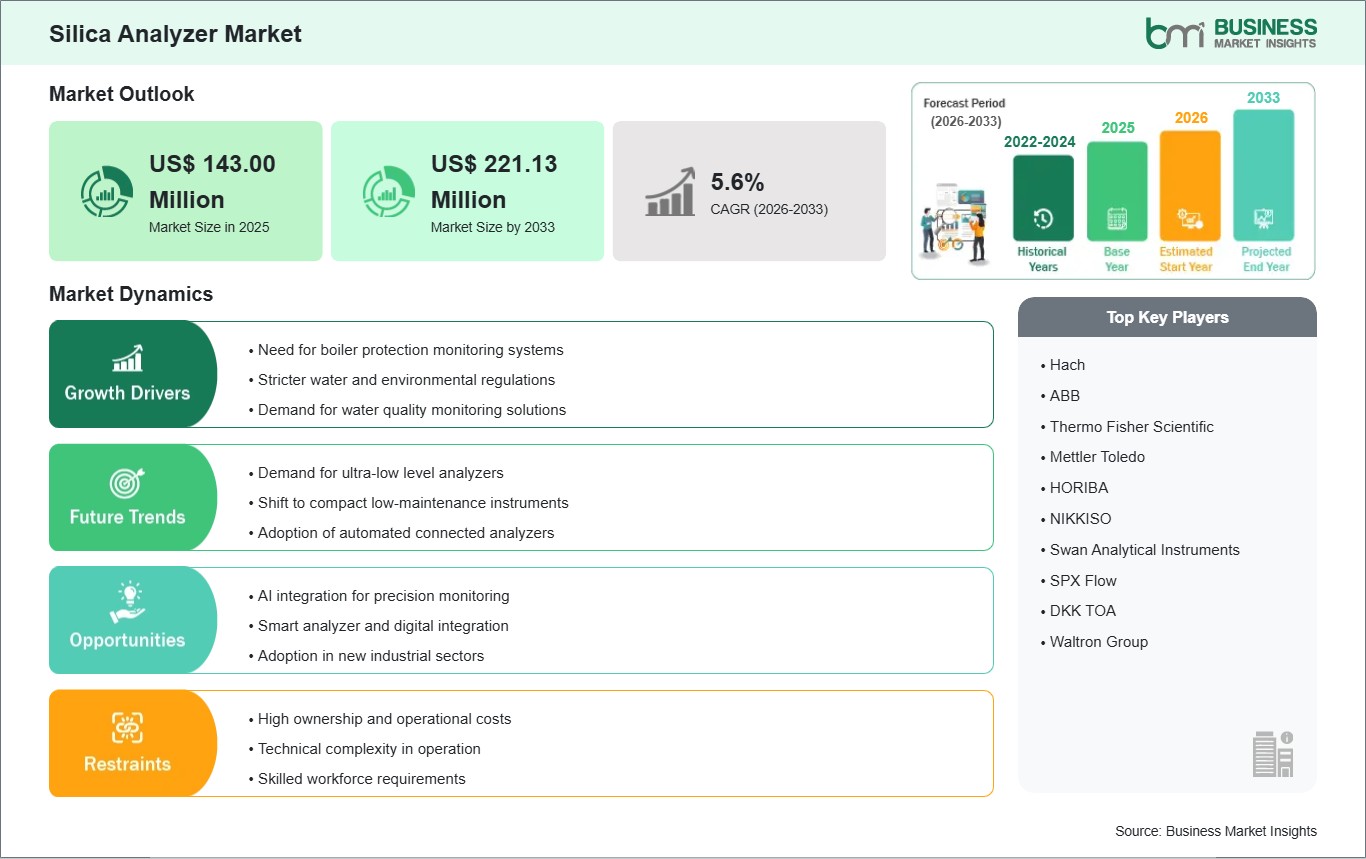
Silica analyzers are specialized analytical instruments used to monitor silica SiO₂ concentrations in water and steam, serving as a critical safeguard for high-value industrial assets. They are essential for industries such as power generation and semiconductors, where even trace amounts of silica can lead to catastrophic equipment failure or product defects. Silica analysis offers vital advantages, including the prevention of glass-like scale formation on turbine blades, protection of high-pressure boiler tubes from overheating, and ensuring the production of ultra-pure water (UPW) required for microchip fabrication. Increasing global electricity demand, the massive expansion of semiconductor "mega-fabs," and the growing complexity of industrial water cycles are fueling the market. Additionally, innovations in reagent-saving technologies, automated calibration, and Industrial IoT (IIoT) are enhancing operational efficiency and data accessibility.
However, several challenges can restrain market growth, such as high initial capital expenditures, the ongoing cost of proprietary reagents, and the technical expertise required for regular maintenance and calibration. The industry is also sensitive to fluctuations in industrial manufacturing output and changes in environmental water discharge regulations. Despite these hurdles, the market holds significant opportunities driven by the rising adoption of smart, cloud-connected analyzers, the construction of next-generation nuclear and super-critical thermal power plants, and the increased demand for high-purity water in emerging electronics hubs. Investment in self-diagnostic sensors and modular equipment designs is also expected to open new avenues for market expansion.
Segment Analysis
Silica Analyzer Market Segmentation
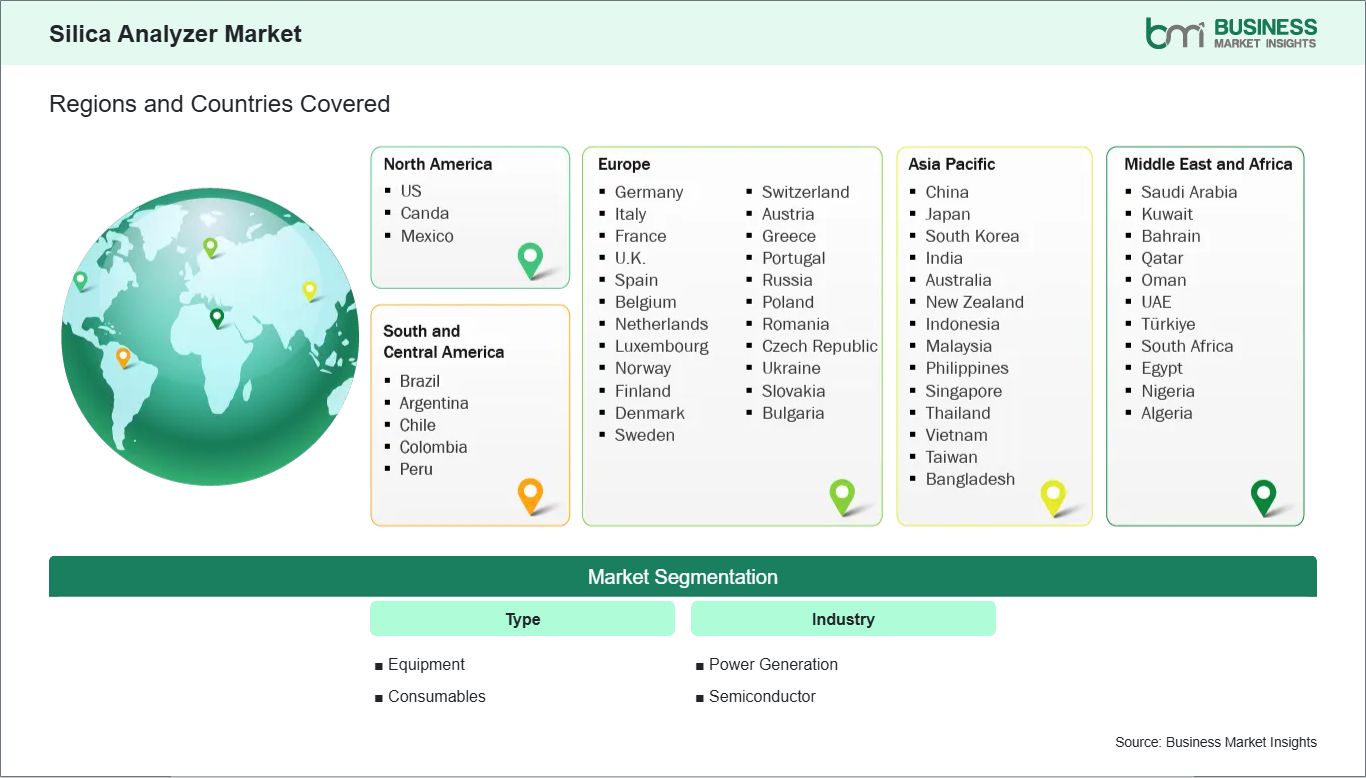
Key segments that contributed to the derivation of the Silica Analyzer market analysis are type and industry.
- By Type, the market is segmented into Equipment and Consumables.
- By Industry, the market is categorized into Power Generation and Semiconductor.
Market Forces
Silica Analyzer Market Drivers and Opportunities
Precise Monitoring Needs for Boiler Protection in Power Generation
The non-negotiable requirement for ultra-low level silica monitoring in high-pressure steam boilers stands as a primary driver for the market. In the power industry, silica is uniquely problematic because it becomes volatile at high pressures, carrying over into the steam phase and depositing as a hard, insulating mineral scale on turbine blades. This scaling disrupts aerodynamic efficiency and can cause severe mechanical imbalances, leading to catastrophic failure or mandatory, expensive overhauls.
Modern super-critical and ultra-super-critical power plants operate under extreme conditions where the tolerance for impurities is virtually zero, often requiring silica levels to stay below 5-10 ppb. As developing nations expand their energy grids and developed nations modernize aging plants, the demand for high-precision online silica analyzers has intensified. Furthermore, the push for operational longevity means utilities are investing more in continuous monitoring equipment to protect their turbines, which represent the single most expensive asset in a power plant, ensuring that uptime is maximized and unplanned maintenance is strictly minimized across global energy networks.
Integration of Artificial Intelligence for Precision Monitoring
The integration of Artificial Intelligence (AI) and Machine Learning (ML) into water quality monitoring represents a transformative opportunity for the silica analyzer market. Traditionally, silica analyzers required rigid maintenance schedules and manual data interpretation. However, the emergence of "Smart Analyzers" equipped with AI-driven diagnostics allows for predictive maintenance, where the system can alert operators before a sensor fails or reagents run low. This transition from reactive to proactive monitoring significantly reduces the Total Cost of Ownership (TCO) for industrial plants. AI algorithms can also filter out "noise" in the data caused by air bubbles or temperature fluctuations, providing a level of measurement stability previously unattainable. For industries like semiconductor manufacturing, where a single false reading can lead to the disposal of an entire wafer batch, the increased reliability offered by AI-enhanced systems is a major selling point. As facilities move toward "Industry 4.0" and fully autonomous water treatment plants, the demand for these intelligent, self-optimizing silica analyzers is expected to grow rapidly, creating a lucrative, high-margin segment for innovative manufacturers.
Size and Share Analysis
Silica Analyzer Market Size and Share Analysis
Based on type, Equipment currently accounts for a significant share of the initial market value, but the Consumables segment is recording faster growth due to the recurring need for reagents and maintenance kits over the 10-15 year lifespan of an analyzer.
In terms of industry, the power generation segment is fueled by the sheer number of thermal and nuclear facilities worldwide that require multiple monitoring points per unit. Semiconductor manufacturing is the fastest-growing industry segment, driven by the intense purity requirements of modern electronics and the rapid capital investment in new production facilities in Asia-Pacific and North America.
Report Coverage
Silica Analyzer Market Report Coverage and Deliverables
The "Silica Analyzer Market Size and Forecast (2022 - 2033)" report provides a detailed analysis of the market covering below areas:
- Silica Analyzer market size and forecast at global, regional, and country levels for all the key market segments covered under the scope.
- Silica Analyzer market trends, as well as market dynamics such as drivers, restraints, and key opportunities.
- Silica Analyzer market analysis covering key market trends, global and regional framework, major players, regulations, and recent market developments.
- Industry landscape and competition analysis covering market concentration, heat map analysis, prominent players, and recent developments for the Silica Analyzer Market.
- Detailed company profiles, including SWOT analysis.
Geographic Insights
Silica Analyzer Market Geographic Insights
The geographical scope of the Silica Analyzer market report is divided into five regions: North America, Asia Pacific, Europe, Middle East & Africa, and South & Central America.
The Asia-Pacific market is fueled by the massive concentration of coal-fired and nuclear power plants in China and India, alongside the world's most advanced semiconductor fabrication hubs in Taiwan and South Korea. Strategic government initiatives, such as South Korea's plan to increase semiconductor tax incentives to 25%, are significantly boosting demand for ultra-pure water monitoring. North America follows as the second-largest market, driven by the expansion of data-center-driven energy demand and the resurgence of domestic semiconductor manufacturing under the U.S. CHIPS Act.
Europe maintains a stable market position with a focus on strict environmental water quality standards and the modernization of chemical manufacturing sectors in Germany and France. The Middle East & Africa and South & Central America are emerging as high-potential regions, with growth primarily linked to the expansion of desalination plants and the development of new industrial water treatment infrastructure to support growing urban populations.
Industry Activity
Recent Developments
The Silica Analyzer market is evaluated by gathering qualitative and quantitative data post primary and secondary research, which includes important corporate publications, association data, and databases. A few of the key developments in the silica analyzer market are:
- In March 2025, Thermo Fisher Scientific Inc. announced the launch of the Thermo Scientific Vulcan™ Automated Lab, a groundbreaking solution designed to drive a new era of process development and control in semiconductor manufacturing. The seamlessly integrated system is designed to enhance productivity, increase yield, and reduce operating costs for semiconductor manufacturers.
- In May 2024, HORIBA Group announced the release of the Laser Gas Analyzer LG-100 Series. Supporting advanced manufacturing processes for semiconductors through HORIBA’s unique built-in IRLAM infrared gas analysis technology.
Trust & Transparency
Research Methodology
The market analysis combines proprietary research with secondary data from government agencies, company disclosures, regulatory filings, industry databases and expert interviews. Market estimates are validated through data triangulation, cross-market benchmarking and analyst
review.
View Full Research Methodology
Key Sources Referred:
World Bank - Global Trade IndicatorsWorld Trade Organization (WTO)International Monetary Fund (IMF)International Trade Administration (ITA)Company websiteCompany annual reportsCompany investor presentations