Market Summary
Executive Summary and Global Market Analysis
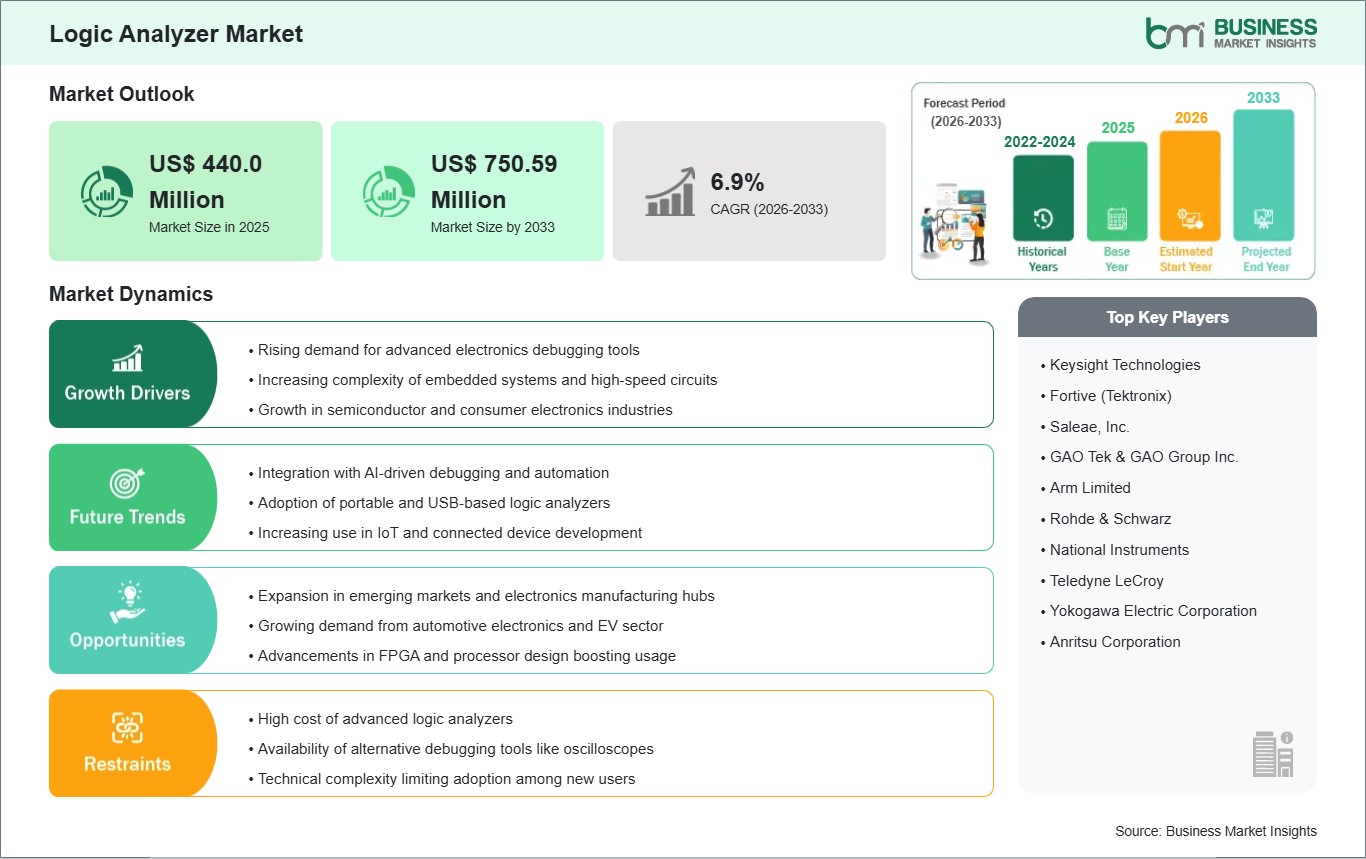
A logic analyzer is a specialized electronic test instrument designed to capture, display, and analyze multiple digital signals simultaneously from a digital system or circuit. Unlike an oscilloscope, which primarily measures analog voltage characteristics over time, a logic analyzer focuses on digital signal transitions, timing relationships, and protocol activity across numerous channels. Market expansion is fundamentally propelled by the rapid proliferation of IoT devices and the surging complexity of automotive electronics, particularly in autonomous and connected vehicle systems.
However, several factors may restrain market progression. The high cost of advanced, high-bandwidth benchtop units and a steep learning curve for sophisticated protocol analysis features can deter adoption by smaller research and development (R&D) firms. Technical challenges regarding signal integrity at ultra-high frequencies necessitate expensive specialized probing solutions, which further increases the total cost of ownership. Additionally, the industry faces competition from Mixed-Signal Oscilloscopes (MSOs), which integrate basic logic analysis capabilities into a single analog-digital instrument, potentially cannibalizing the entry-level and mid-range stand-alone logic analyzer segments.
Despite these hurdles, the market holds significant opportunities in the growth of modular and PC-based logic analyzers, which offer a balance of portability and cost-effectiveness for field diagnostics and academic use. The expansion into 5G telecommunications infrastructure and the demand for AI-driven automated debugging tools are expected to support long-term development. Manufacturers are also finding growth potential in cloud-integrated collaborative testing platforms, allowing distributed engineering teams to share and analyze captured signal data in real-time.
Segment Analysis
Logic Analyzer Market Segmentation
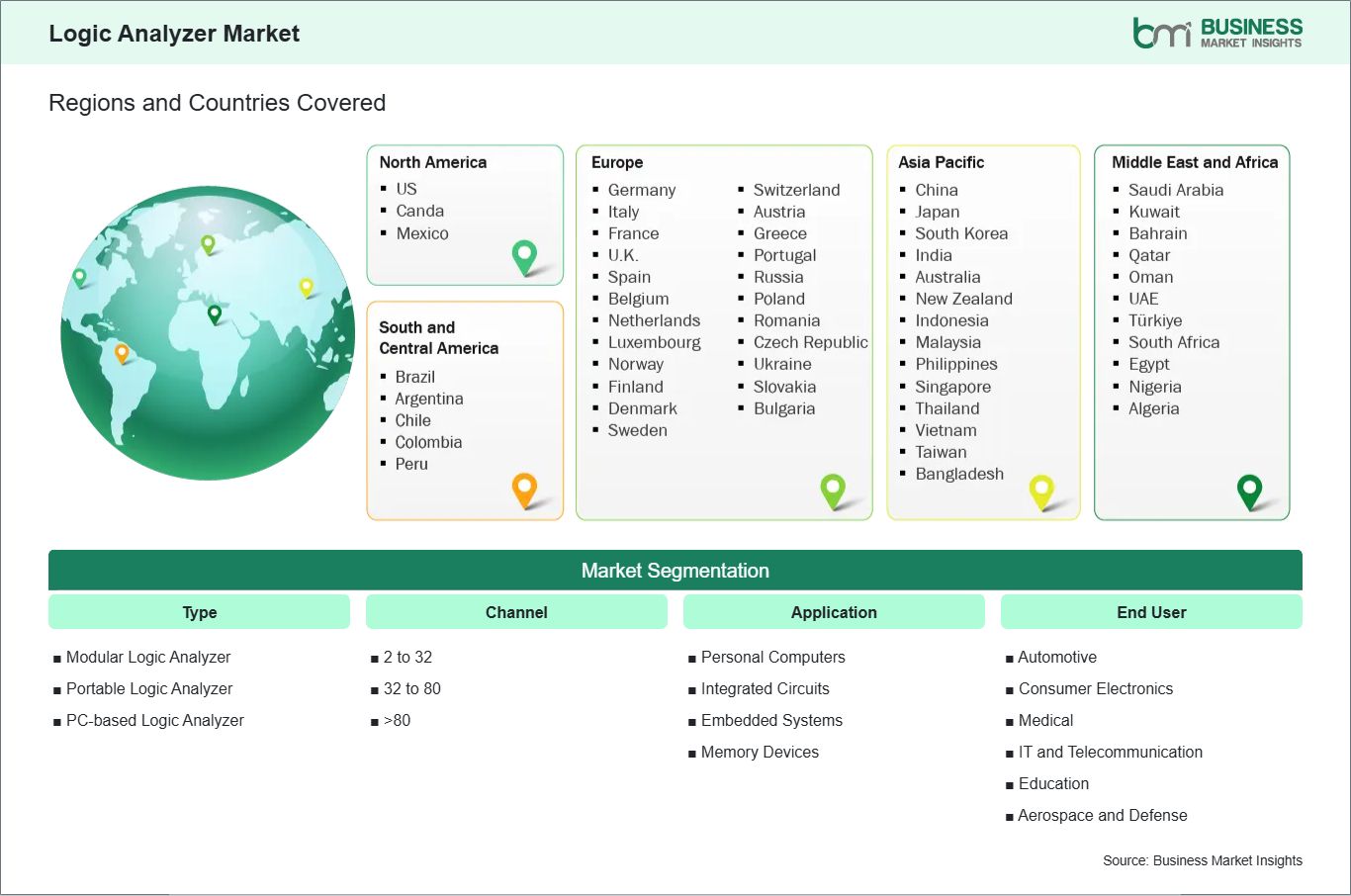
Key segments that contributed to the derivation of the Logic Analyzer market analysis are type, channel, application, and end user.
- By Type, the market is segmented into Modular Logic Analyzer, Portable Logic Analyzer, and PC-based Logic Analyzer.
- By Channel, the market is divided into 2 to 32, 32 to 80, and >80.
- By Application, the market is categorized into Personal Computers, Integrated Circuits, Embedded Systems, and Memory Devices.
- By End User, the market is categorized into Automotive, Consumer Electronics, Medical, IT and Telecommunication, Education, and Aerospace and Defense.
Market Forces
Logic Analyzer Market Drivers and Opportunities
Design Complexity and the Proliferation of Edge AI
The primary driver for the Logic Analyzer Market is the systemic global requirement to verify the integrity of high-speed data transfers within highly complex electronic systems. The Exponential Complexity of Digital System Design acts as a foundational catalyst, as the shift toward sub-7 nanometer process nodes and advanced packaging (such as chiplets) creates intricate timing and signal integrity challenges that necessitate sophisticated multi-channel analysis. This momentum is further propelled by the Rapid Integration of AI and Machine Learning at the Edge, which requires high-performance logic analyzers to debug the real-time inference and local data processing tasks of advanced microcontrollers. In the technological sphere, the Global Rollout of 5G and Preparations for 6G Infrastructure serve as a vital driver, as high-frequency communication protocols demand precise signal capture and correlation across dozens of channels simultaneously. Furthermore, the Strategic Expansion of Autonomous Vehicle Electronics is driving non-discretionary demand, as the development of Advanced Driver Assistance Systems (ADAS) and in-vehicle networks requires rigorous validation of mission-critical control units to meet global safety standards. Together, these factors, design intricacy, edge intelligence, and network evolution, ensure a robust and essential growth path for the global Logic Analyzer Market.
Cloud-Enabled Debugging and the Rise of Modular PC-Based Systems
A significant high-value opportunity lies in the convergence of Logic Analyzer Hardware with Cloud-Native Analytics and Software-Defined Architectures. Next-generation Intelligent Logic Analyzers with AI-Assisted Signal Interpretation are being developed to autonomously filter through terabytes of captured data to isolate rare glitches, providing a major growth frontier for teams seeking to reduce time-to-market for complex SOCs. There is also a significant growth frontier in the development of High-Bandwidth, PC-Based Modular Analyzers; as portability and cost-efficiency become paramount, the demand for USB or Ethernet-connected hardware that leverages the processing power of modern workstations for visualization and storage is expanding rapidly. Furthermore, the expansion of Cloud-Enabled Remote Testing Solutions presents a lucrative opportunity, allowing distributed engineering teams to collaborate on debugging physical hardware in real-time from different geographical locations. Beyond traditional R&D, the rise of Integrated Mixed-Signal Platforms, which combine logic analysis with oscilloscope and spectrum analyzer capabilities, offers a unique frontier for testing the increasingly blurred lines between digital and analog domains in IoT devices. Manufacturers who focus on Open-Architecture API Support for Automated Test Equipment (ATE) and those pioneering High-Density, Low-Loading Probing Technologies are positioned to lead the global Logic Analyzer Market.
Size and Share Analysis
Logic Analyzer Market Size and Share Analysis
The Logic Analyzer market demonstrates steady growth, with size and share analysis revealing evolving trends and competitive positioning among key players. The report examines subsegments categorized within type, channel, application, and end user, offering insights into their contribution to overall market performance.
Based on type, the PC-based Logic Analyzer subsegment is registering the highest pace of adoption in the market. These analyzers are becoming essential for Agile Prototyping and Remote Debugging, as the strategic requirement for portable and cost-effective tools enables distributed engineering teams to conduct sophisticated signal analysis without reliance on capital-intensive benchtop hardware. By combining accessibility with advanced functionality, PC-based analyzers are strengthening their influence, positioning themselves as a critical driver of next-generation electronic design and collaborative development practices.
Report Coverage
Logic Analyzer Market Report Coverage and Deliverables
The "Logic Analyzer Market Size and Forecast (2022 - 2033)" report provides a detailed analysis of the market covering below areas:
- Market size and forecast at global, regional, and country levels for all market segments covered under the scope
- Market trends, as well as drivers, restraints, and opportunities
- Market analysis covering key trends, global and regional framework, major players, and recent developments
- Market concentration, heat map analysis, prominent players, and recent developments
- Detailed company profiles, including SWOT analysis
Geographic Insights
Logic Analyzer Market Geographic Insights
The geographical scope of the Logic Analyzer market report is divided into five regions: North America, Asia Pacific, Europe, Middle East & Africa, and South & Central America.
North America remains the dominant market by revenue, supported by a concentration of leading semiconductor designers and substantial aerospace and defense spending. Asia Pacific is identified as the fastest-growing region, propelled by the massive expansion of semiconductor fabrication facilities and the proliferation of consumer electronics manufacturing hubs. Europe maintains a strong position through its leadership in automotive electronics and industrial automation sectors. The Asia-Pacific Logic Analyzer Market serves as the primary engine for global expansion, anchored by the presence of major technology ecosystems in China, Taiwan, South Korea, and Japan. The region benefits from significant government-led initiatives to achieve semiconductor self-sufficiency and the rapid rollout of 5G infrastructure. China remains the leading force, driven by large-scale investments in integrated circuit (IC) design and the manufacturing of smart devices. India is emerging as a critical growth corridor, supported by rising electronics manufacturing services (EMS) and an increasing focus on localized research and development (R&D).
Industry Activity
Recent Developments
The Logic Analyzer market is evaluated by gathering qualitative and quantitative data post primary and secondary research, which includes important corporate publications, association data, and databases. A few of the key developments in the Logic Analyzer market are:
- In April 2025, Softing Industrial Automation acquired Delta Logic Automatisierungstechnik GmbH, enhancing its industrial communication portfolio with PC-to-PLC and OPC UA solutions. This acquisition strengthens Softing`s expertise in Siemens controllers and Industry 4.0-ready data exchange, creating new growth opportunities in industrial automation and logic analyzer applications. Full integration is expected by early 2026, with Delta Logic products rebranded under Softing Industrial to expand global market reach.
- In November 2025, Good Will Instrument Co., Ltd. introduced the GDS-3102A (2-channel) and GDS-3104A (4-channel) 1 GHz Digital Storage Oscilloscopes, offering 200 Mpts memory per channel and 5 GSa/s real-time sampling. With the optional DS3A-16LA module, these instruments can be upgraded to Mixed-Signal Oscilloscopes (MSOs), enabling 16-channel logic analysis, serial-bus decoding (I²C, SPI, UART, CAN, LIN), and advanced timing measurements. The launch strengthens the Logic Analyzer market by providing high-speed digital signal capture, deep memory for elusive event detection, and versatile solutions for R&D, production testing, and embedded system development.
Trust & Transparency
Research Methodology
The market analysis combines proprietary research with secondary data from government agencies, company disclosures, regulatory filings, industry databases and expert interviews. Market estimates are validated through data triangulation, cross-market benchmarking and analyst
review.
View Full Research Methodology
Key Sources Referred:
World Bank & Global Trade IndicatorsWorld Trade Organization (WTO)(International Monetary Fund )IMFInternational Trade Administration (ITA)Company websiteCompany annual reportsCompany investor presentations