Market Summary
Executive Summary and Global Market Analysis
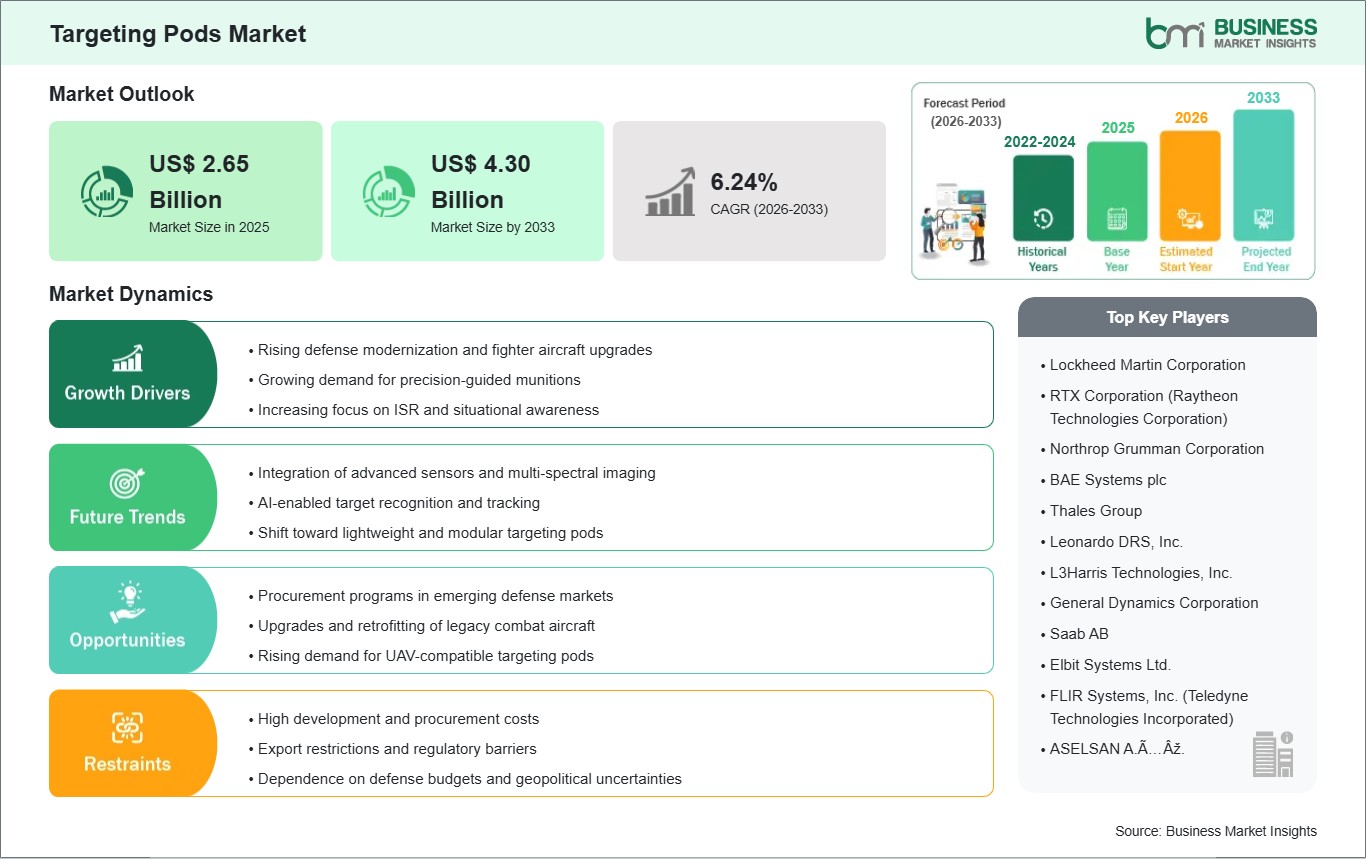
Targeting Pods is the comprehensive knowledge and characterization of the space environment, encompassing the detection, tracking, and identification of all objects in Earth`s orbit. This includes active and inactive satellites, spent rocket stages, and fragmentation debris. SSA leverages a global network of ground-based radars, optical telescopes, and space-based sensors to predict orbital trajectories, assess collision risks (conjunction analysis), and monitor "space weather" (solar activity) that could disrupt satellite electronics or communication signals. Market expansion is primarily attributed to the explosive growth of Low Earth Orbit (LEO) mega-constellations (e.g., Starlink, Kuiper), a rising volume of lethal non-trackable space debris, and increasing geopolitical tensions driving the need for "Space Domain Awareness" to detect hostile orbital maneuvers.
However, several challenges can restrain market growth: high initial procurement and operational costs for global sensor networks, particularly high-power radars and cryogenic telescopes, can limit the participation of emerging space nations. Stringent regulatory hurdles and the lack of a unified international legal framework for "Space Traffic Management" (STM) create inconsistencies in data sharing and liability. Additionally, the industry faces constraints due to data silos and interoperability gaps, where fragmented information from different national and private catalogs can lead to conflicting collision warnings, complicating the decision-making process for satellite operators.
Despite these hurdles, the market holds immense opportunities in the universal mandate for orbital sustainability and the accelerating deployment of active debris removal (ADR) missions. The expansion of commercial SSA data marketplaces and the development of onboard autonomous collision-avoidance software, allowing satellites to maneuver without human intervention, are expected to create significant opportunities for market growth.
Segment Analysis
Targeting Pods Market Segmentation
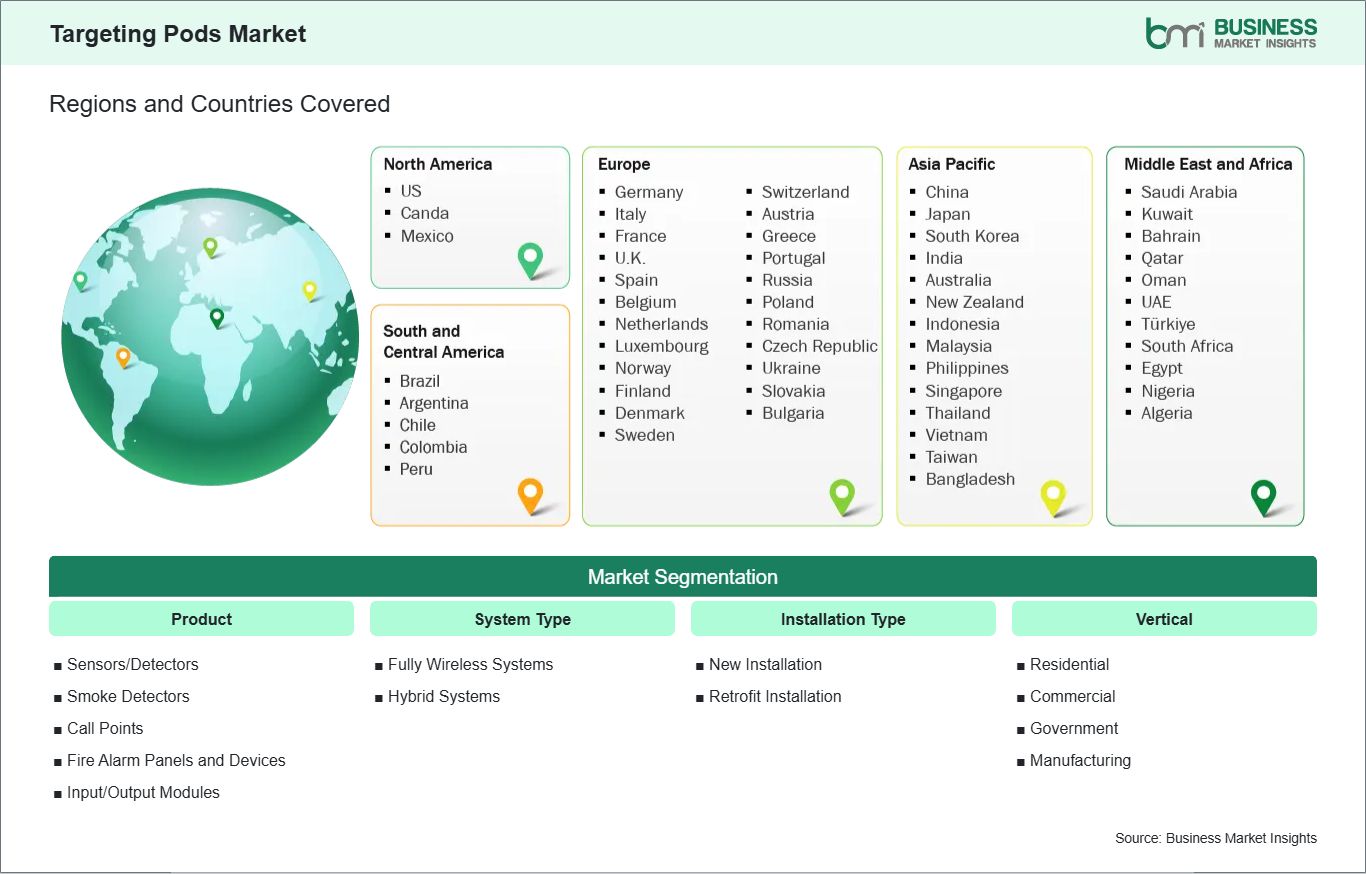
Key segments that contributed to the derivation of the Targeting Pods market analysis are type, component, platform, and fit.
- By Type, the market is segmented into FLIR and Laser Designator Pods and Laser Spot Tracker.
- By Component, the market is divided into FLIR Sensor, CCD Camera, MMS, ECU, HD TV, and Video Datalink.
- By Platform, the market is categorized into Combat Aircraft, Helicopters, and UAV.
- By Fit, the market is segmented into OEM Fit and Upgradation.
Market Forces
Targeting Pods Market Drivers and Opportunities
Advancing Precision Warfare and the Unmanned Combat Evolution
The primary driver for the Targeting Pods Market is the accelerating global requirement for precision-guided engagement and the systemic modernization of aging aircraft fleets. As modern combat shifts toward high-intensity, contested environments, the demand for targeting pods that offer long-range identification and all-weather engagement has become non-discretionary. This is particularly evident in the surging defense budgets of NATO allies and Indo-Pacific nations, where the need to minimize collateral damage and maximize mission success drives the adoption of advanced electro-optical and infrared (EO/IR) technologies. Furthermore, the "Unmanned Evolution" is a critical catalyst; as UAVs transition from simple reconnaissance to active strike roles, manufacturers are developing miniaturized, high-endurance pods tailored for drones. This demand is bolstered by the retrofitting segment, where legacy 4th-generation platforms are being equipped with modern pods to maintain parity with 5th-generation stealth capabilities, ensuring a robust, high-volume growth path through 2026.
AI-Driven Recognition and Network-Centric Sensor Fusion
A significant high-value opportunity lies in the integration of Artificial Intelligence (AI) and Machine Learning (ML) for autonomous target recognition and classification. Next-generation AI-enabled pods can process vast amounts of sensor data in real-time, identifying and prioritizing threats with far greater speed and accuracy than a human operator, which significantly reduces pilot cognitive workload. There is also a major growth frontier in Multi-Spectral and Hyperspectral Sensing, which allows for target detection through dense fog, smoke, and sophisticated camouflage, capabilities that traditional FLIR cannot match. Furthermore, the rise of Network-Centric Warfare presents a lucrative opportunity for "connected" pods that act as data-sharing nodes, transmitting high-definition imagery and target handovers seamlessly across air, sea, and land platforms in a synchronized "kill-web." Manufacturers who focus on Open-Architecture Designs, allowing for rapid software-defined upgrades without the need for hardware replacement, are positioned to lead the most profitable and strategically vital segments of the global defense landscape.
Size and Share Analysis
Targeting Pods Market Size and Share Analysis
The Targeting Pods market demonstrates steady growth, with size and share analysis revealing evolving trends and competitive positioning among key players. The report further examines subsegments categorized within type, component, platform, and fit, offering insights into their contribution to overall market performance.
Based on type, the FLIR and Laser Designator Pods subsegment holds the dominant market share. These pods are indispensable for modern air power because they combine thermal imaging with precise laser marking for guided munitions. A notable trend in 2026 is the surge in the Laser Spot Tracker subsegment for collaborative missions, where "buddy-lasing" allows one platform to track and strike a target designated by another. This is particularly vital in contested environments where electronic warfare may degrade primary sensors. The software-defined nature of these systems now allows for real-time updates to tracking algorithms, ensuring that the Laser Spot Tracker remains effective against increasingly sophisticated camouflage and decoys.
Report Coverage
Targeting Pods Market Report Coverage and Deliverables
The "Targeting Pods Market Size and Forecast (2022 - 2033)" report provides a detailed analysis of the market covering below areas:
- Targeting Pods market size and forecast at global, regional, and country levels for all the key market segments covered under the scope
- Targeting Pods market trends, as well as market dynamics such as drivers, restraints, and key opportunities
- Targeting Pods market analysis covering key market trends, global and regional framework, major players, regulations, and recent market developments
- Industry landscape and competition analysis covering market concentration, heat map analysis, prominent players, and recent developments for the Targeting Pods market
- Detailed company profiles, including SWOT analysis
Geographic Insights
Targeting Pods Market Geographic Insights
The geographical scope of the Targeting Pods market report is divided into five regions: North America, Asia Pacific, Europe, Middle East and Africa, and South and Central America.
The Asia-Pacific Targeting Pods Market is segmented into China, Japan, South Korea, India, Australia, and the Rest of Asia. This region is emerging as the fastest-growing market globally, projected to expand at a significant CAGR through 2030. The expansion is primarily fueled by escalating geopolitical tensions and rapid military modernization in China and India. Both nations are investing heavily in domestic 4th and 5th-generation fighter programs and the deployment of Unmanned Combat Aerial Vehicles (UCAVs), which increasingly require lightweight, high-precision pods for reconnaissance and strike missions.
Growth is further bolstered by a significant shift toward AI-enabled sensor fusion and the adoption of Short-Wave Infrared (SWIR) technology, which allows for targeting through smoke, fog, and haze. The integration of 5G and mesh networking for real-time "sensor-to-shooter" data sharing, alongside the rising demand for retrofit programs to extend the life of legacy 4th-generation aircraft, solidifies Asia-Pacific as a critical hub for innovation and the future scaling of the targeting pods industry.
Industry Activity
Recent Developments
The Targeting Pods market is evaluated by gathering qualitative and quantitative data post primary and secondary research, which includes important corporate publications, association data, and databases. A few of the key developments in the Targeting Pods market are:
- In Jan 2026, Thales expanded its cortAIx AI accelerator with a new site in Germany, strengthening its global network for AI-driven defense and sensor systems. The initiative enhances development of critical, AI-enabled targeting and sensor applications, positively supporting growth in the Targeting Pods Market.
- In November 2025, Lockheed Martin introduced the Sniper Networked Targeting Pod (NTP) by integrating a Hybrid Base Station into its proven Sniper ATP, enhancing secure networking and edge-computing capabilities. This launch strengthens interoperability between fourth- and fifth-generation aircraft and positively supports modernization trends in the Targeting Pods Market.
Trust & Transparency
Research Methodology
The market analysis combines proprietary research with secondary data from government agencies, company disclosures, regulatory filings, industry databases and expert interviews. Market estimates are validated through data triangulation, cross-market benchmarking and analyst
review.
View Full Research Methodology
Key Sources Referred:
World Bank - Global Trade Indicators World Trade Organization (WTO) International Monetary Fund (IMF) International Trade Administration (ITA) Company website Company annual reports Company investor presentations