Market Summary
Executive Summary and Global Market Analysis
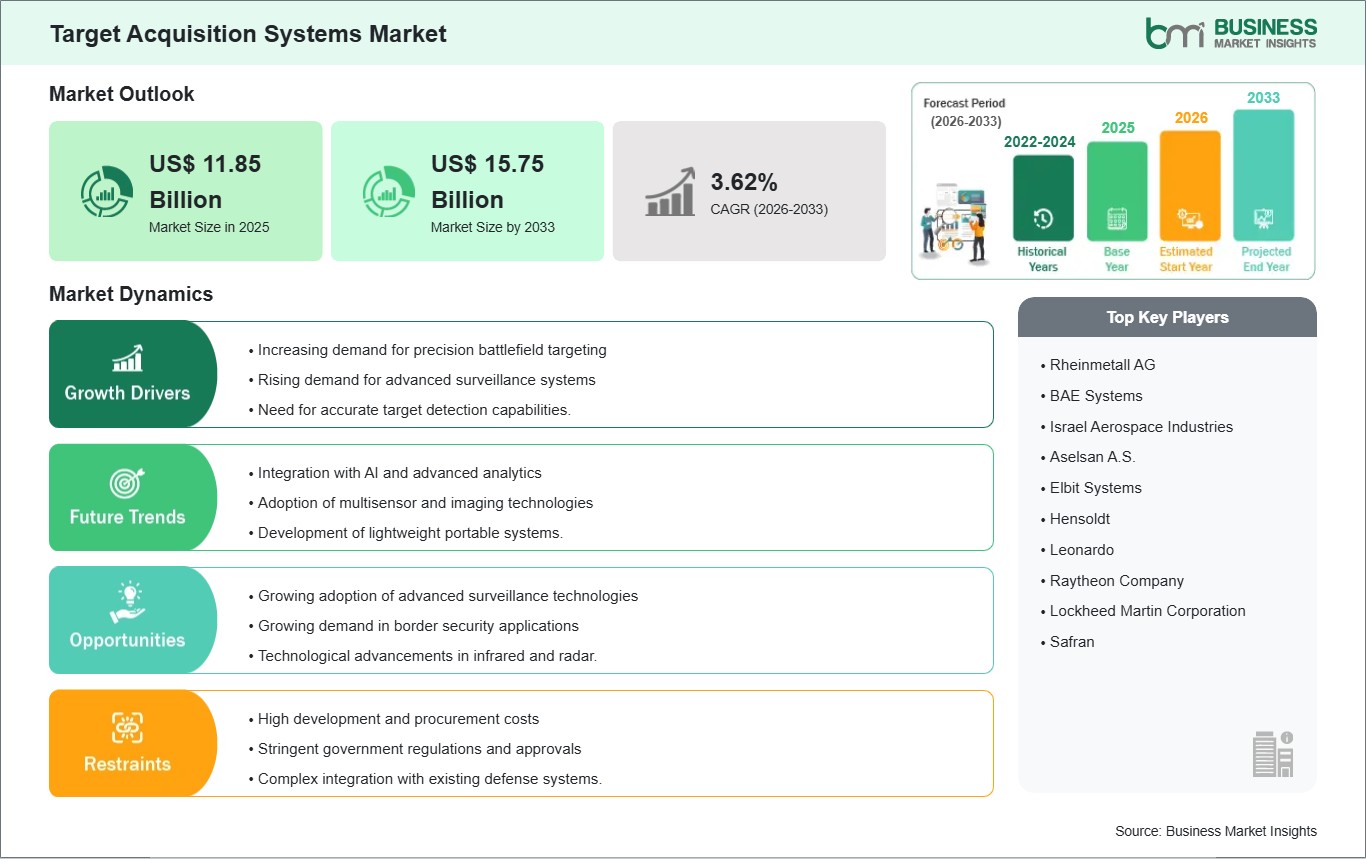
The defense target acquisition systems market shows consistent development because defense organizations require high-tech surveillance systems, accurate engagement methods and complete battlefield monitoring solutions. The military uses target acquisition technologies that allow soldiers to rapidly detect and identify threats through various operational environments. The systems require multiple sensors that include electro-optical imaging, infrared detection, laser designation and radar-based tracking systems to enhance both targeting precision and operational performance. The military now demands real-time intelligence together with data-driven combat operations, which has prompted the implementation of digital communication systems and sensor fusion technology into acquisition systems. Defense forces are also investing in compact and lightweight targeting modules that can be deployed across various platforms, including armored vehicles, unmanned aerial systems, naval vessels and portable soldier equipment.
Artificial intelligence, together with automated image processing technology enhancements enable military forces to identify targets with faster recognition speed while decreasing human operator demands during complex field operations. Modular architecture designs have become popular because they enable armed forces to upgrade single subsystem components without needing to replace their entire operational system. The system design approach faces challenges because operational requirements include secure data transmission, electronic warfare defense and signal interference management. The market presently demonstrates active development through new sensing technology inventions, which digital combat networks are increasingly adopting, and military operations now use multiple domains to enhance their operational capacity.
Segment Analysis
Target Acquisition Systems Market Segmentation
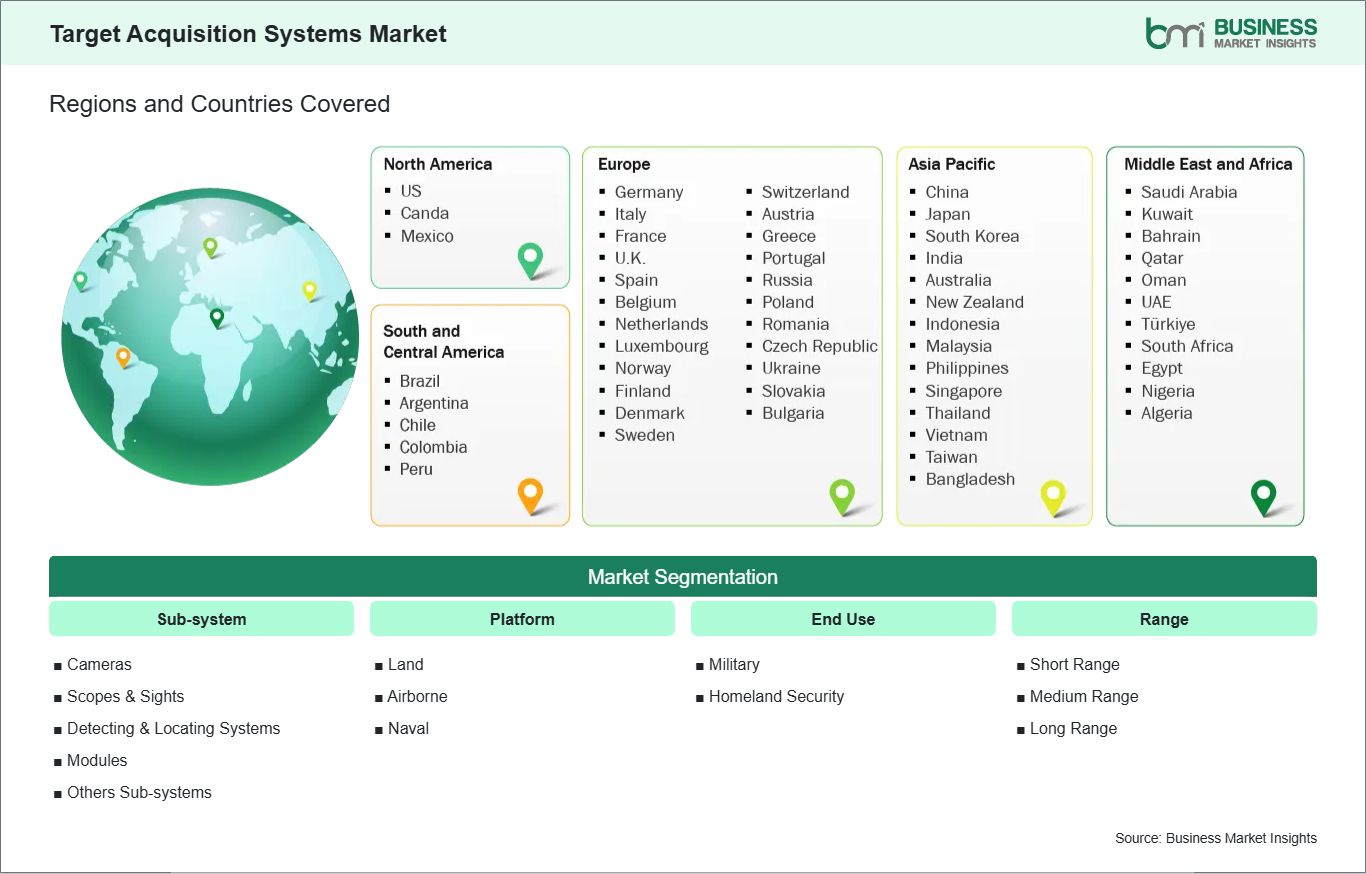
Key segments that contributed to the derivation of the target acquisition systems market analysis are sub-system, platform, end use, and range.
- Sub-system, the target acquisition systems market is segmented into cameras, scopes & sights, detecting & locating systems, modules, others, and add-on systems. The detecting & locating systems segment dominated the market in 2025.
- Platform, the target acquisition systems market is categorized into land, airborne, and naval. The land segment dominated the market in 2025.
- End Use, the target acquisition systems market is classified into military and homeland security. The military segment dominated the market in 2025.
- Range, the target acquisition systems market is segmented into short range (0 - 8 km), medium range (8 - 250 km), and long range (above 250 km). The medium range segment dominated the market in 2025.
Market Forces
Target Acquisition Systems Market Drivers and Opportunities
Increasing demand for precision battlefield targeting
The worldwide target acquisition systems market is growing because modern military operations need accurate battlefield targeting systems. Military forces use systems that can detect targets and identify them, and track their movements with high precision on land, in the air and in naval operations. The systems use electro‑optical and infrared, radar, and laser technologies to deliver real‑time threat assessment capabilities, which enable military personnel to engage threats with high precision in contemporary battlefields. Target detection and tracking accuracy have seen major improvements thanks to advancements in sensor technology. The combination of multi-sensor fusion and improved imaging and low-light detection capabilities enables operators to find threats throughout difficult terrain and bad weather conditions. The new technologies enable military units to identify threats with better accuracy while gaining improved knowledge of their operational environment.
Next-generation targeting systems are being deployed more rapidly because defense modernization programs worldwide continue to expand. The military now requires high-performance target acquisition systems because current combat strategies prioritize delivery of precise strikes that cause minimal damage to nearby areas.
Growing adoption of advanced surveillance technologies
The adoption of advanced surveillance technologies is driving growth in the target acquisition systems market. Militaries are increasingly integrating sophisticated long-range sensors, radar systems, and intelligent imaging platforms to enhance battlefield monitoring and threat detection. These systems enable continuous intelligence, surveillance, and reconnaissance operations, which are essential for accurate targeting and informed decision-making. Unmanned and autonomous platforms, such as drones, are contributing to the growing adoption of advanced surveillance. Equipped with high-resolution sensors, these platforms provide persistent monitoring capabilities, allowing military units to detect and track targets in real time.
Lightweight, integrated target acquisition modules further enable efficient deployment on unmanned vehicles and mobile platforms. Integration of artificial intelligence and sensor fusion technologies is enhancing the capabilities of modern surveillance systems. AI can analyze vast amounts of sensor data, automatically detect potential threats, and support rapid decision-making. As militaries prioritize situational awareness, responsiveness, and efficiency, these advancements are expected to significantly strengthen the global target acquisition systems market.
Size and Share Analysis
Target Acquisition Systems Market Size and Share Analysis
The Target Acquisition Systems Market demonstrates steady growth, with size and share analysis highlighting evolving trends and competitive dynamics among key players. The report examines subsegments categorized within sub-system, platform, end use, and range, offering insights into their contribution to overall market performance.
By Sub-system, the detecting & locating systems subsegment dominated the market in 2025, driven by increasing demand for advanced surveillance, reconnaissance, and target detection technologies in defense operations.
Based on Platform, the land subsegment dominated the market in 2025, owing to the widespread deployment of target acquisition systems in ground combat vehicles, artillery, and infantry operations.
On the Basis of End Use, the military subsegment dominated the market in 2025, propelled by rising defense budgets and modernization of armed forces worldwide.
In terms of Range, the medium range (8 - 250 km) subsegment dominated the market in 2025, driven by its extensive use in battlefield surveillance and tactical targeting applications.
Report Coverage
Target Acquisition Systems Market Report Coverage and Deliverables
The "Target Acquisition Systems Market Size and Forecast (2022 - 2033)" report provides a detailed analysis of the market covering below areas:
- Target Acquisition Systems Market size and forecast at global, regional, and country levels for all the key market segments covered under the scope
- Target Acquisition Systems Market trends, as well as drivers, restraints, and opportunities
- Target Acquisition Systems Market analysis covering key trends, global and regional framework, major players, regulations, and recent developments
- Industry landscape and competition analysis covering market concentration, heat map analysis, prominent players, and recent developments for the Target Acquisition Systems Market
- Detailed company profiles, including SWOT analysis
Geographic Insights
Target Acquisition Systems Market Geographic Insights
The geographical scope of the Target Acquisition Systems Market report is divided into North America, Asia Pacific, Europe, Middle East & Africa, and South & Central America. North America held the largest share in 2025.
Regional adoption patterns in the target acquisition systems market vary according to defense priorities, security conditions, and technological infrastructure. North America demonstrates strong advancement in high-precision targeting technologies, supported by extensive defense research programs and continuous modernization of combat platforms. The region emphasizes integration of advanced sensors with command-and-control networks to improve operational coordination and mission effectiveness.
Europe is focused on enhancing battlefield situational awareness through upgrades to existing armored and artillery systems, with increasing incorporation of thermal imaging, laser guidance, and advanced optics in land-based combat platforms.
Asia Pacific is witnessing significant growth in the deployment of surveillance and targeting technologies as countries strengthen border monitoring capabilities and expand defense modernization initiatives. The region is also investing in advanced reconnaissance platforms and integrated combat systems to improve operational readiness.
Middle East & Africa is placing emphasis on long-range observation and targeting solutions to support border security, infrastructure protection, and tactical surveillance in complex desert and maritime environments.
Meanwhile, South & Central America is gradually integrating modern target acquisition technologies into defense and security operations, particularly in surveillance missions and tactical response activities.
Across these regions, defense modernization programs, evolving security threats, and advancements in sensor technologies are shaping the adoption and development of target acquisition systems.
Industry Activity
Recent Developments
The Target Acquisition Systems Market is evaluated by gathering qualitative and quantitative data post primary and secondary research, which includes important corporate publications, association data, and databases. A few of the key developments in the spatial light Modulator market are:
- In September 2025, HENSOLDT AG announced that it had unveiled its TAROSS electro‑optical target acquisition and reconnaissance sensor system at the DSEI 2025 defence exhibition, a modular solution designed for remote weapon stations, medium‑calibre turrets, light reconnaissance vehicles and unmanned platforms to improve precise target acquisition and engagement capabilities.
- In March 2026, HENSOLDT AG announced that it had signed an agreement to acquire Dutch optronics specialist Nedinsco, strengthening its sensor and electro‑optical technology portfolio (critical for target acquisition systems) and expanding its European industrial footprint, with completion expected in mid‑2026 subject to regulatory approval.
Trust & Transparency
Research Methodology
The market analysis combines proprietary research with secondary data from government agencies, company disclosures, regulatory filings, industry databases and expert interviews. Market estimates are validated through data triangulation, cross-market benchmarking and analyst
review.
View Full Research Methodology
Key Sources Referred:
International Electrotechnical Commission Institute of Electrical and Electronics Engineers International Organization for Standardization Bureau of Indian Standards Central Electricity Authority Ministry of Power Indian Electrical and Electronics Manufacturers' Association European Committee for Electrotechnical Standardization VDE Association for Electrical Electronic & Information Technologies Company Websites Company Annual Reports Company Investor Presentation