Market Summary
Executive Summary and Global Market Analysis
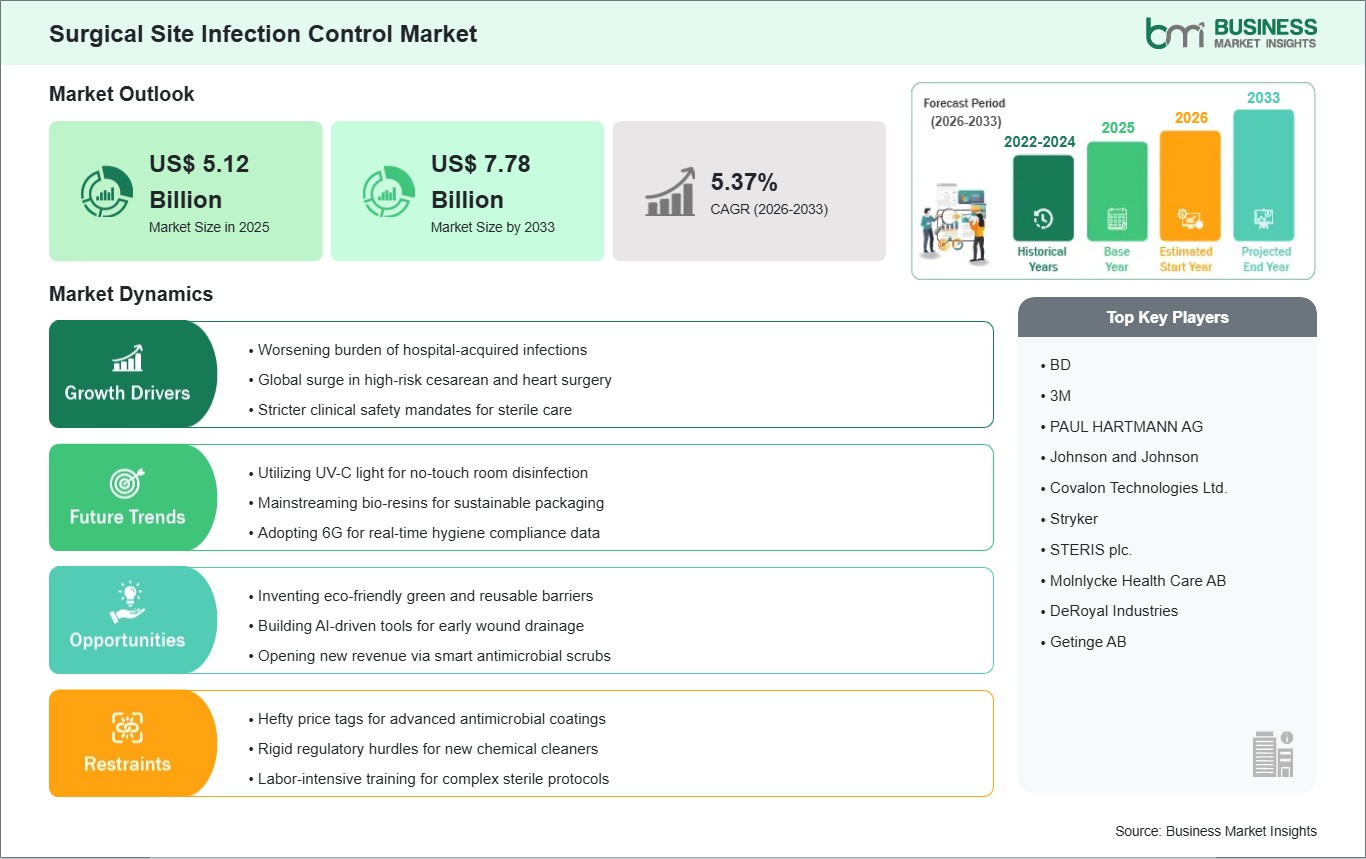
Surgical site infection (SSI) control encompasses a range of products and technologies designed to prevent and manage infections at surgical incision sites, including antimicrobial coatings, advanced dressings, sterilization systems, and real-time monitoring tools. These solutions reduce bacterial contamination, promote faster wound healing, and lower healthcare-associated infection rates, which affect up to 5% of surgical procedures globally. SSI control is critical in high-risk surgeries and aligns with global standards like WHO guidelines for safe surgery.
The Surgical Site Infection Control market is experiencing steady growth, primarily driven by the rising incidence of healthcare-associated infections (HAIs), stringent regulatory mandates for infection prevention, and the surge in surgical volumes due to aging populations and chronic conditions like diabetes and obesity. Market expansion is further fueled by post-pandemic emphasis on hospital hygiene, advancements in nanotechnology-based antimicrobials, and increasing adoption of single-use sterile products to minimize cross-contamination.
Segment Analysis
Surgical Site Infection Control Market Segmentation
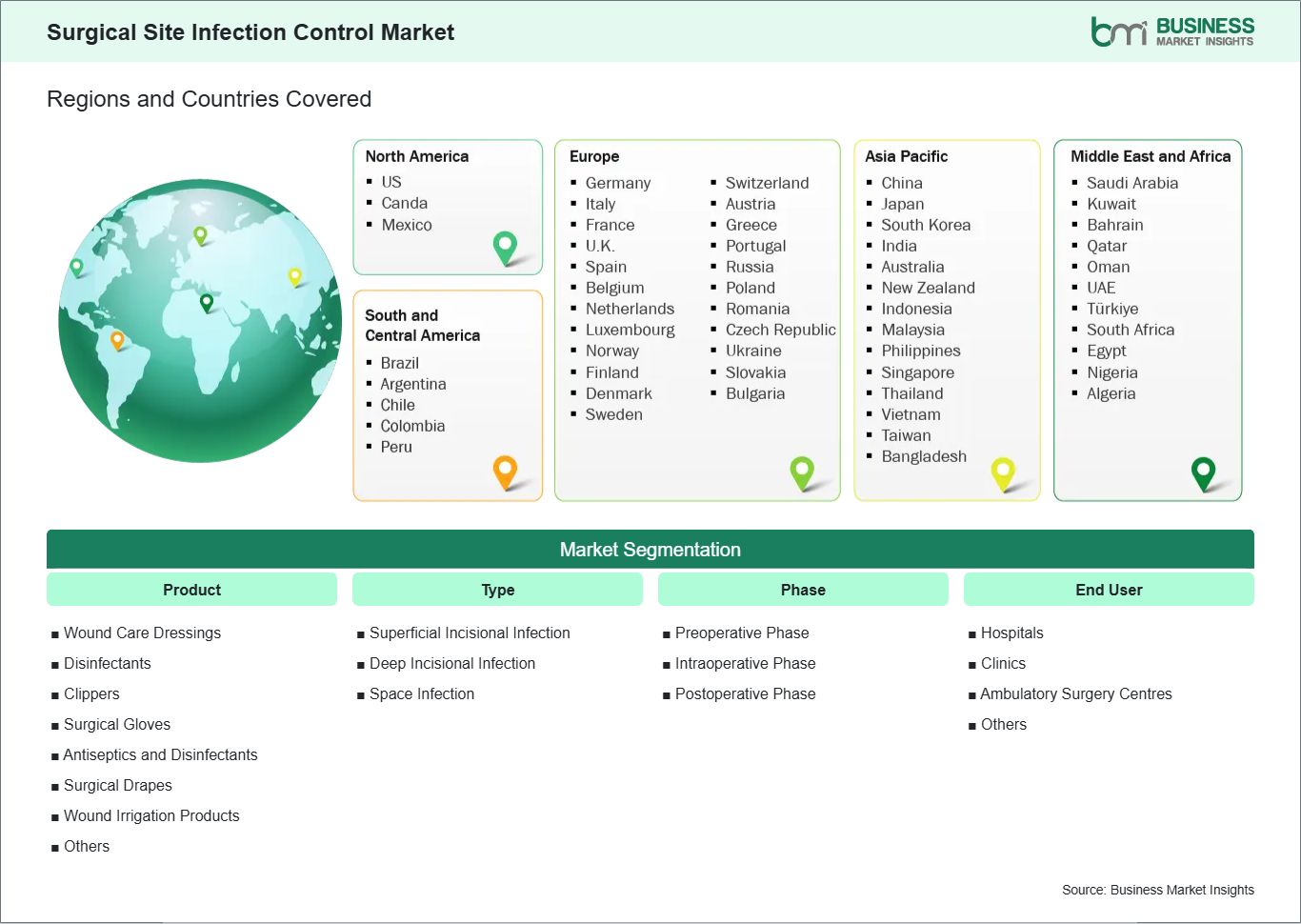
Key segments that contributed to the derivation of the Surgical Site Infection Control Market analysis are product, type, phase, and end user.
- By Product, the market is segmented into Wound Care Dressings, Disinfectants, Clippers, Surgical Gloves, Antiseptics and Disinfectants, Surgical Drapes, Wound Irrigation Products, and Others.
- By Type, the market is segmented into Superficial Incisional Infection, Deep Incisional Infection, and Space Infection.
- By Phase, the market is segmented into Preoperative Phase, Intraoperative Phase, and Postoperative Phase.
- By End User, the market is segmented into Hospitals, Clinics, Ambulatory Surgery Centres, and Others.
Market Forces
Surgical Site Infection Control Market Drivers and Opportunities
Rising Incidence of Surgical Site Infections and HAIs
The paramount driver propelling the Surgical Site Infection Control Market is the escalating global burden of surgical site infections, which affect 2–5% of surgical patients and contribute to over 20% of HAIs, leading to prolonged hospital stays, higher mortality rates, and annual economic costs exceeding US$ 10 billion in the US alone. Regulatory pressures from bodies like the CDC and WHO mandate robust SSI prevention protocols, spurring demand for advanced control solutions. These technologies, such as silver-ion dressings and UV sterilization systems, demonstrably cut infection rates by 30–50%, enabling healthcare facilities to comply with reimbursement policies tied to low HAI metrics while improving patient outcomes and reducing readmissions.
Advancements in Nanotechnology and Smart Monitoring Systems
A significant market opportunity lies in the convergence of nanotechnology applications in wound care; for instance, nanoparticle-containing sutures and dressings, and smart monitoring technology enabled by Internet of Things solutions that offer SSI detection in real-time through biosensors measuring pH, temperature, and biomarkers within the wound environment. This approach launches SSI prevention from a reactive to a proactive approach using AI-driven notifications to facilitate intervention before infection incidents. For high-risk surgeries such as orthopedic and cardiac surgery, these advances have the capability of lowering SSI infection incidents by as much as 60% and entering emerging markets through cheaper and portable technology solutions.
Size and Share Analysis
Surgical Site Infection Control Market Size and Share Analysis
The Surgical Site Infection Control Market demonstrates robust growth, with size and share analysis revealing the strong competitive positioning of established players and the emergence of new technologies. The report further examines subsegments categorized within product, type, phase, and end user, offering insights into their contribution to overall market performance.
For instance, the Wound Care Dressings subsegment dominates the market by product. Their popularity stems from the fact that they are recurring purchases, often disposable or having a limited lifespan, creating a steady and lucrative revenue stream for manufacturers. Hospitals remain the largest end-user segment, driven by the high volume of procedures, the need for advanced infrastructure, and the high initial capital investment required for integrated systems.
Report Coverage
Surgical Site Infection Control Market Report Coverage and Deliverables
The "Surgical Site Infection Control Market Size and Forecast (2022 - 2033)" report provides a detailed analysis of the market covering below areas:
- Surgical Site Infection Control Market size and forecast at global, regional, and country levels for all the key market segments covered under the scope
- Surgical Site Infection Control Market trends, as well as market dynamics such as drivers, restraints, and key opportunities
- Surgical Site Infection Control Market analysis covering key market trends, global and regional framework, major players, regulations, and recent market developments
- Industry landscape and competition analysis covering market concentration, heat map analysis, prominent players, and recent developments for the Surgical Site Infection Control Market
- Detailed company profiles, including SWOT analysis
Geographic Insights
Surgical Site Infection Control Market Geographic Insights
The geographical scope of the Surgical Site Infection Control Market report is divided into five regions: North America, Asia Pacific, Europe, Middle East & Africa, and South & Central America.
North America is the dominant region in the Surgical Site Infection Control Market, holding the largest revenue share, owing to advanced healthcare infrastructure, high healthcare expenditure (both public and private), a high concentration of key market players, and the early and widespread adoption of SSI prevention protocols in clinical practice.
Asia Pacific is projected to be the fastest-growing region, driven by rapidly improving healthcare infrastructure, increasing disposable incomes, government initiatives to promote medical technology adoption, a growing patient pool requiring complex surgeries, and increasing medical tourism.
Industry Activity
Recent Developments
The Surgical Site Infection Control Market is evaluated by gathering qualitative and quantitative data post-primary and secondary research, which includes important corporate publications, association data, and databases. A few of the key developments in the Surgical Site Infection Control Market are:
- In November 2025, BD, a leading global medical technology company, announced the launch of the BD Surgiphor™ Surgical Wound Irrigation System in Europe. The system is the first of its kind to receive Conformité Européenne (CE) approval and is now available in select European countries. BD Surgiphor™ is a sterile, ready-to-use irrigation solution designed to help loosen and remove debris from surgical wounds during procedures. By flushing out debris and foreign materials, including microorganisms, it helps reduce the bacterial load that could lead to infection.
- In July 2025, Global MedTech companies Getinge and Zimmer Biomet Holdings, Inc. announced a strategic partnership where Zimmer Biomet will distribute Getinge’s Operating Room (OR) capital products to its Ambulatory Surgery Center (ASC) customers. This partnership creates a turnkey solution for ASC customers, who can now access Getinge’s infection control and surgical portfolio and Zimmer Biomet’s broad menu of best-in-class implants and surgical robotics from a single source.
Trust & Transparency
Research Methodology
The market analysis combines proprietary research with secondary data from government agencies, company disclosures, regulatory filings, industry databases and expert interviews. Market estimates are validated through data triangulation, cross-market benchmarking and analyst
review.
View Full Research Methodology
Key Sources Referred:
World Bank - Global Trade IndicatorsWorld Trade Organization (WTO)International Monetary Fund (IMF)International Trade Administration (ITA)Company WebsitesCompany Annual ReportsCompany Investor Presentations