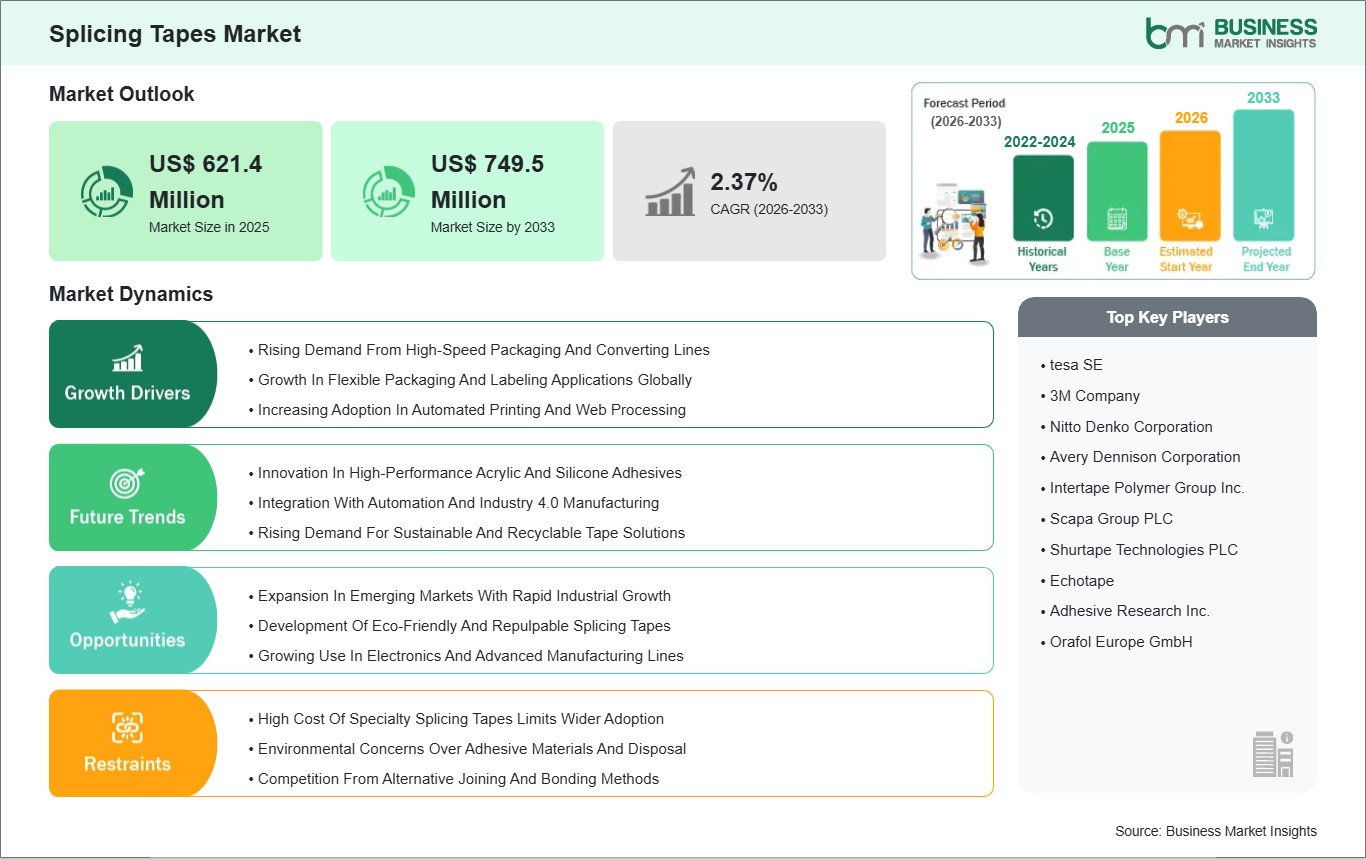
The Splicing Tapes Market size is expected to reach US$ 749.5 million by 2033 from US$ 621.4 million in 2025. The market is estimated to record a CAGR of 2.37% from 2026 to 2033.
The global splicing tapes market is a niche yet critical segment within the specialty adhesives industry, which exists because multiple industries require their manufacturing operations to run continuously while achieving maximum production efficiency. Splicing tapes are designed to connect two material webs by using their adhesive properties to create a bond between paper film foil, and nonwoven materials during processes that need to run continuously. These tapes find extensive application in high-speed conversion operations, which include packaging and printing and paper processing and flexible film production because even short interruptions lead to major productivity losses. The materials establish strong adhesive connections that precisely bond together while withstanding heat and mechanical forces, thus making them essential for process stability and product excellence in automated production systems. The market experiences growth because the global packaging industry expands at a fast pace, especially in the areas of flexible packaging and labeling.
Manufacturers in e-commerce, food delivery and fast-moving consumer goods sectors invest more resources into high-speed production systems, which depend on effective splicing solutions. The manufacturing sector has developed a higher demand for precision-engineered tapes because companies are shifting toward automated processes and Industry 4.0 systems. The electronics sector contributes to market expansion because splicing tapes serve various insulation and cable wrapping and assembly applications, which require thermal and electrical stability. The market operates under various restrictions that affect its activities. The higher price of specialized splicing tapes versus traditional joining methods prevents their use in markets that focus on low expenses.
Manufacturers are forced to develop new material compositions because of environmental issues that arise from adhesive composition and disposal problems. The new splicing tape technology, which enables repulping and recycling presents both technical and financial hurdles. The ongoing development of adhesive technologies together with their customized solutions will ensure that splicing tapes maintain their worldwide importance in various industrial uses.

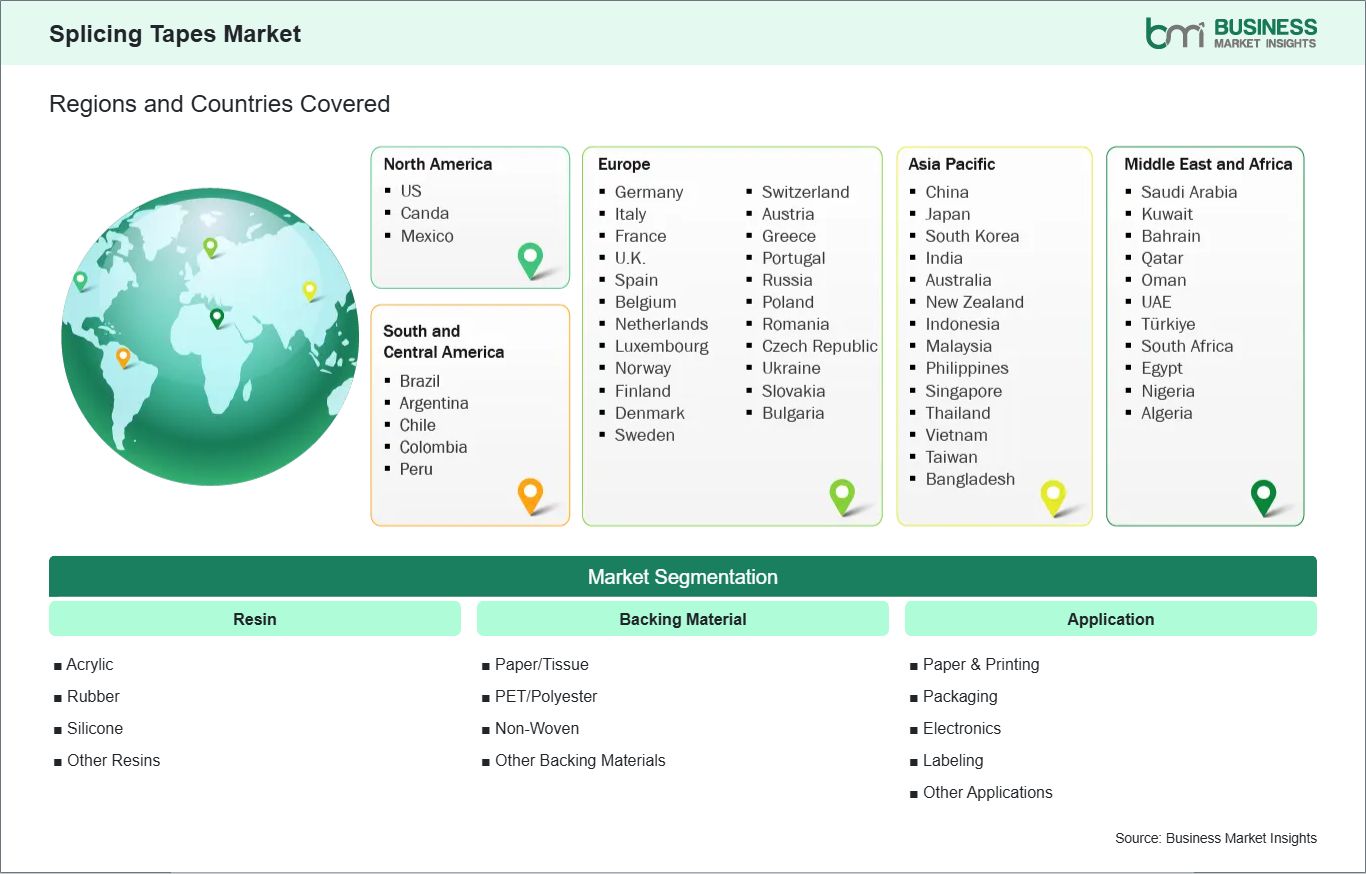
Key segments that contributed to the derivation of the splicing tapes market analysis are resin, backing material, and application.
The global splicing tapes market is significantly driven by the increasing adoption of high-speed packaging and converting lines across industries such as food, beverages, personal care, and e-commerce. Manufacturers are prioritizing uninterrupted production processes to maximize efficiency and reduce operational downtime, making splicing tapes a critical component in modern converting operations. These tapes enable seamless roll changes during continuous production, particularly in flexible packaging films, paperboard, and labeling materials. As global supply chains become more demand-driven, converters are investing in advanced machinery that requires reliable splicing solutions capable of performing under high tension and speed conditions.
In regions such as North America and Europe, established packaging industries are adopting precision-engineered splicing tapes to support automated systems that operate at increasingly higher speeds. These markets emphasize product consistency and minimal waste, pushing demand for tapes with superior adhesion, shear strength, and temperature resistance. Additionally, the shift toward lightweight and flexible packaging formats in global consumer goods industries is further amplifying the use of splicing tapes in film and foil processing applications.
Asia Pacific is also witnessing rapid integration of high-speed converting technologies, particularly in countries like China and India, where packaging demand is rising alongside urbanization and e-commerce growth. Local manufacturers are upgrading production lines to meet export standards, increasing reliance on high-performance splicing tapes. This global transition toward faster, more efficient converting operations continues to strengthen the role of splicing tapes as an essential solution for maintaining productivity and operational continuity.
Emerging markets are playing a crucial role in shaping the growth trajectory of the global splicing tapes market, driven by rapid industrialization and expanding manufacturing activities. Countries across Asia Pacific, Latin America, and parts of the Middle East are witnessing increased investments in packaging, paper processing, and flexible film production facilities. These developments are creating strong demand for splicing tapes that support continuous production and improve operational efficiency. As local industries evolve to meet global quality standards, manufacturers are increasingly adopting advanced adhesive solutions to enhance production reliability and reduce downtime.
In Asia Pacific, countries such as India, Vietnam, and Indonesia are becoming key manufacturing hubs due to favorable labor costs and expanding domestic consumption. The rise of organized retail and e-commerce platforms in these regions is driving demand for high-quality packaging, indirectly boosting the use of splicing tapes in converting processes. Similarly, Latin American markets, particularly Brazil and Mexico, are experiencing gradual growth in packaging and printing industries, encouraging adoption of modern splicing technologies to improve productivity and competitiveness.
The Middle East & Africa region is also showing promising potential, supported by diversification efforts in industrial and manufacturing sectors beyond oil and gas. Investments in food processing, construction materials, and consumer goods production are contributing to the adoption of splicing tapes for efficient material handling. Although cost sensitivity remains a challenge in some emerging markets, increasing awareness of long-term operational benefits and productivity gains is encouraging wider adoption of splicing tapes globally.

The splicing tapes market demonstrates steady growth, with size and share analysis highlighting evolving trends and competitive dynamics among key players. The report examines subsegments categorized within resin, backing material, and application, offering insights into their contribution to overall market performance.
By resin, the acrylic subsegment dominated the market in 2025, driven by its strong adhesion, durability, and versatility across various industrial and paper-processing applications.
Based on backing material, the paper/tissue subsegment dominated the market in 2025, driven by its cost-effectiveness, ease of use, and compatibility with high-speed splicing operations in the paper and printing industry.
In terms of application, the paper & printing subsegment dominated the market in 2025, driven by the high demand for efficient splicing tapes to maintain continuous production in paper manufacturing and printing processes.
| Report Attribute | Details |
|---|---|
| Market size in 2025 | US$ 621.4 Million |
| Market Size by 2033 | US$ 749.5 Million |
| Global CAGR (2026 - 2033) | 2.37% |
| Historical Data | 2022-2024 |
| Forecast period | 2026-2033 |
| Segments Covered | By Resin
|
|
Regions and Countries Covered
| |
| North America | US, Canada, Mexico |
| Europe | Belgium, Austria, Finland, Denmark, Greece, Poland, Romania, Russia, Ukraine, Czech Republic, Slovakia, Bulgaria, Italy, Luxembourg, Germany, Switzerland, France, Netherlands, Norway, Portugal, Spain, Sweden, United Kingdom |
| Asia-Pacific | Australia, China, India, Japan, South Korea, Indonesia, Malaysia, Philippines, Singapore, Thailand, Vietnam, Bangladesh, New Zealand, Taiwan |
| South and Central America | Brazil, Argentina, Peru, Chile, Colombia |
| Middle East and Africa | Bahrain, Kuwait, Oman, Qatar, Saudi Arabia, United Arab Emirates, Turkiye, South Africa, Egypt, Algeria, Nigeria |
| Market leaders and key company profiles |
|
The "Splicing Tapes Market Size and Forecast (2022 - 2033)" report provides a detailed analysis of the market covering below areas:
The geographical scope of the Splicing Tapes Market report is divided into North America, Asia Pacific, Europe, Middle East & Africa, and South & Central America. North America held the largest share in 2025.
North America dominates the global Splicing Tapes Market because its industries require advanced converting, packaging and printing capabilities for their continuous high-speed production operations. The United States leads demand because automated web handling systems have become common in flexible packaging and paper processing and labeling industries, which need splicing tapes to perform roll changes with no downtime. The region maintains its leading position through its strong technical expertise, its access to major adhesive manufacturers, and its early adoption of high-performance acrylic and silicone adhesive systems.
The Asia Pacific market experiences rapid growth because China, India, Japan and South Korea operate extensive manufacturing facilities in the region. E-commerce growth and increased food packaging and industrial production operations have resulted in higher demand for high-speed converting lines, which require trustworthy splicing solutions.
Europe contains a technologically advanced market because Germany, Italy and the UK focus on improving efficiency, precision and sustainability in their packaging and printing processes. The region is increasingly adopting repulpable and environmentally friendly splicing tapes to align with regulatory expectations.
The Middle East and Africa region shows gradual development because the packaging, logistics and industrial sectors are expanding in the Gulf Cooperation Council countries that are modernizing their manufacturing facilities.
South and Central America, which Brazil and Mexico lead, experiences continuous growth in splicing tape usage within packaging and paper industries due to increasing production of consumer goods.
The market experiences moderate growth because customers show price sensitivity, and the existing infrastructure fails to meet their demands. While Asia Pacific achieves volume increases and Europe develops sustainability-based innovations North America remains the leading region because of its technological advancements, industrial strength and high usage of automated manufacturing processes.

The Splicing Tapes Market is evaluated by gathering qualitative and quantitative data post primary and secondary research, which includes important corporate publications, association data, and databases. A few of the key developments in the splicing tapes market are:
The Splicing Tapes Market is valued at US$ 621.4 Million in 2025, it is projected to reach US$ 749.5 Million by 2033.
As per our report Splicing Tapes Market, the market size is valued at US$ 621.4 Million in 2025, projecting it to reach US$ 749.5 Million by 2033. This translates to a CAGR of approximately 2.37% during the forecast period.
The Splicing Tapes Market report typically cover these key segments-
The historic period, base year, and forecast period can vary slightly depending on the specific market research report. However, for the Splicing Tapes Market report:
The Splicing Tapes Market is populated by several key players, each contributing to its growth and innovation. Some of the major players include:
The Splicing Tapes Market report is valuable for diverse stakeholders, including:
Essentially, anyone involved in or considering involvement in the Splicing Tapes Market value chain can benefit from the information contained in a comprehensive market report.
Please tell us your area of interest
(Market Segments/ Regions and Countries/ Companies)