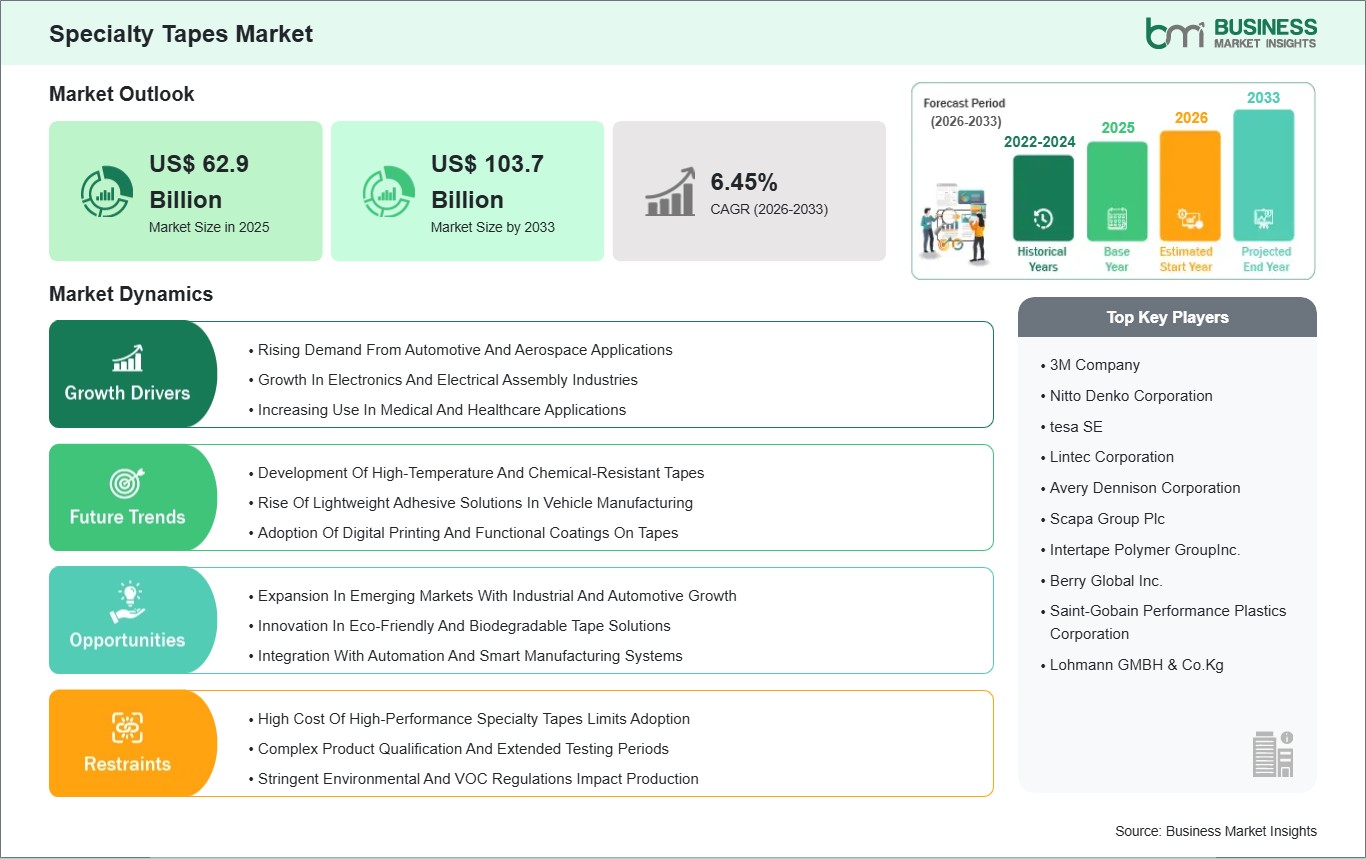
The Specialty Tapes Market size is expected to reach US$ 103.7 billion by 2033 from US$ 62.9 billion in 2025. The market is estimated to record a CAGR of 6.45% from 2026 to 2033.
The worldwide market for specialty tapes includes various adhesive tape products that manufacturers designed to meet different bonding needs, sealing requirements, masking needs and insulation needs and protection needs that occur in multiple industrial sectors. Specialty tapes — including acrylic, foam, double‑sided, filament, high‑temperature, and electrically conductive tapes — are designed for high performance under demanding conditions where traditional tapes fall short. The unique material formulations together with the adhesive technologies enable the products to maintain their adhesion on challenging substrates while they withstand extreme environmental conditions and provide their full range of functional properties, which include electrical insulation, impact damping and vibration control and surface protection. The characteristics make them essential for use in sectors which include automotive, aerospace and electronics, electrical, healthcare and industrial manufacturing. The global market experiences its major growth because companies develop new advanced manufacturing and assembly processes, which need strong bonding and sealing solutions. Automotive production uses specialty tapes instead of mechanical fasteners to attach interior trim and exterior trims and NVH (noise, vibration, and harshness) reduction systems, which leads to lighter assemblies and better manufacturing efficiency.
The electronics industry increasingly relies on specialty tapes for flexible circuit bonding, electromagnetic interference shielding, and display protection, which needs high precision and performance because these factors affect product reliability. The renewable energy sectors experience growth in wind and solar power, which leads to increased demand for high-durability tapes that can withstand both outdoor conditions and long-term usage. The market encounters its main restrictions because of strong customer demand, which exists in the market. High-performance specialty tapes cost more than standard pressure-sensitive tapes, which creates difficulties for businesses that need to use their products in applications that require cost control or in emerging markets that need to compete on pricing. The process of selecting specialty tapes requires testing procedures, which consume time during both design testing and production testing stages in manufacturing.
Environmental and regulatory considerations about volatile organic compound (VOC) emissions and end-of-life disposal methods determine both product formulations and customer choices, which make some market segments shift toward different bonding methods. The global specialty tapes market develops through three main factors, which include performance needs from advanced industrial sectors, new adhesive and backing technologies, and the search for lightweight assembly materials that deliver efficient and reliable performance.

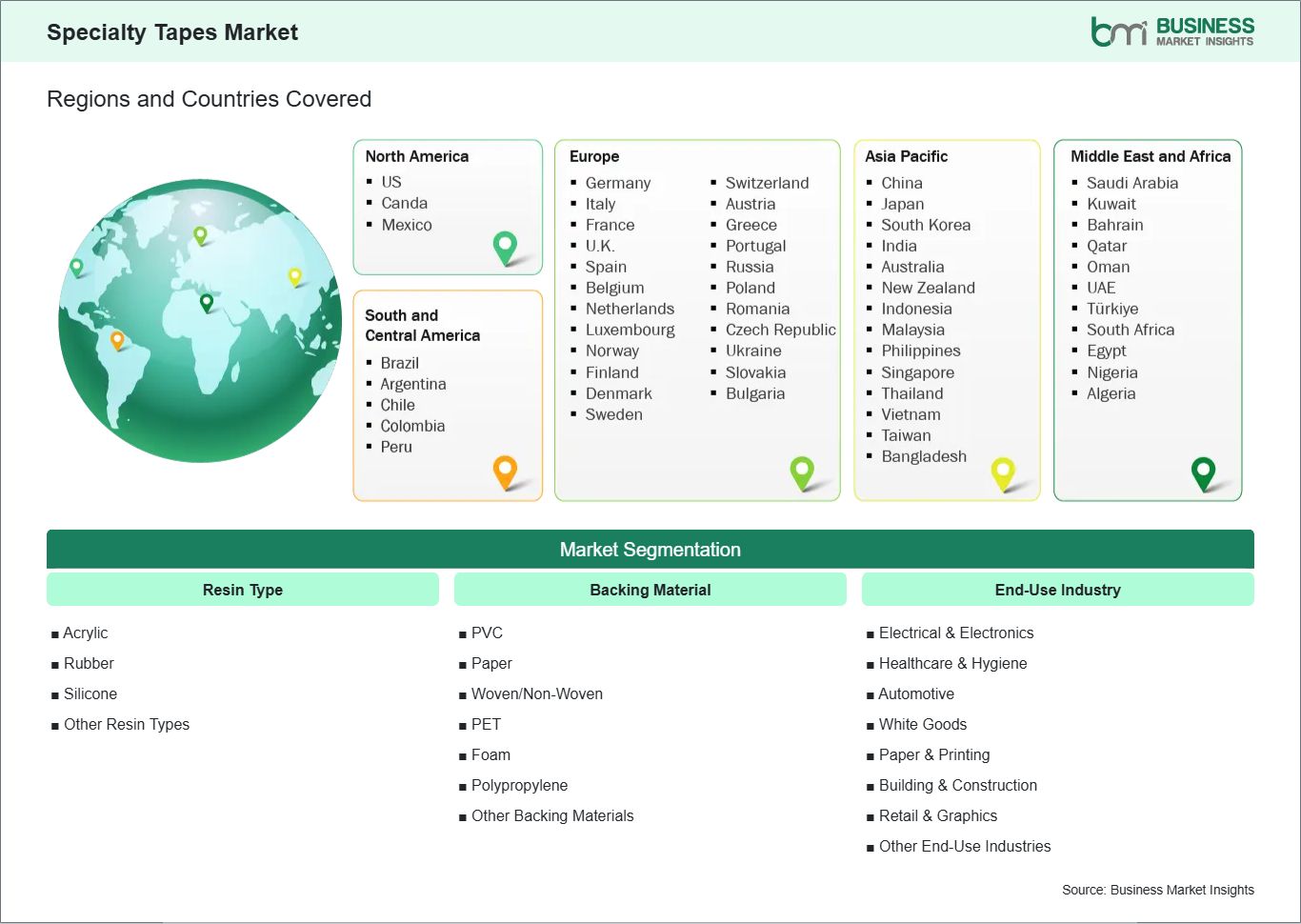
Key segments that contributed to the derivation of the specialty tapes market analysis are resin type, backing material, and end‑use industry.
The specialty tapes market is experiencing significant growth driven by rising demand in automotive and aerospace applications worldwide. In the automotive industry, manufacturers are increasingly adopting specialty tapes for interior trim attachment, exterior moldings, and NVH (noise, vibration, and harshness) control solutions, replacing mechanical fasteners and liquid adhesives. These tapes offer lightweight bonding, design flexibility, and consistent performance, aligning with the industry`s broader push toward vehicle weight reduction and fuel efficiency. Leading production hubs in North America, Europe, and Asia Pacific are at the forefront of this trend, integrating double‑sided acrylics, foam tapes, and structural bonding tapes into next‑generation vehicle assemblies. This shift supports automation on assembly lines and enhances production throughput without compromising build quality.
In aerospace, the use of high‑performance specialty tapes has expanded beyond traditional masking and surface protection to structural bonding, insulation, and composite assembly. Airlines and OEMs in the U.S., Europe, and China are deploying advanced tape solutions that withstand extreme temperatures, vibration, and long service cycles. These tapes contribute to overall aircraft performance by reducing weight compared to rivets and welds, simplifying maintenance, and improving fuel efficiency.
Emerging markets are playing an increasingly critical role in the global specialty tapes landscape as industrialization and automotive production accelerate across Asia Pacific, Latin America, and parts of the Middle East & Africa. In Asia Pacific, rapid expansion of manufacturing hubs in countries such as India, Vietnam, and Indonesia is creating robust demand for specialty tapes in automotive assembly, consumer electronics, and industrial machinery. Local OEMs and global manufacturers establishing regional operations are specifying high‑performance tapes for bonding, sealing, and protection to enhance product quality while meeting international standards. This regional growth is reinforced by investments in infrastructure and export‑oriented manufacturing facilities that benefit from cost‑competitive production and expanding domestic markets.
In South America, countries like Brazil and Mexico are witnessing incremental uptake of specialty tapes in automotive interiors, packaging, and consumer goods, driven by urbanization and rising disposable incomes. Manufacturers in these regions are exploring advanced tape applications as alternatives to traditional fastening methods to improve assembly efficiency and reduce production costs. Although slower compared to more developed regions, this trend is gaining momentum as local converters and resin suppliers strengthen supply chains and technical support.
The specialty tapes market demonstrates steady growth, with size and share analysis highlighting evolving trends and competitive dynamics among key players. The report examines subsegments categorized within resin type, backing material, and end‑use industry, offering insights into their contribution to overall market performance.
By resin type, the acrylic subsegment dominated the market in 2025, driven by its excellent adhesion, durability, and resistance to temperature and UV, making it ideal for industrial and healthcare applications.
Based on backing material, the woven/non‑woven subsegment dominated the market in 2025, driven by superior strength, flexibility, and conformability, which are critical for medical, hygiene, and industrial tapes.
In terms of end‑use industry, the healthcare & hygiene subsegment dominated the market in 2025, driven by growing demand for medical tapes, wound care products, and hygiene applications requiring reliable, high-performance adhesives.
| Report Attribute | Details |
|---|---|
| Market size in 2025 | US$ 62.9 Billion |
| Market Size by 2033 | US$ 103.7 Billion |
| Global CAGR (2026 - 2033) | 6.45% |
| Historical Data | 2022-2024 |
| Forecast period | 2026-2033 |
| Segments Covered | By Resin Type
|
|
Regions and Countries Covered
| |
| North America | US, Canada, Mexico |
| Europe | Belgium, Austria, Finland, Denmark, Greece, Poland, Romania, Russia, Ukraine, Czech Republic, Slovakia, Bulgaria, Italy, Luxembourg, Germany, Switzerland, France, Netherlands, Norway, Portugal, Spain, Sweden, United Kingdom |
| Asia-Pacific | Australia, China, India, Japan, South Korea, Indonesia, Malaysia, Philippines, Singapore, Thailand, Vietnam, Bangladesh, New Zealand, Taiwan |
| South and Central America | Brazil, Argentina, Peru, Chile, Colombia |
| Middle East and Africa | Bahrain, Kuwait, Oman, Qatar, Saudi Arabia, United Arab Emirates, Turkiye, South Africa, Egypt, Algeria, Nigeria |
| Market leaders and key company profiles |
|
The "Specialty Tapes Market Size and Forecast (2022 - 2033)" report provides a detailed analysis of the market covering below areas:
The geographical scope of the Specialty Tapes Market report is divided into North America, Asia Pacific, Europe, Middle East & Africa, and South & Central America. North America held the largest share in 2025.
The Specialty Tapes Market demonstrates multiple regional markets, which identify North America as the primary market because the region possesses a strong industrial base, advanced manufacturing infrastructure, and high rates of technological adhesive solution adoption. The automotive industry and aerospace sector, electronics field and medical industry in the United States and Canada use specialty tapes for their essential high-performance bonding, sealing and surface protection needs. Automotive manufacturers in Michigan, Ohio and the southern U.S. use foam, acrylic and double-sided tapes as alternatives to mechanical fasteners because these materials enable them to achieve vehicle weight reduction and production efficiency improvements. The electronics and electrical OEMs in Silicon Valley and the Pacific Northwest use tapes for flexible circuits, EMI/RFI shielding and precise assembly operations.
Europe represents a mature market driven by high demand in automotive manufacturing, renewable energy installations, and industrial machinery sectors. Germany, France, and Italy use advanced specialty tape applications for electric vehicle assembly, wind turbine construction and industrial automation systems, which create energy-efficient, durable and safe products.
The Asia Pacific region experiences rapid industrialization while automotive and electronics manufacturing and infrastructure development advance in China Japan India, and South Korea. Specialty tapes are becoming more popular in packaging, electronics assembly and medical uses because domestic production expands and international tape manufacturers enter these markets.
The Middle East and Africa market is growing because construction and energy, oil, and gas sectors need tapes which provide sealing, insulation and protection in extreme weather conditions.
The South and Central American market shows slow development because the automotive, packaging, and industrial manufacturing industries in Brazil, Mexico and Argentina drive economic growth. The implementation process faces two main obstacles because organizations show price sensitivity, and there are existing problems with the necessary infrastructure.
North America proves to be the main market because the region has its own special market drivers and challenges, which create opportunities for growth through established industrial systems and widespread use of advanced specialty tapes and strong partnerships between production companies and their end users.

The Specialty Tapes Market is evaluated by gathering qualitative and quantitative data post primary and secondary research, which includes important corporate publications, association data, and databases. A few of the key developments in the specialty tapes market are:
The Specialty Tapes Market is valued at US$ 62.9 Billion in 2025, it is projected to reach US$ 103.7 Billion by 2033.
As per our report Specialty Tapes Market, the market size is valued at US$ 62.9 Billion in 2025, projecting it to reach US$ 103.7 Billion by 2033. This translates to a CAGR of approximately 6.45% during the forecast period.
The Specialty Tapes Market report typically cover these key segments-
The historic period, base year, and forecast period can vary slightly depending on the specific market research report. However, for the Specialty Tapes Market report:
The Specialty Tapes Market is populated by several key players, each contributing to its growth and innovation. Some of the major players include:
The Specialty Tapes Market report is valuable for diverse stakeholders, including:
Essentially, anyone involved in or considering involvement in the Specialty Tapes Market value chain can benefit from the information contained in a comprehensive market report.
Please tell us your area of interest
(Market Segments/ Regions and Countries/ Companies)