
Small Scale LNG Market Outlook: Size, Share, Trends, Growth Analysis, Competitive Landscape & Forecast, 2026-2033

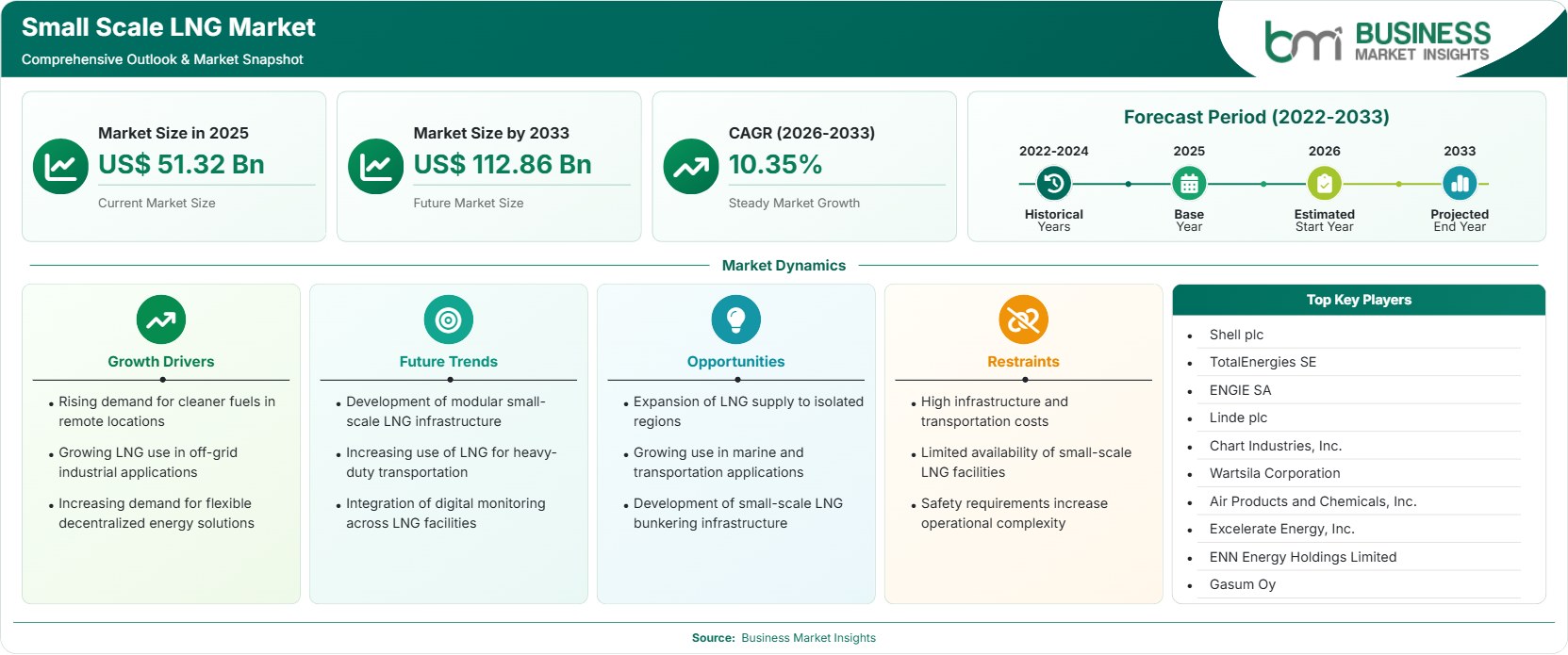
The Small Scale LNG Market size was valued at US$ 51.32 Billion in 2025 and is projected to reach US$ 112.86 Billion by 2033, growing at a CAGR of 10.35% during 2026–2033.

Demand for decentralized gas, LNG bunkering, modular terminals, remote power supply, industrial fuel switching, and flexible logistics is creating investable opportunities across emerging energy systems.

Report Coverage
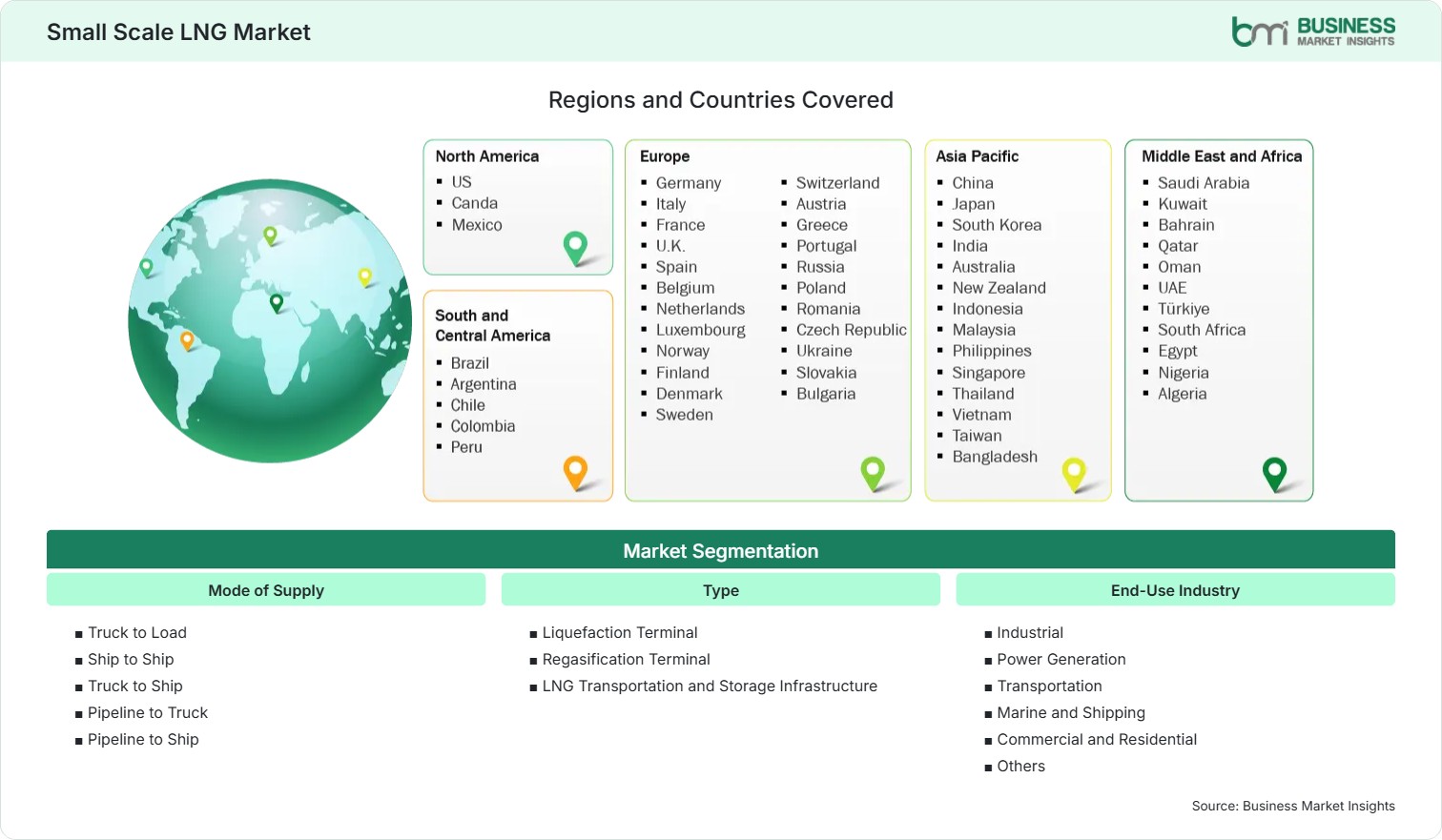
  • Mode of Supply: Truck to Load, Ship to Ship, Truck to Ship, Pipeline to Truck, Pipeline to Ship
  • Type: Liquefaction Terminal, Regasification Terminal, LNG Transportation and Storage Infrastructure
  • End-Use Industry: Industrial, Power Generation, Transportation, Marine and Shipping, Commercial and Residential, Others
US$ 51.32 Bn Market size in 2025
US$ 112.86 Bn Market Size by 2033
10.35% CAGR, 2026 - 2033
2026-2033 Forecast Period

AI Overview

Small Scale LNG Market Summary

  • North America Region: North America holds a Small Scale LNG market share of 25%–29% in 2025, growing at a CAGR of 8.5%–10.0%. A combination of modular liquefaction facilities, export flexibility, Caribbean distribution, trucking, and LNG power applications is a positive factor for infrastructure investments. The United States enjoys feed gas abundance, export infrastructure, and growing small scale authorizations leading to an 8.5%-10.0% CAGR until 2033.
  • Fastest Growing Region: Asia Pacific holds a 38%–43% share in 2025, with a CAGR of 11.0%–13.0%. Island economies, industrial clusters, marine bunkering, pipeline gaps, and rising energy-security requirements create scalable opportunities for modular LNG infrastructure and distributed supply networks.
  • Leading Segment: Liquefaction Terminal holds a 55%–68% share in 2025, with a CAGR of 7.0%–9.0%. Modular trains monetize stranded gas, support virtual pipelines, reduce infrastructure dependence, enable local LNG production, and improve supply flexibility for remote industrial customers.
  • High Growth Segment: Regasification Terminal holds a 12%–17% share in 2025, with a CAGR of 12.5%–14.6%. Compact receiving systems, floating solutions, satellite terminals, and rapid deployment models expand LNG access where pipelines remain uneconomic, unreliable, or unavailable.
  • Key Market Opportunity: Distributed LNG infrastructure can bridge pipeline gaps while supporting power reliability, industrial fuel switching, marine bunkering, and remote energy access, particularly across Asia, Caribbean markets, and emerging import economies.
  • Major Market Players: Shell plc, TotalEnergies SE, ENGIE SA, Linde plc, Chart Industries, Inc., Wärtsilä Corporation, Air Products and Chemicals, Inc., Excelerate Energy, Inc., ENN Energy Holdings Limited, Gasum Oy.
Strategic Insights

Small Scale LNG Market: Strategic Insights

Small Scale LNG Market Strategic Framework
FREE PDF
Request your free sample
Request free sample
Stakeholder View

Key Takeaways

  • Small Scale LNG Market supply chains are moving from centralized infrastructure toward hub-and-spoke networks combining liquefaction, storage, trucks, ISO containers, small carriers, and satellite regasification.
  • The potential of substitution of diesel or limited pipeline availability lies in transportation, marine bunkering, distributed power, and industrial end uses.
  • Modular approaches to projects result in lower complexity via standardization of equipment, reduced footprint, replicable engineering work, and phased capacity expansions without oversizing the project at its early stages.
  • Asia Pacific is the region with the best investment case due to its island structure, rapid industrial development, maritime traffic, and insufficient pipeline network.
  • Investments are focused on the concept of integrated facilities including LNG supplies, terminal operation, maritime transportation, power generation, and downstream logistics.
Geographic Outlook

Small Scale LNG Market Regional Highlights

North America Small Scale LNG Market

North America represented 25%–29% share in 2025, with a CAGR of 8.5%–10.0% through 2033. The region benefits from abundant gas, established LNG infrastructure, and mature logistics. The market share is supported by U.S. exports, Caribbean demand, industrial fuel switching, and remote power requirements. Canada adds liquefaction and marine opportunities. The Small Scale LNG Market growth profile remains investment-led, with modular assets helping developers serve customers without extensive pipeline construction.

  • The ability to use U.S. LNG facilitates truck loading, satellite delivery, and Caribbean exports, while flexibility in licensing allows fewer complications when licensing qualifying small-scale export facilities.
  • Canada offers possibilities for module-based liquefaction close to the gas production sites, especially if there is enough maritime access and need for small export or local distribution networks.
  • Caribbean countries represent interesting cases of potential use of LNG for power generation and decentralized delivery since island grids need reliable fuels and there is a lack of pipelines.
  • Industrial clients consider the use of LNG more flexibly as an alternative if the cost of diesel, emission controls, and lack of pipelines make standard fuel procurement difficult.

US Small Scale LNG Market

The U.S. accounted for 21%–25% of global share in 2025, while representing approximately 82%–88% of North American activity, with a 8.5%–10.0% CAGR through 2033. Domestic gas abundance, export infrastructure, truck logistics, and distributed power underpin demand. Regulatory actions have maintained a pathway for qualifying small-scale LNG exports. The country also provides engineering depth, cryogenic equipment supply, and established terminal infrastructure supporting project development.

  • Gulf Coast infrastructure provides access to abundant feedgas and established marine logistics, allowing smaller projects to connect with export, bunkering, and regional distribution opportunities.
  • DOE authorizations during 2025 included multiple small-scale LNG export actions, demonstrating continued regulatory activity around flexible LNG trade.
  • Caribbean and Central American customers remain important downstream opportunities because smaller LNG cargoes can substitute for pipeline-dependent supply models.

Europe Small Scale LNG Market

Europe held 20%–24% share in 2025, with a CAGR of 9.0%–11.0% through 2033. Germany, Spain, France, and the Netherlands are well established terminal ecosystems, while Italy and the Nordic countries are ideal destinations for marine fuel operations. The area balances between LNG security needs and the push towards maritime decarbonization. France is especially pertinent to truck loading and bunkering. Europe was forecasted to import record LNG volumes by 2025.

  • France is characterized by a combination of already existing LNG terminals and trucking and maritime bunkering, allowing for the provision of integrated possibilities of small-scale distribution and maritime fuel supply.
  • The Nordic countries focus on LNG and bio-LNG bunkering because of shipping decarbonization needs and existing marine-fuel infrastructure.
  • Germany has advantages of both industry demand and maritime traffic, while Italy is good for heavy transport, maritime logistics, and industrial energy.
  • France is estimated at 8.5%–10.5% CAGR, while Nordic marine applications can reach 10.0%–12.0%, supported by alternative-fuel adoption.

Asia Pacific Small Scale LNG Market

Asia Pacific represented 38%–43% share in 2025, with a CAGR of 11.0%–13.0% through 2033, making it the fastest-growing region. China, Japan, South Korea, India, Indonesia, and Southeast Asian economies provide diverse applications. China has extensive LNG distribution infrastructure, while island markets favor satellite terminals and virtual pipelines. The region combines industrial demand, marine trade, energy-security priorities, and uneven pipeline coverage.

  • The leadership in regional application can be seen with China in terms of LNG logistics, industrial fuel requirements, vehicle fuel, and existing connectivity between natural gas pipeline systems and smaller terminal locations.
  • In India, possibilities exist in industrial fuel sourcing and future distributed application, driven by increasing LNG procurement and diversity in downstream customers.
  • In Indonesia, there is potential for island-based LNG distribution due to fragmented geography that renders pipelining uneconomical in many demand locations.
  • Southeast Asian marine corridors support bunkering infrastructure as shipping operators seek lower-emission fuel pathways and reliable port-based LNG availability.

Rest of World Small Scale LNG Market

Rest of World held 9%–13% share in 2025, with a CAGR of 10.0%–12.0% through 2033. South and Central America benefit from island and remote-grid applications, while Middle Eastern and African markets emphasize power reliability and industrial fuel access. LNG-to-power and modular regasification can address infrastructure gaps without large pipeline commitments. Excelerate’s Caribbean platform demonstrates the commercial potential of integrated storage, regasification, and last-mile distribution.

  • Jamaica and neighboring Caribbean markets offer integrated LNG-to-power and distribution opportunities where flexible storage and truck-based delivery can improve reliability.
  • South American markets can use small-scale LNG to monetize stranded gas and serve mining, industrial, transport, and remote-generation customers.
  • Middle Eastern applications emphasize backup power, industrial demand, and flexible gas supply where pipeline networks face localized capacity constraints.
  • African markets offer opportunities for modular terminals and distributed generation, particularly where unreliable grids and limited gas infrastructure constrain industrial expansion.
Global Market Geography
FREE PDF
Request your free sample
Request free sample
Segment Analysis

Small Scale LNG Market Segmentation

Mode of Supply

Mode of Supply represented a major logistics layer in 2025, with Truck to Load leading at an estimated 34%–39% share and overall segment growth aligned with decentralized distribution. Small Scale LNG Market scope increasingly includes flexible truck, ship, and pipeline interfaces. Adoption depends on distance, terminal access, customer density, storage capacity, and delivered-fuel economics.

  • Truck to Load (TTL): Provides flexible last-mile LNG distribution for industrial, commercial, transport, and remote power users, benefiting from road accessibility and modular storage requirements.
  • Ship to Ship (STS): Enables offshore or port-based LNG transfer between vessels, supporting marine bunkering where conventional terminal interfaces constrain operational flexibility.
  • Truck to Ship (TTS): Connects road-delivered LNG with vessels, providing scalable bunkering for ports where dedicated LNG bunker terminals remain limited.
  • Pipeline to Truck (PTT): Converts pipeline gas into truck-loadable LNG supply chains, supporting regional distribution and remote customer access.
  • Pipeline to Ship (PTS): Links pipeline-fed LNG facilities with marine distribution, improving utilization of terminal assets and supporting bunkering networks.

Type

Type segmentation is led by liquefaction infrastructure, supported by demand for local LNG production and virtual pipelines. The leading segment holds 55%–68% share in 2025, while regasification expands faster. Small Scale LNG Market trends favor modular equipment, standardized engineering, scalable storage, and compact footprints. Investment decisions increasingly prioritize flexible expansion rather than maximum initial capacity.

  • Liquefaction Terminal: Converts natural gas into LNG near production or demand centers, enabling compact storage, transport, virtual pipelines, and stranded-gas monetization.
  • Regasification Terminal: Converts LNG back into gas for power, industry, commercial demand, and grid injection, with modular systems enabling rapid deployment.
  • LNG Transportation and Storage Infrastructure: Provides cryogenic transport, storage, ISO containers, carriers, and handling systems required to connect production with dispersed customers.

End-Use Industry

End-use demand is diversified across transportation, power, marine, industrial, and commercial applications. Transportation remains a leading application because LNG can displace diesel in suitable duty cycles. The Small Scale LNG Market trends toward integrated fuel solutions that combine supply, storage, and customer infrastructure. Adoption depends on fuel economics, emissions requirements, operating patterns, and infrastructure availability across target markets.

  • Industrial: Supports factories, mining, manufacturing, and thermal processes where reliable gas supply can replace liquid fuels and reduce exposure to pipeline limitations.
  • Power Generation: Provides flexible fuel for distributed generation, captive plants, backup systems, and isolated grids requiring dependable dispatchable energy.
  • Transportation: Serves heavy-duty fleets and long-distance operations where centralized refueling networks and suitable vehicle utilization support LNG economics.
  • Marine and Shipping: Enables bunkering for LNG-fueled vessels, with demand supported by tightening emissions requirements and expanding alternative-fuel infrastructure.
  • Commercial and Residential: Supplies customers through satellite LNG systems where pipeline access is unavailable, helping diversify energy sources and improve reliability.
Market Forces

Small Scale LNG Market Dynamics

Key Market Drivers

Decentralized Energy Demand

Small Scale LNG Market growth is supported by customers located beyond economical pipeline networks. LNG enables compact storage and road, marine, or containerized distribution. The IEA reported global gas demand increased about 1% in 2025, while LNG supply grew almost 7%, improving availability for flexible downstream applications. Modular infrastructure can therefore serve isolated industrial facilities, islands, mines, and power plants without requiring full pipeline buildouts.

Marine Fuel Transition

The Small Scale LNG Market trends have become more linked with marine fuel bunkering. The IMO has adopted an agreement in April 2025, which combines mandatory fuel regulations with emissions pricing, aimed at large ocean ships that account for 85% of total global shipping emissions. LNG bunker fuel could serve as a stop-gap measure while the ports build up their low carbon fuel facilities.

Modular Infrastructure Economics

Modular liquefaction and regasification reduce the need for oversized initial projects. Chart Industries describes modular LNG plants spanning small capacities through larger modular configurations, while Wärtsilä emphasizes modularization, standardization, simplicity, and flexible operations for small-scale projects. These approaches allow capacity to expand alongside demand, reducing exposure to demand forecasting errors and improving project scalability for regional markets.

Key Market Opportunities

Island and Remote Energy Systems

The use of small-scale LNG can help in replacing diesel reliance in remote areas where logistics is expensive and pipelines are not viable. In the Caribbean, there is a business case for utilizing such energy because of integration through terminals, storage, and trucking that can enable replication of a hub and spoke network. The Jamaica facility by Excelerate is an example that involves small-scale storage and regasification facilities.

Asia Pacific Industrial Clusters

There is a potential market for modular LNG systems in Asia Pacific within industrial complexes, ports, mining districts, and island nations. The countries such as China, India, Indonesia, and Southeast Asia have high concentration of industries along with inadequate pipe network distribution. Investments could be made in satellite facilities, ISO container logistics, and smaller liquefaction plants. The LNG contracts in India are a case in point.

Integrated LNG and Power Platforms

Small Scale LNG Market Forecasts improve where developers combine LNG supply with power generation, storage, regasification, and distribution. Such an integrated system makes it possible to earn money from more than one stage of the process, rather than depending only on revenues from the terminal. An example is the acquisition of Excelerate in Jamaica with respect to LNG terminals, power plants, and small scale distribution.

Market Restraints and Challenges

High Infrastructure and Financing Requirements

Factor: Even if the LNG is on a smaller scale, it still needs to be stored and transported using cryogenics and have proper safety mechanisms. Impact: Demand fragmentation can reduce efficiency of the assets and elongate payback period of the project. Previous research by the Wärtsilä corporation highlighted that higher initial cost and lack of dedicated vessels and terminals were significant obstacles for the industry. Modular technology lessens complexity, but financing and capacity planning must precede investment.

Price Volatility and Alternative Fuels

Factor: LNG prices remain exposed to global supply disruptions, shipping constraints, weather, and geopolitical shocks. Impact: customers may delay conversions when delivered LNG loses its cost advantage over diesel, pipeline gas, renewables, or other fuels. IEA reporting shows geopolitical disruption and tighter supply conditions can materially influence gas prices and demand. Small-scale projects therefore need flexible contracts, diversified sourcing, and efficient logistics to preserve customer economics during volatile periods.

Company Analysis

Competitive Landscape

Small Scale LNG Market analysis indicates competition spans LNG producers, cryogenic technology suppliers, terminal developers, marine-equipment specialists, and integrated energy companies.

Company Name

Overview

Products and Services relevant to this market

Shell plc

Global integrated energy company with extensive LNG supply, trading, shipping, and downstream infrastructure capabilities.

LNG supply, trading, marine bunkering, LNG infrastructure, and distributed-energy initiatives.

TotalEnergies SE

Integrated energy producer with LNG production, trading, infrastructure interests, and growing Asian downstream exposure.

LNG supply, terminal participation, trading, transportation, and downstream gas solutions.

ENGIE SA

European energy company active across LNG sourcing, terminal services, and small-scale distribution applications.

LNG portfolio management, terminal services, truck loading, bunkering, and distributed LNG supply.

Linde plc

Industrial gases and engineering specialist with extensive cryogenic and LNG process technology expertise.

LNG liquefaction technology, cryogenic equipment, engineering, and process solutions.

Chart Industries, Inc.

Cryogenic equipment provider offering modular LNG liquefaction, storage, transportation, and regasification solutions.

Modular liquefaction plants, storage tanks, regasification, transport equipment, and LNG systems.

Wärtsilä Corporation

Marine and energy technology provider with specialized small-scale LNG terminal and bunkering capabilities.

LNG terminals, liquefaction, cargo handling, fuel-gas systems, bunkering, and lifecycle services.

Air Products and Chemicals, Inc.

Global industrial-gas company supplying LNG process technology and cryogenic equipment for major projects.

LNG heat exchangers, liquefaction technology, cryogenic systems, and engineering services.

Excelerate Energy, Inc.

Integrated LNG infrastructure company combining supply, terminals, power generation, and downstream distribution.

FSRUs, LNG supply, regasification, storage, truck distribution, and LNG-to-power solutions.

ENN Energy Holdings Limited

Chinese energy-services company with downstream gas distribution and LNG-related infrastructure exposure.

LNG distribution, natural gas infrastructure, retail energy, and integrated downstream services.

Gasum Oy

Nordic gas-energy company focused on LNG, bio-LNG, marine bunkering, and regional gas distribution.

LNG supply, bunkering, terminal operations, bio-LNG, and maritime fuel services.

Trust & Transparency

Research Methodology

The market analysis combines proprietary research with secondary data from government agencies, company disclosures, regulatory filings, industry databases and expert interviews. Market estimates are validated through data triangulation, cross-market benchmarking and analyst review.

View Full Research Methodology

Questions Answered

Frequently Asked Questions

What should investors prioritize when evaluating projects?

Investors should assess delivered LNG economics, contracted offtake, storage utilization, feedgas reliability, transport distance, regulatory requirements, terminal scalability, and exposure to competing fuels before approving capital-intensive projects.

Why is Asia Pacific attractive for investors?

Asia Pacific combines industrial expansion, island geography, marine trade, pipeline gaps, and energy-security requirements. These characteristics create multiple localized demand centers suitable for satellite terminals, virtual pipelines, bunkering, and modular liquefaction.

How important is modularization to future projects?

Modularization allows developers to match capacity with actual demand, reduce construction complexity, standardize equipment, and expand projects in stages. This can improve capital discipline where customer demand is fragmented.

Which applications can generate the strongest demand?

Marine bunkering, distributed power, industrial fuel switching, heavy transportation, and remote energy supply offer strong demand potential because these users can benefit directly from flexible LNG logistics.

What makes small-scale LNG different from conventional LNG infrastructure?

Small-scale LNG uses modular production, storage, transportation, and regasification assets designed for lower-volume customers. It can operate through truck, ISO-container, small-vessel, or virtual-pipeline logistics rather than relying exclusively on large terminals and extensive pipeline networks.

Access the Full Small Scale LNG Market Report

Get segment-level forecasts, regional estimates, competitive benchmarking, company profiles and downloadable Excel datasets.

Access the full Small Scale LNG Market Report
350 pages PDF & Excel | 2026-09-15
Similar Research

Related Market Reports