
Grid Scale Battery Market Outlook: Size, Share, Trends, Growth Analysis, Competitive Landscape & Forecast, 2026–2033

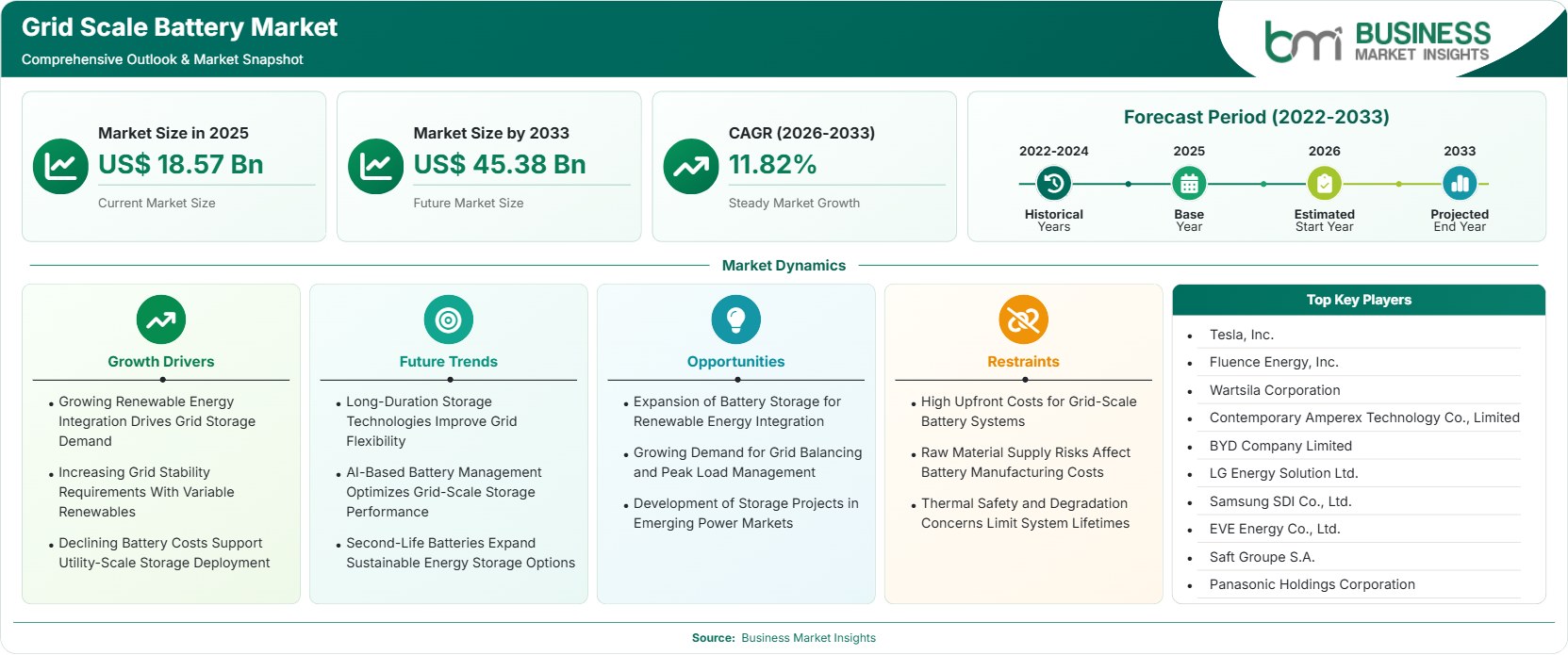
The Grid Scale Battery Market size was valued at US$ 18.57 Billion in 2025 and is projected to reach US$ 45.38 Billion by 2033, growing at a CAGR of 11.82% during 2026–2033, driven by renewable integration, grid balancing, peak shifting, and storage investment.

Report Coverage
  • Battery Chemistry: Lead-acid, Sodium-based, Redox Flow, Lithium-ion, Others
  • Ownership: Third-party Owned, Utility Owned
  • Application: Renewables, Peak Shifting, Ancillary Services, Backup Power, Others
US$ 18.57 Bn Market size in 2025
US$ 45.38 Bn Market Size by 2033
11.82% CAGR, 2026 - 2033
2026-2033 Forecast Period

01 AI Overview

Grid Scale Battery Market Summary

  • North America Region: holds a 28%–32% Grid Scale Battery Market share in 2025, growing at a CAGR of 10.90%–11.70%, supported by renewable integration, grid modernization, peak-load management, utility procurement, and expanding storage requirements from increasingly variable electricity demand. The US market remains the regional anchor, with a CAGR of 11.20%–12.00% from 2026–2033, supported by utility-scale renewable deployment, flexible capacity requirements, and merchant storage models.
  • Fastest Growing Region: Asia Pacific holds a 38%–42% share in 2025, growing at a CAGR of 13.00%–14.00%, supported by rapid renewable capacity additions, expanding transmission networks, industrial electrification, utility modernization, and increasing demand for flexible electricity resources.
  • Leading Segment: Lithium-ion holds a 72%–76% share in 2025, growing at a CAGR of 11.60%–12.30%, supported by established manufacturing capacity, mature supply chains, proven cycling performance, falling system costs, and suitability for frequent grid balancing applications.
  • High Growth Segment: Peak Shifting holds a 20%–24% share in 2025, growing at a CAGR of 13.00%–14.00%, supported by rising evening demand, renewable generation variability, capacity constraints, electricity price volatility, and increasing utility interest in flexible load management.
  • Key Market Opportunity: Expansion of storage paired with renewable generation creates opportunities for developers, utilities, system integrators, and battery suppliers through flexible capacity, ancillary services, peak management, and grid resilience.
  • Major Market Players: Tesla, Inc., Fluence Energy, Inc., Wartsila Corporation, Contemporary Amperex Technology Co., Limited; BYD Company Limited, LG Energy Solution Ltd., Samsung SDI Co., Ltd., EVE Energy Co., Ltd., Saft Groupe S.A., Panasonic Holdings Corporation.
02 Strategic Insights

Grid Scale Battery Market: Strategic Insights

Grid Scale Battery Market Strategic Framework
FREE PDF
Request your free sample
Request free sample
03 Stakeholder View

Key Takeaways

  • The value chain is becoming increasingly integrated, as there is increasing coordination among cell makers, battery system integrators, software providers, utilities, and project developers on battery selection, controls, warranties, maintenance, and grid participation.
  • The strongest near-term application potential is represented by peak shifting and renewables integration, as storage systems have the capability of shifting energy production between periods of surplus and deficits while contributing to grid stability.
  • Lithium-ion batteries will continue to dominate, yet sodium batteries and redox flow batteries might become an option for projects that value resource diversification, safety, durability, or lesser lithium exposure.
  • Asia Pacific offers the strongest regional investment case because renewable deployment, industrial electricity demand, utility modernization, and expanding transmission infrastructure are creating sustained requirements for flexible storage assets.
  • Investment efforts are now focused on integrated projects, local manufacturing, battery supply arrangements, and technology partnerships, placing greater emphasis on bankability, warranties, and supply chain management.
  • Future project economics will rely more on revenue stacking, rather than a particular application, meaning that developers have to integrate energy arbitrage, capacity provision, ancillary services, renewable firming, and grid balancing revenues.
04 Geographic Outlook

Grid Scale Battery Market Regional Highlights

North America Grid Scale Battery Market

North America Grid Scale Battery Market held a 28%–32% share in 2025 and is projected to grow at a CAGR of 10.90%–11.70% through 2033. The region is supported by utility procurement, renewable generation, grid congestion, flexible capacity needs, and existing battery value chains. Storage projects have become more complex by generating multiple streams of income to increase their efficiency for investment purposes. The United States still is the leader in the storage market, but Canada is also growing with its new storage prospects.

  • Utility-scale storage deployment is increasingly linked with renewable projects, allowing developers to manage generation variability and reduce dependence on conventional peaking resources.
  • Grid congestion and lengthy transmission development timelines are encouraging storage deployment at strategically constrained nodes where flexible capacity can improve network utilization.
  • Merchant storage models are expanding alongside contracted utility projects, creating opportunities for operators able to optimize batteries across multiple electricity-market services.
  • Domestic battery manufacturing and localized supply chains are becoming more important as procurement strategies increasingly consider trade exposure, delivery certainty, and long-term equipment availability.

US Grid Scale Battery Market

The US Grid Scale Battery Market held a 24%–28% share of the global market in 2025 and is projected to grow at a CAGR of 11.20%–12.00% through 2033. Strong renewable additions, regional electricity-market participation, transmission constraints, and rising demand for dispatchable flexibility support deployment. Texas, California, Arizona, and other high-growth electricity markets provide attractive conditions for utility and merchant storage.

  • Renewable generation growth is increasing the need for flexible assets that can absorb surplus electricity and discharge during periods of higher system demand.
  • Storage developers increasingly prioritize project locations with favourable interconnection conditions, strong price spreads, renewable generation growth, and access to multiple market revenues.
  • Domestic manufacturing initiatives are strengthening interest in localized battery supply chains while increasing attention to cell sourcing, system integration, and long-term procurement contracts.

Europe Grid Scale Battery Market

Europe Grid Scale Battery Market represented a 18%–22% share in 2025 and is projected to expand at a CAGR of 10.50%–11.40% through 2033. The renewable penetration, electricity price volatility, balancing requirements, and flexibility needs of the grid provide the conditions that promote deployment. The leaders in the market have been Germany and the UK, although there is considerable growth potential in Spain and Italy. Europe is also looking into energy security and flexible capacity, batteries and their recycling, and supply chain diversification.

  • Germany benefits from renewable integration requirements and increasing interest in batteries capable of balancing decentralized generation and managing electricity-market volatility.
  • The United Kingdom is developing storage capacity around balancing needs, renewable integration, and flexible electricity-market participation, supporting demand for utility-scale systems.
  • Spain is emerging as a high-growth market, with expanding renewable generation creating stronger requirements for storage capable of shifting electricity across periods.
  • Italy is also gaining momentum as utilities and developers seek flexible resources capable of supporting renewable penetration and regional grid balancing.

Asia Pacific Grid Scale Battery Market

Asia Pacific Grid Scale Battery Market accounted for a 38%–42% share in 2025 and is projected to grow at a CAGR of 13.00%–14.00%, making it the fastest-growing regional market. China leads regional deployment, supported by renewable expansion, utility modernization, and domestic battery manufacturing. India, Australia, Japan, and South Korea provide additional opportunities.

  • China remains the leading country because large-scale renewable development, domestic cell manufacturing, and grid modernization support rapid battery storage deployment.
  • India represents a high-growth market as renewable integration, peak-demand management, and expanding electricity consumption increase the requirement for flexible grid resources.
  • Australia continues to develop storage around renewable integration, electricity-market balancing, and grid reliability, creating opportunities for both utility and merchant battery projects.
  • Japan and South Korea are strengthening storage requirements through renewable integration, energy-security priorities, distributed power-system flexibility, and technology-oriented battery manufacturing capabilities.

Rest of World Grid Scale Battery Market

South and Central America represented a 7%–10% share in 2025 and are projected to grow at a CAGR of 9.80%–10.80% through 2033. Brazil and Chile lead regional opportunities as renewable generation expands and power systems require greater flexibility. Storage deployment remains closely linked to renewable integration, isolated systems, transmission constraints, and electricity reliability.

The Middle East and Africa represented a 6%–9% share in 2025 and are projected to grow at a CAGR of 10.00%–11.00%. Saudi Arabia, the United Arab Emirates, and South Africa provide leading opportunities, supported by renewable projects, grid modernization, energy diversification, and demand for reliable electricity.

  • Brazil offers opportunities for storage linked with renewable generation, transmission management, and electricity-system flexibility as variable generation expands.
  • Chile is positioned for strong storage growth because renewable generation and transmission constraints increase the value of flexible electricity resources.
  • Saudi Arabia and the United Arab Emirates are developing storage opportunities around renewable power expansion, energy diversification, and large-scale electricity infrastructure.
  • South Africa requires additional flexible capacity to strengthen grid reliability and manage renewable generation variability, supporting long-term storage investment opportunities.
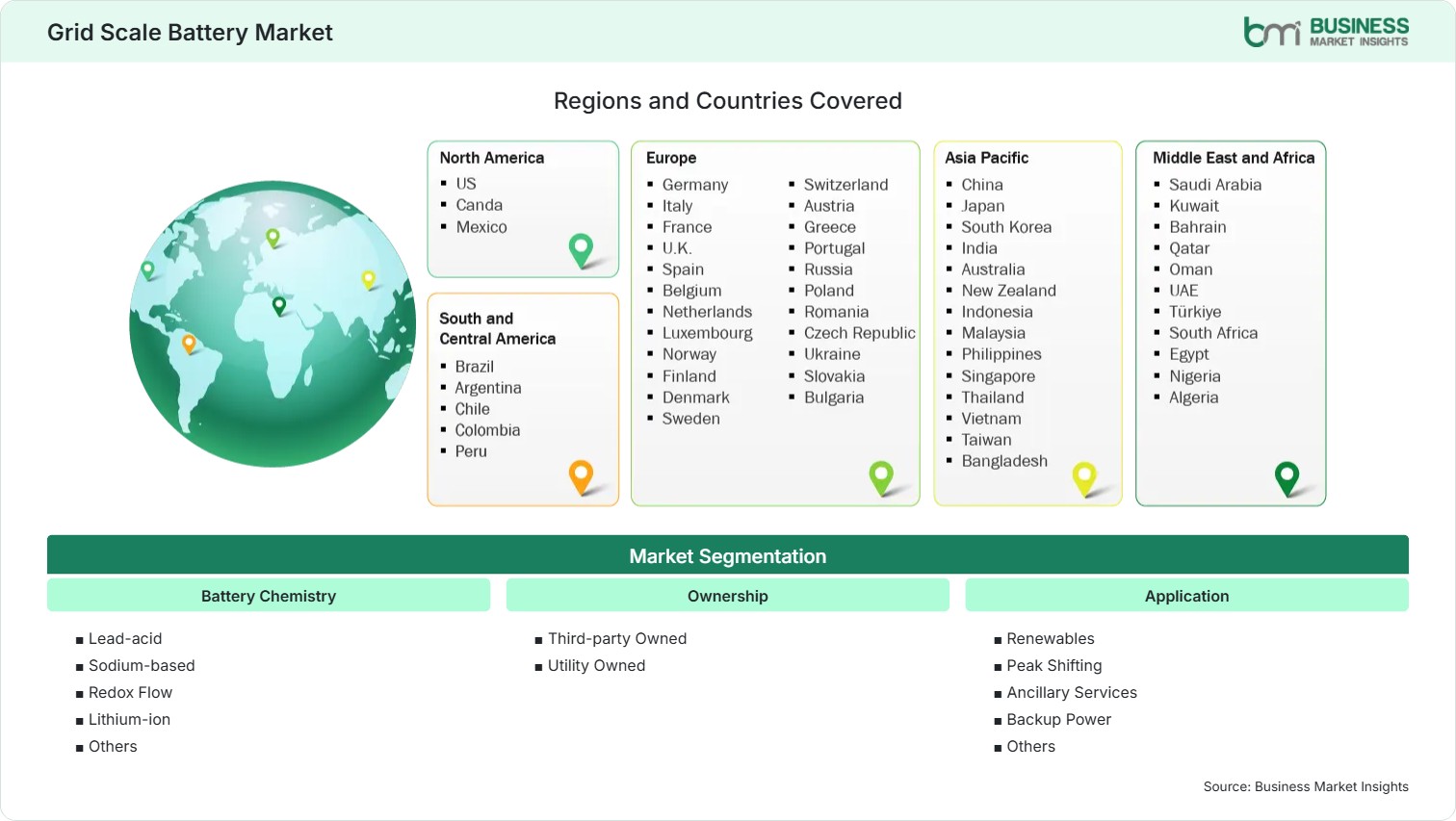
Global Market Geography
FREE PDF
Request your free sample
Request free sample
05 Segment Analysis

Grid Scale Battery Market Segmentation

Battery Chemistry

Lithium-ion represented a 72%–76% share in 2025 and is projected to grow at a CAGR of 11.60%–12.30% through 2033. Established manufacturing, strong energy efficiency, modular design, and proven utility applications support adoption. Sodium-based and redox-flow technologies are gaining consideration for projects requiring alternative materials, enhanced safety, or longer-duration storage.

  • Lead-acid: Remains relevant in selected stationary applications where established recycling networks, familiar maintenance practices, and lower initial equipment complexity support continued deployment.
  • Sodium-based: Gains interest for stationary storage where abundant raw materials, thermal stability, supply-chain diversification, and cost control can offset lower energy density.
  • Redox Flow: Supports longer-duration applications requiring repeated cycling, independent power and energy scaling, and reduced degradation under intensive operating schedules.
  • Lithium-ion: Maintains leadership through mature manufacturing, compact system design, established performance data, and strong compatibility with renewable integration and grid-balancing requirements.

Ownership

Utility-owned systems represented a 55%–60% share in 2025 and are projected to grow at a CAGR of 10.80%–11.60% through 2033. Utility ownership enables greater control over dispatch, planning, capacity purchases, and renewables integration. Third-party ownership is growing where the developer finances, operates, and optimizes without forcing the utility to shoulder the entire burden of capital investment.

  • Third-party Owned: Enables utilities and commercial operators to access storage without full upfront ownership, while specialized developers manage financing, operation, maintenance, and market optimization.
  • Utility Owned: Gives electricity providers direct control over dispatch, capacity planning, grid support, renewable integration, and long-term asset utilization.

Application

Renewables represented a 30%–34% share in 2025 and are projected to grow at a CAGR of 12.20%–13.00% through 2033. Peak Shifting is the high-growth application, supported by rising demand during constrained periods and increasing renewable variability. Ancillary services and backup power remain important for grid stability and reliability.

  • Renewables: Supports solar and wind integration by shifting electricity availability, reducing curtailment pressure, and improving dispatch flexibility across variable generation profiles.
  • Peak Shifting: Gains adoption where batteries discharge during high-demand periods, reducing peak exposure and improving utilization of existing electricity infrastructure.
  • Ancillary Services: Provides fast-response grid support for frequency regulation, balancing, voltage management, and other operational requirements requiring flexible resources.
  • Backup Power: Supports grid resilience and continuity where utilities require stored electricity during outages, supply interruptions, extreme conditions, or network disturbances.
06 Market Forces

Grid Scale Battery Market Dynamics

Key Market Drivers

Growing Renewable Energy Integration Drives Grid Storage Demand

Renewable generation is increasing the need for flexible electricity resources capable of balancing variable output across changing demand conditions. The market growth is therefore closely linked with renewable capacity expansion, particularly where solar and wind generation create timing mismatches between production and demand. Battery systems can absorb surplus generation and discharge during constrained periods, improving renewable utilization. These requirements are shaping Grid Scale Battery Market trends toward larger systems, longer durations, advanced controls, and integrated energy-management platforms.

Increasing Grid Stability Requirements with Variable Renewables

Power systems with higher shares of variable renewable generation require faster balancing resources and greater operational flexibility. Batteries respond rapidly to changes in grid conditions and can participate across several services depending on market design. This creates demand beyond conventional energy shifting, particularly for frequency support, reserve capacity, congestion management, and system balancing. Developers are therefore placing greater emphasis on dispatch optimization, state-of-charge management, thermal controls, and battery health monitoring. This shift supports Grid Scale Battery Market growth across mature electricity markets where renewable penetration is already high.

Declining Battery Costs Support Utility-Scale Storage Deployment

Falling battery system costs are improving the economics of utility-scale storage, although project economics continue to vary by chemistry, duration, location, financing, and interconnection requirements. Lower costs allow developers to consider longer-duration systems and larger project capacities without relying entirely on high-value short-duration services. The effect is particularly important for renewable-heavy power systems where batteries can capture multiple revenue streams. Grid Scale Battery Market trends are consequently moving toward standardized system architectures, higher energy density, simplified installation, and integrated controls.

Key Market Opportunities

Expansion of Battery Storage for Renewable Energy Integration

Renewable integration remains one of the largest commercial opportunities because solar and wind projects increasingly require flexible resources to manage generation variability. Co-located storage can improve the timing of renewable electricity delivery, reduce curtailment exposure, and provide additional grid services. The opportunity extends beyond new renewable projects because existing generation assets can also be paired with batteries where interconnection capacity is available. Grid Scale Battery Market Forecasts are therefore increasingly shaped by storage requirements attached to renewable development plans rather than by standalone battery demand alone.

Growing Demand for Grid Balancing and Peak Load Management

Peak demand management offers a direct application for batteries in electricity markets where there is high consumption of electricity over short periods of time. This is because storage can use times of low electricity consumption to store the energy and then discharge it at times of high network utilization without necessarily having to increase the peaking power generation capacities. Such an application would be more profitable where there is spread of electricity prices or demand charges. Advanced energy-management software can further improve returns by shifting operating strategies according to market conditions and battery health.

Development of Storage Projects in Emerging Power Markets

Emerging electricity markets offer substantial room for battery deployment because renewable generation, transmission expansion, and electricity demand are increasing simultaneously. Developers can address grid flexibility requirements where transmission construction is slower than generation development or where isolated networks need dependable balancing resources. India, Brazil, Chile, the Middle East, and selected Southeast Asian markets offer different commercial structures, but all require careful assessment of grid rules, financing, import exposure, and local supply chains. Battery projects in these markets can also support renewable firming and reliability improvement.

Market Restraints and Challenges

High Upfront Costs for Grid-Scale Battery Systems

Factor: Utility-scale battery systems entail significant initial cost, including expenses related to cells, enclosures, power-conversion technology, thermal control, controls, engineering, construction, and connectivity to the grid. Impact: The large initial investment may lead to delays in procurement, scale-down of projects, or preference for more financially sound markets where there is greater clarity on how storage can be compensated.

Raw Material Supply Risks Affect Battery Manufacturing Costs

Factor: Battery manufacturing depends on mineral and processed-material supply chains that can be concentrated geographically, exposing producers to price movements, trade restrictions, processing constraints, and procurement disruptions. Impact: Supply volatility can raise cell costs, extend procurement timelines, and encourage developers to reconsider chemistry selection or supplier concentration. Lithium-ion systems remain dominant, but growing interest in sodium-based and redox-flow technologies reflects broader efforts to diversify battery materials and reduce exposure to specific mineral chains.

07 Company Analysis

Competitive Landscape

The Grid Scale Battery Market analysis indicates competition is increasingly based on system integration, battery availability, software optimization, project execution, warranties, and lifecycle service capability. Major suppliers are differentiating through modular architectures, advanced energy-management systems, chemistry expertise, and integrated project delivery.

Company Name

Overview

Products and Services relevant to this market

Tesla, Inc.

Energy technology company with strong capabilities across battery systems, software, power management, and utility-scale storage deployment.

Megapack utility-scale battery systems, energy-management software, grid storage integration, monitoring, and lifecycle support.

Fluence Energy, Inc.

Energy storage and digital infrastructure provider focused on utility-scale battery systems and grid optimization.

Battery storage systems, optimization software, digital platforms, grid services, asset management, and project integration.

Wärtsilä Corporation

Energy technology supplier providing flexible power and storage solutions for utility and renewable-heavy electricity systems.

Grid-scale energy storage, battery systems, energy-management software, integration, and lifecycle services.

Contemporary Amperex Technology Co., Limited

Battery manufacturer with extensive cell production capabilities and growing stationary energy-storage solutions.

Lithium-ion cells, energy-storage systems, battery containers, system integration, and storage technology solutions.

BYD Company Limited

Diversified technology manufacturer with significant battery production and stationary storage capabilities.

Battery energy-storage systems, lithium-based battery technologies, storage containers, and integrated energy solutions.

LG Energy Solution Ltd.

Battery manufacturer serving stationary storage markets through large-scale cell production and system solutions.

Energy-storage cells, modules, battery systems, monitoring solutions, and utility-scale storage technologies.

Samsung SDI Co., Ltd.

Battery technology company supplying advanced rechargeable battery products for stationary energy applications.

Energy-storage battery cells, modules, systems, and supporting battery technology solutions.

EVE Energy Co., Ltd.

Battery manufacturer expanding its presence across large-format cells and stationary energy-storage applications.

Large-format lithium battery cells, energy-storage systems, battery modules, and related integration solutions.

Saft Groupe S.A.

Specialized battery company providing energy-storage technologies for demanding industrial and grid applications.

Stationary battery systems, lithium-ion technologies, grid storage solutions, monitoring, and lifecycle services.

Panasonic Holdings Corporation

Diversified technology group with established battery manufacturing capabilities and energy-storage expertise.

Lithium-ion battery technologies, energy-storage systems, battery components, and power-management solutions.

10 Trust & Transparency

Research Methodology

The market analysis combines proprietary research with secondary data from government agencies, company disclosures, regulatory filings, industry databases and expert interviews. Market estimates are validated through data triangulation, cross-market benchmarking and analyst review.

View Full Research Methodology

11 Questions Answered

Frequently Asked Questions

What is changing in the competitive landscape?

Competition is shifting from battery supply alone toward integrated offerings covering cells, power conversion, controls, software, project execution, warranties, monitoring, and long-term lifecycle services.

How are storage developers improving project economics?

Developers increasingly combine energy arbitrage, renewable firming, ancillary services, capacity value, and peak management rather than relying on a single application. Software optimization is becoming important for coordinating these revenue streams.

What factors influence the selection of a grid-scale battery system?

Selection depends on duration, cycling profile, degradation characteristics, safety requirements, local grid rules, project location, financing conditions, warranty structure, supply availability, and the revenue streams available to the asset.

Why is peak shifting becoming an important storage application in Grid Scale Battery Market report?

Peak shifting allows utilities and storage operators to move electricity from lower-demand periods into higher-demand periods, improving grid flexibility and reducing pressure on constrained generation and network infrastructure.

Which battery chemistry will remain dominant in utility-scale storage?

Lithium-ion, particularly LFP-based systems, is likely to retain its leading position because of established manufacturing capacity, proven operating performance, mature supply chains, and broad availability of system integration expertise.

Access the Full Grid Scale Battery Market Report

Get segment-level forecasts, regional estimates, competitive benchmarking, company profiles and downloadable Excel datasets.

Access the full Grid Scale Battery Market Report
350 pages PDF & Excel | 2026-08-19