Market Summary
Executive Summary and Global Market Analysis
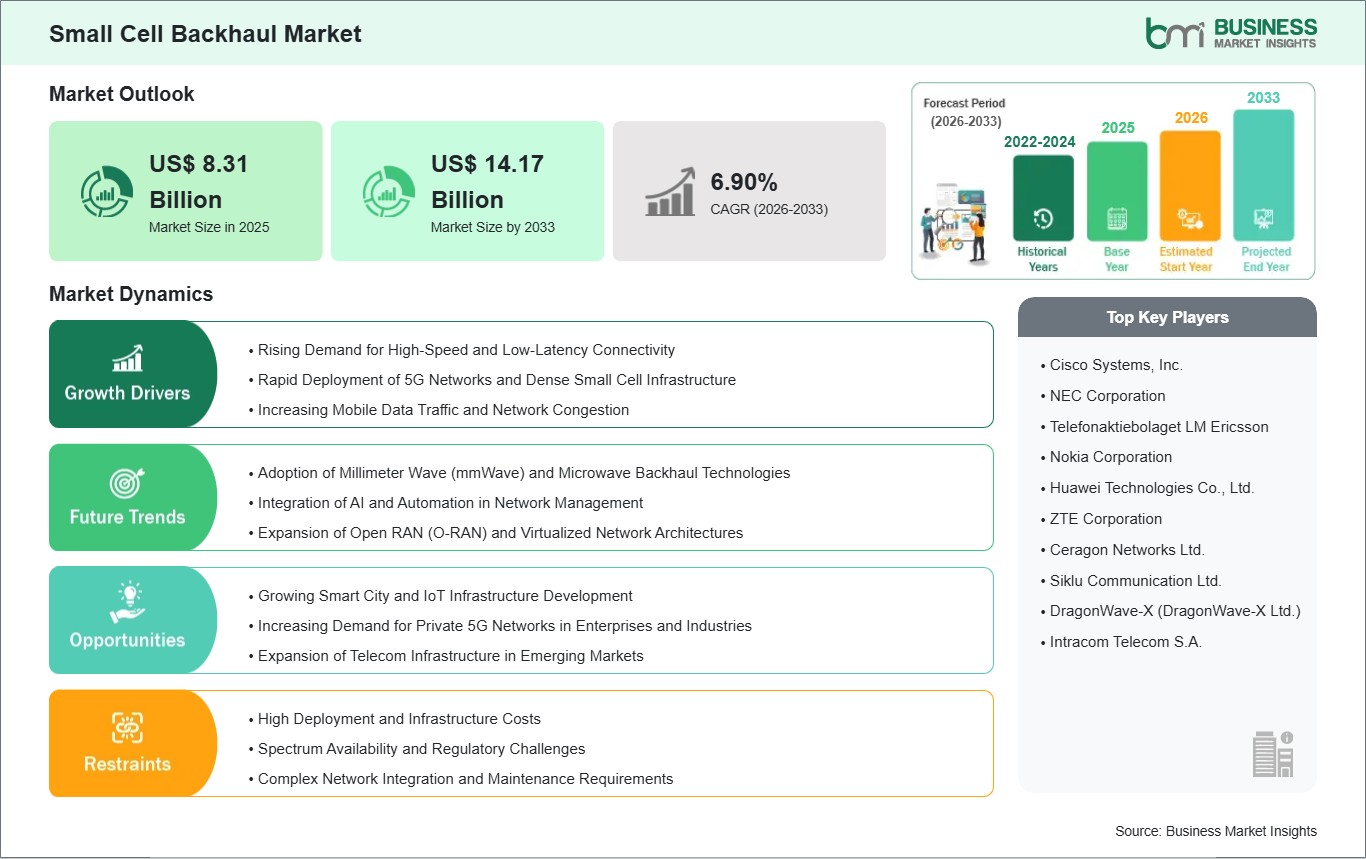
Small cell backhaul refers to the critical infrastructure and technology required to link low-power cellular radio access nodes to a service provider`s core network. As mobile operators face the challenge of massive data traffic growth, particularly in urban and indoor environments, small cells have become indispensable for network densification and capacity offloading. These solutions play a vital role across multiple sectors, including telecommunications, smart cities, industrial automation, and enterprise connectivity. Small cell backhaul provides distinct advantages such as high spectral efficiency, improved coverage in "dead zones," and the low-latency transmission required for modern applications. The rapid global adoption of mobile devices, rising network congestion, and the global transition to 5G are major catalysts for market expansion. Furthermore, the development of high-capacity wireless links and software-defined networking is enhancing the flexibility of these solutions.
However, the market faces significant restraints, including high initial deployment costs, spectrum availability limitations, and the complexity of securing site permits in metropolitan areas. Infrastructure overlaps and the logistical difficulty of power distribution to thousands of nodes also present hurdles. Despite these challenges, the market holds vast opportunities through the integration of AI-driven network management, the proliferation of private 5G networks in the industrial sector, and the use of satellite backhaul for rural and maritime connectivity. Investment in green energy-efficient hardware and standardized Open RAN architectures is expected to further drive the industry toward more sustainable and cost-effective growth models.
Segment Analysis
Small Cell Backhaul Market Segmentation
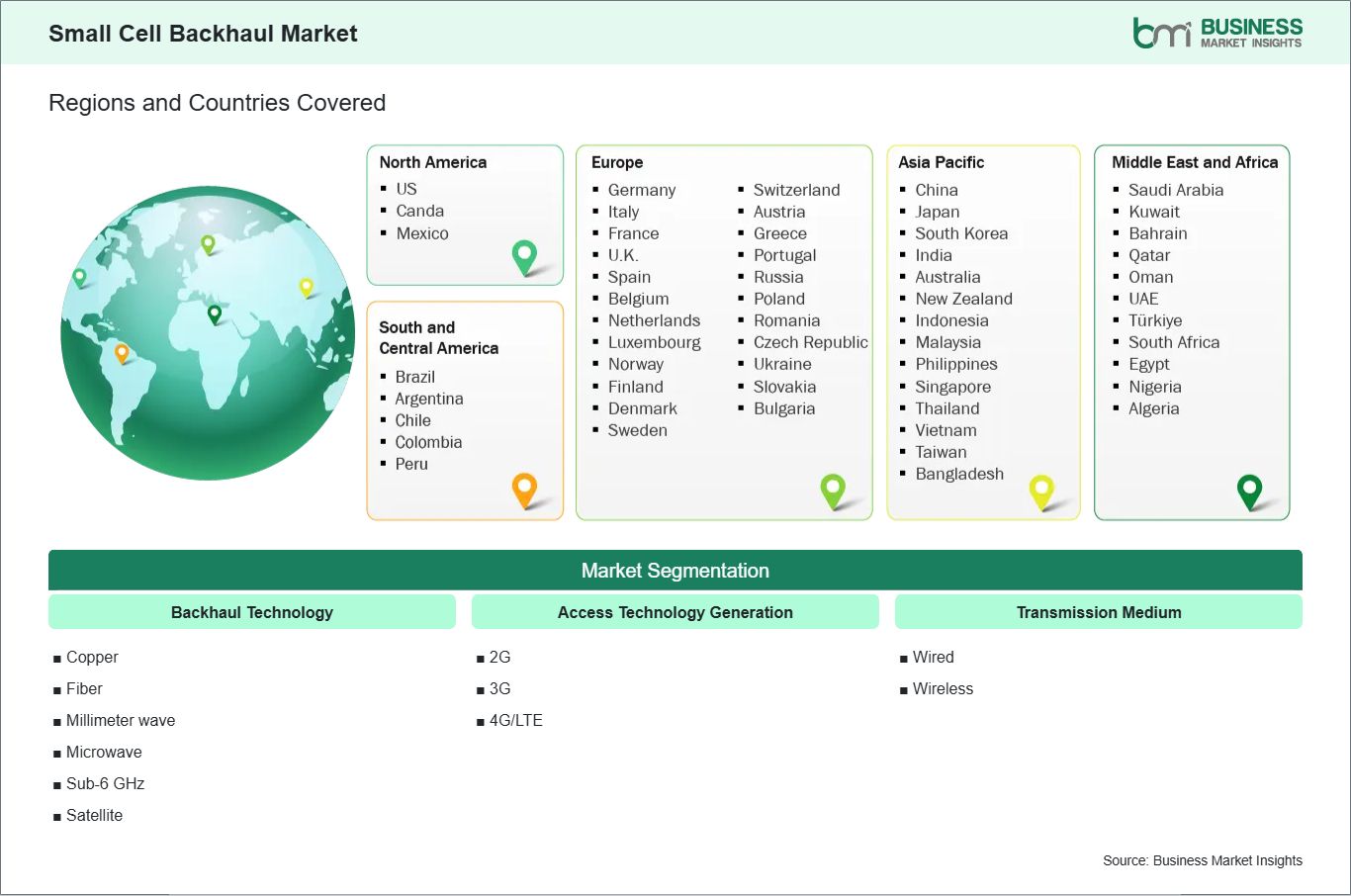
Key segments that contributed to the derivation of the Small Cell Backhaul market analysis are backhaul technology, access technology generation, and transmission medium.
- By Backhaul Technology, the market is segmented into Copper, Fiber, Millimeter wave, Microwave, Sub-6 GHz, and Satellite.
- By Access Technology Generation, the market is divided into 2G, 3G, and 4G/LTE.
- By Transmission Medium, the market is categorized into Wired and Wireless.
Market Forces
Small Cell Backhaul Market Drivers and Opportunities
Surging Global Mobile Data Traffic and Network Densification Needs
The exponential rise in global mobile data consumption is a primary driver for the small cell backhaul market. As consumers and businesses increasingly rely on bandwidth-intensive applications such as high-definition video streaming, cloud computing, and real-time interactive gaming, existing macrocell networks are struggling to maintain performance. To alleviate this congestion, telecommunications providers are deploying dense networks of small cells to offload traffic and provide localized capacity. This strategy necessitates a robust backhaul architecture capable of handling high data throughput.
The global mobile data traffic is expected to grow. This surge directly forces operators to invest in backhaul solutions, ranging from fiber-to-the-small-cell to high-frequency wireless links, to ensure that the user experience remains seamless. Without efficient backhaul, the benefits of network densification cannot be realized, making these solutions an essential part of the modern telecom supply chain. As urbanization continues and the number of connected devices per person rises, the demand for backhaul infrastructure to support these small-form-factor base stations will remain a cornerstone of market growth through 2033.
Advancements in Satellite and Wireless for Remote Area Connectivity
The expansion of satellite-based backhaul and high-frequency wireless links presents a massive opportunity for market growth, particularly in bridging the digital divide. While fiber is the gold standard for capacity, its deployment in rural, mountainous, or maritime environments is often cost-prohibitive. This creates a significant gap that next-generation satellite constellations and millimeter-wave (mmWave) technologies are perfectly positioned to fill.
Specifically, Low Earth Orbit (LEO) satellite constellations are revolutionizing backhaul by offering significantly lower latency and higher speeds compared to traditional geostationary systems. This allows mobile network operators to extend 4G/LTE and early 5G services to previously underserved populations without the need for terrestrial cable installation. Furthermore, innovations in E-band and V-band wireless technologies allow for rapid, street-level deployment in urban centers where digging is restricted. This "wireless-first" approach significantly reduces time-to-market for operators and lowers the total cost of ownership per node. By leveraging these flexible backhaul alternatives, service providers can unlock new revenue streams from government-led rural broadband initiatives and industrial IoT projects in remote locations. As satellite bandwidth prices continue to fall and hardware becomes more compact, the addressable market for small cell backhaul will expand significantly beyond traditional urban hubs.
Size and Share Analysis
Small Cell Backhaul Market Size and Share Analysis
The Small Cell Backhaul market demonstrates steady growth, with size and share analysis revealing evolving trends and competitive positioning among key players. The report further examines subsegments categorized within backhaul technology, access technology generation, and transmission medium, offering insights into their contribution to overall market performance.
Based on backhaul technology, the Fiber backhaul remains a dominant segment due to its scalability and stability, particularly in supporting the rigorous requirements of 4G/LTE and early 5G networks. However, wireless transmission via microwave and millimeter wave is growing rapidly as a cost-effective alternative for rapid deployment in congested metropolitan areas.
By access technology generation, 4G/LTE continues to hold a significant share of the market as emerging economies focus on completing their national coverage footprints.
In terms of transmission medium, the wireless segment is seeing increased adoption for "last-mile" connectivity, while the wired segment (primarily fiber) continues to anchor the core-to-aggregation layers of the network.
Report Coverage
Small Cell Backhaul Market Report Coverage and Deliverables
The "Small Cell Backhaul Market Size and Forecast (2022 - 2033)" report provides a detailed analysis of the market covering below areas:
- Small Cell Backhaul market size and forecast at global, regional, and country levels for all the key market segments covered under the scope
- Small Cell Backhaul market trends, as well as market dynamics such as drivers, restraints, and key opportunities
- Small Cell Backhaul market analysis covering key market trends, global and regional framework, major players, regulations, and recent market developments
- Industry landscape and competition analysis covering market concentration, heat map analysis, prominent players, and recent developments for the Small Cell Backhaul market
- Detailed company profiles, including SWOT analysis
Geographic Insights
Small Cell Backhaul Market Geographic Insights
The geographical scope of the Small Cell Backhaul market report is divided into five regions: North America, Asia Pacific, Europe, Middle East and Africa, and South and Central America.
North America currently leads the global market. This is driven by high investment in 5G infrastructure, advanced technological innovation, and favorable regulatory frameworks such as the FCC's spectrum allocation. In the United States, operators are aggressively densifying urban networks, with over 60% of new installations utilizing a hybrid of millimeter-wave and fiber backhaul.
The Asia-Pacific region is the fastest-growing market. Countries like China, India, and South Korea are leading the surge, fueled by massive government-led smart city projects and a rapid rise in mobile data consumption. China, in particular, has seen state-supported infrastructure projects significantly increase small cell density.
Europe remains a key contributor due to EU-driven digital targets for 100% high-speed population coverage, which encourages spectrum liberalization. Meanwhile, the Middle East and Africa and South and Central America are emerging as lucrative markets for satellite-based backhaul, as operators focus on bridging the digital divide in remote areas and expanding 4G/LTE networks.
Industry Activity
Recent Developments
The Small Cell Backhaul market is evaluated by gathering qualitative and quantitative data post primary and secondary research, which includes important corporate publications, association data, and databases. A few of the key developments in the small cell backhaul market are:
- In January 2025, Siemens announced a significant update to its industrial-grade private 5G infrastructure solution, which will enable manufacturers to cover larger industrial areas with enhanced connectivity capabilities. The expanded solution now supports up to 24 radio units, with each unit capable of covering approximately 5,000 m².
- In September 2024, Ansys and TSMC announced their collaboration to leverage AI for advancing 3D-IC design and develop next-generation multiphysics solutions for a wider array of advanced semiconductor technologies. Together, the companies developed new workflows to analyze 3D-IC, photonic, electromagnetic (EM), and radio frequency (RF) designs while achieving higher productivity. These capabilities are critical to creating the world's leading semiconductor products for high-performance computing (HPC), AI, datacenter connectivity, and wireless telecommunication.
Trust & Transparency
Research Methodology
The market analysis combines proprietary research with secondary data from government agencies, company disclosures, regulatory filings, industry databases and expert interviews. Market estimates are validated through data triangulation, cross-market benchmarking and analyst
review.
View Full Research Methodology
Key Sources Referred:
World Bank - Global Trade Indicators World Trade Organization (WTO) International Monetary Fund (IMF) International Trade Administration (ITA) Company website Company annual reports Company investor presentations