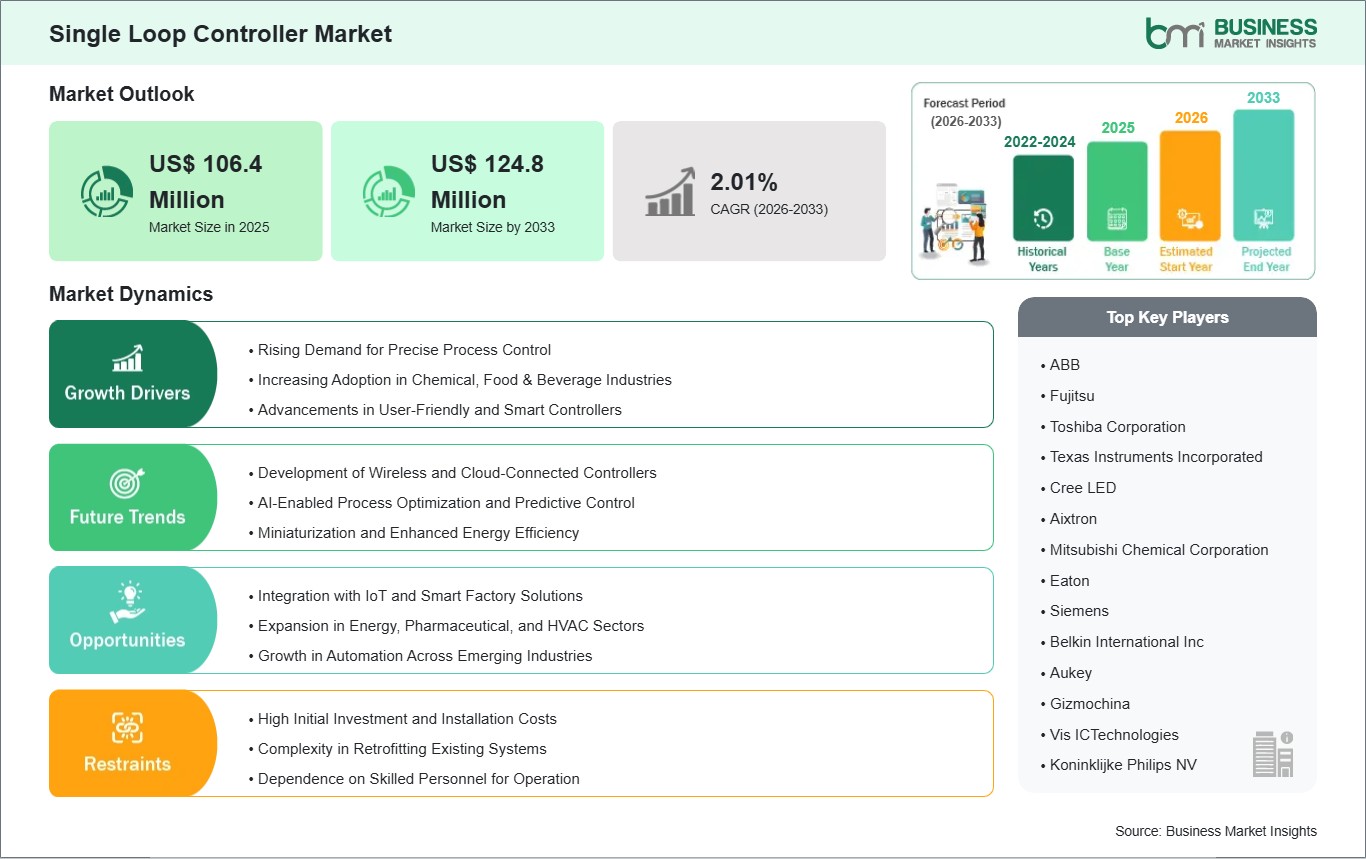
The Single Loop Controller Market size is expected to reach US$ 124.8 million by 2033 from US$ 106.4 million in 2025. The market is estimated to record a CAGR of 2.01% from 2026 to 2033.
The single loop controller market is growing steadily as industries are increasingly focusing on precision automation, reliability, and efficient process management. These controllers are widely used in various industries such as oil & gas, chemicals, pharmaceuticals, food & beverage, and power generation. They are the backbone of necessary feedback control processes, ensuring reliable and safe process operation. The increasing digitalization of manufacturing processes has further fueled the demand for more robust and DCS/PLC-compatible controllers. Industry efforts to optimize asset performance, reduce process variability, and minimize operating costs are also fueling the demand. Environmental and regulatory factors also have a significant impact, as they encourage organizations to adopt advanced control solutions that can assist in maintaining regulatory compliance and minimizing waste.
However, there are still challenges; legacy plant infrastructure can make retrofitting difficult, and some organizations are also resistant to replacing existing analog systems without a compelling reason. Increasing automation complexity also demands experienced personnel, making deployment more challenging. Single loop controllers remain an essential tool for industries looking to modernize their processes and ensure consistent process performance globally.

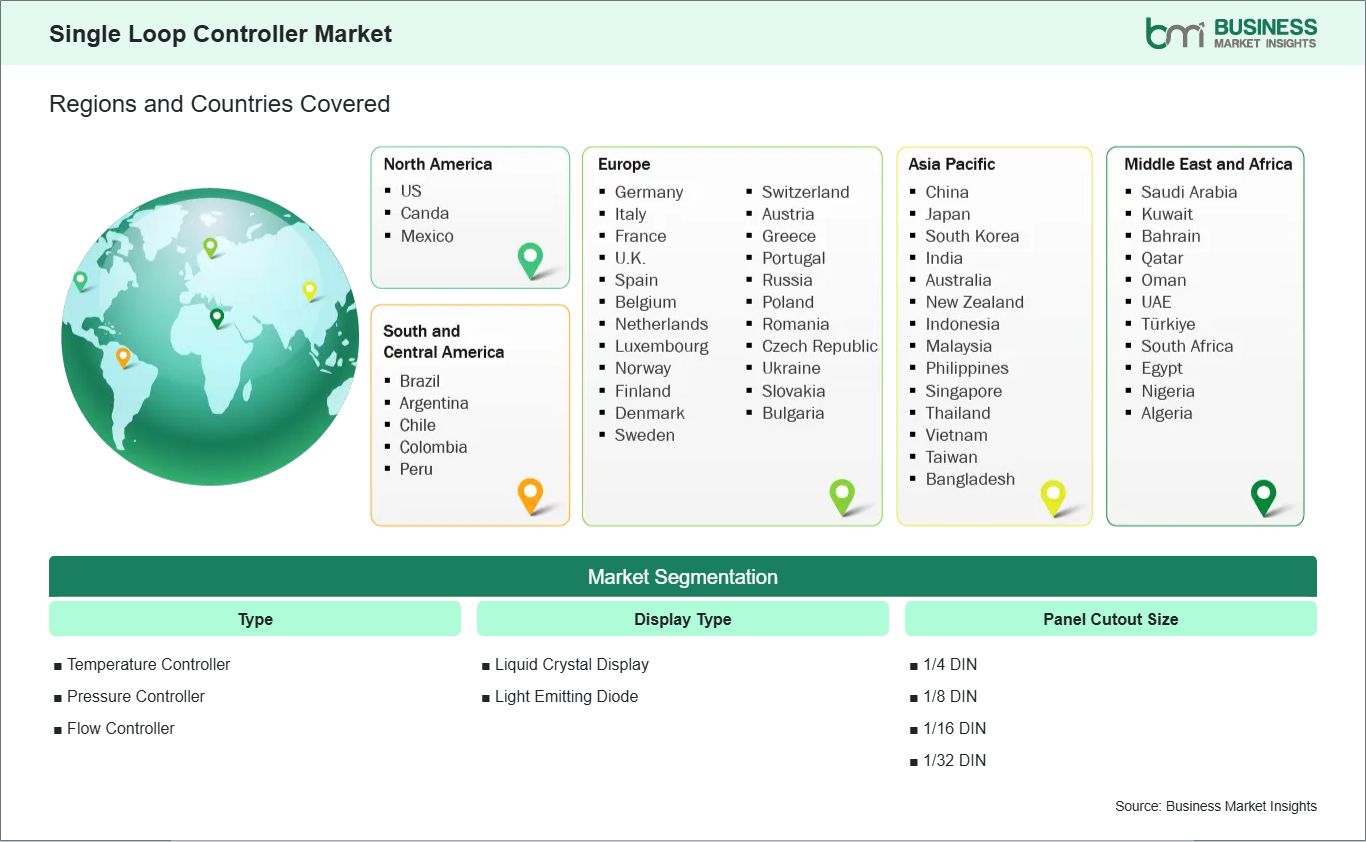
Key segments that contributed to the derivation of the single loop controller market analysis are type, display type, and panel cutout size.
The need to control processes precisely has been growing as industries seek to enhance efficiency, consistency, and product quality. Single-loop controllers are essential in ensuring that processes are kept in check, with variations in temperature, pressure, flow, and level remaining constant in different applications. This ability to maintain constant set points with minimal deviations from the expected value ensures that no matter the changes, the quality of the product remains unaltered. As processes have become increasingly complex, with automation standards constantly improving, the need for reliable loop controllers in ensuring consistency has also grown.
In different processes, especially in the production of different goods, it has been essential to maintain precise control over different processes, especially those involving chemicals, dosing, and mixing. This has been especially essential in ensuring that processes are controlled precisely, with advanced loop controllers allowing different processes to be maintained within precise limits. In different processes, especially in the food, beverage, and consumer goods industry, it has been essential to maintain precise control over different processes, especially those involving temperature and ratios. In all these processes, advanced controllers have been essential in ensuring stability.
Process control is equally important in energy generation and utilities management. Stable pressure in steam and fluid systems, accurate flow regulation, and consistent combustion control are all tasks where single loop controllers enhance operational efficiency and reduce the risk of downtime. By minimizing variability and ensuring processes run smoothly, these controllers help organizations optimize performance, improve safety, and prevent costly corrective actions.
It is noticed that single loop controllers are increasingly being integrated with connected systems and smart factory platforms, and this is changing the way process monitoring and control are carried out. It is understood that traditional single loop controllers were not connected with digital systems, whereas modern systems are connected with digital systems and can communicate with digital systems, thus providing a better view of process monitoring and enabling faster and better responses to process upsets and equipment issues.
In digitally enabled operations, connected loop controllers facilitate data aggregation on various points of control. This data can be used for analytics that identify patterns that could lead to failures or inefficiencies. This results in improved troubleshooting, minimized inspection, and more proactive maintenance. If loop controllers are used in smart factory environments, they facilitate automated decision-making, improved throughput, and consistent product quality.
The benefits of connected loop control are more pronounced in large-scale or asset-intensive operations. With remote monitoring and diagnostic capabilities, operators can monitor equipment from a central location. This is important for operation and safety. Smart controllers use real-time data and historical data to maintain optimal conditions, minimize energy consumption, and maximize equipment usage. With more interconnected and automated industrial systems, the integration of smart single loop controllers will be pivotal in supporting industrial process control systems.

The single loop controller market is experiencing steady growth, with market size and share analysis reflecting evolving treatment preferences and competitive dynamics among key players. The report evaluates important subsegments categorized within type, display type, and panel cutout size, highlighting their respective contributions to overall market performance.
By type, the temperature controller segment dominated the Single Loop Controller market in 2025. This is driven by the recurring demand for precise temperature regulation across industrial processes, which is essential for maintaining product quality, energy efficiency, and process stability. Temperature controllers serve as a key revenue driver for manufacturers and ensure consistent adoption across manufacturing, chemical, and food processing industries.
Based on display type, the liquid crystal display (LCD) segment dominated the market in 2025. The leadership of LCD controllers is attributed to their clear visibility, ease of use, and ability to provide real-time process feedback. These features make LCD-based controllers highly preferred by operators for monitoring and adjusting process parameters accurately, enhancing operational efficiency.
In terms of panel cutout size, the 1/4 DIN segment dominated the market in 2025. The strong adoption of 1/4 DIN controllers is driven by their compact design, which allows easy integration into control panels without occupying excessive space. Their balance of size, functionality, and versatility makes them highly suitable for a wide range of industrial applications, reinforcing their dominance in the single loop controller market.
| Report Attribute | Details |
|---|---|
| Market size in 2025 | US$ 106.4 Million |
| Market Size by 2033 | US$ 124.8 Million |
| Global CAGR (2026 - 2033) | 2.01% |
| Historical Data | 2022-2024 |
| Forecast period | 2026-2033 |
| Segments Covered | By Type
|
|
Regions and Countries Covered
| |
| North America | US, Canada, Mexico |
| Europe | Belgium, Austria, Finland, Denmark, Greece, Poland, Romania, Russia, Ukraine, Czech Republic, Slovakia, Bulgaria, Italy, Luxembourg, Germany, Switzerland, France, Netherlands, Norway, Portugal, Spain, Sweden, United Kingdom |
| Asia-Pacific | Australia, China, India, Japan, South Korea, Indonesia, Malaysia, Philippines, Singapore, Thailand, Vietnam, Bangladesh, New Zealand, Taiwan |
| South and Central America | Brazil, Argentina, Peru, Chile, Colombia |
| Middle East and Africa | Bahrain, Kuwait, Oman, Qatar, Saudi Arabia, United Arab Emirates, Turkiye, South Africa, Egypt, Algeria, Nigeria |
| Market leaders and key company profiles |
|
The "Single Loop Controller Market Size and Forecast (2022 - 2033)" report provides a detailed analysis of the market covering below areas:
The geographical scope of the Single Loop Controller market report is divided into five regions: North America, Asia Pacific, Europe, Middle East & Africa, and South & Central America. The Single Loop Controller market in North America is expected to grow during the forecast period.
North America is a leading market for Single Loop Controller, primarily due to the established industrial base and early adoption of automation technology in the region. The manufacturing base in the United States and Canada has been a major driver for demand in the Single Loop Controller market, as industries in these countries have been looking for efficient control solutions in process-intensive industries such as petrochemicals, refining, and specialty chemicals. Industries in these countries are increasingly embarking on modernization projects that optimize process efficiency and minimize energy consumption, making single loop controllers an essential component of maintaining precise and continuous control of critical processes. The region has a strong ecosystem of automation technology suppliers, system integrators, and service partners that facilitate market growth and smooth implementation.
In addition, programs related to safety, regulatory, and Industry 4.0 digitalization are promoting upgrades from traditional systems to smart and network-capable controllers that can interface with advanced analytics and asset management software. Although new control topologies and multi-loop control concepts are emerging as new alternatives, the market for traditional single loop controllers is strong. North America’s emphasis on efficiency, innovation, and technology adoption ensures that the region will continue to influence the global market.

The single loop controller market is evaluated by gathering qualitative and quantitative data post primary and secondary research, which includes important corporate publications, association data, and databases. A few of the key developments in the single loop controller market are:
The Single Loop Controller Market is valued at US$ 106.4 Million in 2025, it is projected to reach US$ 124.8 Million by 2033.
As per our report Single Loop Controller Market, the market size is valued at US$ 106.4 Million in 2025, projecting it to reach US$ 124.8 Million by 2033. This translates to a CAGR of approximately 2.01% during the forecast period.
The Single Loop Controller Market report typically cover these key segments-
The historic period, base year, and forecast period can vary slightly depending on the specific market research report. However, for the Single Loop Controller Market report:
The Single Loop Controller Market is populated by several key players, each contributing to its growth and innovation. Some of the major players include:
The Single Loop Controller Market report is valuable for diverse stakeholders, including:
Essentially, anyone involved in or considering involvement in the Single Loop Controller Market value chain can benefit from the information contained in a comprehensive market report.
Please tell us your area of interest
(Market Segments/ Regions and Countries/ Companies)