Market Summary
Executive Summary and Global Market Analysis
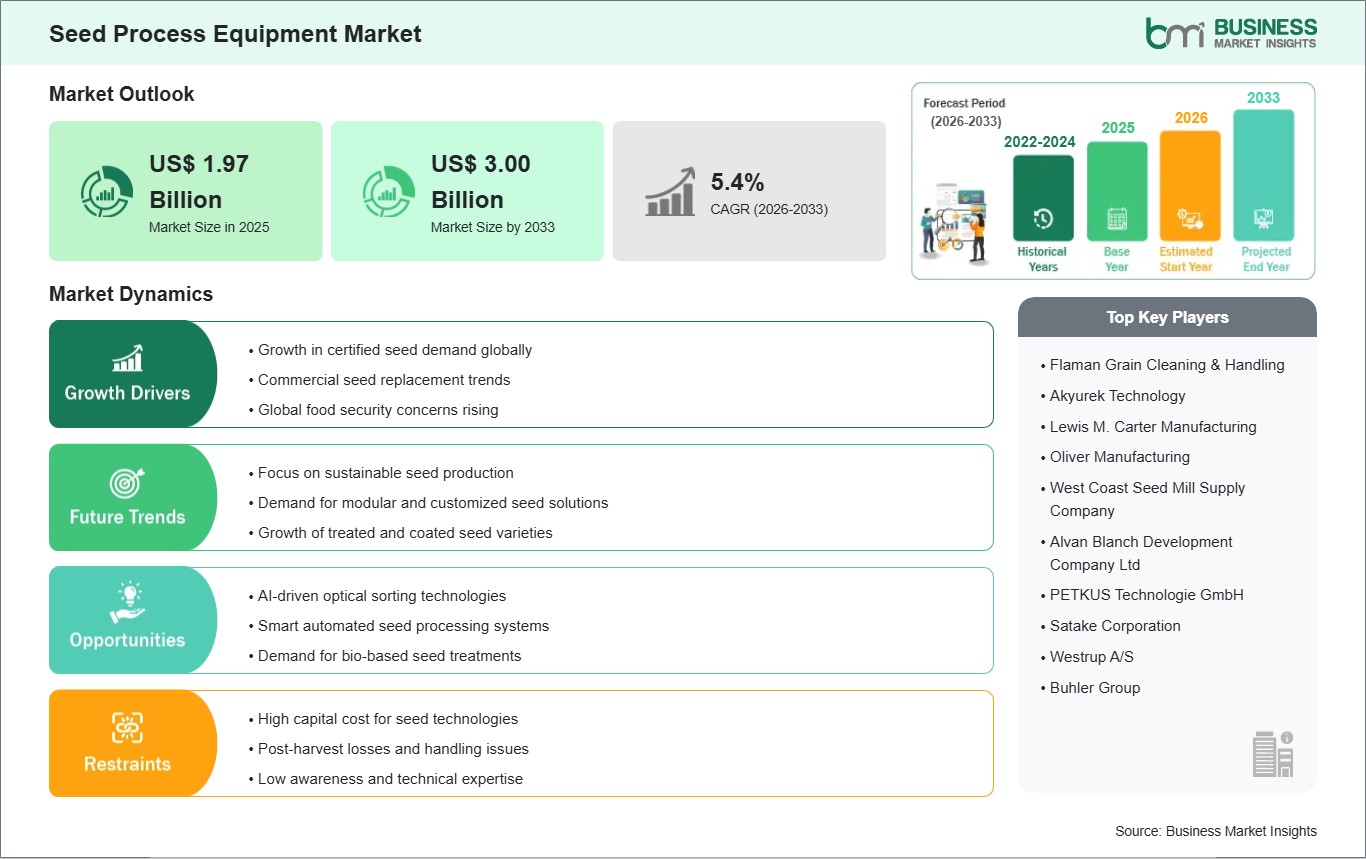
Seed processing equipment comprises a specialized suite of post-harvest machinery engineered to clean, grade, treat, and package seeds, thereby ensuring high purity and viability standards. This sector represents a vital component of the global agricultural value chain, including product categories such as air-screen cleaners, gravity separators, optical sorters, and automated coating systems. These technologies provide significant strategic value by converting raw agricultural harvests into certified, high-value planting materials that support global food security. Market growth is primarily driven by increased commercial seed demand, rapid advancements in AI-powered optical sorting technology that enable near-perfect purity, and the broader adoption of biological seed treatment systems aimed at reducing environmental impact. Additionally, the transition to fully automated, modular processing lines is markedly enhancing throughput and decreasing labor dependency in both developed and emerging agricultural markets.
However, several challenges can restrain market growth: high initial capital expenditure for smart, sensor-integrated machinery remains a significant barrier for small-to-medium-scale processors. Technical expertise requirements for operating and maintaining sophisticated AI-enabled equipment can lead to slower adoption in regions with limited skilled labor. Additionally, the industry faces constraints due to regulatory hurdles and chemical bans affecting traditional seed coatings, forcing manufacturers to undergo costly re-engineering of equipment to accommodate newer, viscous biological alternatives.
Despite these hurdles, the market holds immense opportunities in the universal push for climate-resilient crop varieties and the accelerating deployment of mobile processing units for remote farming communities. The expansion of precision-coated hybrid seeds and the development of energy-efficient, low-carbon drying technologies are expected to create significant opportunities for long-term market growth.
Segment Analysis
Seed Process Equipment Market Segmentation
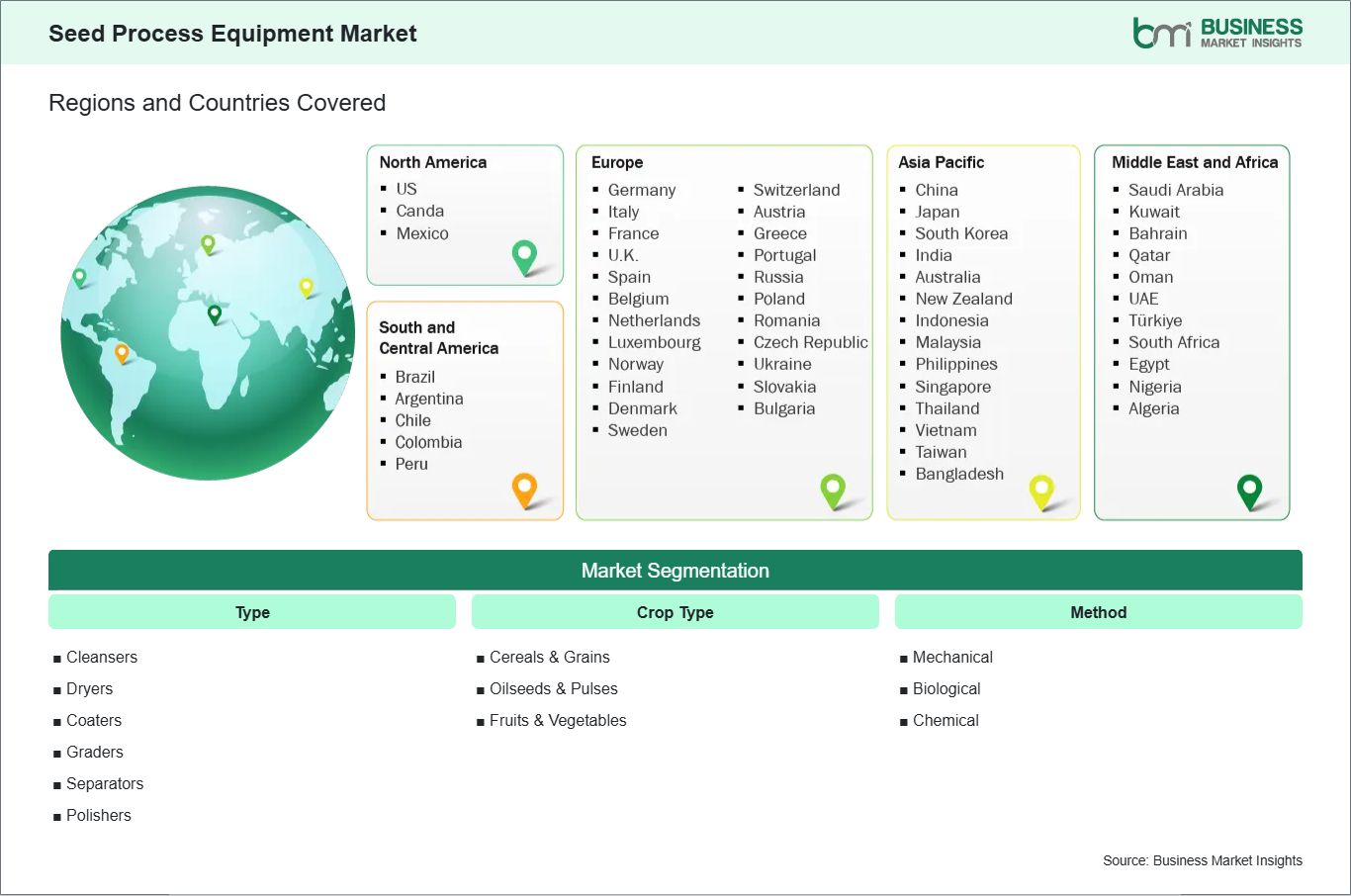
Key segments that contributed to the derivation of the Seed Process Equipment market analysis are type, crop type, and method.
- By Type, the market is segmented into Cleansers, Dryers, Coaters, Graders, Separators, and Polishers.
- By Crop Type, the market is divided into Cereals & Grains, Oilseeds & Pulses, and Fruits & Vegetables.
- By Method, the market is categorized into Mechanical, Biological, and Chemical.
Market Forces
Seed Process Equipment Market Drivers and Opportunities
Growing Urbanization and Smart City Development
The primary driver of the Seed Process Equipment Market is the global transition from farm-saved seeds to commercial seed replacement, favoring certified, high-yield varieties. In emerging economies, farmers increasingly emphasize crop resilience and disease resistance, resulting in heightened demand for equipment capable of producing uniform, high-purity seed lots. This trend is reinforced by the rapid adoption of integrated seed treatments, which require modern equipment to apply precise, multi-layered coatings, including biologicals, fungicides, and growth promoters, while preserving the integrity of the seed embryo. Seed-applied technology is integral to sustainable intensification, enabling targeted pest protection with a substantially lower environmental impact than broad-acre foliar spraying.
Additionally, the proliferation of hybrid and genetically modified (GM) seeds serves as a significant catalyst, as these high-value products necessitate meticulous processing to maintain quality and market value. Collectively, these factors, along with the imperative for food security, regulatory requirements for residue-compliant produce, and the ongoing industrialization of agriculture, establish advanced seed processing as an essential component of modern agribusiness.
AI-Native Optical Sorting and Biological Treatment Precision
The convergence of seed processing equipment with AI-enabled optical sorting and computer vision represents a significant high-value opportunity. Next-generation sorters are capable of analyzing seeds at high speeds, using multispectral imaging to detect internal defects or fungal infections that are not visible to the human eye. This technology substantially improves the quality of the final product. Another major growth area is the development of advanced coating systems for biologicals and bio-stimulants. As global regulations increasingly restrict synthetic chemicals, manufacturers have the opportunity to develop specialized equipment for live microbial treatments that ensures consistent coverage and extended shelf-life. The expansion of modular and mobile processing units also offers a promising avenue for reaching smallholder farmers in remote regions by providing industrial-grade cleaning and treating services directly at the farm gate.
In addition to traditional cereals, specialized processing for high-value horticultural and organic seeds is becoming increasingly important, as these crops require gentler handling and strict zero-contamination protocols. Manufacturers investing in IoT-integrated real-time monitoring and pioneering non-labor product drying (NLPD) technologies are well positioned to lead the most innovative and high-margin segments of the global agricultural technology sector.
Size and Share Analysis
Seed Process Equipment Market Size and Share Analysis
Based on type, Cleansers and Coaters subsegments demonstrate substantial market presence and serve as industry benchmarks for seed purity and protection. Cleansers constitute the largest segment and are essential for removing inert matter and low-quality seeds, thereby ensuring a uniform product for cultivators. The Coaters subsegment is experiencing significant growth, as these systems are increasingly vital for Value-Added Seed Production. They enable precise application of microplastic-free polymers and bioactive inoculants, which improve germination and early seedling vigor. This trend indicates a strategic industry shift toward proactive crop protection.
By crop type, the market is segmented into cereals & grains, oilseeds & pulses, and fruits & vegetables. The cereals and grains segment held the largest share of the market in 2025, driven by high global demand for staple crops such as wheat, rice, and maize. These crops require advanced cleaning, grading, and treatment technologies to ensure yield and quality. However, oilseeds and pulses are also expanding steadily due to rising protein consumption, while fruits and vegetables contribute through hybrid and high-value seed production demand.
By method, the market is segmented mechanical, biological, and chemical. The mechanical segment held the largest share of the market in 2025, driven by high demand for cleaning, grading, and sorting machinery. Mechanical solutions offer efficiency, scalability, and cost-effectiveness, outperforming biological and chemical methods, which are niche. Innovations in automation and precision further strengthen mechanical equipment’s market leadership globally.
Report Coverage
Seed Process Equipment Market Report Coverage and Deliverables
The "Seed Process Equipment Market Size and Forecast (2022 - 2033)" report provides a detailed analysis of the market covering below areas:
- Seed Process Equipment market size and forecast at global, regional, and country levels for all the key market segments covered under the scope
- Seed Process Equipment market trends, as well as market dynamics such as drivers, restraints, and key opportunities
- Seed Process Equipment market analysis covering key market trends, global and regional framework, major players, regulations, and recent market developments
- Industry landscape and competition analysis covering market concentration, heat map analysis, prominent players, and recent developments for the Seed Process Equipment market
- Detailed company profiles, including SWOT analysis
Geographic Insights
Seed Process Equipment Market Geographic Insights
The geographical scope of the Seed Process Equipment market report is divided into five regions: North America, Asia Pacific, Europe, Middle East & Africa, and South & Central America.
The Asia-Pacific Seed Process Equipment Market is segmented into China, Japan, South Korea, India, Australia, and the Rest of Asia. China and India are the primary drivers of regional volume, where the focus is on scaling up commercial seed multiplication hubs to ensure national food security. In Japan and South Korea, the market is defined by high-precision equipment used in research institutes and specialized horticultural applications. The region is witnessing a shift toward all-in-one processing units that integrate cleaning, grading, and treatment into a single automated workflow to address rising labor costs and the need for consistent seed quality.
Growth is further bolstered by a significant shift toward integrated seed coating solutions and the adoption of smart vision systems for real-time quality monitoring. The increasing demand for treated, value-added seeds that can withstand climate-related stressors, alongside the expansion of professional seed processing plants across Southeast Asia, solidifies Asia-Pacific as a critical hub for innovation and the future scaling of the Seed Process Equipment Market.
Industry Activity
Recent Developments
The Seed Process Equipment market is evaluated by gathering qualitative and quantitative data post primary and secondary research, which includes important corporate publications, association data, and databases. A few of the key developments in the Seed Process Equipment market are:
- In January 2026, Sofiprotéol and Bpifrance launched the Sofiprotéol Accelerator, a strategic support program for agri-food and seed processing companies in Sofiprotéol’s portfolio. The initiative will help companies like Flanquart and Innolea enhance innovation, operational efficiency, and growth, driving modernization and demand in the Seed Process Equipment Market.
- In April 2025, Westrup and Fowler Westrup acquired Dutch company Premium Seeds Machines (PSM), forming a strategic three-way partnership to expand resources and product offerings. The acquisition strengthens seed processing capabilities with PSM’s innovative drying technologies, boosting efficiency and driving growth in the Seed Process Equipment Market.
Trust & Transparency
Research Methodology
The market analysis combines proprietary research with secondary data from government agencies, company disclosures, regulatory filings, industry databases and expert interviews. Market estimates are validated through data triangulation, cross-market benchmarking and analyst
review.
View Full Research Methodology
Key Sources Referred:
World Bank - Global Trade IndicatorsWorld Trade Organization (WTO)International Monetary Fund (IMF)International Trade Administration (ITA)Company websiteCompany annual reportsCompany investor presentations