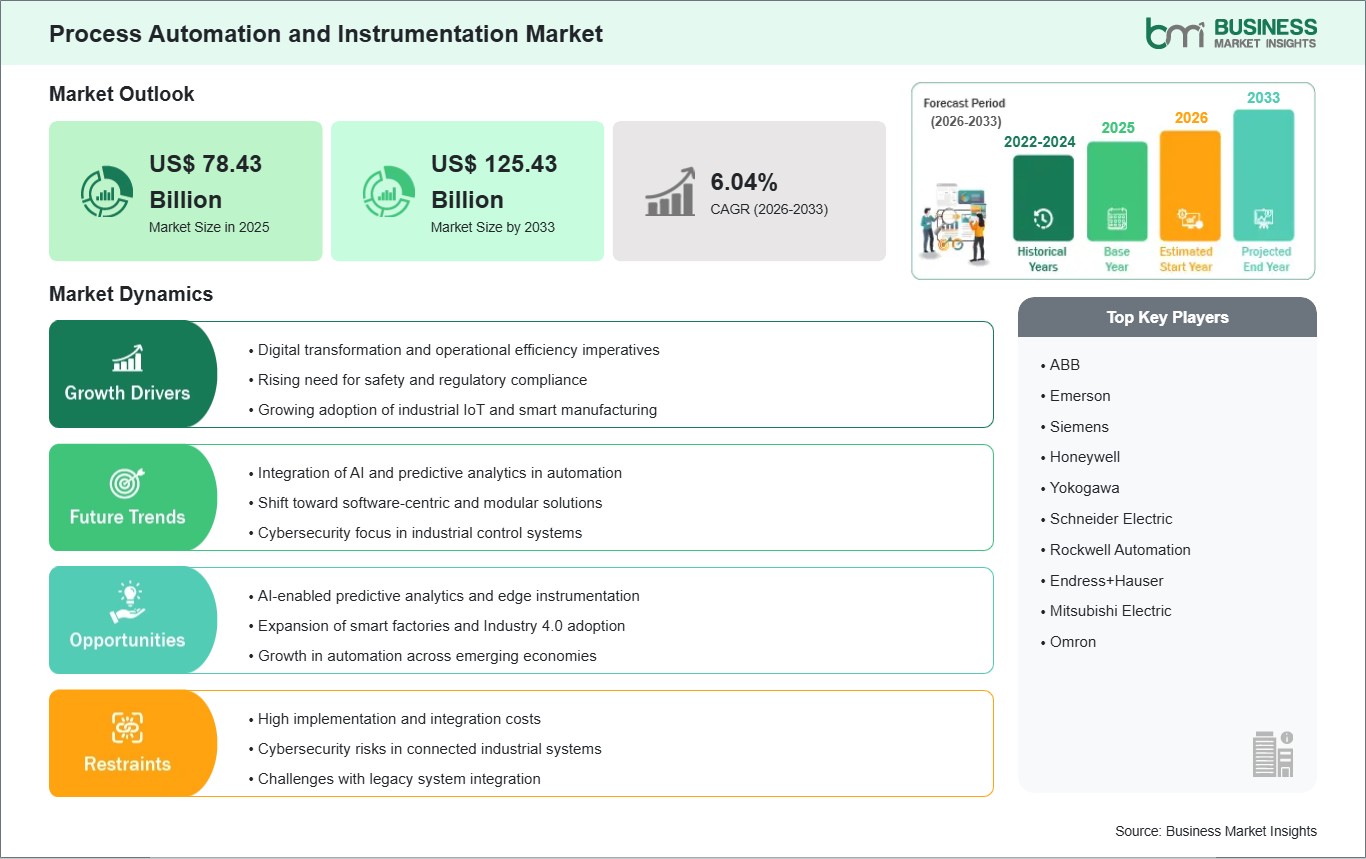
The Process Automation and Instrumentation Market size is expected to reach US$ 125.43 billion by 2033 from US$ 78.43 billion in 2025. The market is estimated to record a CAGR of 6.04% from 2026 to 2033.
The global process automation and instrumentation market is propelled by rapid industrial digitization, stringent regulatory requirements, and the rising emphasis on safety, efficiency, and productivity across manufacturing and process‑centric industries. Automation and instrumentation technologies — including transmitters, analyzers, PLCs, DCS, SCADA, HMIs, and MES — form the backbone of industrial control systems that enhance operational visibility, reduce human error, and enable real‑time decision‑making.
With Industry 4.0 and smart manufacturing paradigms gaining traction globally, enterprises are accelerating investments in integrated automation solutions that combine hardware, software, and services.
Competitive dynamics focus on interoperability, scalability, and cybersecurity. Vendors are increasingly offering modular, software‑centric solutions that integrate with legacy systems while enabling digital transformation.
Geographically, North America and Europe currently lead in adoption due to advanced industrial infrastructure and high investments in digital transformation. However, emerging markets in Asia Pacific and the Middle East are witnessing accelerated demand driven by industrial expansion, infrastructure spend, and modernization of process industries.
Strategic initiatives that emphasize cost optimization, regulatory compliance, and digital integration position the process automation and instrumentation market at the forefront of industrial efficiency improvements and long‑term competitive advantage.

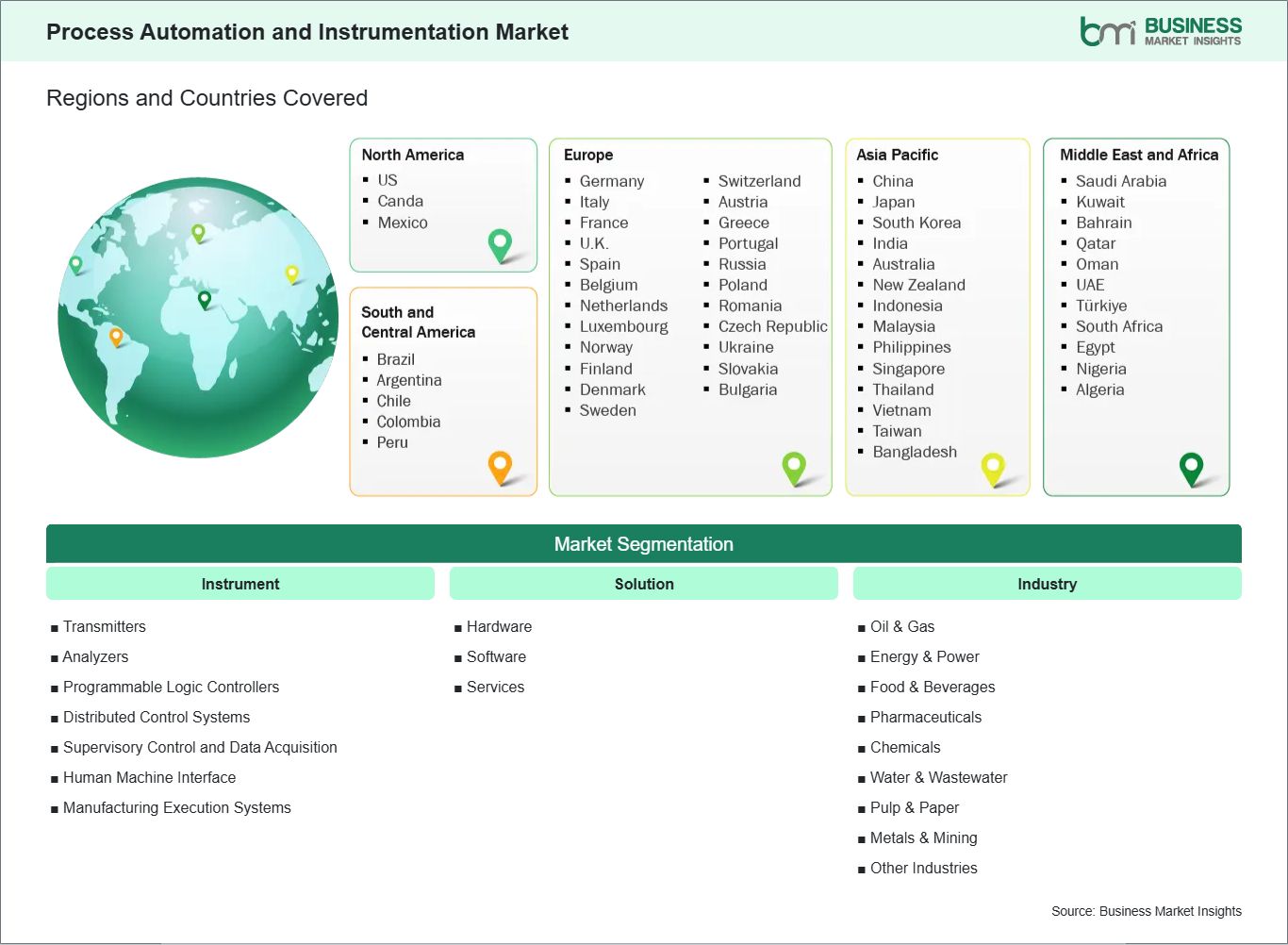
Key segments that contributed to the derivation of the process automation and instrumentation market analysis are instrument, solution, and industry.
The primary driver for the process automation and instrumentation market is the accelerating shift toward digital transformation and operational efficiency across industrial sectors. Organizations are under increasing pressure to optimize production, improve quality, and lower operational costs — all while maintaining safety and regulatory compliance. Automation and instrumentation technologies fulfill these needs by providing real‑time monitoring, precise control, and advanced analytics capabilities.
Key technologies such as PLCs, DCS, SCADA, and HMIs enable seamless control and visualization of complex industrial processes, reducing reliance on manual intervention and minimizing errors. Additionally, the integration of industrial IoT (IIoT) devices, smart sensors, and analytics platforms enhances predictive maintenance and asset performance management. This integration allows companies to pre‑empt equipment failures, reduce unplanned downtime, and extend the lifecycle of critical assets — leading to significant cost savings and improved throughput.
Furthermore, digital transformation initiatives are supported by advanced software solutions that provide data aggregation, remote access, and scalable architectures. Cloud connectivity and edge computing improve responsiveness and allow distributed operations teams to monitor processes from anywhere. The result is a connected ecosystem where automation output directly informs strategic decision‑making and continuous improvement.
Regulatory frameworks in sectors such as energy, pharmaceuticals, and chemicals also mandate rigorous safety and environmental standards. Compliance requirements drive investments in reliable instrumentation for monitoring pressures, temperatures, flow rates, and emissions, ensuring operational integrity and reducing risk.
A significant opportunity in the process automation and instrumentation market is the integration of AI‑enabled predictive analytics and edge computing with instrumentation systems. Traditional automation architectures primarily focus on process control and historical data logging. However, the advent of AI, machine learning, and cloud‑edge orchestration is reshaping how industrial data is consumed and applied.
Smart instrumentation equipped with edge analytics can process data locally, identify anomalies, and trigger corrective actions without latency associated with cloud dependency. This capability enhances responsiveness for critical operations — such as detecting equipment degradation, predicting failures before they occur, and enabling automated corrective workflows. The combination of predictive insights with real‑time control improves uptime and optimizes maintenance schedules, significantly reducing operational expenditures.
AI analytics also help uncover hidden patterns across multiple process parameters, enabling operators to fine‑tune settings for peak efficiency. For example, in chemical processing or energy generation, AI algorithms can identify optimal setpoints that maximize yield while minimizing energy use and waste. The result is a smarter instrumentation ecosystem that actively contributes to operational decision‑making rather than merely reporting data.
Moreover, as industries adopt hybrid cloud strategies, instrumentation platforms that seamlessly integrate edge processing with centralized analytics and visualization tools present a compelling value proposition. Vendors that offer modular solutions combining smart sensors, edge hardware, AI analytics, and secure connectivity stand to capture market share by enabling digital transformation at scale. This trend creates opportunities for cross‑industry application — from improving water treatment plant efficiencies to optimizing throughput in food & beverage manufacturing — solidifying smart automation and AI‑augmented instrumentation as a cornerstone of next‑generation industrial operations.

The Process Automation and Instrumentation Market demonstrates steady growth, with size and share analysis highlighting evolving trends and competitive dynamics among key players. The report examines subsegments categorized within instrument, solution, and industry, offering insights into their contribution to overall market performance.
By instrument, the distributed control systems (DCS) subsegment dominated the market in 2025, driven by its ability to centralize control, facilitate complex process coordination, and provide scalability for large industrial environments.
By solution, the hardware subsegment dominated the market in 2025, driven by demand for field instrumentation, controllers, and control hardware in new installations and modernization projects.
By industry, the oil & gas subsegment dominated the market in 2025, driven by extensive automation requirements to improve safety, compliance, and production efficiency across exploration, drilling, refining, and distribution operations.
| Report Attribute | Details |
|---|---|
| Market size in 2025 | US$ 78.43 Billion |
| Market Size by 2033 | US$ 125.43 Billion |
| Global CAGR (2026 - 2033) | 6.04% |
| Historical Data | 2022-2024 |
| Forecast period | 2026-2033 |
| Segments Covered | By Instrument
|
|
Regions and Countries Covered
| |
| North America | US, Canada, Mexico |
| Europe | Belgium, Austria, Finland, Denmark, Greece, Poland, Romania, Russia, Ukraine, Czech Republic, Slovakia, Bulgaria, Italy, Luxembourg, Germany, Switzerland, France, Netherlands, Norway, Portugal, Spain, Sweden, United Kingdom |
| Asia-Pacific | Australia, China, India, Japan, South Korea, Indonesia, Malaysia, Philippines, Singapore, Thailand, Vietnam, Bangladesh, New Zealand, Taiwan |
| South and Central America | Brazil, Argentina, Peru, Chile, Colombia |
| Middle East and Africa | Bahrain, Kuwait, Oman, Qatar, Saudi Arabia, United Arab Emirates, Turkiye, South Africa, Egypt, Algeria, Nigeria |
| Market leaders and key company profiles |
|
The "Process Automation and Instrumentation Market Size and Forecast (2022 - 2033)" report provides a detailed analysis of the market covering below areas:
The geographical scope of the Process Automation and Instrumentation Market report is divided into North America, Asia Pacific, Europe, Middle East & Africa, and South & Central America. North America held the largest share in 2025.
North America held a significant share in 2025 due to advanced industrial automation adoption, strong presence of key vendors, and robust modernization initiatives across manufacturing, energy, and chemical sectors. The U.S. particularly drives high investment in digital transformation, predictive maintenance, and integrated control systems.
Europe remains a major market, supported by stringent safety and environmental standards, particularly in oil & gas, chemical, and pharmaceutical industries. Automation and instrumentation solutions are increasingly adopted for compliance with European emissions regulations and Industry 4.0 initiatives emphasizing connectivity and data integration.
The Asia Pacific region is poised for rapid growth, driven by expanding manufacturing capacity, infrastructure projects, and increased automation in sectors such as food & beverage, power generation, and water treatment. Countries like China, India, Japan, and South Korea are major hubs for both production and deployment of automation systems.
Middle East & Africa and South & Central America show emerging opportunities aligned with investments in energy projects, mining operations, and utility modernization. However, slower infrastructure build‑outs and economic constraints temper near‑term adoption relative to more developed regions.
Across regions, the push toward smart, connected industrial ecosystems supported by IoT, AI, and improved instrumentation underpins long‑term market expansion and value creation.

The Process Automation and Instrumentation Market is evaluated by gathering qualitative and quantitative data post primary and secondary research. A few of the key developments in the process automation and instrumentation market are,
The Process Automation and Instrumentation Market is valued at US$ 78.43 Billion in 2025, it is projected to reach US$ 125.43 Billion by 2033.
As per our report Process Automation and Instrumentation Market, the market size is valued at US$ 78.43 Billion in 2025, projecting it to reach US$ 125.43 Billion by 2033. This translates to a CAGR of approximately 6.04% during the forecast period.
The Process Automation and Instrumentation Market report typically cover these key segments-
The historic period, base year, and forecast period can vary slightly depending on the specific market research report. However, for the Process Automation and Instrumentation Market report:
The Process Automation and Instrumentation Market is populated by several key players, each contributing to its growth and innovation. Some of the major players include:
The Process Automation and Instrumentation Market report is valuable for diverse stakeholders, including:
Essentially, anyone involved in or considering involvement in the Process Automation and Instrumentation Market value chain can benefit from the information contained in a comprehensive market report.
Please tell us your area of interest
(Market Segments/ Regions and Countries/ Companies)