Market Summary
Executive Summary and Global Market Analysis
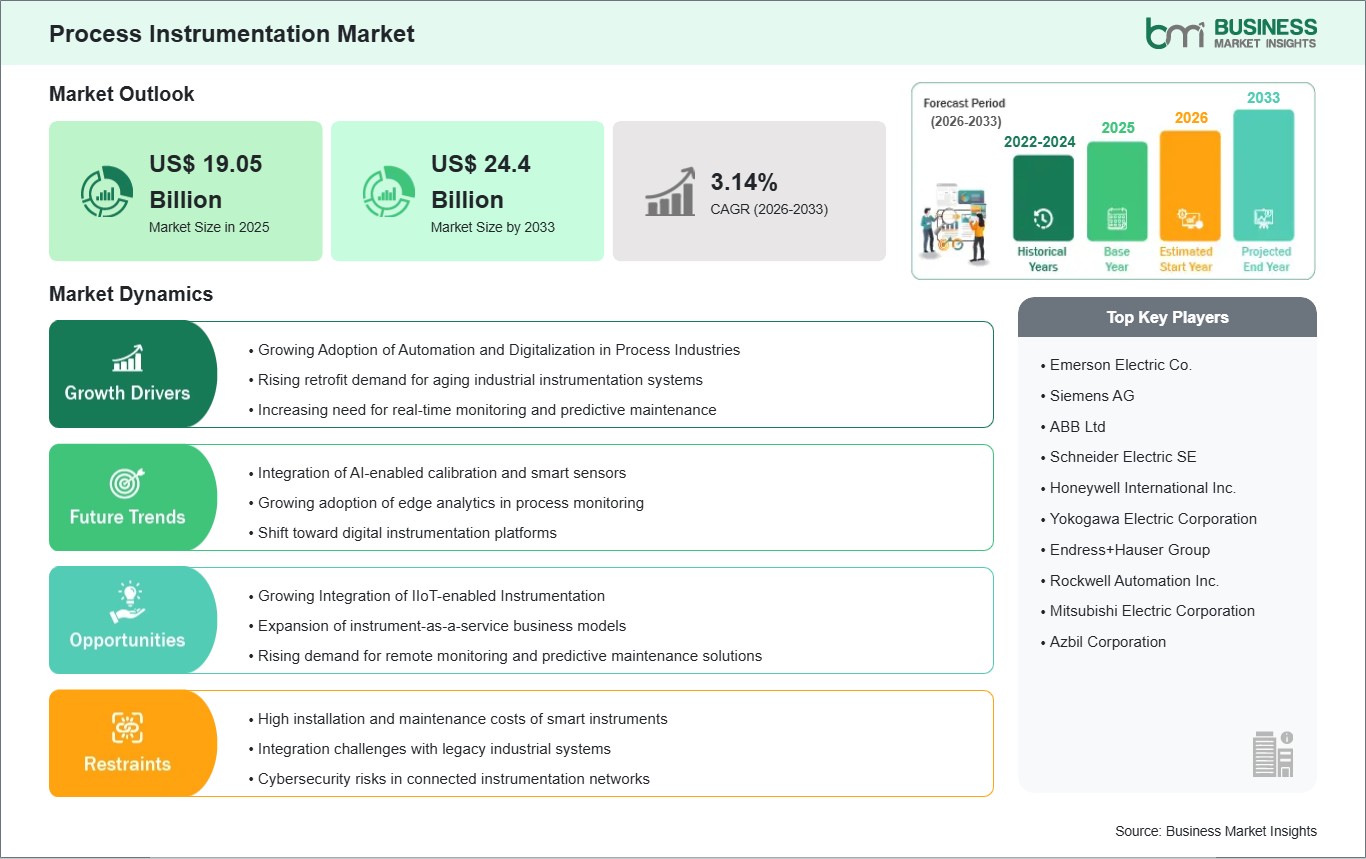
The global process instrumentation market is witnessing steady growth due to increasing automation adoption, rising retrofit programs, and decarbonization mandates across developed and emerging economies. Process instruments such as transmitters, analytical devices, and control valves are critical for optimizing industrial operations, ensuring safety, and improving process efficiency. Advances in digital instrumentation, AI-based calibration, and integrated hardware-software solutions enable predictive maintenance and energy optimization.
Rising need for continuous emissions monitoring and stricter industrial regulations encourage firms to upgrade legacy systems to smart instrumentation with edge analytics capabilities. North America continues to dominate due to mature automation ecosystems, while Asia-Pacific is expected to witness rapid growth as manufacturers adopt IIoT-enabled devices to enhance efficiency and compliance. Bundled services, including instrument-as-a-service and subscription-based calibration offerings, are emerging as key trends.
Segment Analysis
Process Instrumentation Market Segmentation
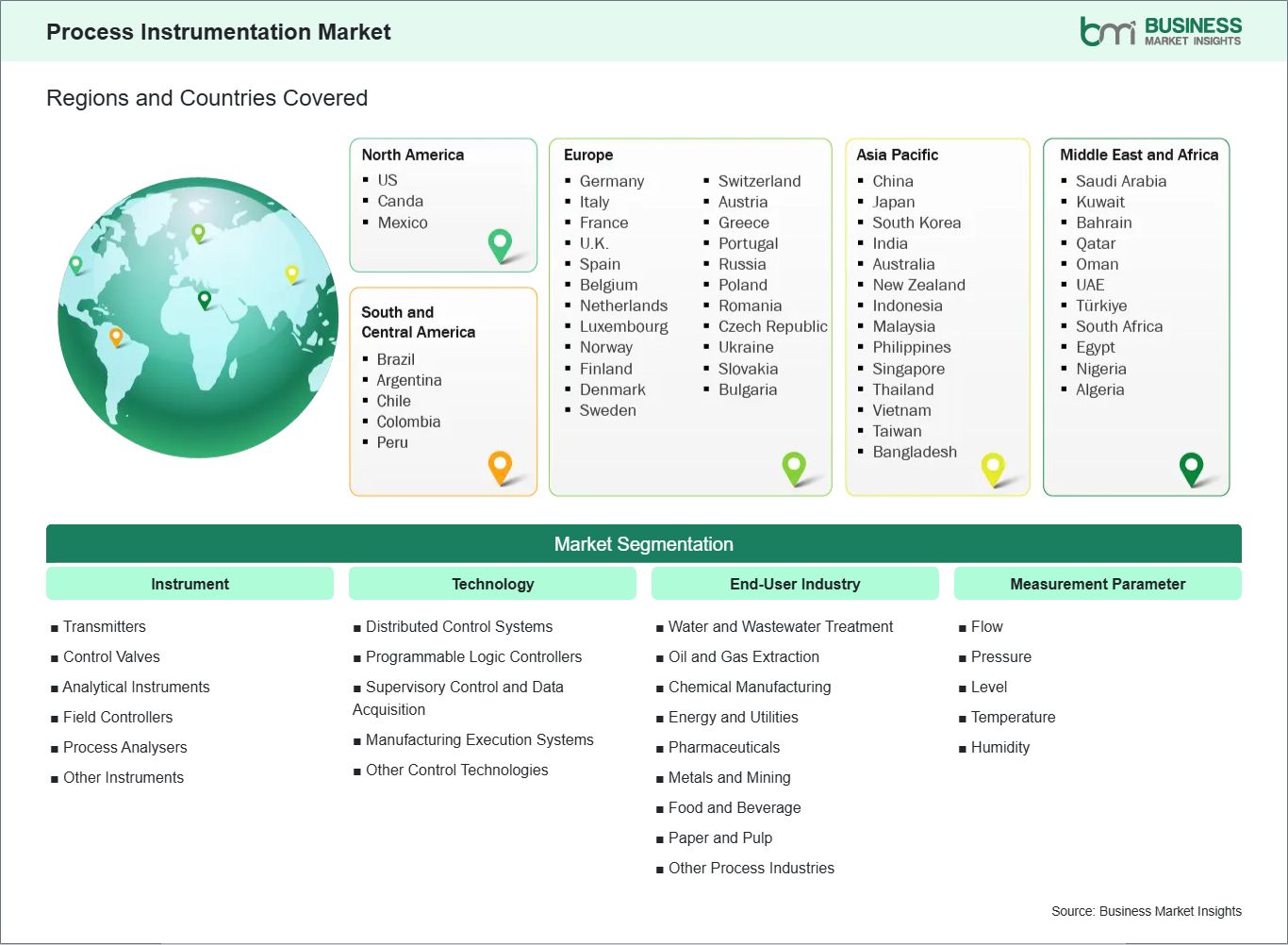
Key segments that contributed to the derivation of the process instrumentation market analysis are instrument, technology, end-user industry, and measurement parameter.
- By Instrument, transmitters, control valves, analytical instruments, field controllers (RTU/PLC), process analysers, other instruments. Transmitters dominated in 2025.
- By Technology, DCS, PLC, SCADA, MES, other control technologies. DCS dominated in 2025.
- By End-User Industry, water & wastewater, oil & gas, chemicals, energy & utilities, pharmaceuticals, metals & mining, food & beverage, paper & pulp, other industries. Oil & gas extraction dominated in 2025.
- By Measurement Parameter, flow, pressure, level, temperature, humidity. Flow measurement dominated in 2025.
Market Forces
Process Instrumentation Market Drivers and Opportunities
Growing Adoption of Automation and Digitalization in Process Industries
The adoption of automation and digitalization is driving the market as industries focus on operational efficiency, process safety, and environmental compliance. Retrofitting aging equipment in oil & gas, chemicals, and pharmaceuticals boosts demand for smart transmitters, analytical instruments, control valves, and field controllers. Aging infrastructure in North America and Europe creates replacement demand, while energy-intensive industries seek process optimization to reduce costs and carbon emissions.
Growing Integration of IIoT-enabled Instrumentation
IIoT-enabled instruments provide real-time monitoring, predictive maintenance, and operational visibility, enabling manufacturers to optimize processes, reduce downtime, and cut costs. Cloud-based analytics and remote monitoring allow data-driven decision-making, enhancing productivity and compliance. Subscription-based models and instrument-as-a-service solutions create recurring revenue streams. AI integration enables predictive maintenance, fault detection, and process optimization across sectors including pharmaceuticals, water treatment, energy, and chemicals.
Size and Share Analysis
Process Instrumentation Market Size and Share Analysis
The Process Instrumentation Market demonstrates steady growth, with size and share analysis highlighting evolving trends and competitive dynamics among key players. The report examines subsegments categorized within instrument, technology, end-user industry, and measurement parameter, offering insights into their contribution to overall market performance.
By Instrument, transmitters subsegment dominated the market in 2025, driven by real-time measurement demand.
By Technology, DCS subsegment dominated the market in 2025, driven by integrated control requirements.
By End-User Industry, oil and gas extraction subsegment dominated the market in 2025, driven by instrumentation demand for safety and compliance.
By Measurement Parameter, flow measurement subsegment dominated the market in 2025, driven by critical monitoring needs across industries.
Report Coverage
Process Instrumentation Market Report Coverage and Deliverables
The "Process Instrumentation Market Size and Forecast (2022 - 2033)" report provides a detailed analysis of the market covering below areas:
- Process Instrumentation Market size and forecast at global, regional, and country levels for all the key market segments covered under the scope
- Process Instrumentation Market trends, as well as drivers, restraints, and opportunities
- Process Instrumentation Market analysis covering key trends, global and regional framework, major players, regulations, and recent developments
- Industry landscape and competition analysis covering market concentration, heat map analysis, prominent players, and recent developments for the Process Instrumentation Market
- Detailed company profiles, including SWOT analysis
Geographic Insights
Process Instrumentation Market Geographic Insights
The geographical scope of the Process Instrumentation Market report is divided into North America, Asia Pacific, Europe, Middle East & Africa, and South & Central America. North America held the largest share in 2025.
The regional dynamics of the process instrumentation market vary significantly across the globe. North America dominated the market in 2025, largely due to mature industrial automation infrastructure, stringent regulatory frameworks, and high adoption of smart instrumentation across oil & gas, chemicals, pharmaceuticals, and energy sectors. Advanced process plants in the United States and Canada rely on smart transmitters, analytical instruments, and control systems to optimize production efficiency and comply with emissions standards. Europe shows steady growth as companies retrofit aging infrastructure to meet environmental regulations, with Germany, France, and the UK leading in digitalization and adoption of DCS and PLC systems. Investments in smart instrumentation are driven by decarbonization mandates and efficiency improvement initiatives. Asia-Pacific is emerging as the fastest-growing market due to rapid industrialization, expansion of manufacturing facilities, and adoption of IIoT-enabled instruments in China, Japan, India, and South Korea. The push for Industry 4.0 solutions and modernized process automation in emerging economies is creating substantial demand for advanced instrumentation, analytics, and remote monitoring solutions. Middle East & Africa and South & Central America are in early stages of adoption but are witnessing growth due to oil and gas projects, industrial modernization, and infrastructure expansion.
Industry Activity
Recent Developments
The Process Instrumentation Market is evaluated by gathering qualitative and quantitative data post primary and secondary research, which includes important corporate publications, association data, and databases. A few of the key developments in the process instrumentation market are:
- In August 2025, Emerson Electric launched next-generation smart transmitters with enhanced AI-based predictive maintenance capabilities.
- In February 2025, Siemens introduced DCS solutions integrated with edge analytics for chemical and pharmaceutical plants.
Trust & Transparency
Research Methodology
The market analysis combines proprietary research with secondary data from government agencies, company disclosures, regulatory filings, industry databases and expert interviews. Market estimates are validated through data triangulation, cross-market benchmarking and analyst
review.
View Full Research Methodology
Key Sources Referred:
International Society of Automation (ISA)United Nations Industrial Development Organization (UNIDO)World BankOrganisation for Economic Co-operation and Development (OECD)International Electrotechnical Commission (IEC)International Trade Administration