Market Summary
Executive Summary and Global Market Analysis
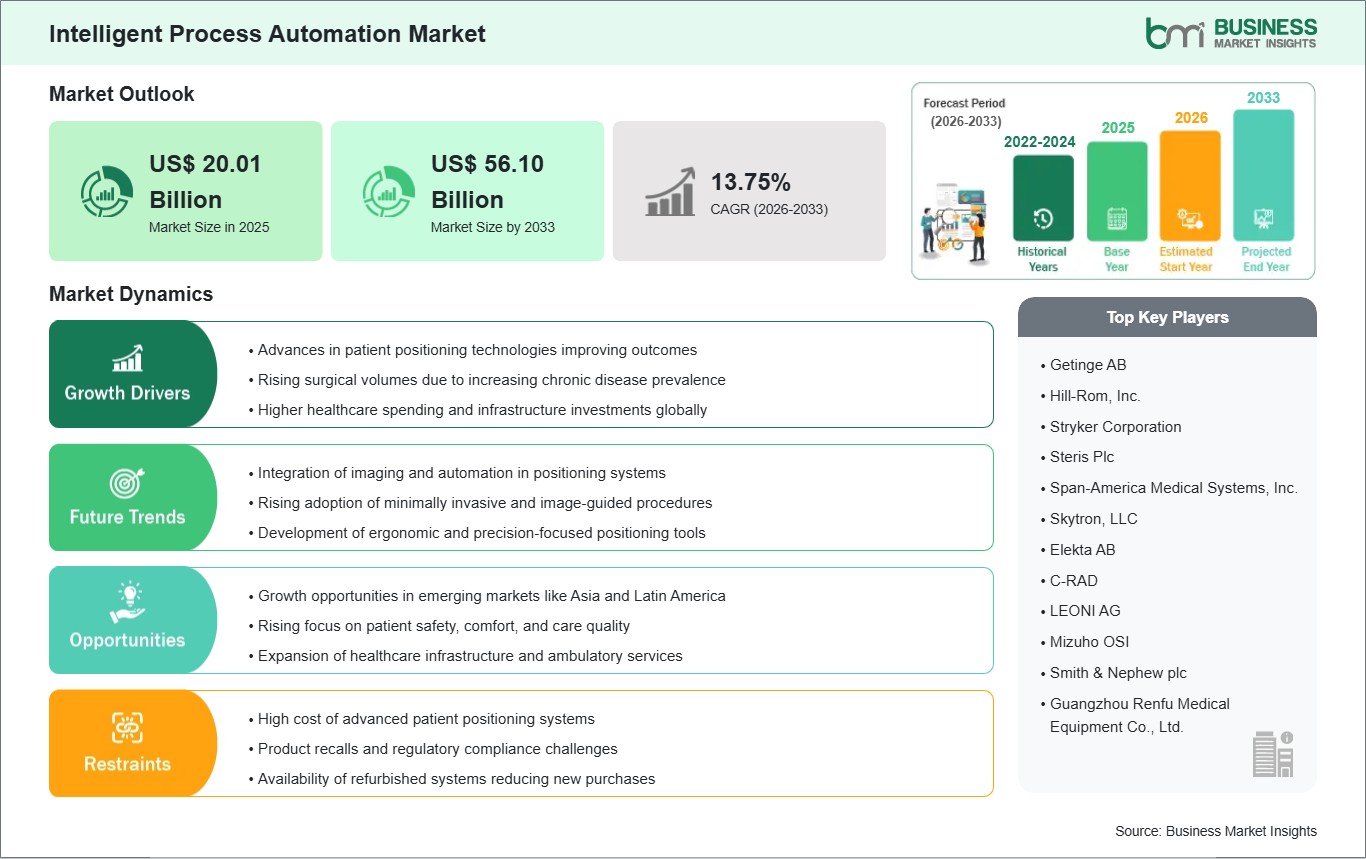
Intelligent Process Automation refers to the strategic convergence of Robotic Process Automation and Artificial Intelligence technologies, including machine learning, natural language processing, and computer vision. Unlike traditional automation, which executes rule-based tasks, IPA systems possess cognitive capabilities, enabling them to interpret unstructured data, learn from historical outcomes, and execute complex decision-making processes. Market progression is fundamentally propelled by the urgent enterprise requirement for hyperautomation and the integration of generative AI into autonomous workflow orchestration.
However, several factors may restrain market development. The substantial initial capital expenditure and complex technical integration required for legacy system modernization remain a significant barrier for many organizations. Technical challenges, specifically regarding the black box nature of AI decision-making and the need for rigorous algorithmic governance, can impact trust and adoption. Additionally, the industry faces hurdles related to a critical shortage of specialized AI talent and the necessity of complying with evolving global regulations on data privacy and automated labor.
Despite these hurdles, the market holds significant opportunities in the rise of Agentic RPA, where autonomous AI agents can handle self-healing workflows without human intervention. The expansion of low-code and no-code automation platforms, democratizing AI for non-technical users, and the demand for Intelligent Document Processing (IDP) in heavily regulated sectors are expected to support long-term development. Manufacturers and software providers are also finding growth potential in the healthcare and life sciences sectors, where IPA is increasingly utilized to manage complex clinical data and electronic medical records.
Segment Analysis
Intelligent Process Automation Market Segmentation
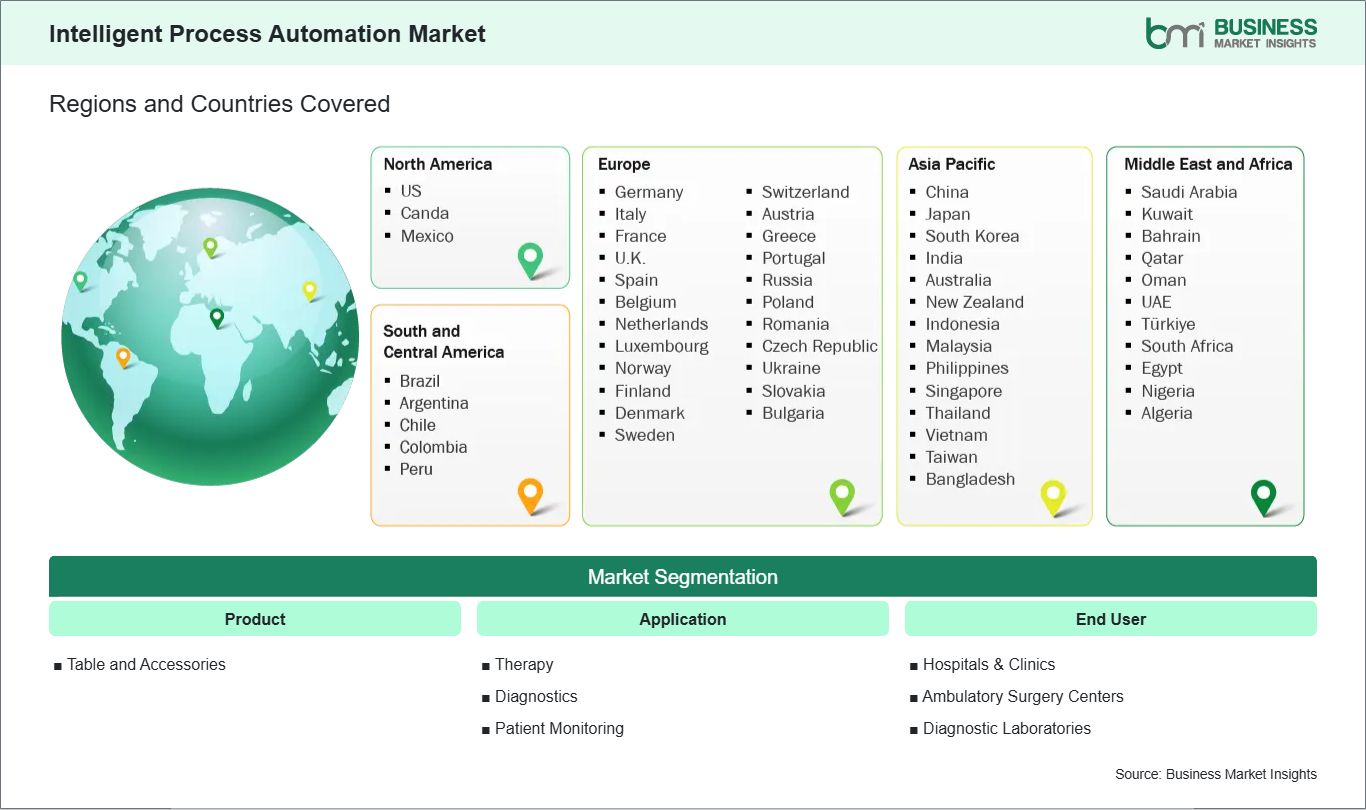
Key segments that contributed to the derivation of the Intelligent Process Automation market analysis are component, enterprise size, deployment, and end user.
- By Component, the market is segmented into Solution and Services.
- By Enterprise Size, the market is divided into Large Enterprises and SMEs.
- By Deployment, the market is categorized into Cloud and On Premises.
- By End User, the market is categorized into BFSI, Healthcare, Retail, IT and Telecom, and Manufacturing.
Market Forces
Intelligent Process Automation Market Drivers and Opportunities
Push for Hyperautomation and Critical Shortage of Specialized Labor
The primary driver for the Intelligent Process Automation Market is the systemic global requirement for organizations to achieve operational agility and cost-efficiency amidst increasing market volatility. The Institutionalization of Hyperautomation Frameworks acts as a foundational catalyst, as enterprises move beyond isolated bot deployments to integrate comprehensive platforms that combine process mining, AI-powered document processing, and low-code orchestration. This momentum is further propelled by Persistent Labor Shortages and the Rising Cost of Human Capital; as specialized administrative and technical talent becomes increasingly difficult to source and retain, organizations are turning to IPA to maintain output without expanding headcount. In the technological sphere, the Rapid Proliferation of Generative AI and Agentic Automation serves as a vital driver, as the ability to utilize natural language processing (NLP) allows non-technical employees to create and manage sophisticated automated workflows.
Furthermore, Stringent Global Compliance and Data Governance Standards are compelling the adoption of IPA, as automated systems provide a transparent, audit-ready log of every transaction, significantly reducing the risk of human error in highly regulated sectors such as banking and healthcare. Together, these factors, the hyperautomation mandate, labor pressures, and compliance needs, ensure a robust and essential growth path for the global Intelligent Process Automation Market.
Proactive Process Mining and Rise of AI-Human Collaborative Co-Bots
A significant high-value opportunity lies in the convergence of IPA Platforms with Advanced Analytics and Autonomous Decision-Making. Next-generation Decision Intelligence Engines with Integrated Process Mining are being developed to utilize historical data to identify hidden bottlenecks and automatically suggest new automation candidates, providing a growth frontier for proactive optimization. There is also a major growth frontier in the development of Cognitive Co-Bots and AI-Human Orchestration Systems; as the focus shifts toward collaborative automation, the demand for platforms that can seamlessly hand off tasks between digital agents and human experts is expanding, particularly in complex customer service and clinical diagnostic environments.
Furthermore, the expansion of Intelligent Document Processing (IDP) for Unstructured Data presents a lucrative opportunity, as vendors develop models capable of extracting context and intent from handwritten forms, legal contracts, and multimedia files. Beyond back-office efficiency, the rise of Automated Cybersecurity Incident Response and Fraud Detection offers a unique frontier, where IPA systems can autonomously identify and contain threats in real time. Manufacturers and software providers who focus on Explainable AI (XAI) for Governance and those pioneering Sustainable, Green Automation Algorithms are positioned to lead the global Intelligent Process Automation Market.
Size and Share Analysis
Intelligent Process Automation Market Size and Share Analysis
The Intelligent Process Automation market demonstrates steady growth, with size and share analysis revealing evolving trends and competitive positioning among key players. The report examines subsegments categorized within component, enterprise size, deployment, and end user, offering insights into their contribution to overall market performance.
Based on end user, the Healthcare subsegment is registering the fastest growth within the IPA market. In this sector, intelligent process automation is becoming essential for Precision Patient Care and Administrative Streamlining, where intelligent document processing is applied to claims handling, appointment scheduling, and medical record management. The strategic use of automation reduces administrative overhead and significantly shortens surgical wait times, directly improving patient outcomes. By enhancing efficiency and accuracy in critical workflows, this subsegment is rapidly strengthening its influence, positioning healthcare as a key driver of IPA adoption in mission-critical environments.
Report Coverage
Intelligent Process Automation Market Report Coverage and Deliverables
The "Intelligent Process Automation Market Size and Forecast (2022–2033)" report provides a detailed analysis of the market covering below areas:
- Intelligent Process Automation market size and forecast at global, regional, and country levels for all market segments covered under the scope
- Intelligent Process Automation market trends, as well as drivers, restraints, and opportunities
- Intelligent Process Automation market analysis covering key trends, global and regional framework, major players, regulations, and recent developments
- Industry landscape and competition analysis covering market concentration, heat map analysis, prominent players, and recent developments for the Intelligent Process Automation market
- Detailed company profiles, including SWOT analysis
Geographic Insights
Intelligent Process Automation Market Geographic Insights
The geographical scope of the Intelligent Process Automation market report is divided into five regions: North America, Asia Pacific, Europe, Middle East & Africa, and South & Central America.
North America maintains the preeminent market position, supported by early adoption of advanced technologies and a robust ecosystem of automation vendors. Asia Pacific is identified as the fastest-growing region, propelled by rapid digital transformation and large-scale industrialization in emerging economies.
Europe represents a sophisticated market characterized by rigorous regulatory frameworks and a strong institutional focus on operational transparency and energy-efficient automation.
The Asia-Pacific Intelligent Process Automation Market serves as a vital engine for global industry expansion, driven by the massive shift toward smart manufacturing and digital-first services in China, India, and Southeast Asia. These nations are leading the transition toward AI-Integrated Workflow Orchestration, prioritizing the modernization of legacy systems to support high-growth sectors like e-commerce and fintech. Japan and South Korea continue to lead in the development of sophisticated robotic process automation (RPA) and cognitive agents, focusing on precision and human-bot collaboration. The region benefits from a maturing digital workforce and an increasing institutional focus on Hyperautomation to manage escalating data volumes and complex supply chains.
Industry Activity
Recent Developments
The Intelligent Process Automation market is evaluated by gathering qualitative and quantitative data post primary and secondary research, which includes important corporate publications, association data, and databases. A few of the key developments in the Intelligent Process Automation market are:
- In February 2026, Ricoh acquired ValueTech, a Chile-based leader in process automation and document management, to expand AI-powered intelligent workplace solutions across Latin America. The acquisition enhances smart automation, predictive analytics, and secure information management for highly regulated industries. This move strengthens Ricoh`s position in the intelligent process automation market, supporting efficiency, compliance, and scalable digital transformation initiatives.
- In December 2025, PTC launched the Arena AI Engine for its PLM and QMS workflows, leveraging AI to automate document review, comparison, and compliance monitoring. The release enhances decision-making, reduces errors, and strengthens supply chain and regulatory compliance. This development positions PTC to expand its footprint in the intelligent process automation market, supporting AI-driven product lifecycle and quality management.
Trust & Transparency
Research Methodology
The market analysis combines proprietary research with secondary data from government agencies, company disclosures, regulatory filings, industry databases and expert interviews. Market estimates are validated through data triangulation, cross-market benchmarking and analyst
review.
View Full Research Methodology
Key Sources Referred:
World Bank – Global Trade Indicators World Trade Organization (WTO) (International Monetary Fund )IMF International Trade Administration (ITA) Company website Company annual reports Company investor presentations