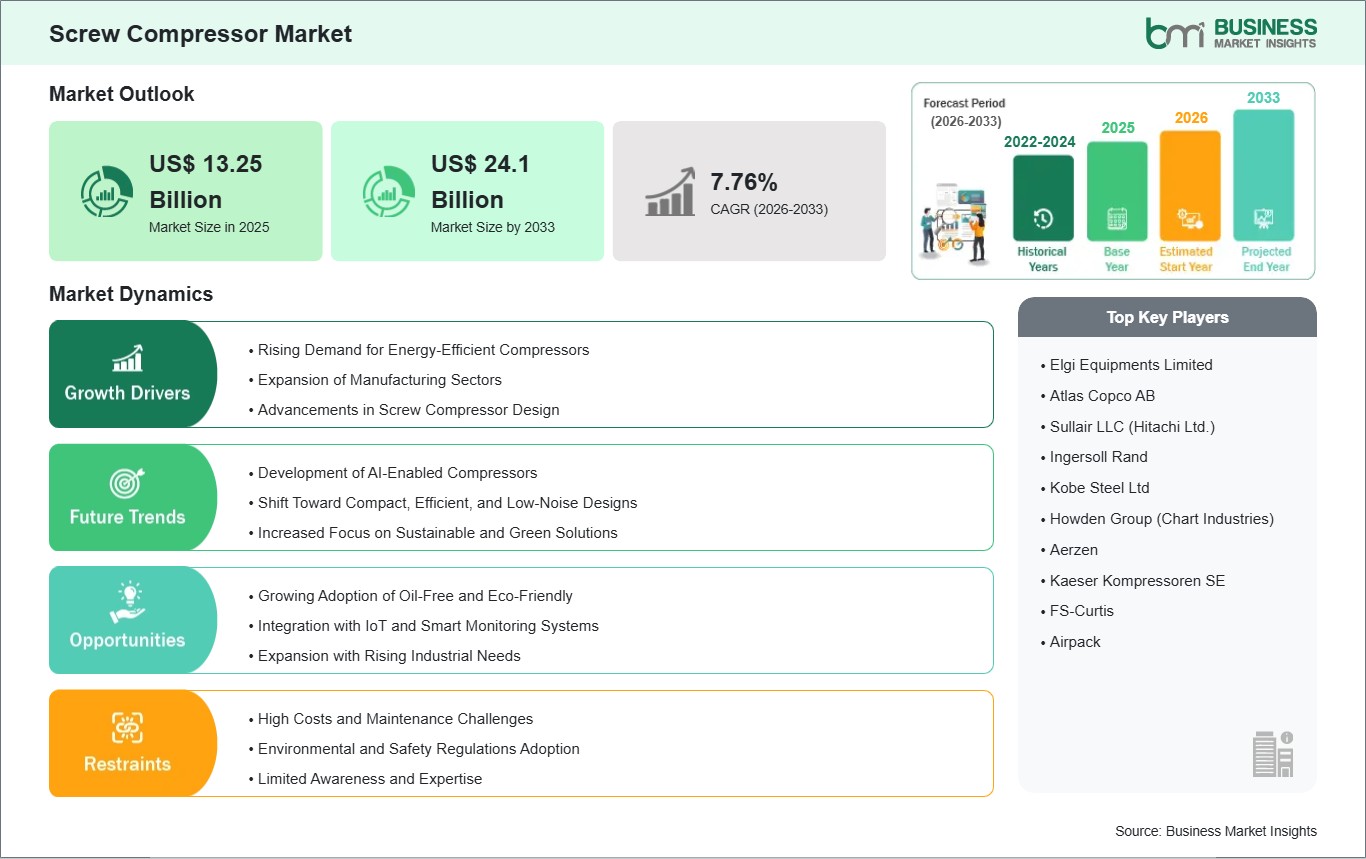
The Screw Compressor Market size is expected to reach US$ 24.1 billion by 2033 from US$ 13.25 billion in 2025. The market is estimated to record a CAGR of 7.76% from 2026 to 2033.
The global screw compressor market is affected by factors like the growing need for reliable, efficient, and continuous supply of compressed air in different industries. Screw compressors, which utilize helical rotors to maintain continuous supply of air, have been recognized as essential equipment in different industries like manufacturing, oil and gas, pharmaceutical, automobile, food processing, etc. Their ability to maintain continuous performance in harsh environments has made screw compressors more popular in industries that require continuous production and accurate control.
The screw compressor market is mainly affected by factors like energy efficiency and automation. Industries are increasingly using advanced compressor equipment to maintain energy-efficient operations. Screw compressors have become more popular due to factors like continuous supply of air, continuous performance in harsh environments, and their ability to maintain continuous production.
However, factors like high initial investment, especially for advanced types of screw compressors, have created significant challenges for industries like small-scale industries. Screw compressors are complex equipment that require skilled maintenance staff to maintain smooth operation. Other factors like screw compressor equipment also affect the market. Manufacturers of screw compressors need to prove the efficiency and durability benefits of their equipment.

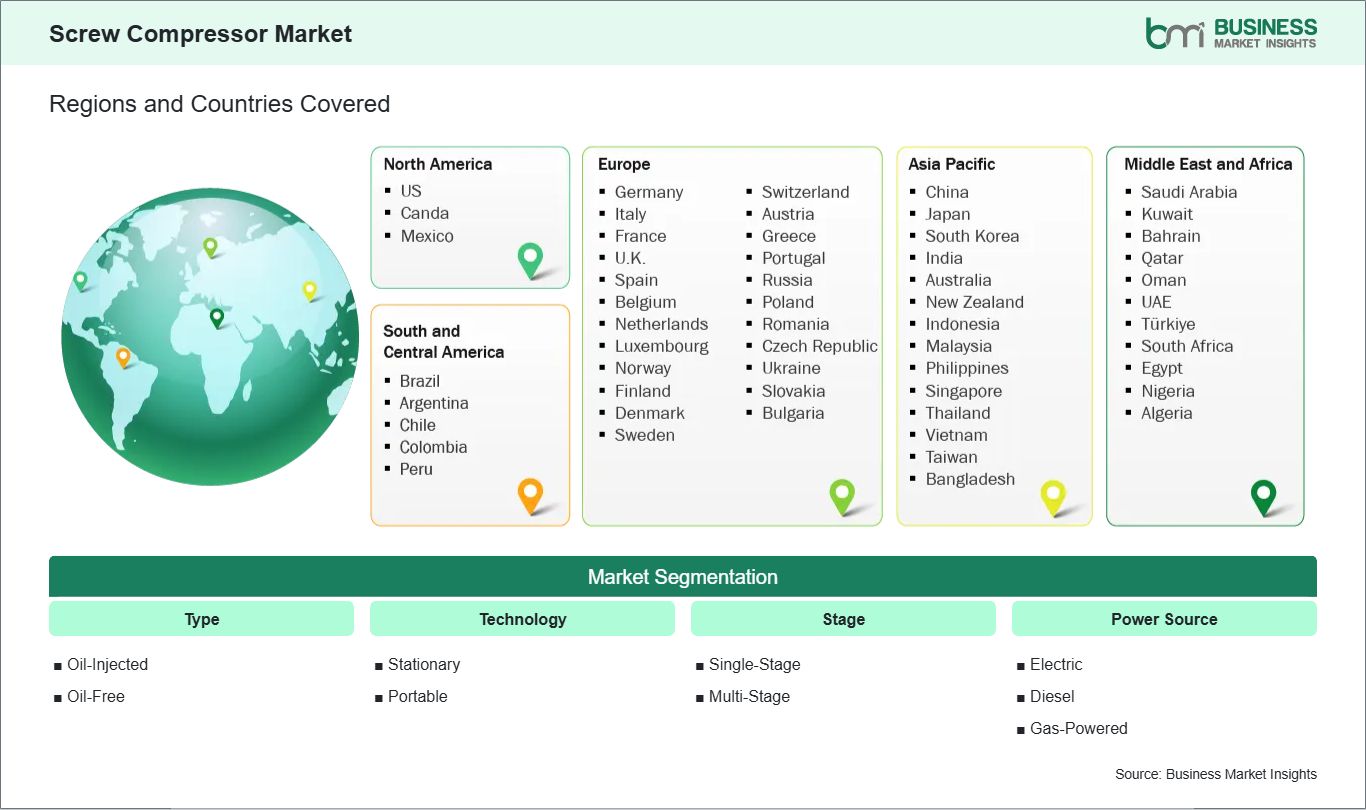
Key segments that contributed to the derivation of the screw compressor market analysis are type, technology, stage, power source, capacity, and end user.
The global screw compressor market is gaining strong momentum as industrial users increasingly prioritize energy efficiency to reduce operating costs. Across manufacturing facilities, processing plants, and construction sites, end‑users are replacing older, less efficient compressors with modern, energy‑optimized models. These newer designs use advanced rotor profiles, variable speed drives (VSD), and intelligent control systems that reduce energy consumption while maintaining reliable performance a key factor for industries where compressed air is a critical utility.
Pressure on industrial power usage has elevated the importance of energy‑efficient compressors in heavy‑duty applications. In regions with high electricity costs, plant operators are choosing screw compressors with integrated energy recovery and automation to minimize waste and lower total cost of ownership. These trends are particularly evident in energy‑intensive sectors such as automotive assembly, food processing, and chemical manufacturing, where operational efficiency directly affects overall productivity and competitiveness.
In addition to cost savings, energy‑efficient screw compressors support broader corporate sustainability objectives. Companies with global supply chains are setting greenhouse gas reduction targets that include energy‑use benchmarks for utilities like compressed air. This has encouraged procurement of next‑generation compressors that can deliver consistent pressure outputs with lower input power. By aligning equipment investment with efficiency strategies, organizations can enhance both environmental performance and long‑term operational resilience.
Environmental issues and tighter regulations concerning emissions have created a market for environmentally safe and oil-free screw compressors. Oil-free compressors offer the advantage of not having to deal with the issue of fluid contamination in the compressed air supply. In the pharmaceutical, food and beverage, and precision manufacturing industries, customers are opting to buy oil-free compressors to ensure that their products do not become contaminated.
Regulatory bodies that offer guidelines on clean air delivery have also become key players in influencing customer demand for compressors. Governments and industry regulators have become stricter in their guidelines concerning emissions. In such environments, oil-free compressors have become the only viable solution where air purity cannot be compromised. The appeal of environmentally safe compressors goes beyond regulatory requirements to meet industry standards.
The manufacturers are reacting to this trend by diversifying their product lines with environmentally friendly compressor solutions that combine oil-free technology with other sustainable attributes. For instance, products with sophisticated heat recovery technology, environmentally friendly refrigerants in cooling parts, and modular designs that maximize energy efficiency are becoming popular. This trend towards cleaner technology is not only unlocking new market opportunities but also allowing the end-users to achieve their operational and sustainability objectives without compromising on performance.
The screw compressor market is experiencing steady growth, with market size and share analysis reflecting evolving treatment preferences and competitive dynamics among key players. The report evaluates important subsegments categorized within type, technology, stage, power source, capacity, and end user, highlighting their respective contributions to overall market performance.
On the basis of type, the oil‑injected subsegment dominated the Screw Compressor market in 2025. This is driven by the extensive use of oil‑injected compressors in heavy‑duty industrial applications, where the oil not only lubricates internal components to reduce friction and wear but also enhances operational life and reliability. Their broad applicability across industries such as chemicals & petrochemicals, automotive, and oil & gas supports strong demand and positions this segment as a key revenue contributor.
By technology, the stationary subsegment dominated the Screw Compressor market in 2025. The dominance of stationary compressors stems from their ability to deliver high capacity, continuous air flow, and robust performance in large industrial settings, making them crucial for manufacturing, construction, and energy sectors requiring uninterrupted compressed air.
Based on stage, the single‑stage subsegment dominated the Screw Compressor market in 2025. Single‑stage compressors are preferred in a variety of applications due to their simpler design, lower cost, and efficiency in meeting moderate pressure requirements, which makes them suitable for broad industrial use.
In terms of power source, the electric subsegment dominated the Screw Compressor market in 2025. Electric‑powered compressors lead the market because they offer cleaner, more energy‑efficient operation with lower maintenance needs compared to diesel or gas‑powered alternatives, aligning with global industrial trends toward energy savings and sustainability.
By capacity, the above 250 HP subsegment dominated the Screw Compressor market in 2025. High‑capacity compressors are essential for critical heavy‑industry applications such as oil & gas, power generation, and mining, where large volumes of compressed air are required continuously; this drives demand for units with above 250 HP ratings.
By end user, the food & beverages subsegment dominated the Screw Compressor market in 2025. Increasing automation in food and beverage production, stringent safety standards, and demand for energy‑efficient equipment have elevated the use of screw compressors in packaging, processing, and bottling operations across this sector.

| Report Attribute | Details |
|---|---|
| Market size in 2025 | US$ 13.25 Billion |
| Market Size by 2033 | US$ 24.1 Billion |
| Global CAGR (2026 - 2033) | 7.76% |
| Historical Data | 2022-2024 |
| Forecast period | 2026-2033 |
| Segments Covered | By Type
|
|
Regions and Countries Covered
| |
| North America | US, Canada, Mexico |
| Europe | Belgium, Austria, Finland, Denmark, Greece, Poland, Romania, Russia, Ukraine, Czech Republic, Slovakia, Bulgaria, Italy, Luxembourg, Germany, Switzerland, France, Netherlands, Norway, Portugal, Spain, Sweden, United Kingdom |
| Asia-Pacific | Australia, China, India, Japan, South Korea, Indonesia, Malaysia, Philippines, Singapore, Thailand, Vietnam, Bangladesh, New Zealand, Taiwan |
| South and Central America | Brazil, Argentina, Peru, Chile, Colombia |
| Middle East and Africa | Bahrain, Kuwait, Oman, Qatar, Saudi Arabia, United Arab Emirates, Turkiye, South Africa, Egypt, Algeria, Nigeria |
| Market leaders and key company profiles |
|
The "Screw Compressor Market Size and Forecast (2022 - 2033)" report provides a detailed analysis of the market covering below areas:
The geographical scope of the Screw Compressor market report is divided into five regions: North America, Asia Pacific, Europe, Middle East & Africa, and South & Central America. The Screw Compressor market in North America is expected to grow during the forecast period.
The market for screw compressors in North America is significant due to the region's well-established industrial sector and high level of technology adoption. North America has a wide range of manufacturing industries, including automotive, aerospace, oil and gas, and food and beverage, which rely heavily on screw compressors to deliver efficient and uninterrupted air supply.
Additionally, the oil and gas industry also requires high-performance compressors that can work in extreme conditions, making it a competitive market with innovation being one of the major differentiating factors. Energy efficiency and sustainability are also of utmost importance to industries in North America. Industries are increasingly using oil-free and energy-efficient compressors to minimize their energy consumption and environmental impact, especially in food processing and pharmaceutical industries.
North America has also placed great emphasis on automation in industries, which has led to the use of smart compressors in the region. Even though the market for screw compressors in North America is mainly driven by replacement and technology upgrades, it does not leave room for new installations.

The screw compressor market is evaluated by gathering qualitative and quantitative data post primary and secondary research, which includes important corporate publications, association data, and databases. A few of the key developments in the screw compressor market are:
The Screw Compressor Market is valued at US$ 13.25 Billion in 2025, it is projected to reach US$ 24.1 Billion by 2033.
As per our report Screw Compressor Market, the market size is valued at US$ 13.25 Billion in 2025, projecting it to reach US$ 24.1 Billion by 2033. This translates to a CAGR of approximately 7.76% during the forecast period.
The Screw Compressor Market report typically cover these key segments-
The historic period, base year, and forecast period can vary slightly depending on the specific market research report. However, for the Screw Compressor Market report:
The Screw Compressor Market is populated by several key players, each contributing to its growth and innovation. Some of the major players include:
The Screw Compressor Market report is valuable for diverse stakeholders, including:
Essentially, anyone involved in or considering involvement in the Screw Compressor Market value chain can benefit from the information contained in a comprehensive market report.
Please tell us your area of interest
(Market Segments/ Regions and Countries/ Companies)