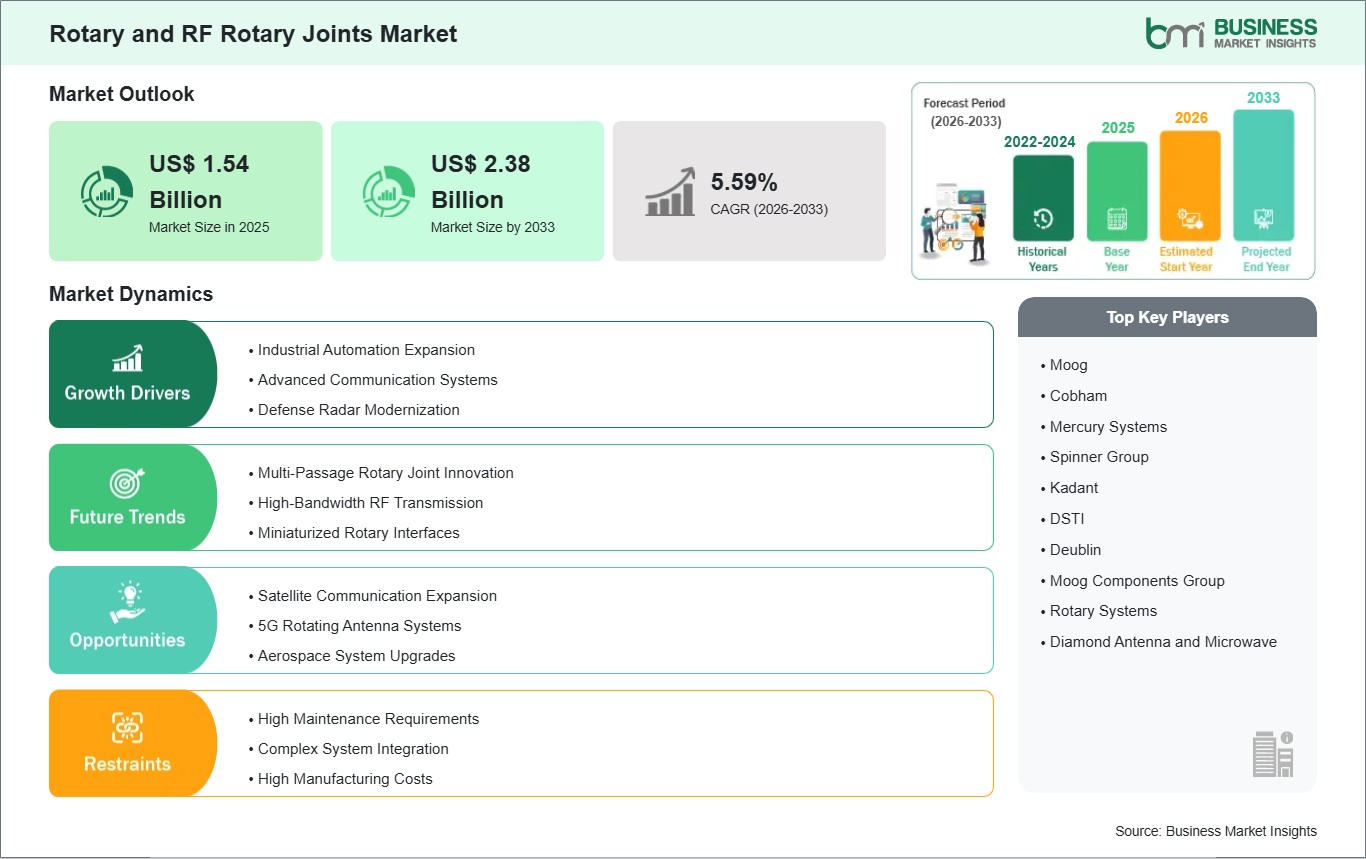
The Rotary and RF Rotary Joints Market size is expected to reach US$ 2.38 billion by 2033 from US$ 1.54 billion in 2025. The market is estimated to record a CAGR of 5.59% from 2026 to 2033.
The global rotary and RF rotary joints market is driven by demand for reliable rotational interfaces that transmit power, fluids, and high-frequency signals between stationary and rotating parts in complex electromechanical systems.
Traditional rotary joints enable fluid and pneumatic transfer, while RF rotary joints facilitate uninterrupted radio frequency transmission in rotating platforms like radar antennas and satellite ground stations.
Growth is fueled by industrial automation, aerospace, telecommunications, and military communication systems requiring high-performance rotational couplings.
Manufacturers focus on innovations such as compact multi-passage designs, advanced sealing technologies, and durable materials suited for harsh environments. Smart manufacturing and connected systems increase the importance of these joints in next-generation automated and communication platforms.

Key segments that contributed to the derivation of the rotary and RF roatary joints market analysis are type, rotary joints channel, rotary joints type, industry, rf rotary joints type, applications, and end user.
Growth is driven by industrial automation, manufacturing robotics, and energy production requiring fluid and gas transfer through rotary joints with enhanced sealing and multi-passage capabilities for continuous operation.
RF rotary joints are critical for high-frequency communication in radar platforms, satellite stations, and rotating antennas, supporting 5G infrastructure, space exploration, and defense radar modernization.
Aerospace and defense investments boost demand for durable, high-performance rotary and RF joints used in harsh environments and continuous rotations.
Satellite broadband expansion, LEO constellations, and ground stations increase the need for RF rotary joints that ensure low-loss signal transmission between rotating antennas and fixed infrastructure.
Defense modernization emphasizes advanced radar and surveillance platforms relying on RF rotary joints, with military applications driving investment in high-precision solutions.
Commercial applications like rotating satellite earth stations and 5G dynamic antennas are emerging markets for rotary solutions, enhanced by innovations such as hybrid rotary joints and miniaturization.
The Rotary and RF Roatary Joints Market demonstrates steady growth, with size and share analysis highlighting evolving trends and competitive dynamics among key players. The report examines subsegments categorized within type, rotary joints channel, rotary joints type, industry, rf rotary joints type, applications, and end user, offering insights into their contribution to overall market performance.
By type, the rf rotary joints subsegment dominated the market in 2025, driven by their essential role in radar communication systems and satellite signal transmission.
By rotary joints channel, the single passage subsegment dominated the market in 2025, supported by its widespread use in simpler fluid or signal transfer applications.
For rotary joints type, the hydraulic rotary joints subsegment dominated the market in 2025, driven by demand for fluid transfer components in heavy machinery and industrial systems.
Across rotary joints industry, the aerospace subsegment dominated the market in 2025, reflecting high requirements for reliability and performance in aircraft and defense radar systems.
In rf rotary joints type, the coaxial subsegment dominated the market in 2025, owing to its broad adoption in high‑frequency communication systems.
By rf rotary joints application, the military subsegment dominated in 2025, supported by defense procurement for advanced radar and surveillance systems.
In terms of application, the security and surveillance subsegment dominated the market in 2025, driven by rotating camera systems and monitoring infrastructure.
By end user, the commercial buildings subsegment dominated the market in 2025 given larger capital expenditure on rotating systems in commercial facilities.
Hydraulic rotary joints lead in fluid transfer for heavy machinery.
Aerospace industry dominance reflects high reliability and performance demands.
Coaxial RF rotary joints are favored for high-frequency communication.
Military RF rotary joints dominate applications due to defense procurement.
Security and surveillance applications lead in usage for rotating camera systems.
Commercial buildings as end users invest heavily in rotating system infrastructure.
| Report Attribute | Details |
|---|---|
| Market size in 2025 | US$ 1.54 Billion |
| Market Size by 2033 | US$ 2.38 Billion |
| Global CAGR (2026 - 2033) | 5.59% |
| Historical Data | 2022-2024 |
| Forecast period | 2026-2033 |
| Segments Covered | By Product
|
|
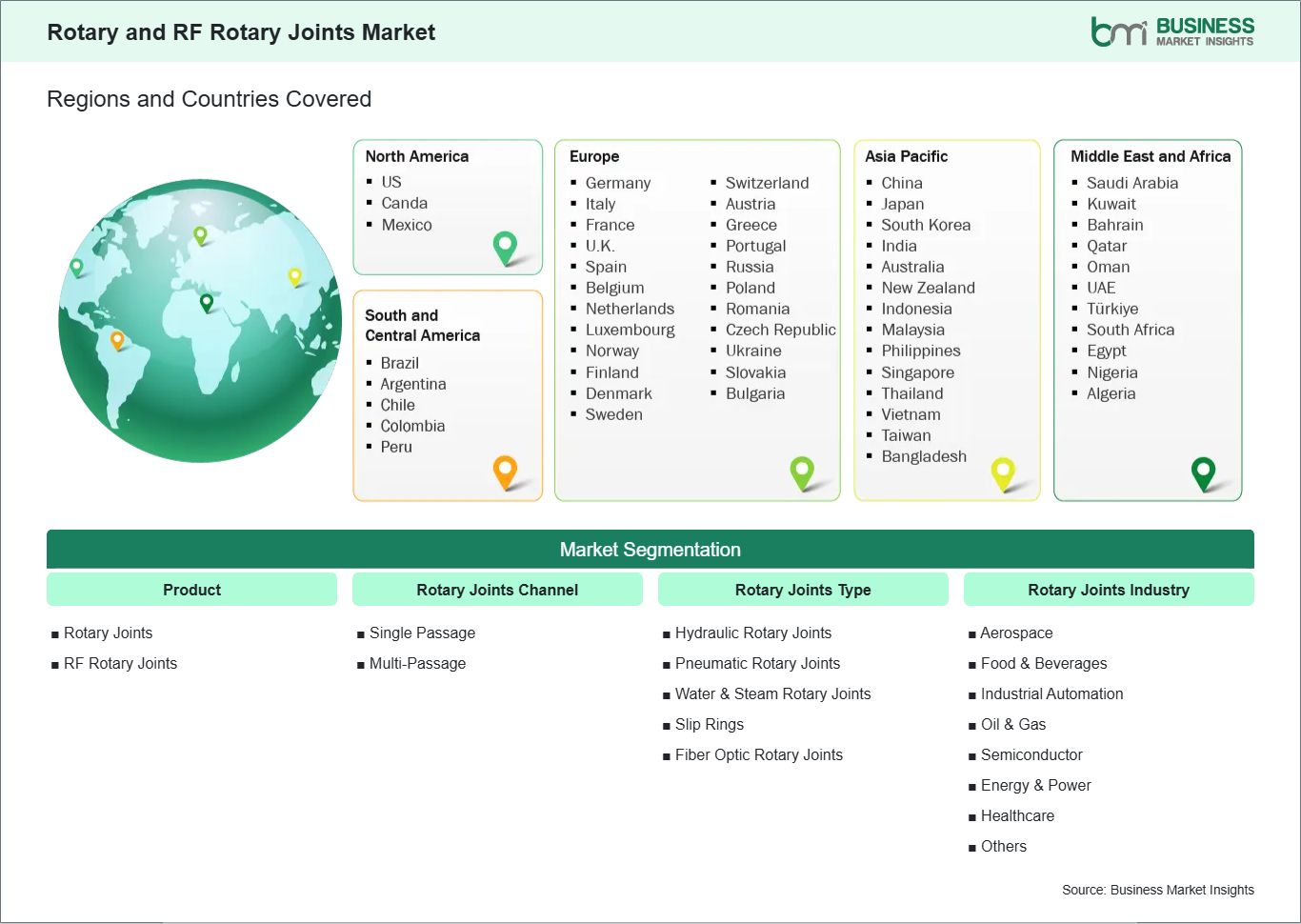
Regions and Countries Covered
| |
| North America | US, Canada, Mexico |
| Europe | Belgium, Austria, Finland, Denmark, Greece, Poland, Romania, Russia, Ukraine, Czech Republic, Slovakia, Bulgaria, Italy, Luxembourg, Germany, Switzerland, France, Netherlands, Norway, Portugal, Spain, Sweden, United Kingdom |
| Asia-Pacific | Australia, China, India, Japan, South Korea, Indonesia, Malaysia, Philippines, Singapore, Thailand, Vietnam, Bangladesh, New Zealand, Taiwan |
| South and Central America | Brazil, Argentina, Peru, Chile, Colombia |
| Middle East and Africa | Bahrain, Kuwait, Oman, Qatar, Saudi Arabia, United Arab Emirates, Turkiye, South Africa, Egypt, Algeria, Nigeria |
| Market leaders and key company profiles |
|
The "Rotary and RF Roatary Joints Market Size and Forecast (2022 - 2033)" report provides a detailed analysis of the market covering below areas:
The geographical scope of the Rotary and RF Roatary Joints Market report is divided into North America, Asia Pacific, Europe, Middle East & Africa, and South & Central America. North America held the largest share in 2025.
North America commanded a significant share in 2025, backed by strong aerospace manufacturing, defense technology deployments, and advanced telecommunications infrastructure. High military expenditure in the U.S. and Canada has driven the adoption of RF rotary joints for radar, surveillance systems, and rotating antennas. Continued investments in industrial automation further bolster demand for rotary joints in manufacturing and automation hubs. Europe maintains a substantial market presence driven by aerospace and industrial automation sectors. Countries such as Germany, France, and the UK have deep engineering ecosystems, which support adoption of rotary and RF rotary joints in advanced machinery and radar systems. Europe’s commitment to innovation in automation and communication technologies supports steady market growth. Asia Pacific is emerging as the fastest‑growing region. Rapid industrialization, expansion of telecommunications networks including 5G, and rising defense spending in China, India, Japan, and South Korea are driving high demand for both traditional rotary joints and RF rotary solutions. Asia Pacific is poised to benefit from increased manufacturing automation, aerospace production growth, and deployment of rotating communication platforms. Middle East & Africa displays increased uptake for rotary and RF rotary joints in oil & gas, energy, and defense infrastructure, while countries like the UAE and Saudi Arabia invest in modern radar and communication systems. South & Central America is gradually adopting rotary technologies as industrial automation expands in countries such as Brazil, Mexico, and Argentina, supported by infrastructure modernization and manufacturing upgrades.

The Rotary and RF Roatary Joints Market is evaluated by gathering qualitative and quantitative data post primary and secondary research, which includes important corporate publications, association data, and databases. A few of the key developments in the rotary and RF roatary joints market are:
The Rotary and RF Rotary Joints Market is valued at US$ 1.54 Billion in 2025, it is projected to reach US$ 2.38 Billion by 2033.
As per our report Rotary and RF Rotary Joints Market, the market size is valued at US$ 1.54 Billion in 2025, projecting it to reach US$ 2.38 Billion by 2033. This translates to a CAGR of approximately 5.59% during the forecast period.
The Rotary and RF Rotary Joints Market report typically cover these key segments-
The historic period, base year, and forecast period can vary slightly depending on the specific market research report. However, for the Rotary and RF Rotary Joints Market report:
The Rotary and RF Rotary Joints Market is populated by several key players, each contributing to its growth and innovation. Some of the major players include:
The Rotary and RF Rotary Joints Market report is valuable for diverse stakeholders, including:
Essentially, anyone involved in or considering involvement in the Rotary and RF Rotary Joints Market value chain can benefit from the information contained in a comprehensive market report.
Please tell us your area of interest
(Market Segments/ Regions and Countries/ Companies)