Market Summary
Executive Summary and Global Market Analysis
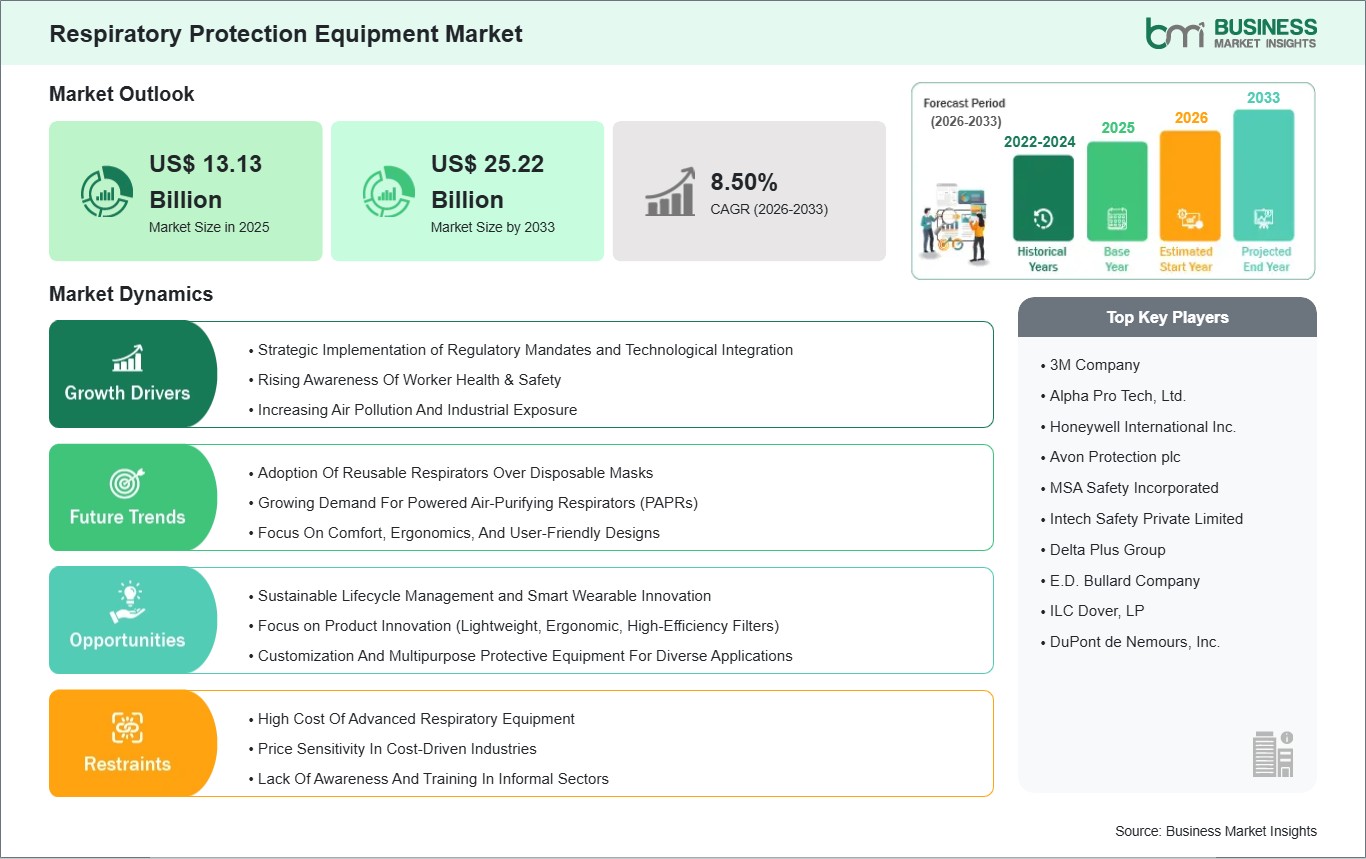
Respiratory protection equipment refers to specialized personal protective gear designed to safeguard individuals from inhaling hazardous substances, including airborne contaminants like dust, fumes, vapors, and infectious biological agents. These products provide immense strategic value by mitigating the risk of long-term respiratory illnesses and ensuring compliance with national safety standards. Market expansion is primarily attributed to the global implementation of stringent workplace safety regulations and a rising awareness of the long-term health risks associated with particulate and chemical exposure. Furthermore, the shift toward reusable elastomeric and powered systems in industrial settings is substantially improving cost-efficiency and sustainability by reducing the reliance on single-use disposables.
However, several challenges can restrain market growth. High price sensitivity in developing regions often leads to the use of substandard or uncertified products, which can compromise safety and undermine legitimate manufacturers. Complex fit-testing requirements and user discomfort during extended shifts remain significant barriers to consistent compliance, potentially leading to workplace injuries. Additionally, the industry faces constraints due to fluctuating raw material costs and the logistical challenges of maintaining large-scale stockpiles for emergency preparedness
Despite these hurdles, the market holds immense opportunities in the growth of smart, sensor-integrated respirators that monitor air quality and filter life. The expansion of specialized healthcare respiratory programs and the development of lightweight, high-performance filter media are expected to create significant opportunities for long-term market growth.
Segment Analysis
Respiratory Protection Equipment Market Segmentation
Key segments that contributed to the derivation of the Respiratory Protection Equipment market analysis are product type and end user.
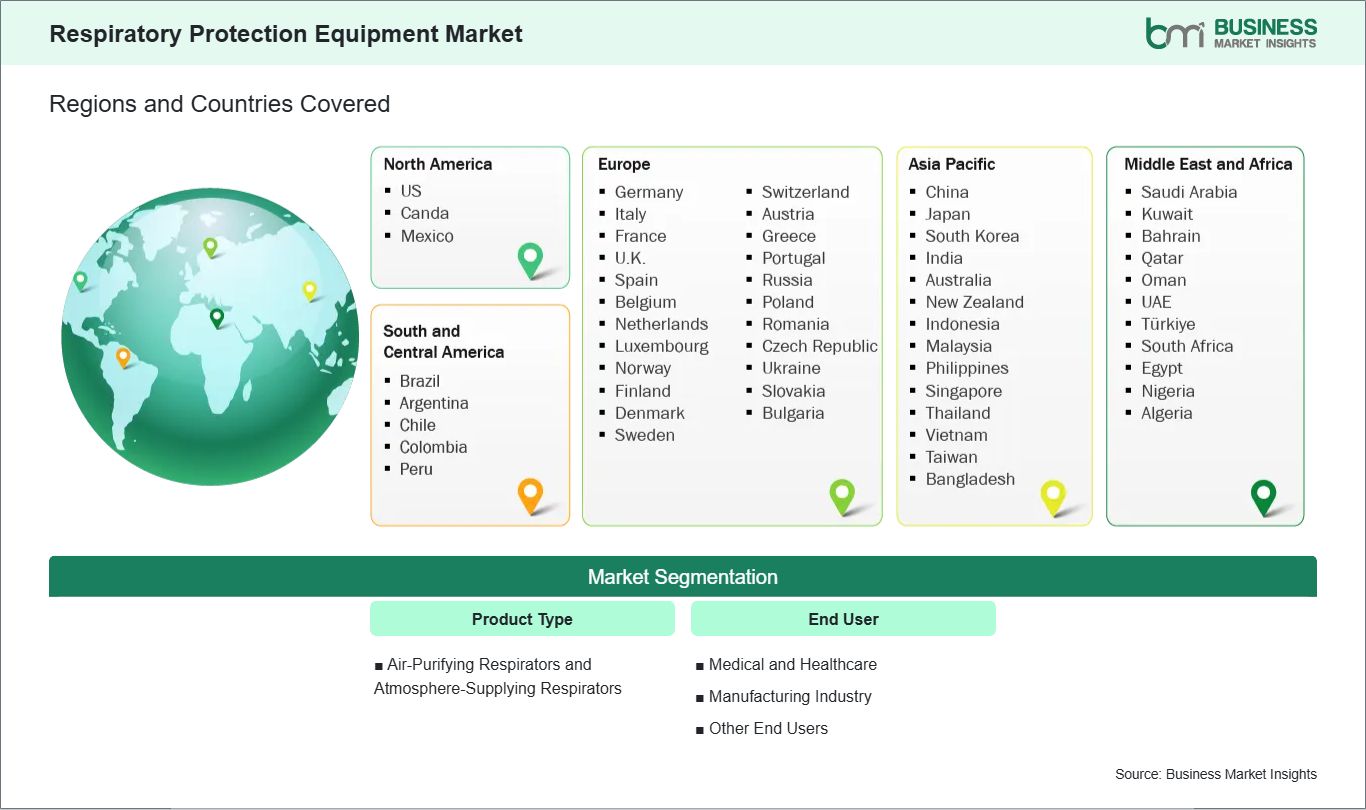
- By Product Type, the market is segmented into Air-Purifying Respirators and Atmosphere-Supplying Respirators.
- By End User, the market is categorized into Medical and Healthcare, Manufacturing Industry, and Other End Users.
Market Forces
Respiratory Protection Equipment Market Drivers and Opportunities
Strategic Implementation of Regulatory Mandates and Technological Integration
The primary driver for the Respiratory Protection Equipment Market is the global strengthening of Occupational Health and Safety Regulations. Regulatory bodies are increasingly mandating rigorous fit-testing and the use of certified filtration media in sectors such as mining, construction, and chemical processing to mitigate long-term respiratory diseases. This momentum is further propelled by the Strategic Adoption of Powered Air-Purifying Respirators (PAPRs); industries are pivoting toward these systems as they offer superior protection and reduced breathing resistance compared to non-powered alternatives. In the technology sphere, the Integration of Internet of Things (IoT) and Smart Sensors serves as a significant catalyst, enabling real-time monitoring of filter life, air quality, and wearer physiological data. Furthermore, the Heightened Demand within the Healthcare and Pharmaceutical Sectors continues to act as a foundational driver, as facilities prioritize sterile airflow and clinician safety during high-risk procedures and compounding activities. Together, these factors, stringent compliance, the shift toward powered systems, and digital connectivity, ensure a highly sophisticated and sustainable trajectory for the global respiratory protection equipment market.
Sustainable Lifecycle Management and Smart Wearable Innovation
A significant high-value opportunity lies in the convergence of Respiratory Protection with Sustainable and Circular Economy Principles. There is a growing demand for reusable, high-durability elastomeric respirators that reduce the environmental impact and procurement costs associated with single-use disposables. There is also a major growth frontier in the development of Advanced Communication-Integrated Interfaces; manufacturers are increasingly embedding voice diaphragms and electronic communication systems into full-face masks to improve team coordination in high-noise or sterile environments. Furthermore, the expansion of Customized and Anatomically Optimized Fit Profiles presents a lucrative opportunity, utilizing three-dimensional scanning to create bespoke seal interfaces that accommodate diverse facial structures and improve wearer compliance. Beyond traditional hardware, the rise of Predictive Maintenance and Service Bundling Models offers a unique opportunity for manufacturers to provide managed safety services, including automated filter replacement schedules and digital compliance auditing. Manufacturers who focus on Ultra-Lightweight Material Science and those pioneering Hybrid Filtration Media for Complex Chemical Environments are positioned to lead the most innovative and high-margin segments of the global respiratory protection equipment market.
Size and Share Analysis
Respiratory Protection Equipment Market Size and Share Analysis
Based on product type, the Air-Purifying Respirators and Atmosphere-Supplying Respirators subsegments hold a significant market presence, representing the spectrum of protection from ambient filtration to independent air delivery. Air-Purifying Respirators, including disposable units and reusable elastomeric half-masks, are indispensable for the Daily Operational vertical, as they offer a versatile defense against common particulate and vapor hazards. A notable trend is the surge in the Atmosphere-Supplying Respirators subsegment, which is registering higher interest. These devices are becoming essential for Extreme Environments, such as deep-mine rescues or chemical spills, where ambient air is oxygen-deficient or immediately dangerous. Strategic examinations show a move toward Hybrid Systems that allow users to switch between filtered and supplied air, providing unprecedented flexibility in volatile industrial zones.
Report Coverage
Respiratory Protection Equipment Market Report Coverage and Deliverables
The "Respiratory Protection Equipment Market Size and Forecast (2022–2033)" report provides a detailed analysis of the market covering below areas:
- Respiratory Protection Equipment market size and forecast at global, regional, and country levels for all market segments covered under the scope
- Respiratory Protection Equipment market trends, as well as drivers, restraints, and opportunities
- Respiratory Protection Equipment market analysis covering key trends, global and regional framework, major players, regulations, and recent developments
- Industry landscape and competition analysis covering market concentration, heat map analysis, prominent players, and recent developments for the Respiratory Protection Equipment market
- Detailed company profiles, including SWOT analysis
Geographic Insights
Respiratory Protection Equipment Market Geographic Insights
The geographical scope of the Respiratory Protection Equipment market report is divided into five regions: North America, Asia Pacific, Europe, Middle East & Africa, and South & Central America.
North America maintains a prominent market position due to rigorous oversight by occupational health and safety authorities and the substantial presence of the oil, gas, and pharmaceutical sectors. Europe represents a mature market segment, where demand is sustained by comprehensive industrial safety mandates and an increasing emphasis on sustainable, reusable respiratory solutions. Asia Pacific is identified as the most rapidly advancing region, propelled by extensive industrialization, large-scale infrastructure projects, and heightened awareness of workplace hazards in emerging economies.
The Asia-Pacific Respiratory Protection Equipment Market is segmented into China, Japan, South Korea, India, Australia, and the Rest of Asia Pacific. China serves as a central hub for both production and consumption, driven by significant manufacturing output and evolving safety standards. India is experiencing notable growth in demand as domestic industrial regulations align with international safety benchmarks and the healthcare sector expands. Japan and South Korea continue to prioritize high-specification respiratory devices, focusing on technological integration and specialized protection for aging workforces and advanced electronic manufacturing environments.
Industry Activity
Recent Developments
The Respiratory Protection Equipment market is evaluated by gathering qualitative and quantitative data post primary and secondary research, which includes important corporate publications, association data, and databases. A few of the key developments in the Respiratory Protection Equipment market are:
- In Feb 2026, Dräger partnered with MES Life Safety, the largest SCBA supplier in the U.S., to expand nationwide access and service for its AirBoss SCBAs. This collaboration strengthens support for fire departments, enhances equipment availability, and ensures compliance with NFPA 1970:2025 standards, positively impacting the respiratory protection equipment market.
- In June 2025, Intertek enhanced its respiratory product testing capabilities by acquiring ATOR Labs’ Automated Breathing Metabolic Simulator (ABMS). The system enables high-precision testing for respirators, SCBAs, and PAPRs, accelerating development cycles and ensuring compliance with global standards. This move strengthens innovation and safety in the respiratory protection equipment market.
Trust & Transparency
Research Methodology
The market analysis combines proprietary research with secondary data from government agencies, company disclosures, regulatory filings, industry databases and expert interviews. Market estimates are validated through data triangulation, cross-market benchmarking and analyst
review.
View Full Research Methodology
Key Sources Referred:
World Bank – Global Trade IndicatorsWorld Trade Organization (WTO)(International Monetary Fund )IMFInternational Trade Administration (ITA)Company websiteCompany annual reportsCompany investor presentations