
Predictive Maintenance Market Outlook: Size, Share, Trends, Growth Analysis, Competitive Landscape & Forecast, 2026-2033

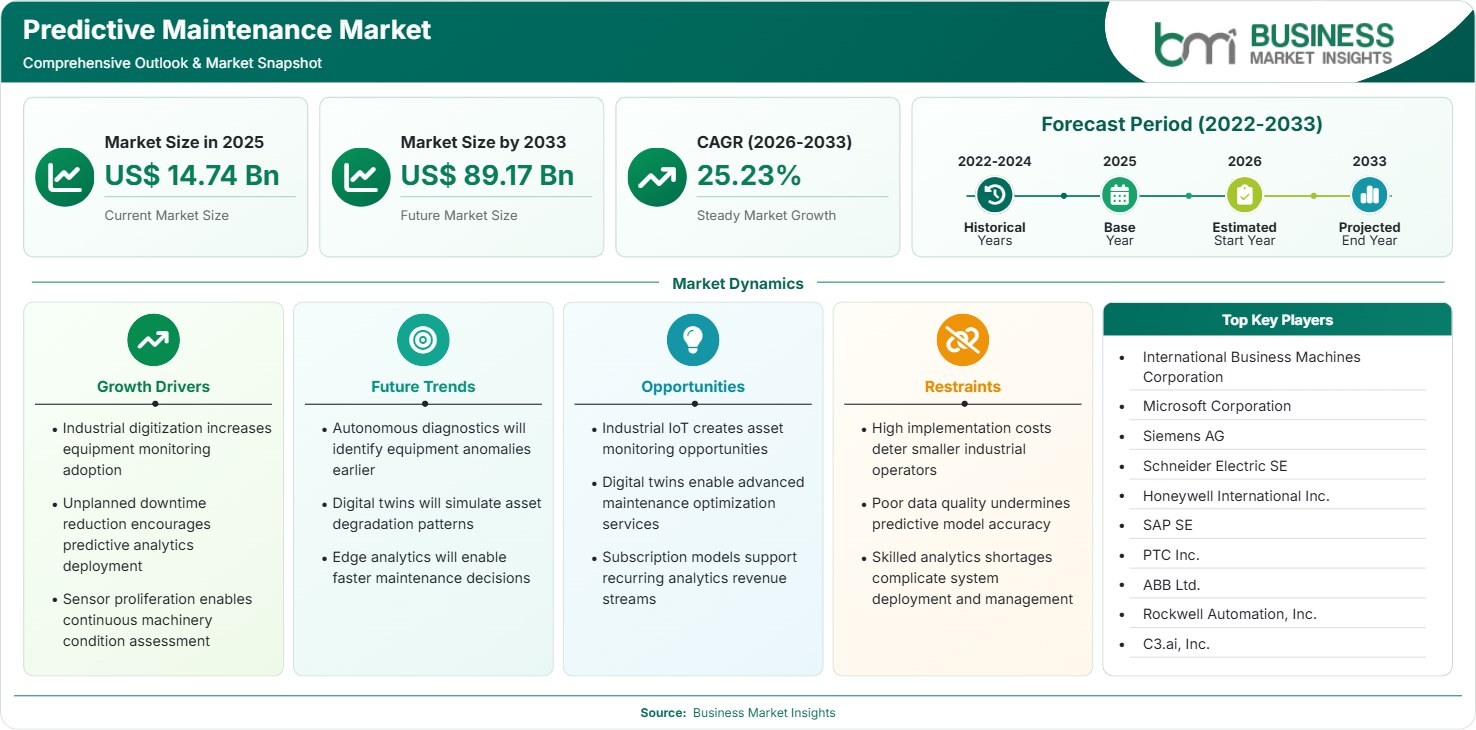
The Predictive Maintenance Market size was valued at US$ 14.74 Billion in 2025 and is projected to reach US$ 89.17 Billion by 2033, growing at a CAGR of 25.23% during 2026–2033, driven by industrial digitization, AI-enabled asset intelligence, cloud adoption, connected equipment, and demand for lower downtime.

Report Coverage
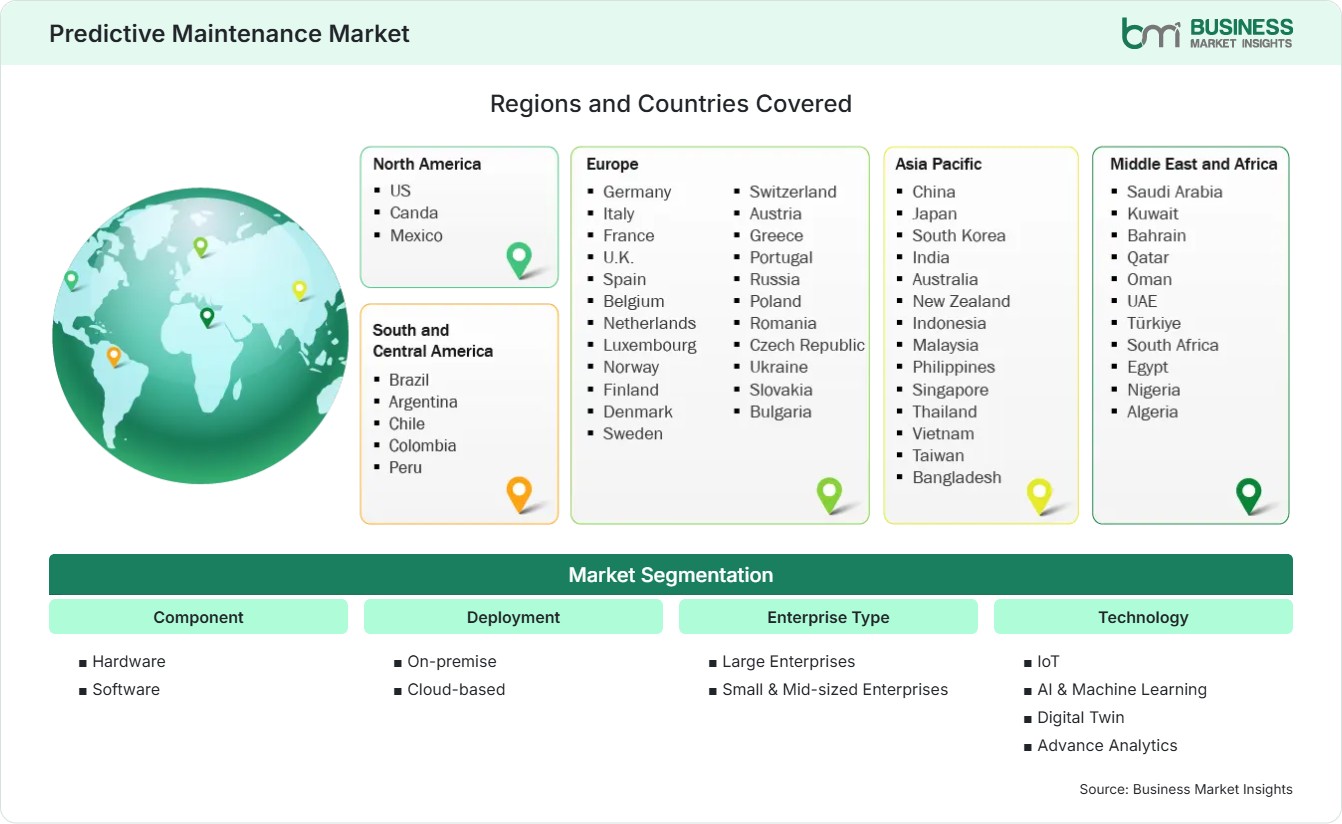
  • Component: Hardware, Software
  • Deployment: On-premise, Cloud-based
  • Enterprise Type: Large Enterprises, Small & Mid-sized Enterprises
  • Technology: IoT, AI & Machine Learning, Digital Twin, Advance Analytics
  • Application: Condition Monitoring, Predictive Analytics, Remote Monitoring, Asset Tracking, Maintenance Scheduling
US$ 14.74 Bn Market size in 2025
US$ 89.17 Bn Market Size by 2033
25.23% CAGR, 2026 - 2033
2026-2033 Forecast Period

AI Overview

Predictive Maintenance Market Summary

  • North America Region: North America holds market share of 32%–34% in 2025, growing with a CAGR of 25%–28% during 2026–2033, supported by industrial AI, connected assets, cloud platforms, aging infrastructure, and reliability investments. The US market is advancing at approximately 25%–27% CAGR, supported by manufacturing, utilities, transportation, and technology investment.
  • Fastest Growing Region: Asia Pacific holds Predictive Maintenance Market share of 25%–27% in 2025, growing with a CAGR of 29%–31% during 2026–2033, driven by smart manufacturing, automation, cloud adoption, large equipment bases, and digital transformation across China, India, Japan, and Southeast Asia.
  • Leading Segment: Software holds market share of 55%–58% in 2025, growing with a CAGR of 25%–28% during 2026–2033, supported by AI analytics, centralized asset intelligence, subscription models, workflow integration, and scalable condition-based maintenance platforms.
  • High Growth Segment: Small & Mid-sized Enterprises hold market share of 35%–38% in 2025, growing with a CAGR of 35%–37% during 2026–2033, as cloud delivery, lower sensor costs, subscription pricing, and packaged analytics reduce implementation barriers.
  • Key Market Opportunity: Vendors can capture incremental demand by combining low-cost sensing, edge analytics, generative AI, digital twins, and automated work orders into modular platforms serving distributed assets and underserved mid-market operators.
  • Major Market Players: International Business Machines Corporation, Microsoft Corporation, Siemens AG, Schneider Electric SE, Honeywell International Inc., SAP SE, PTC Inc., ABB Ltd., Rockwell Automation, Inc., and C3.ai, Inc.
Strategic Insights

Predictive Maintenance Market: Strategic Insights

Predictive Maintenance Market Strategic Framework
FREE PDF
Request your free sample
Request free sample
Stakeholder View

Key Takeaways

  • Supply chains are increasingly being driven by software as manufacturers of sensors, cloud service providers, analytics companies, EAM platforms, system integrators, and equipment OEMs compete with and collaborate on common asset-data layers.
  • There is a strong potential for gain in cases where decisions regarding maintenance have an impact on high-value assets and on continuous operations, such as in the areas of energy infrastructure, advanced manufacturing, transportation fleets, healthcare equipment, defense systems, and distributed facilities.
  • Product innovation is changing from a focus on anomaly detection to one on explainable recommendations and automated workflows, as shown by examples such as IBM Maximo and Siemens Senseye, which demonstrate the move towards embedded maintenance intelligence.
  • The Asia Pacific region has great potential for expansion since its manufacturing sector combines a high level of equipment density with rapidly advancing industrial digitization. India's modeled external compound annual growth rate for the period 2026–2033 is 32.5%.
  • More of the investment is now being channeled into platforms that link operational technology with enterprise applications, and the vendors are extending their offerings from monitoring to include AI-assisted diagnosis, field service, asset intelligence, and automated maintenance decisions.
Geographic Outlook

Predictive Maintenance Market Regional Highlights

North America Predictive Maintenance Market

North America represented approximately 32%–34% share in 2025, with a 25%–28% CAGR through 2033. External market research identifies the region as the largest market, supported by mature industrial digitization, cloud infrastructure, AI capabilities, and high-value equipment fleets. The region's Predictive Maintenance Market share reflects established technology ecosystems and enterprise readiness.

  • Increasingly, industrial companies are combining IoT telemetry with AI moddetectrder to detect abnormal equipment behavior and causes, causing disruptions, thus enabling continuous monitoring in factories, plants, warehouses, and other distributed infrastructure.
  • Cloud platforms are helping to extend access to predictive analytics since organisations can avoid the need for extensive local infrastructure and, at the same time, connect multiple sites to common asset-health dashboards and maintenance workflows.
  • Energy and utility companies are using connected monitoring to improve the reliability of electrical, mechanical, and rotating equipment, thereby aiding in planned interventions and the management of asset life.
  • Large vendors in the fields of technology and industrial automation have developed ecosystems that include sensors, connectivity, analytics, EAM, digital twins, and field-service applications, which in turn reduce the integration barriers for enterprise customers.

US Predictive Maintenance Market

The US Predictive Maintenance Market represents the largest country opportunity within North America and accounts for approximately 75%–80% of regional revenue in 2025, with a 25%–27% CAGR during 2026–2033. External research estimates a US CAGR of 25.6% for the period.

  • Manufacturing remains important because connected production equipment produces a continuous stream of operational data that can be used to predict failures, prioritize maintenance,, and plan production.
  • It is increasingly the case that energy and infrastructure operators need to have a remote view of their assets, which are spread out over different geographical areas, thereby making cloud analytics, edge processing, and automated alerts commercially relevant.
  • Building operators are now adopting AI-powered maintenance capabilities, with Honeywell stating that 84 percent of the US commercial building decision-makers surveyed intended to boost their use of AI the following year.

Europe Predictive Maintenance Market

Europe Predictive Maintenance Market held approximately 21%–23% share in 2025, with a 26%–28% CAGR through 2033. External research places the European share at 22.4% and the regional CAGR at 27%. Germany, the United Kingdom, France, Italy, and Spain form important industrial markets, while Spain represents a high-growth opportunity.

  • Germany enjoys its advanced capabilities in manufacturing and its acceptance of Industry 4.0, which in turn leads to a demand for connected equipment, digital twins, industrial analytics, and integrated maintenance workflows.
  • There are opportunities in the United Kingdom and France in the fields of transportation, utilities, aerospace, healthcare, and industrial facilities since reliability requirements lend themselves to continuous asset monitoring.
  • Spain offers greater growth potential within Europe, as external regional analysis identifies it as the fastest-growing country in the European market through 2033.
  • European buyers now require a secure way to integrate operational technology with enterprise systems, which in turn is increasing demand for governance, traceability, and controlled data access.

Asia Pacific Predictive Maintenance Market

Asia Pacific represented approximately 25%–27% share in 2025, with a 29%–31% CAGR through 2033. External research reports a 26.2% share and 30% CAGR for the region. The region's Predictive Maintenance Market scope is reinforced by smart-factory investment and industrial automation.

  • By combining extensive manufacturing with investments in smart factories, China is creating widespread opportunities for machine monitoring, industrial IoT, AI analytics, and the deployment of digital twins.
  • Japan possesses a well-developed ecosystem for industrial automation, and its external market is growing at a compound annual growth rate of about 29.4%, which enables advanced asset-health applications in both the manufacturing and infrastructure sectors.
  • India represents a high-growth market, and external research has estimated a 32.5% compound annual growth rate from 2026 to 2033 as a result of industrial modernization.
  • Further opportunities are available in Southeast Asia's economies, as the electronics, automotive, logistics, and industrial sectors expand, leading to greater deployments of connected equipment.

Rest of World Predictive Maintenance Market

Rest of World Predictive Maintenance Market accounts for approximately 17%–19% share in 2025, with a 22%–25% CAGR through 2033. South and Central America benefit from mining, manufacturing, energy, and logistics applications, while the Middle East and Africa are supported by oil and gas, utilities, infrastructure, and industrial modernization.

  • Brazil and Mexico offer opportunities due to industrial automation, energy assets, manufacturing plants, logistics networks, and the modernization of large-scale infrastructure.
  • There are opportunities in Saudi Arabia and the United Arab Emirates in smart industrial infrastructure, energy facilities, utilities, and digital asset management.
  • The mining and heavy industry sectors in Latin America and Africa need remote monitoring because equipment spread across large areas can be both expensive and difficult to inspect manually.
  • Cloud delivery can accelerate adoption in cases where organizations need advanced analytics but do not wish to set up a large local technology infrastructure.
Global Market Geography
FREE PDF
Request your free sample
Request free sample
Segment Analysis

Predictive Maintenance Market Segmentation

Component

Software represents approximately 55%–58% Predictive Maintenance Market share in 2025, with a 25%–28% CAGR through 2033. Predictive analytics platforms capture increasing value because enterprises need centralized intelligence, model management, visualization, workflow integration, and automated recommendations.

  • Hardware: Sensors, gateways, controllers, and edge devices collect equipment-health data while improving wireless connectivity, local processing, and continuous monitoring across industrial assets.
  • Software: AI analytics, asset-health platforms, dashboards, and maintenance applications convert operational data into failure predictions, prioritization signals, recommendations, and maintenance workflows.

Deployment

Cloud-based deployment is becoming more popular as distributed operations require scalable access, centralized data management, and reduced infrastructure overhead. On-premise environments still have a place when cybersecurity, latency, sovereignty, or the need to use legacy systems require local control, which results in a hybrid deployment scenario.

  • On-premise: Supports local control, predictable data residency, legacy integration, and low-latency processing within sensitive industrial environments.
  • Cloud-based: Enables multi-site monitoring, scalable analytics, subscription pricing, centralized model management, and rapid deployment without extensive enterprise-owned computing infrastructure.

Enterprise Type

Large companies already have a wide range of opportunities in place, as they operate complex networks of assets and have more resources for digital transformation. In contrast, small and mid-sized enterprises are expanding more quickly because the barriers to adopting cloud subscriptions, packaged solutions, and cheaper sensors are being lowered across smaller facilities.

  • Large Enterprises: Multi-site asset portfolios, compliance requirements, centralized maintenance functions, and high downtime exposure encourage integrated predictive programs across business units.
  • Small & Mid-sized Enterprises: Subscription software, managed services, inexpensive sensors, and standardized analytics packages are making advanced maintenance capabilities more accessible.

Technology

AI and machine learning are now at the heart of predictive workflows since these models are able to detect complex patterns in data from equipment telemetry, maintenance records, and operating conditions. Digital twins and advanced analytics provide contextual intelligence, whereas the IoT continues to serve as the foundation for collecting data and enabling constant visibility of assets.

  • IoT: Connects machines, sensors, gateways, and enterprise systems, creating continuous telemetry streams for monitoring equipment condition and operational performance.
  • AI & Machine Learning: Detects anomalies, identifies failure patterns, predicts asset behavior, and increasingly supports explainable maintenance recommendations.
  • Digital Twin: Creates dynamic digital representations of equipment or systems, supporting simulation, performance comparison, asset-health assessment, and lifecycle optimization.
  • Advance Analytics: Applies statistical analysis, pattern recognition, and operational data modeling to identify deterioration signals and improve maintenance prioritization.

Application

Condition monitoring continues to be fundamental since effective health monitoring of advanced predictive models depends on having toiable asset-health data. Through predictive analytics, remote monitoring, asset tracking, and maintenance scheduling, operations are extended from detection to coordinated intervention, thereby establishing integrated operational maintenance processes.

  • Condition Monitoring: Continuously evaluates equipment parameters to identify deviations, degradation patterns, and early indicators requiring further investigation.
  • Predictive Analytics: Uses historical and real-time data to estimate equipment behavior, identify failure probabilities, and support intervention planning.
  • Remote Monitoring: Enables centralized teams to observe geographically dispersed equipment without frequent physical inspections, improving visibility across distributed assets.
  • Asset Tracking: Maintains visibility into asset location, utilization, condition, and lifecycle status, supporting maintenance prioritization and operational planning.
  • Maintenance Scheduling: Converts predictive signals into planned work, aligning technician availability, spare parts, production constraints, and equipment condition.

End-Use

Manufacturing is a key area for adoption, since uninterrupted production relies on equipment availability, whereas energy and utilities, reliability is needed throughout the distributed infrastructure. In the sectors of healthcare, defense, telecommunications, and logistics,, there are special requirements because equipment failure can impact safety, service continuity, or mission readiness.

  • Military & Defense: Supports readiness by monitoring high-value equipment, vehicles, engines, and mission-critical systems where maintenance timing affects operational availability.
  • Energy & Utilities: Applies predictive intelligence to generation, transmission, distribution, rotating equipment, and utility infrastructure requiring high reliability.
  • Manufacturing: Uses equipment-health data to protect production lines, improve maintenance planning, reduce interruptions, and optimize machinery utilization.
  • Healthcare: Monitors critical facility and medical equipment to support uptime, safety, service continuity, and maintenance compliance.
  • IT and Telecom: Applies predictive monitoring to network infrastructure, power systems, cooling equipment, and distributed technology assets requiring continuous availability.
  • Logistics & Transportation: Supports fleets, warehouses, material-handling equipment, rail assets, and transportation infrastructure through condition monitoring and maintenance planning.
Market Forces

Predictive Maintenance Market Dynamics

Key Market Drivers

Industrial IoT Expands Continuous Asset Visibility

Industrial IoT adoption is increasing the volume and frequency of equipment data available for maintenance decisions. Sensors capture vibration, temperature, pressure, electrical characteristics, operating cycles, and other indicators continuously. Predictive architectures combine IoT data, machine learning, asset metadata, maintenance history, and real-time analytics. The Predictive Maintenance Market growth, therefore, depends on reliable data infrastructure alongside algorithms. IoT connectivity also supports remote monitoring of distributed assets, enabling organizations to centralize maintenance intelligence and prioritize interventions based on equipment condition rather than fixed schedules.

AI Converts Equipment Data Into Actionable Decisions

Artificial intelligence is moving predictive maintenance beyond threshold alerts toward anomaly detection, failure forecasting, root cause analysis, and recommended actions. IBM's Maximo Condition Insight combines asset data, work orders, time-series information, alerts, and failure-mode information to generate explainable maintenance insights. Siemens has expanded Senseye capabilities with generative AI to support prediction, prevention, repair, and optimization. These developments reinforce Predictive Maintenance Market trends toward embedded intelligence, conversational interfaces, automated workflows, and greater accessibility for maintenance personnel without specialist data-science expertise.

Downtime Exposure Strengthens the Business Case

The economic consequences of equipment failure are increasing emphasis on proactive maintenance across industrial environments. Downtime can interrupt production, disrupt supply commitments, increase emergency labor requirements, and accelerate component damage. Schneider Electric reports that downtime costs can range from US$10,000 to US$10 million per hour, depending on the operating environment. This creates a financial rationale for applying predictive intelligence to high-value assets. Organizations can justify investment when analytics connect to production continuity, energy efficiency, inventory planning, labor utilization, and asset lifecycle decisions.

Key Market Opportunities

Cloud Platforms Democratize Advanced Maintenance

Cloud delivery creates an opportunity to extend asset intelligence beyond organizations with extensive internal technology teams. Subscription models can reduce upfront infrastructure expenditure, while centralized platforms allow multiple facilities to share data models, dashboards, and workflows. This opportunity is particularly relevant among smaller manufacturers, logistics operators, commercial facilities, and distributed infrastructure owners. Cloud adoption can broaden access by reducing infrastructure requirements. The Predictive Maintenance Market Forecast, therefore, includes substantial room for vendors offering modular pricing, rapid deployment, preconfigured models, and managed analytics services.

Generative AI Opens New Maintenance Workflow Use Cases

Generative AI is able to generate value by converting detailed information about assets into explanations in natural language, along with maintenance summaries, advice for troubleshooting, and suggestions for actions. This, in turn, reduces the need for specialist interpretation and enables technicians to access the equipment's history without having to navigate multiple applications. The 9.2 version of IBM's Maximo Application Suite includes AI as part of the reliability, field execution, safety, compliance, and scheduling processes. PTC does the same by linking asset information together across PLM, ERP, CRM, IoT, EAM, and field-service systems. Vendors can thus move from prediction to AI-assisted execution and at the same time, increase the recurring software value.

Digital Twins Enable Lifecycle-Based Asset Optimization

Digital twins provide an opportunity to bring together information about equipment design, operating conditions, sensor data, maintenance records, and simulation results into a single asset representation. This in turn, enables a more accurate understanding of degradation and helps with decisions regarding repair, replacement, performance optimization, and capital planning. Siemens points out the increasing importance of both AI and digital twins in the area of asset performance management. The potential of digital twins goes beyond just predicting individual failures and involves lifecycle optimization, especially in the case of complex machinery, energy infrastructure, transportation systems, and high-value industrial assets.

Market Restraints and Challenges

Poor Data Quality and Legacy-System Fragmentation

Factor: Industrial organizations frequently operate equipment with inconsistent sensor coverage, incompatible protocols, incomplete maintenance histories, and disconnected operational systems. Impact: Predictive models can produce unreliable outputs when training data is incomplete, poorly labeled, or inconsistent across assets. Enterprises must establish asset identities, clean historical records, normalize telemetry, and connect maintenance workflows. Predictive architectures require real-time industrial events alongside asset metadata, maintenance history, technician information, and component costs. Without this foundation, organizations may struggle to demonstrate measurable returns, slowing enterprise-wide deployment and increasing implementation costs.

Cybersecurity, Skills Gaps, and Operational Integration

Factor: Connected maintenance systems expand the operational technology footprint and require skills spanning industrial engineering, data science, cybersecurity, cloud infrastructure, and maintenance operations. Impact: 0rganizations can face longer implementation cycles, governance concerns, and resistance when recommendations do not integrate with established workflows. Honeywell's 2025 building study found that 92% of surveyed decision makers reported challenges hiring skilled, technology-oriented personnel. Maintenance platforms therefore require strong security controls, explainable models, role-based access, and practical interfaces that complement technician expertise rather than creating another disconnected technology layer.

Company Analysis

Competitive Landscape

The Predictive Maintenance Market analysis shows competition across industrial automation, enterprise software, AI, cloud infrastructure, asset performance management, and specialized analytics. Leading vendors increasingly differentiate through ecosystem integration, embedded AI, installed industrial relationships, workflow capabilities, and lifecycle coverage rather than monitoring alone.

Company Name

Overview

Products and Services relevant to this market

International Business Machines Corporation

Enterprise technology provider with deep asset-management and AI capabilities serving asset-intensive industries.

IBM Maximo Application Suite, Maximo Monitor, Maximo Health, Maximo Predict, asset performance management, and maintenance workflows.

Microsoft Corporation

Global cloud and software provider supporting industrial IoT, edge computing, analytics, and AI-enabled maintenance architectures.

Azure IoT, Azure Machine Learning, Microsoft Fabric, Azure IoT Operations, edge analytics, and predictive maintenance architectures.

Siemens AG

Industrial technology provider combining automation, digitalization, asset management, AI, and industrial software capabilities.

Senseye Predictive Maintenance, Industrial Copilot, Industrial Operations X, asset-management software, IoT connectivity, and analytics.

Schneider Electric SE

Energy-management and industrial automation company with connected asset and maintenance capabilities.

EcoStruxure, EcoCare services, remote monitoring, AI-enabled condition-based maintenance, power monitoring, and asset performance solutions.

Honeywell International Inc.

Diversified technology company serving industrial, building, aerospace, and energy applications.

Honeywell Forge, remote monitoring, predictive maintenance prompts, industrial analytics, and asset-management technologies.

SAP SE

Enterprise software provider connecting maintenance intelligence with ERP, asset management, supply chain, and operational workflows.

SAP Asset Management, SAP S/4HANA asset management, maintenance planning, analytics, and enterprise workflows.

PTC Inc.

Industrial software provider focused on product lifecycle, service lifecycle, IoT, asset intelligence, and AI.

ServiceMax, PTC Orbit, ThingWorx, asset intelligence, service management, predictive analytics, and connected-product technologies.

ABB Ltd.

Industrial technology provider combining automation, electrification, robotics, digital solutions, and asset analytics.

ABB Ability, industrial analytics, asset performance management, condition monitoring, digital solutions, and predictive maintenance capabilities.

Rockwell Automation, Inc.

Industrial automation and information technology provider serving connected manufacturing environments.

FactoryTalk, Plex, industrial analytics, asset management, machine monitoring, connected services, and predictive maintenance technologies.

C3.ai, Inc.

Enterprise AI company providing industrial AI applications for equipment reliability and operational optimization.

C3 AI Reliability, predictive maintenance applications, AI models, asset intelligence, anomaly detection, and industrial analytics.

Trust & Transparency

Research Methodology

The market analysis combines proprietary research with secondary data from government agencies, company disclosures, regulatory filings, industry databases and expert interviews. Market estimates are validated through data triangulation, cross-market benchmarking and analyst review.

View Full Research Methodology

Questions Answered

Frequently Asked Questions

What information does the Predictive Maintenance Market Report provide?

The Predictive Maintenance Market Report provides market size, growth trends, regional insights, segmentation analysis, technology developments, competitive intelligence, recent company developments, and strategic opportunities across major end-use industries.

What determines the accuracy of predictive maintenance models?

Accuracy depends on data quality, sensor reliability, asset identification, failure history, operating context, model selection, and continuous validation. Effective programs combine engineering expertise with data governance and ongoing model monitoring.

Can predictive maintenance work with existing industrial equipment?

Yes. Retrofit sensors, gateways, industrial protocols, and software connectors can capture data from existing equipment. This approach is relevant for facilities with large installed bases that cannot economically replace machinery solely to introduce digital monitoring.

How does edge computing change predictive maintenance deployment?

Edge computing processes equipment data closer to the asset, reducing dependence on continuous cloud connectivity and supporting faster responses. It is useful for remote sites, latency-sensitive applications, bandwidth-constrained facilities, and environments requiring selected local processing.

What types of assets are most suitable for predictive maintenance?

High-value, failure-sensitive, continuously operated assets are particularly suitable. Rotating machinery, motors, pumps, compressors, turbines, production equipment, vehicles, electrical infrastructure, and critical facility systems generate measurable condition signals that can be analyzed continuously.

Access the Full Predictive Maintenance Market Report

Get segment-level forecasts, regional estimates, competitive benchmarking, company profiles and downloadable Excel datasets.

Access the full Predictive Maintenance Market Report
350 pages PDF & Excel | 2026-10-05
Similar Research

Related Market Reports