
Potassium Chloride Market Outlook: Size, Share, Trends, Growth Analysis, Competitive Landscape & Forecast, 2026-2033

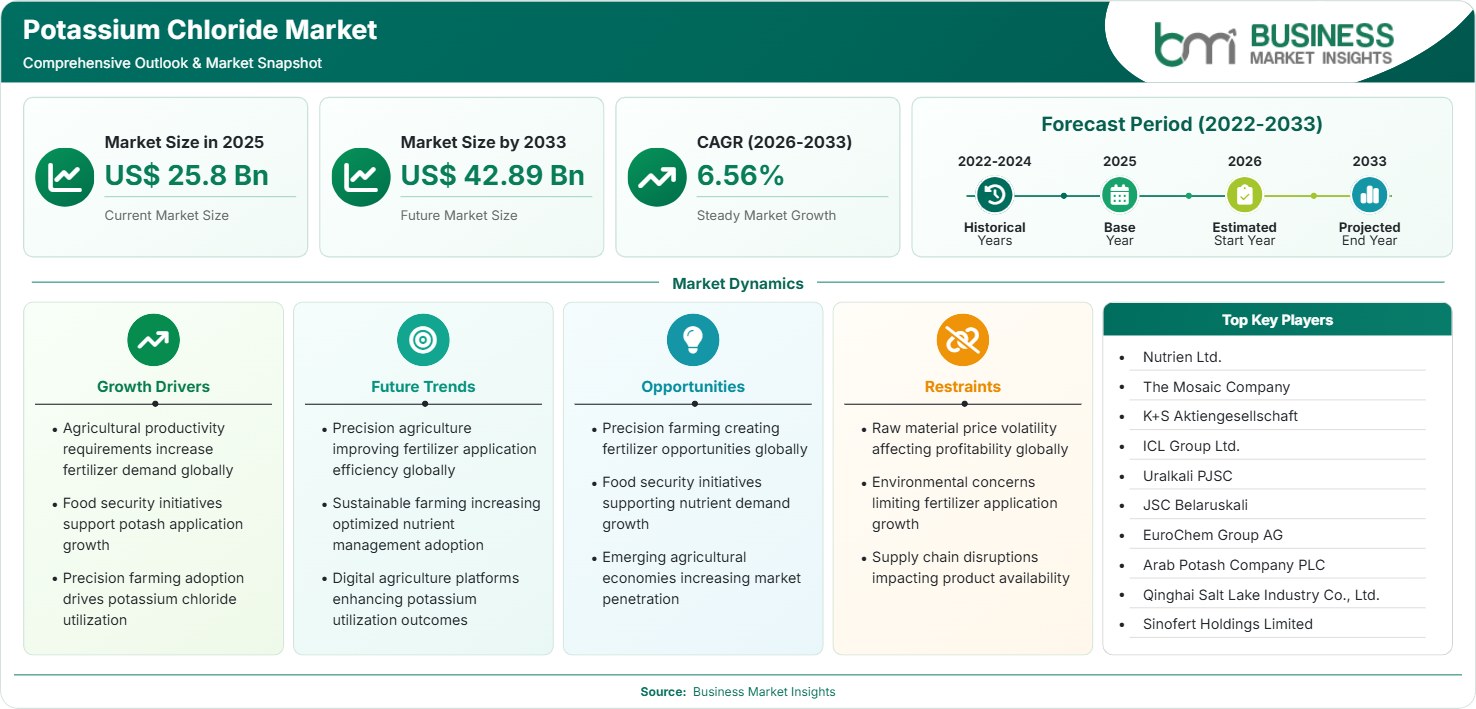
The Potassium Chloride Market size was valued at US$ 25.8 Billion in 2025 and is projected to reach US$ 42.89 Billion by 2033, growing at a CAGR of 6.56% during 2026–2033. Rising fertilizer consumption, expanding food production requirements, increasing soil nutrient management practices, and growing industrial utilization create significant opportunities across developed and emerging economies.

Report Coverage
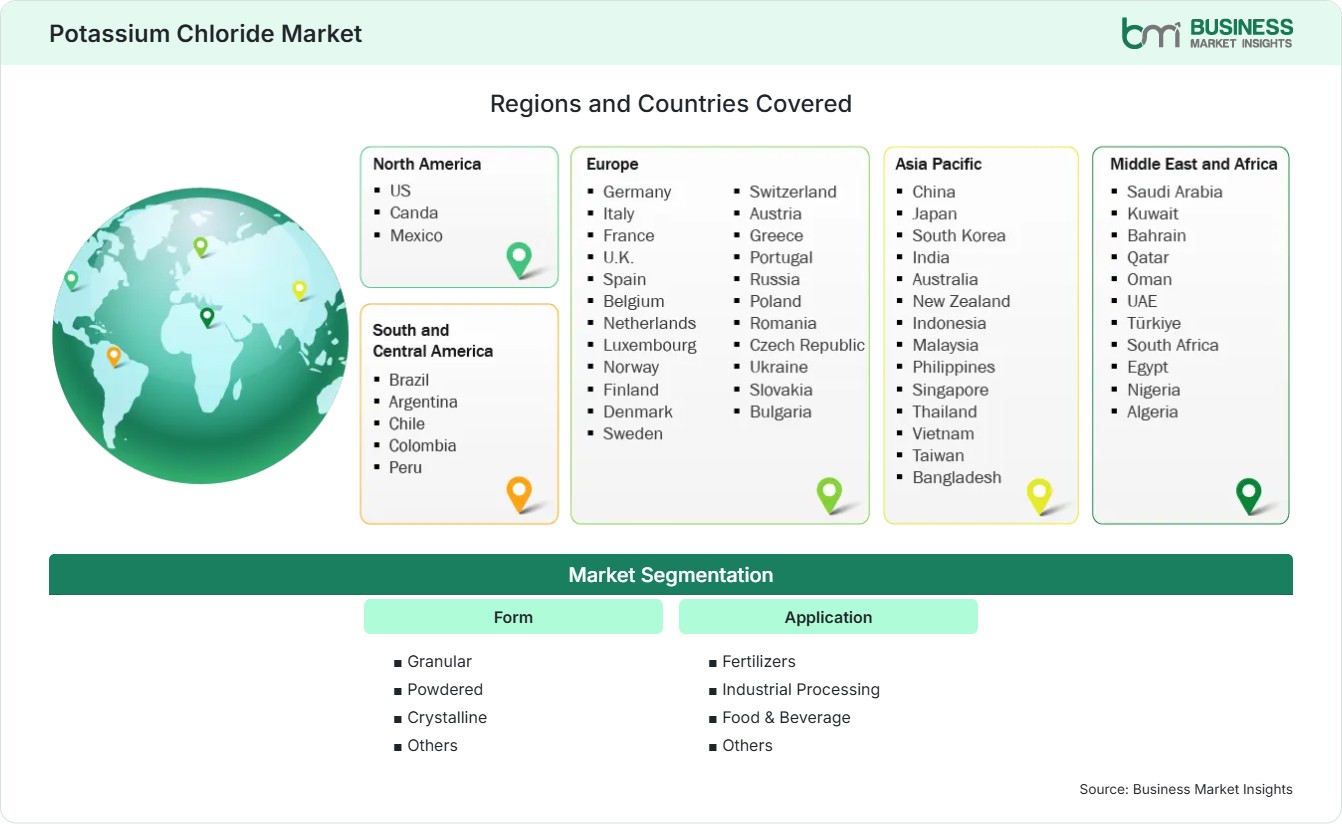
  • Form: Granular, Powdered, Crystalline, Others
  • Application: Fertilizers, Industrial Processing, Food & Beverage, Others
US$ 25.8 Bn Market size in 2025
US$ 42.89 Bn Market Size by 2033
6.56% CAGR, 2026 - 2033
2026-2033 Forecast Period

AI Overview

Potassium Chloride Market Summary

  • North America Region: North America holds a market share of 32%–35% in 2025, growing with a CAGR of 5.8%–6.2% during 2026–2033, supported by large-scale crop cultivation, advanced fertilizer application practices, stable potash mining capacities, and increasing precision agriculture investments that improve nutrient-use efficiency across farming systems. The US market benefits from strong agricultural exports and fertilizer demand, advancing at a CAGR of 5.9%–6.3%.
  • Fastest Growing Region: Asia Pacific accounts for 27%–30% market share in 2025 and is projected to expand at a CAGR of 7.1%–7.8% during 2026–2033, driven by population growth, food security programs, fertilizer subsidy initiatives, crop yield optimization programs, and increasing agricultural modernization throughout major developing economies.
  • Leading Segment: Fertilizers represent 68%–72% Potassium Chloride Market share in 2025 and are expected to grow at a CAGR of 6.4%–6.8% during 2026–2033, supported by increasing nutrient-deficient agricultural land, expanding global food demand, fertilizer application intensification, soil productivity enhancement programs, and government-backed agricultural development initiatives.
  • High Growth Segment: Industrial Processing holds a 12%–15% share in 2025 and is anticipated to expand at a CAGR of 7.2%–7.9% during 2026–2033, supported by chemical manufacturing expansion, water treatment requirements, specialty industrial applications, process efficiency improvements, production diversification strategies, and increasing industrial mineral consumption globally.
  • Key Market Opportunity: Expansion of precision agriculture technologies enables optimized nutrient application rates, reduces fertilizer waste, improves productivity, enhances sustainability outcomes, and supports long-term demand growth across commercial farming operations worldwide.
  • Major Market Players: Nutrien Ltd., The Mosaic Company, K+S Aktiengesellschaft, ICL Group Ltd., Uralkali PJSC, JSC Belaruskali, EuroChem Group AG, Arab Potash Company PLC, Qinghai Salt Lake Industry Co., Ltd., and Sinofert Holdings Limited.
Strategic Insights

Potassium Chloride Market: Strategic Insights

Potassium Chloride Market Strategic Framework
FREE PDF
Request your free sample
Request free sample
Stakeholder View

Key Takeaways

  • The industry is helped by an integrated value chain which extends from the mining operations and processing plants through to the fertilizer manufacturers, the distributors, the cooperatives, and the large commercial farming enterprises.
  • Because crop nutrient needs are increasing, global food demand is expanding, and there is greater pressure on agricultural productivity, the application of fertilizers presents the greatest opportunity for revenue.
  • Product innovation is nowadays more concentrated on improved nutrient efficiency, controlled-release formulations, compatibility with precision application methods, and agricultural solutions that are oriented towards sustainability.
  • The investment environment in Asia Pacific is highly attractive due to its growing populations, the presence of programs aimed at modernizing agriculture, the fact that fertilizer subsidies are available, and the rising use of advanced farming techniques.
  • The merger activities taking place among mining companies, fertilizer makers, and distribution networks are still helping to secure the supply and enhance their competitive position.
  • Stability in long-term demand is due to the decreasing amount of arable land available per person and the requirement to obtain greater crop yields from the present agricultural resources.
Geographic Outlook

Potassium Chloride Market Regional Highlights

North America Potassium Chloride Market

North America accounted for approximately 32%–35% of global revenue in 2025 and is projected to register a CAGR of 5.8%–6.2% during the forecast period. Extensive cultivation of corn, soybeans, wheat, and specialty crops supports sustained fertilizer consumption. The Potassium Chloride Market share within North America remains supported by productivity-focused farm management strategies and robust distribution infrastructure.

  • The Canadian production capacity allows for exports and, at the same time, ensures stability in the supply of fertilizers within the various agricultural markets in the region.
  • Accuracy in the management of nutrients is still improving and is helping to promote sustainable agricultural practices.
  • Increasingly, commercial farming operations are relying on soil testing and on strategies for the application of nutrients which are based on data.
  • The need for increased crop productivity and balanced fertilization programs is constantly driven by agricultural exports.
  • The networks involved in the retail sale of fertilizer are still putting money into logistics, storage and digital agronomy services.

US Potassium Chloride Market

The United States represents approximately 68%–72% of North American Potassium Chloride Market demand and is forecast to expand at a CAGR of 5.9%–6.3%. Strong grain production, intensive cultivation practices, and adoption of advanced farm technologies support consumption. Farmers increasingly focus on maximizing yield performance amid variable weather conditions and rising productivity requirements.

  • The amount of land used for growing corn and soybeans continues to be a major factor in the demand for nutrients and in expenditure on agricultural inputs.
  • The adoption of precision agriculture enables more accurate application of fertilizers and leads to better crop performance results.
  • Advisory services in the field of agriculture are increasingly encouraging the use of nutrient balancing methods and soil health evaluations.
  • The demand for specialty crops leads to steady consumption in a variety of agricultural areas.

Europe Potassium Chloride Market

Europe captured approximately 22%–25% of global Potassium Chloride Market revenue in 2025 and is anticipated to record a CAGR of 5.3%–5.9% through 2033. Agricultural sustainability objectives, precision fertilization practices, and strong crop management standards support market expansion. Germany remains the leading country, benefiting from established fertilizer production and distribution capabilities, while Eastern European countries demonstrate stronger consumption growth.

  • Germany has the highest level of demand in the region, due to its capable fertilizer production and its sophisticated agricultural management practices.
  • Poland's growth is above average due to its agricultural modernization schemes and the increased investments in crop productivity.
  • The uptake of precision agriculture is still expanding in Western Europe, and this is leading to greater efficiency in the use of nutrients as well as improved farm economics.
  • Regulations have been introduced to promote the balanced use of fertilizers while at the same time preserving soil fertility and ensuring sustainable crop production.
  • Strategic investments in logistics and storage infrastructure improve product availability across agricultural regions.

Asia Pacific Potassium Chloride Market

Asia Pacific accounted for approximately 27%–30% of global Potassium Chloride Market revenue in 2025 and is projected to register the highest CAGR of 7.1%–7.8% during 2026–2033. Large populations, increasing food consumption, and government-backed agricultural development programs continue strengthening demand. China remains the dominant consumer owing to its extensive agricultural sector, while India represents the fastest-growing major market due to expanding fertilizer utilization and food security initiatives.

  • China holds on to its leadership by means of large-scale agricultural production and by placing greater emphasis on optimizing yields.
  • India's growth is strong, due to its fertilizer subsidy schemes and its efforts to modernize agriculture.
  • The countries of Southeast Asia are still increasing their use of fertilizers in both the plantation and the food crop areas.
  • Putting money into rural infrastructure leads to better access to fertilizer and more efficient supply chains.
  • Measures aimed at improving crop productivity help to meet the long-term demand for nutrients in major economies.

Rest of World Potassium Chloride Market

The Rest of World region, including South & Central America and the Middle East & Africa, accounts for approximately 13%–16% of global Potassium Chloride Market revenue and is projected to grow at a CAGR of 6.5%–7.1% through 2033. Brazil remains a major agricultural consumer due to large-scale soybean and sugarcane cultivation.

  • Brazil has the highest level of demand in the region as a result of its large-scale agricultural production geared towards exports and its reliance on fertilizers.
  • Argentina is gaining from the expansion of grain farming and the greater emphasis on nutrient management efficiency.
  • The Gulf countries are putting their money into agricultural projects that need more productive solutions.
  • The governments of Africa are still advocating for the availability of fertilizers to enhance crop yields and ensure food security.
  • Expanding the distribution network leads to greater market penetration in previously underserved agricultural areas.
Global Market Geography
FREE PDF
Request your free sample
Request free sample
Segment Analysis

Potassium Chloride Market Segmentation

Form

The form segment influences storage efficiency, handling convenience, application methods, and end-user preferences. Granular products accounted for approximately 42%–46% market share in 2025 and are projected to grow at a CAGR of 6.3%–6.7% during 2026–2033. The Potassium Chloride Market scope continues to expand due to increasing agricultural mechanization, precision nutrient application requirements, and demand for products that provide operational efficiency across large farming operations.

  • Granular: Widely preferred in large-scale agriculture because of uniform application characteristics, compatibility with mechanical spreading equipment, and suitability for extensive crop production systems.
  • Powdered: Utilized across specialty agricultural applications and industrial processes where rapid dissolution, formulation flexibility, and blending efficiency remain critical purchasing considerations.
  • Crystalline: Commonly adopted in industrial processing, water treatment, and chemical manufacturing where purity standards and controlled chemical properties influence procurement decisions.

Application

Application-based demand remains dominated by fertilizer consumption. Fertilizers represented approximately 68%–72% of total share in 2025 and are expected to register a CAGR of 6.4%–6.8% through 2033. The segment benefits from increasing global food requirements, declining arable land availability per capita, and continuous efforts to improve crop productivity. The Potassium Chloride Market trends indicate sustained fertilizer demand supported by both developed agricultural systems and emerging farming economies.

  • Fertilizers: Primary demand source driven by crop yield optimization, nutrient replacement requirements, and agricultural productivity enhancement initiatives across major farming regions.
  • Industrial Processing: Increasing utilization in chemical manufacturing, water treatment applications, specialty industrial formulations, and process optimization activities supports steady segment expansion.
  • Food & Beverage: Used in food processing applications, salt substitution formulations, and nutritional product manufacturing where potassium enrichment and sodium reduction objectives are important.
Market Forces

Potassium Chloride Market Dynamics

Key Market Drivers

Rising Global Food Demand and Agricultural Intensification

Growing populations and changing dietary patterns continue to increase pressure on agricultural systems to deliver higher crop yields from limited cultivable land. Farmers are adopting nutrient management programs designed to maximize productivity while preserving soil fertility. Potassium remains one of the essential macronutrients for plant development, making demand closely tied to global agricultural output. The Potassium Chloride Market growth trajectory benefits from expanding cultivation of grains, oilseeds, fruits, and vegetables. Increased mechanization, improved farming practices, and higher awareness regarding balanced fertilization further support consumption.

Expansion of Precision Agriculture Technologies

The use of digital farming technologies is changing the way nutrients are applied in modern agriculture. Nowadays, farmers are using satellite images, variable-rate application systems, soil analysis tools, and data-driven agronomy programs to improve the way they use fertilizers. Because of precision farming, nutrient use becomes more efficient, waste is reduced, and the return on investment is increased, which in turn leads to continued demand for potassium-based inputs. With the spread of technology in both developed and developing markets, farmers' decisions about buying fertilizers are becoming more focused on improving productivity.

Strong Potash Mining and Supply Chain Investments

The major producers are still making investments in the expansion of mining operations, in the optimization of their logistics, and in upgrading their processing facilities to secure a steady supply. By improving production efficiency, they can keep up with growing global demand while reducing the operational risks associated with supply interruptions. Investments are being made in rail infrastructure, port facilities, and storage systems to enhance distribution throughout the agricultural areas. They are also adopting advanced extraction and processing technologies to improve the quality of their product and their operational performance. Continuous investment along the entire supply chain helps to ensure long-term availability, promotes trade growth, and strengthens the suppliers' ability to serve both agricultural and industrial customers effectively.

Key Market Opportunities

Expansion of Specialty Fertilizer Formulations

Growing demand for customized crop nutrition programs is creating opportunities for producers to develop value-added fertilizer products. Farmers are increasingly adopting nutrient blends tailored to specific crops, soil conditions, and climatic requirements. Enhanced-efficiency fertilizers that improve nutrient uptake and reduce losses are gaining attention in commercial agriculture. Potassium Chloride Market Forecasts indicate favorable growth potential for suppliers offering differentiated formulations and agronomic support services. Companies investing in research, product innovation, and strategic partnerships with agricultural technology providers are expected to strengthen their competitive position.

Growth of Agricultural Markets in Emerging Economies

In Asia, Africa, and Latin America, emerging economies are still increasing their investments in the modernization of agriculture. To improve access to fertilizers, governments have introduced subsidy schemes, launched initiatives aimed at developing infrastructure, and put in place policies concerned with food security. Higher incomes in rural areas and greater awareness of the importance of applying a balanced mix of nutrients are leading to a wider acceptance of modern crop nutrition methods. The large number of farmers who have not yet been reached creates huge long-term demand. Businesses that can establish local distribution channels, build technical support networks, and offer affordable products will be able to capitalize on the growing use of fertilizers.

Industrial Diversification Beyond Agriculture

There are other areas for growth in addition to the usual demand for fertilizers. Potassium chloride is being used in chemical manufacturing, in water treatment processes, in the preparation of pharmaceuticals, and in various special industrial applications. Greater industrial production in the developing regions will lead to wider patterns of use. Companies that broaden their customer base can decrease their reliance on agricultural cycles and achieve more stable revenues. It is expected that investments in higher-purity grades, in improved processing technologies, and in the development of products tailored to specific applications will help to increase market penetration.

Market Restraints and Challenges

Price Volatility in Global Potash Supply Chains

The impact is that price fluctuations continue to pose a major problem for producers, distributors, and the various end users in the agricultural sector. Alterations in international trade policies, geopolitical events, transportation costs, and disruptions in production can all quickly affect global pricing conditions. The uncertainty about the cost of inputs usually influences people's decisions regarding purchasing and their inventory management strategies. When prices are high, farmers might postpone their purchases or lower the amount of inputs they apply, which in turn affects demand. Manufacturers have to constantly strike a balance between profitability and competitiveness in situations of market volatility.

Environmental and Regulatory Compliance Pressures

The increased attention being paid to nutrient management and environmental sustainability brings about a number of operational difficulties throughout the fertilizer supply chains. Regulatory bodies are continuously enforcing more stringent standards in the areas of emissions, the use of resources, and the management of agricultural runoff. The need to comply often leads to higher production costs and calls for investments in more advanced technologies. Farmers and other agricultural users might have to meet extra requirements relating to reporting, monitoring, and the responsible use of nutrients. Although the aim of promoting sustainability helps to ensure responsible management of resources, the costs of implementing such measures can affect profitability and influence the extent to which they are adopted.

Company Analysis

Competitive Landscape

The competitive environment remains characterized by resource control, production scale, logistics capabilities, and geographic reach. The Potassium Chloride Market analysis indicates that leading producers continue emphasizing operational efficiency, mine expansion, supply-chain resilience, and customer-focused fertilizer solutions.

Company Name

Overview

Products and Services relevant to this market

Nutrien Ltd.

One of the world's largest crop input and potash producers with integrated mining, retail, and distribution operations.

Potash fertilizers, crop nutrient solutions, agricultural services, retail distribution, and precision agriculture offerings.

The Mosaic Company

Major global producer supplying crop nutrient products through extensive mining and processing operations.

Potash products, phosphate fertilizers, crop nutrition solutions, and agricultural supply services.

K+S Aktiengesellschaft

German specialty minerals and fertilizer producer serving agricultural and industrial customers globally.

Potash fertilizers, industrial salts, specialty mineral products, and nutrient management solutions.

ICL Group Ltd.

Diversified specialty minerals company with strong fertilizer and agricultural inputs portfolio.

Potash fertilizers, specialty plant nutrition products, industrial chemicals, and agronomic solutions.

Uralkali PJSC

Leading potash producer with substantial mining assets and global export capabilities.

Potassium chloride products, bulk fertilizer materials, and agricultural nutrient products.

JSC Belaruskali

Major global producer supplying potash products across international agricultural markets.

Standard and granular potassium chloride, fertilizer raw materials, and export supply solutions.

EuroChem Group AG

Integrated fertilizer company with mining, production, and distribution operations worldwide.

Potash fertilizers, nitrogen products, specialty nutrients, and crop productivity solutions.

Arab Potash Company PLC

Regional producer serving agricultural and industrial markets through large-scale operations.

Potash derivatives, fertilizer materials, industrial-grade products, and export solutions.

Qinghai Salt Lake Industry Co., Ltd.

Chinese producer leveraging domestic mineral resources for fertilizer and industrial products.

Potassium chloride products, chemical materials, mineral extraction, and fertilizer manufacturing inputs.

Sinofert Holdings Limited

Agricultural input supplier supporting fertilizer distribution and crop productivity initiatives.

Potash distribution, fertilizer trading, nutrient products, and agricultural support services.

Trust & Transparency

Research Methodology

The market analysis combines proprietary research with secondary data from government agencies, company disclosures, regulatory filings, industry databases and expert interviews. Market estimates are validated through data triangulation, cross-market benchmarking and analyst review.

View Full Research Methodology

Questions Answered

Frequently Asked Questions

What insights does a Potassium Chloride Market Report provide?

A comprehensive report evaluates market size, competitive dynamics, regional opportunities, segment performance, technology developments, supply-demand trends, investment prospects, and strategic considerations affecting future industry development.

How are industrial users contributing to demand?

Industrial customers utilize potassium chloride in chemical processing, water treatment, specialty manufacturing, and related applications. These uses help diversify revenue streams beyond agriculture-focused consumption patterns.

Which region offers the strongest Potassium Chloride Market growth potential?

Asia Pacific presents the strongest growth outlook due to population expansion, food security initiatives, agricultural modernization programs, and increasing adoption of efficient fertilizer application technologies.

How does potassium chloride support agricultural productivity?

The nutrient helps improve plant vigor, water regulation, disease tolerance, and crop quality. Farmers use potassium-based fertilizers to enhance yields and maintain soil fertility across multiple crop systems.

What factors are driving long-term demand for potassium chloride?

Long-term demand is supported by increasing food consumption, declining arable land availability per capita, rising crop productivity requirements, and expanding adoption of balanced nutrient management practices across commercial agriculture.

Access the Full Potassium Chloride Market Report

Get segment-level forecasts, regional estimates, competitive benchmarking, company profiles and downloadable Excel datasets.

Access the full Potassium Chloride Market Report
350 pages PDF & Excel | 2026-11-03
Similar Research

Related Market Reports