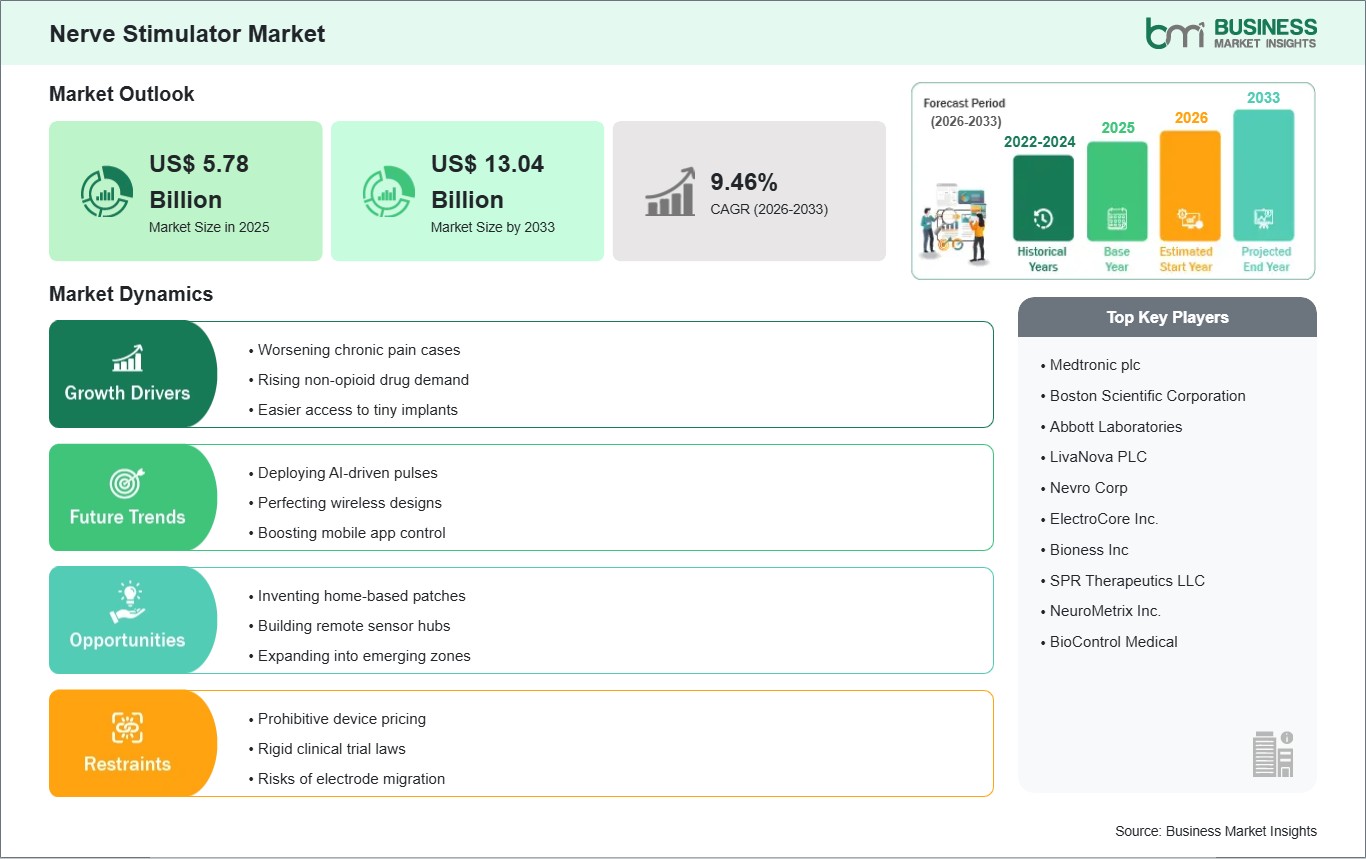
The Nerve Stimulator Market size is estimated to be around US$ 5.78 billion in 2025. The market is projected to reach approximately US$ 13.04 billion by 2033, registering a CAGR of 9.46% from 2026 to 2033.
Nerve stimulators, often referred to as neurostimulation devices, are advanced medical technologies that use electrical impulses to modulate or alter nerve activity. These devices are employed to treat a range of chronic and debilitating conditions, including chronic pain, movement disorders (like Parkinson's disease), epilepsy, and various psychiatric and urological disorders.
The Nerve Stimulator market is witnessing strong growth, primarily fueled by the global surge in neurological and chronic pain disorders, a growing preference for minimally invasive and non-opioid pain management solutions, and continuous, rapid advancements in device technology. Innovations such as miniaturization, rechargeable batteries, and the integration of smart, closed-loop systems are enhancing device efficacy and patient comfort, further propelling market adoption.

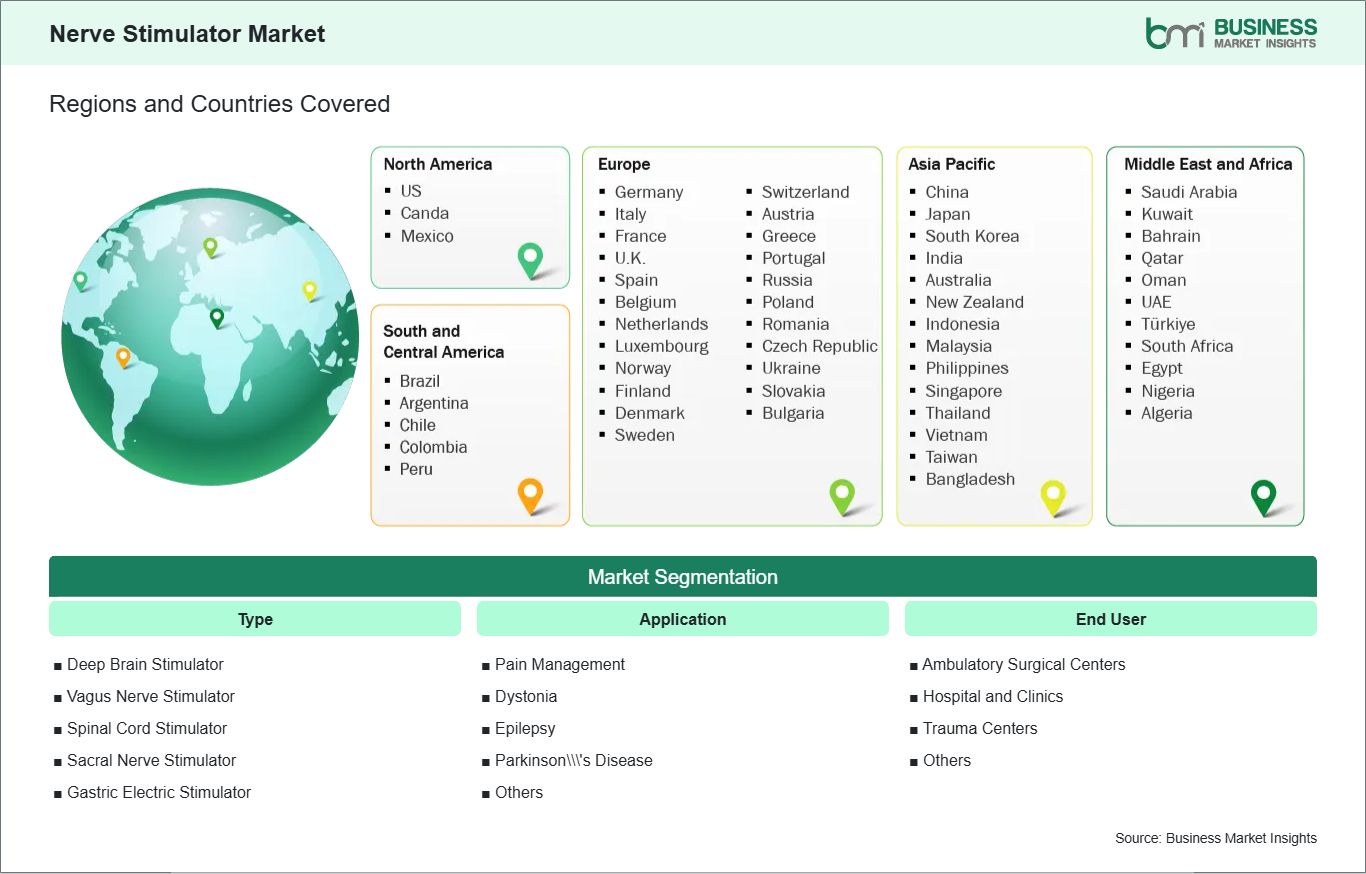
Key segments that contributed to the derivation of the Nerve Stimulator Market analysis are type, application, and end user.
The global healthcare system is experiencing a significant shift away from long-term opioid use due to the widespread crisis of addiction, dependency, and severe side effects associated with pharmacological approaches. This critical need for effective, alternative pain management strategies is the primary driver for the Nerve Stimulator Market.
Nerve stimulation devices, particularly Spinal Cord Stimulators (SCS) and Peripheral Nerve Stimulators (PNS), offer a targeted, non-pharmacological, and often minimally invasive approach to managing chronic pain conditions, such as Failed Back Surgery Syndrome (FBSS), complex regional pain syndrome, and neuropathic pain. These procedures typically involve placing a small device near the affected nerves, providing long-term relief without systemic side effects or the risk of addiction. This combination of proven clinical efficacy, a favorable long-term cost profile compared to continuous pain medication, and alignment with modern non-opioid pain protocols positions nerve stimulators as the preferred second-line treatment option, significantly expanding their adoption among both patients and healthcare providers.
A major opportunity for market players lies in the accelerated development and commercialization of non-invasive and wearable nerve stimulators. Traditional implantable devices, while effective, come with high costs and the risk associated with surgery. The new generation of non-invasive systems, such as Transcranial Magnetic Stimulation (TMS) and external Transcutaneous Vagus Nerve Stimulation (tVNS), as well as miniaturized, temporary peripheral nerve stimulators (PNS), eliminates the need for surgery.
This technology makes neurostimulation therapy more accessible, cost-effective, and less intimidating for a broader patient population, including those with less severe conditions or those in the initial stages of therapy. The development of user-friendly, at-home, and digitally-connected wearable devices, which can be monitored remotely by clinicians, opens up new applications beyond traditional pain management into areas like migraine, depression, and stroke rehabilitation. This push toward convenience, lower risk, and expanded therapeutic scope offers a vast, untapped market and a pathway for major revenue growth.

The Nerve Stimulator Market demonstrates robust growth, with size and share analysis revealing key competitive positions. The report further examines subsegments categorized within type, application, and end user, offering insights into their contribution to overall market performance.
For instance, the Spinal Cord Stimulators subsegment dominates the market by type, owing to their long-standing clinical evidence and extensive adoption for managing chronic back and leg pain. Pain Management is the largest revenue-generating application segment globally, driven by the high prevalence of chronic pain. Hospitals & Ambulatory Surgical Centers (ASCs) dominate the end-user segment due to the requirement for specialized facilities and trained staff for implant procedures.
| Report Attribute | Details |
|---|---|
| Market size in 2025 | US$ 5.78 Billion |
| Market Size by 2033 | US$ 13.04 Billion |
| Global CAGR (2026 - 2033) | 9.46% |
| Historical Data | 2022-2024 |
| Forecast period | 2026-2033 |
| Segments Covered | By Type
|
|
Regions and Countries Covered
| |
| North America | US, Canada, Mexico |
| Europe | Belgium, Austria, Finland, Denmark, Greece, Poland, Romania, Russia, Ukraine, Czech Republic, Slovakia, Bulgaria, Italy, Luxembourg, Germany, Switzerland, France, Netherlands, Norway, Portugal, Spain, Sweden, United Kingdom |
| Asia-Pacific | Australia, China, India, Japan, South Korea, Indonesia, Malaysia, Philippines, Singapore, Thailand, Vietnam, Bangladesh, New Zealand, Taiwan |
| South and Central America | Brazil, Argentina, Peru, Chile, Colombia |
| Middle East and Africa | Bahrain, Kuwait, Oman, Qatar, Saudi Arabia, United Arab Emirates, Turkiye, South Africa, Egypt, Algeria, Nigeria |
| Market leaders and key company profiles |
|
The "Nerve Stimulator Market Size and Forecast (2022 - 2033)" report provides a detailed analysis of the market covering below areas:
The geographical scope of the Nerve Stimulator Market report is divided into five regions: North America, Asia Pacific, Europe, Middle East & Africa, and South & Central America.
North America is the dominant region in the Nerve Stimulator Market, holding the largest revenue share. This is attributed to the presence of an advanced healthcare infrastructure, high consumer and physician awareness of neurostimulation therapies, favorable reimbursement policies, high prevalence of chronic neurological disorders, and the urgent need for non-opioid pain solutions.
Asia Pacific is projected to be the fastest-growing region, driven by improving healthcare infrastructure, rising disposable incomes, increasing awareness of advanced pain management options, and a rapidly expanding elderly population susceptible to chronic conditions.

The Nerve Stimulator Market is evaluated by gathering qualitative and quantitative data post-primary and secondary research, which includes important corporate publications, association data, and databases. A few of the key developments in the Nerve Stimulator Market are:
The Nerve Stimulator Market is valued at US$ 5.78 Billion in 2025, it is projected to reach US$ 13.04 Billion by 2033.
As per our report Nerve Stimulator Market, the market size is valued at US$ 5.78 Billion in 2025, projecting it to reach US$ 13.04 Billion by 2033. This translates to a CAGR of approximately 9.46% during the forecast period.
The Nerve Stimulator Market report typically cover these key segments-
The historic period, base year, and forecast period can vary slightly depending on the specific market research report. However, for the Nerve Stimulator Market report:
The Nerve Stimulator Market is populated by several key players, each contributing to its growth and innovation. Some of the major players include:
The Nerve Stimulator Market report is valuable for diverse stakeholders, including:
Essentially, anyone involved in or considering involvement in the Nerve Stimulator Market value chain can benefit from the information contained in a comprehensive market report.
Please tell us your area of interest
(Market Segments/ Regions and Countries/ Companies)