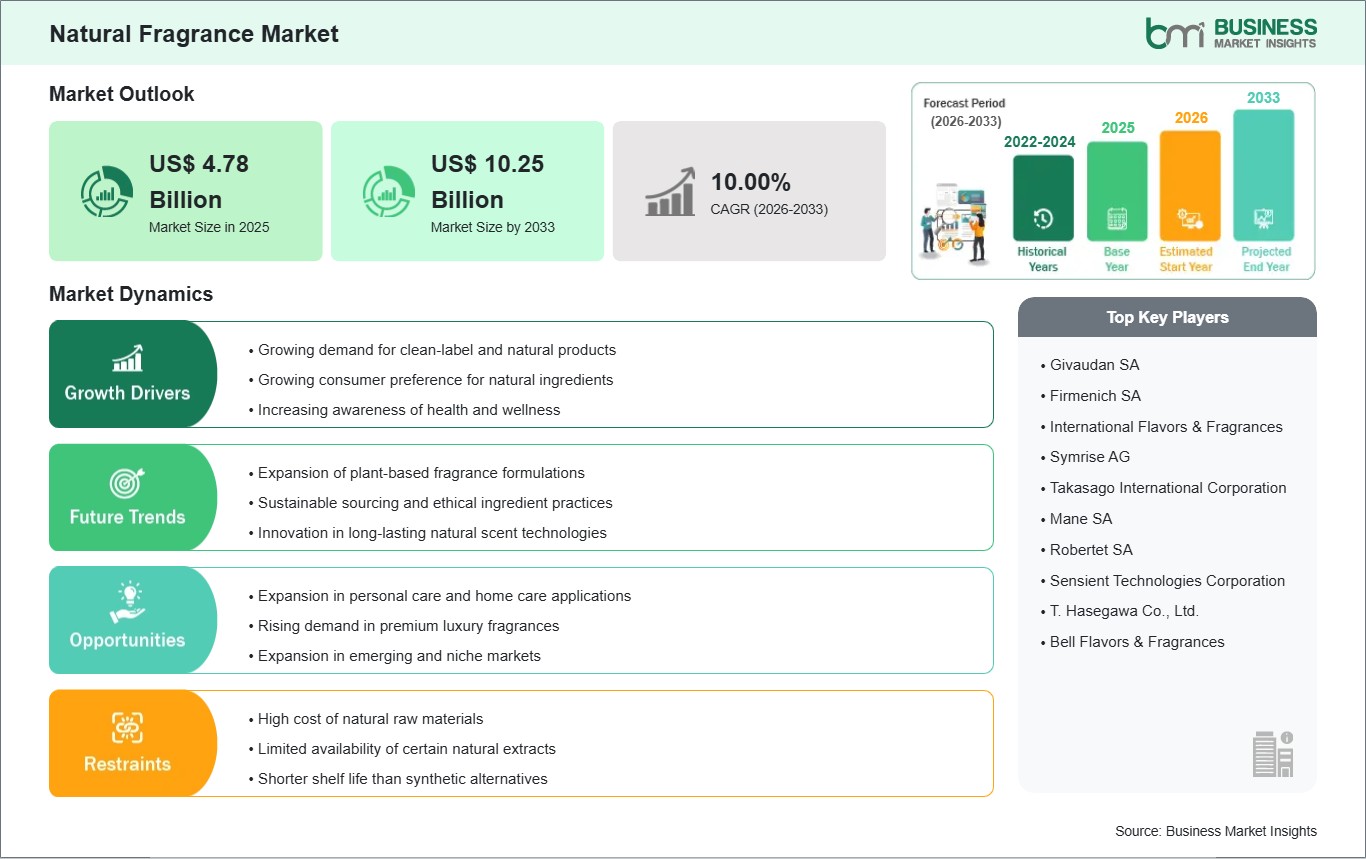
The Natural Fragrance Market size is expected to reach US$ 10.25 Billion by 2033 from US$ 4.78 Billion in 2025. The market is estimated to record a CAGR of 10.00% from 2026 to 2033.
The natural fragrance market is growing rapidly and is being driven by the increasing demand for clean label, organic, and sustainable products in personal care, cosmetic, and home care products. Natural fragrance, which is obtained from natural sources such as essential oils and plant extracts, is gaining popularity over its synthetic counterpart due to the increasing awareness of natural sensitivities and allergies. The market is also being driven by the premiumization of personal care products, where consumers are willing to pay a premium for natural ingredients. From a business point of view, innovation and differentiation are important factors. Companies are investing in novel extraction techniques, such as cold pressing, steam distillation, and supercritical CO₂ extraction, to maintain aroma integrity and improve yield efficiency.
Additionally, there is a growing emphasis on traceability and transparency in sourcing, with brands highlighting ethically sourced and certified organic ingredients to attract conscious consumers. Partnerships with local farmers and cooperatives are emerging as strategic initiatives to ensure a consistent supply of raw materials while supporting sustainable agriculture. Despite these opportunities, challenges such as high production costs, limited raw material availability, and complex regulatory frameworks for labeling and safety testing remain significant. However, ongoing R&D in synthetic-biological blends and scalable extraction methods is expected to enhance product availability and affordability, further supporting market expansion across diverse geographies.

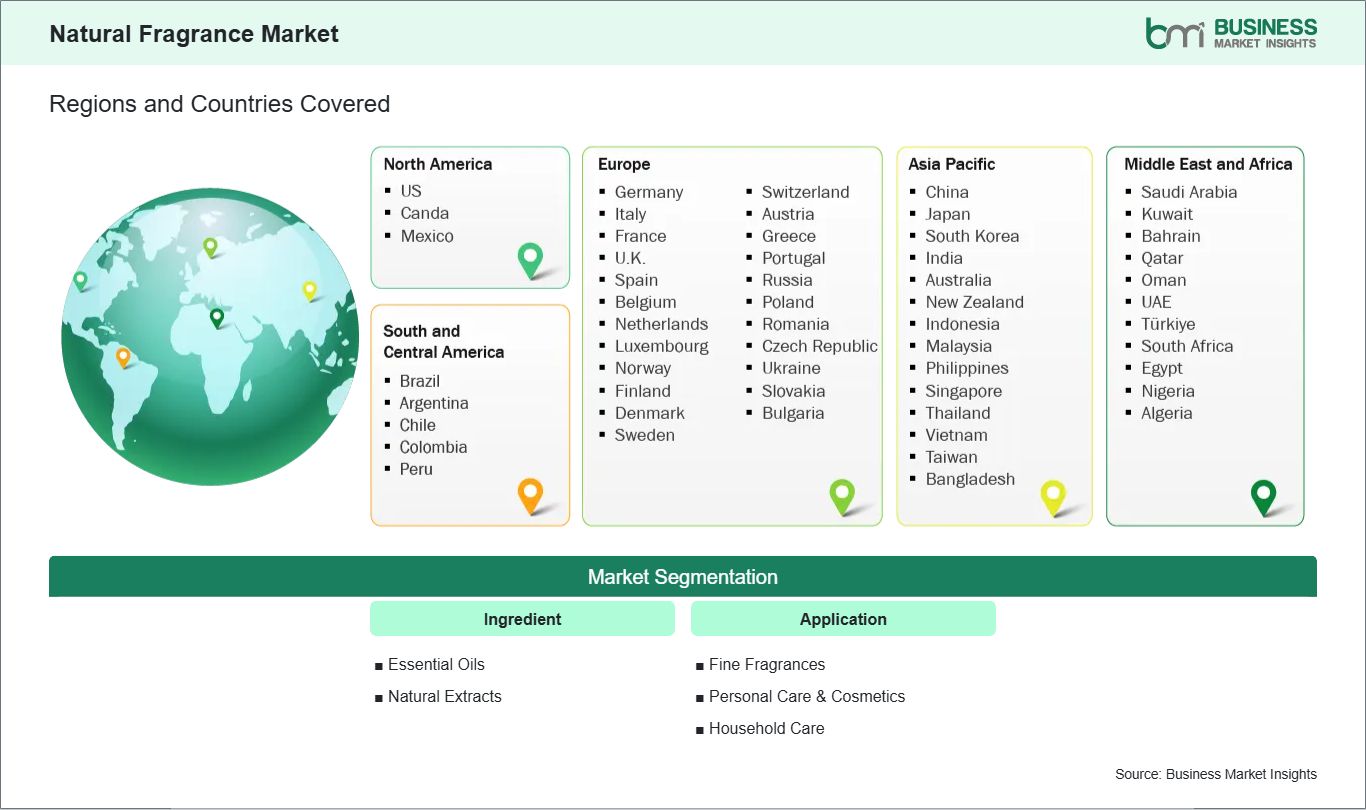
Key segments that contributed to the derivation of the natural fragrance market analysis are ingredient and application.
The increasing consumer preference for clean-label and natural products is a primary driver of the natural fragrance market. Consumers are becoming more conscious of product ingredients, seeking fragrances derived from plant-based sources rather than synthetic chemicals. This trend is fueled by a broader shift toward health and wellness, where products with natural formulations are perceived as safer and less likely to cause allergic reactions or skin irritation. Natural fragrances are now commonly incorporated in personal care, cosmetics, household products, and air care, reflecting a widespread adoption across multiple industries.
The need for transparency and authenticity is further driving the growth of the market. Consumers are looking for products that incorporate ethically sourced, sustainable, and naturally derived fragrance ingredients. This has led many brands to focus on the origin of their raw materials and ensure traceability for environmentally conscious consumers. The ability to marry beauty with natural safety profiles makes natural fragrances a preferred option for consumers.
Lastly, innovation in extraction and formulation technology has helped to create a new array of natural fragrance products. Technologies such as steam distillation, cold pressing, and solvent-free extraction enable the manufacturer to retain the strength of natural active ingredients. With the continued awareness of the benefits of natural ingredients, the global natural fragrance market is set to rise steadily in the future.
The natural fragrance market is benefiting from rapid expansion in personal care and home care applications. In personal care, natural fragrances are increasingly incorporated into products such as skincare, haircare, soaps, and deodorants to enhance sensory appeal while maintaining safe and natural formulations. The preference for gentle, plant-based fragrances allows brands to cater to consumers seeking holistic wellness solutions, creating opportunities for innovative blends and premium offerings.
In the home care segment, natural fragrance is being utilized in the form of air fresheners, detergents, and cleaning agents. Not only do these natural fragrances provide the consumer with the desired sensory experience, but they also meet the growing demand for eco-friendly and non-toxic home care products. The capacity of natural fragrance to deliver the desired fresh, natural, and non-toxic fragrance to the consumer has resulted in healthier living conditions, which is now the need of the hour for homes around the world.
Furthermore, the varied nature of natural fragrance ingredients allows manufacturers to create signature scents and customized products for the personal care and home care segments. The discovery of new aromatic plants and eco-friendly natural fragrance ingredients has resulted in the differentiation of these products, thereby increasing the appeal of the natural fragrance market. As the demand for natural and eco-friendly products increases, the natural fragrance market, particularly the personal care and home care segment, is likely to exhibit consistent growth in the near future.

The natural fragrance market demonstrates steady growth, with size and share analysis highlighting evolving trends and competitive dynamics among key players. The report examines subsegments categorized within ingredient and application, offering insights into their contribution to overall market performance.
By Ingredient, the essential oils subsegment dominated the market in 2025, driven by its purity, aroma intensity, and natural sourcing.
Based on Application, the fine fragrances subsegment dominated the market in 2025, owing to increasing consumer demand for premium natural perfumes and scents.
| Report Attribute | Details |
|---|---|
| Market size in 2025 | US$ 4.78 Billion |
| Market Size by 2033 | US$ 10.25 Billion |
| Global CAGR (2026 - 2033) | 10.00% |
| Historical Data | 2022-2024 |
| Forecast period | 2026-2033 |
| Segments Covered | By Ingredient
|
|
Regions and Countries Covered
| |
| North America | US, Canada, Mexico |
| Europe | Belgium, Austria, Finland, Denmark, Greece, Poland, Romania, Russia, Ukraine, Czech Republic, Slovakia, Bulgaria, Italy, Luxembourg, Germany, Switzerland, France, Netherlands, Norway, Portugal, Spain, Sweden, United Kingdom |
| Asia-Pacific | Australia, China, India, Japan, South Korea, Indonesia, Malaysia, Philippines, Singapore, Thailand, Vietnam, Bangladesh, New Zealand, Taiwan |
| South and Central America | Brazil, Argentina, Peru, Chile, Colombia |
| Middle East and Africa | Bahrain, Kuwait, Oman, Qatar, Saudi Arabia, United Arab Emirates, Turkiye, South Africa, Egypt, Algeria, Nigeria |
| Market leaders and key company profiles |
|
The "Natural Fragrance Market Size and Forecast (2022 - 2033)" report provides a detailed analysis of the market covering below areas:
The geographical scope of the Natural Fragrance Market report is divided into North America, Asia Pacific, Europe, Middle East & Africa, and South & Central America. North America held the largest share in 2025.
the natural fragrance market exhibits varied growth trajectories shaped by consumer sophistication, regulatory frameworks, and industrial adoption. North America dominates, driven by high consumer awareness, premium personal care trends, and stringent safety and environmental regulations that favor natural formulations. The U.S. leads demand for both home care and personal care applications, supported by well-established distribution networks and strong marketing of clean-label products.
Europe demonstrates steady growth, particularly in Germany, France, and the U.K., where regulatory compliance with EU cosmetic and fragrance standards promotes the adoption of natural ingredients. Consumer preference for organic and sustainable products in personal care, perfumes, and home fragrances further stimulates demand.
Asia Pacific is witnessing rapid expansion due to increasing disposable incomes, urbanization, and rising demand for premium personal care products in China, India, and Southeast Asia. Cultural affinity for herbal and botanical products also supports growth in natural fragrance adoption.
Middle East & Africa is growing steadily, with the GCC countries driving demand in luxury perfumes and home care products. The region`s affinity for aromatic and culturally significant scents encourages innovation in natural fragrance blends.
South & Central America shows moderate growth, with Brazil and Argentina leading due to their strong cosmetics and personal care markets. Growing interest in ethically sourced and sustainable fragrances is gradually shaping consumer preferences and driving adoption.

The Natural Fragrance Market is evaluated by gathering qualitative and quantitative data post primary and secondary research, which includes important corporate publications, association data, and databases. A few of the key developments in the natural fragrance market are:
The Natural Fragrance Market is valued at US$ 4.78 Billion in 2025, it is projected to reach US$ 10.25 Billion by 2033.
As per our report Natural Fragrance Market, the market size is valued at US$ 4.78 Billion in 2025, projecting it to reach US$ 10.25 Billion by 2033. This translates to a CAGR of approximately 10.00% during the forecast period.
The Natural Fragrance Market report typically cover these key segments-
The historic period, base year, and forecast period can vary slightly depending on the specific market research report. However, for the Natural Fragrance Market report:
The Natural Fragrance Market is populated by several key players, each contributing to its growth and innovation. Some of the major players include:
The Natural Fragrance Market report is valuable for diverse stakeholders, including:
Essentially, anyone involved in or considering involvement in the Natural Fragrance Market value chain can benefit from the information contained in a comprehensive market report.
Please tell us your area of interest
(Market Segments/ Regions and Countries/ Companies)