Market Summary
Executive Summary and Global Market Analysis
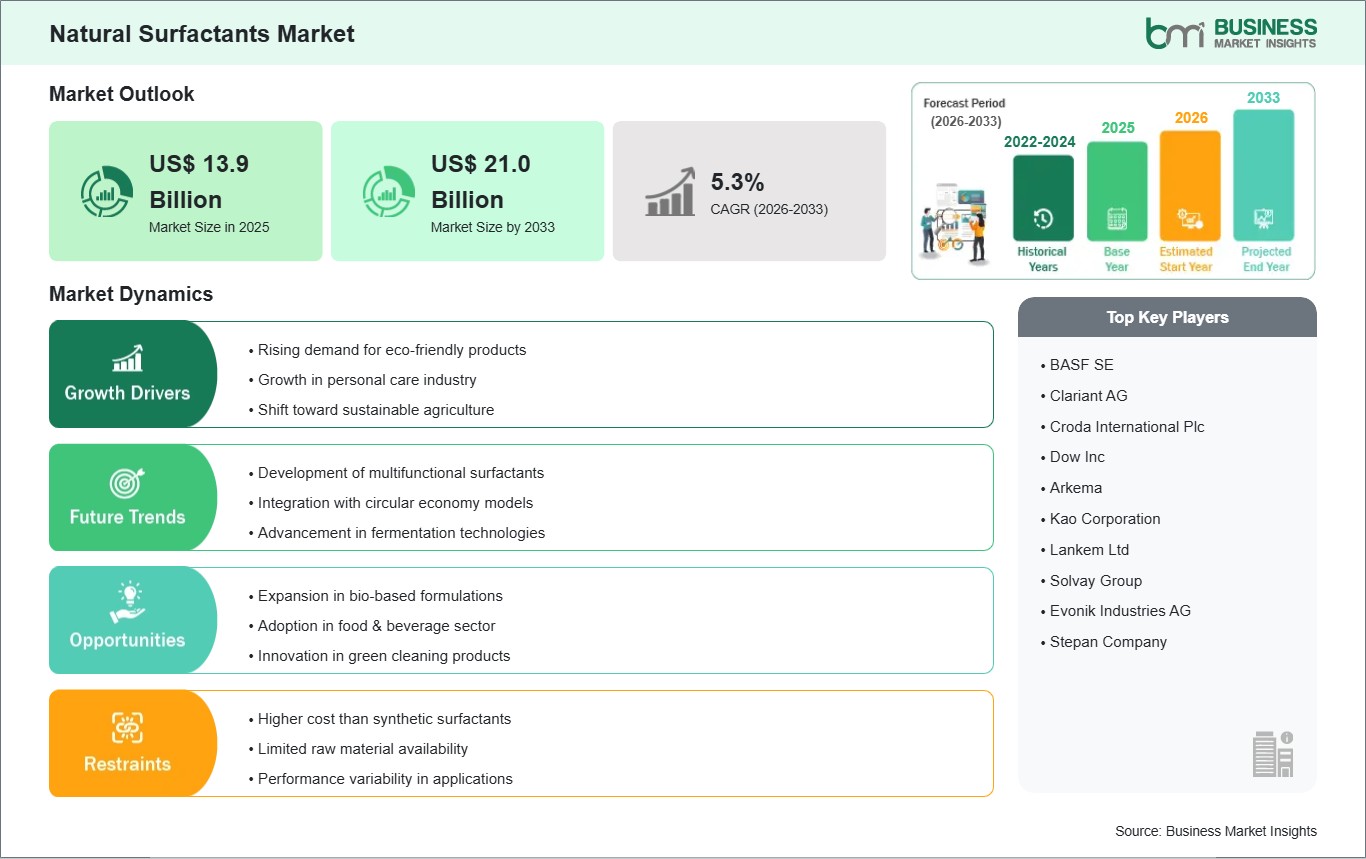
Natural surfactants represent a class of surface-active agents derived from renewable resources such as vegetable oils, sugars, and microbial fermentation. Unlike petrochemical-based surfactants, these bio-based alternatives offer superior environmental benefits, including biodegradability, low toxicity, and sustainability. Their adoption spans multiple industries, including personal care, household cleaning, agriculture, pharmaceuticals, and oilfield chemicals, driven by rising consumer awareness and regulatory mandates favoring eco-friendly formulations.
However, the market faces notable challenges. Production costs for biosurfactants, particularly those synthesized through fermentation, remain significantly higher than conventional surfactants, limiting their penetration in price-sensitive segments like mass-market detergents. Performance gaps also persist in industrial applications where petrochemical surfactants deliver superior foaming, stability, and cleaning efficiency. Additionally, raw material volatility, linked to agricultural commodities such as palm oil and coconut oil, creates supply chain uncertainties.
Despite these restraints, the outlook for natural surfactants is highly promising. Global consumer trends toward clean-label and wellness-oriented products, coupled with stringent environmental regulations, are accelerating demand for sustainable alternatives. Technological advancements in green chemistry, enzymatic synthesis, and fermentation processes are improving cost efficiency and functional performance, opening lucrative opportunities in premium personal care, specialty agriculture, and pharmaceutical applications. Strategic investments by leading players in capacity expansion and R&D further underscore the market's potential for robust growth through 2033.
Segment Analysis
Natural Surfactants Market Segmentation
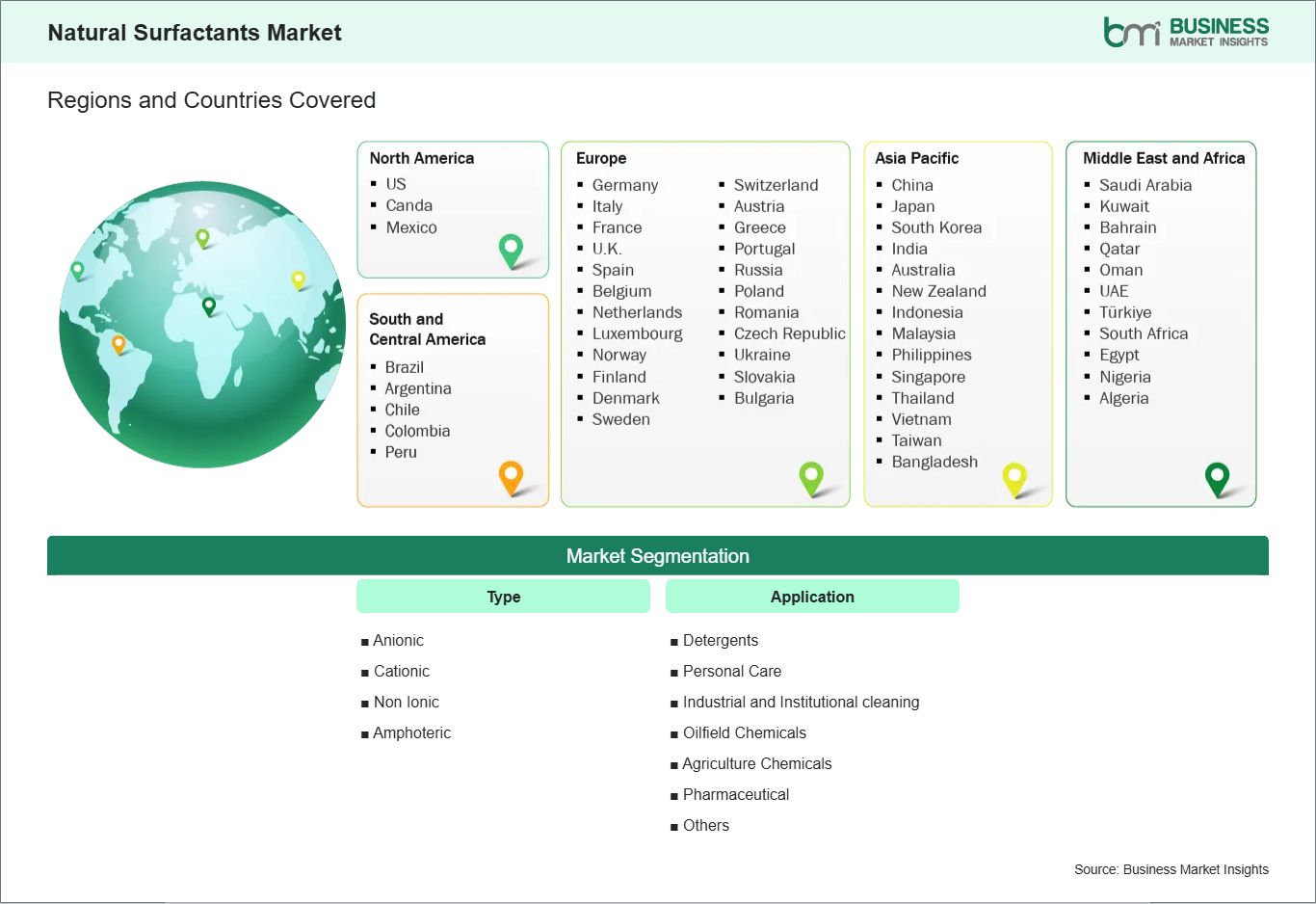
Key segments that contributed to the derivation of the Natural Surfactants market analysis are type and application.
- By Type, the market is segmented into Anionic (Glutamate, Potassium Cocoate, Isethionate, and Others), Cationic (Brassicyl Isoleucinate Esylate, Dialkylester Ammonium Methosulfate, Esterquat Benzalkonium chloride, Polyquaternium, Cetrimonium Chloride, Behentrimonium Chloride, and Others), Non Ionic (Saponins, Glucosides, Glycerides, Ethoxylates, Cocamide MEA, Cocamide DEA, and Others), and Amphoteric (Betaines, Amphoacetates, Sulatines, and Amine Oxides and Others)
- By Application, the market is segmented into Detergents, Personal Care, Industrial and Institutional cleaning, Oilfield Chemicals, Agriculture Chemicals, Pharmaceutical, and Others.
Market Forces
Natural Surfactants Market Drivers and Opportunities
Rising Consumer Demand for Eco-Friendly and Clean-Label Products
One of the most influential factors driving the surge in demand for natural surfactants is the fundamental shift in consumer buying behavior toward health-conscious and environmentally responsible products, particularly across North America and Europe. In the personal care and cosmetics industry, the rapid rise of the clean beauty movement, coupled with organic certifications and wellness-focused branding, has significantly boosted the preference for non-irritating, gentle surfactants derived from natural sources. Popular examples include alkyl polyglucosides and amino acid-based surfactants, which offer mild cleansing properties while aligning with sustainability goals.
This trend extends beyond personal care into household cleaning products, where consumers increasingly seek biodegradable and non-toxic ingredients in laundry detergents, dishwashing liquids, and surface cleaners to minimize chemical exposure and environmental impact. Consequently, the market is witnessing accelerated substitution of petroleum-based surfactants with natural alternatives sourced from renewable feedstocks such as coconut and palm oil. These developments not only reflect growing ecological awareness but also position natural surfactants as a cornerstone of sustainable product innovation, ensuring continued market growth in the years ahead.
Stringent Environmental Regulations and Technological Advancements
Regulatory pressure on chemical manufacturers to reduce environmental pollution and improve biodegradability has created a highly favorable environment for the adoption of natural surfactants. Increasing restrictions on certain petrochemical-derived surfactants, particularly alkylphenol ethoxylates, have compelled formulators to transition toward bio-based alternatives to meet stringent compliance requirements in regions such as Europe and North America. This regulatory shift is not only driving sustainability but also reshaping product development strategies across multiple industries.
At the same time, technological advancements in green chemistry, fermentation processes, and enzymatic synthesis are unlocking new market opportunities. Innovations in production techniques have significantly improved the yield, purity, and cost efficiency of biosurfactants such as rhamnolipids and sophorolipids, making them commercially viable for high-value applications. These include agriculture, pharmaceuticals, and specialty chemicals, where both environmental responsibility and functional performance are critical. As these technologies mature, natural surfactants are poised to become a mainstream solution, offering superior biodegradability and reduced toxicity while supporting global sustainability goals.
Size and Share Analysis
Natural Surfactants Market Size and Share Analysis
The natural surfactants market demonstrates steady growth, with size and share analysis revealing evolving trends and competitive positioning among key players. The report further examines subsegments categorized within type and application, offering insights into their contribution to overall market performance.
For instance, the Anionic subsegment holds a significant market share. Anionic surfactants, specifically Glutamate and Isethionate, are indispensable in Personal Care products, where they are favored for their high foaming capacity and mildness on the skin. A notable trend in 2025 is the rapid shift toward sulfate-free formulations, driven by consumer demand for "clean-label" shampoos and facial cleansers. These innovations are particularly vital in premium skincare, where they empower brands to deliver high-performance cleansing without the irritation associated with traditional synthetic surfactants.
Report Coverage
Natural Surfactants Market Report Coverage and Deliverables
The "Natural Surfactants Market Size and Forecast (2022–2033)" report provides a detailed analysis of the market covering below areas:
- Natural Surfactants Market size and forecast at global, regional, and country levels for all the key market segments covered under the scope.
- Natural Surfactants Market trends, as well as market dynamics such as drivers, restraints, and key opportunities.
- Natural Surfactants Market analysis covering key market trends, global and regional framework, major players, regulations, and recent market developments
- Industry landscape and competition analysis covering market concentration, heat map analysis, prominent players, and recent developments for the Natural Surfactants Market
- Detailed company profiles, including SWOT analysis
Geographic Insights
Natural Surfactants Market Geographic Insights
The geographical scope of the Natural Surfactants Market report is divided into five regions: North America, Europe, Asia Pacific, the Middle East & Africa, and South & Central America.
In North America, the surge in clean-label and wellness-focused products, coupled with strong R&D investments, is shaping market growth. Europe continues to emphasize sustainability through stringent environmental regulations and consumer preference for eco-certified formulations. Asia Pacific is emerging as a dynamic hub, fueled by rapid urbanization, rising disposable incomes, and growing demand for household and personal care products. In the Middle East & Africa, industrial expansion and heightened awareness of environmental compliance are encouraging the use of bio-based surfactants in cleaning and oilfield applications. Meanwhile, South & Central America are seeing increased uptake in agricultural and industrial sectors, supported by expanding oilfield activities and a gradual shift toward greener chemical solutions.
Industry Activity
Recent Developments
The Natural Surfactants market is evaluated by gathering qualitative and quantitative data post-primary and secondary research, which includes important corporate publications, association data, and databases. A few of the key developments in the Natural Surfactants market are:
- In July 2024, Unilever launched Sunlight Biocare Nature, a 100% food-grade dishwashing product leveraging plant-based RhamnoClean technology. The product is biodegradable, gentle on hands, and effective for washing baby tableware, fruits, and vegetables. The launch, held at Senayan Park in Indonesia, emphasized consumer safety, natural ingredients, and sustainability, aligning with trends in the Natural Surfactants market.
- In November 2025, BASF expanded its Alkyl Polyglucosides (APGs) production at the Bangpakong site in Thailand, reinforcing supply for Asia-Pacific markets. APGs, being bio-based, biodegradable, and non-ionic, serve personal care, home care, and industrial applications. This expansion complements BASF’s global APG network, with existing sites in Germany and China and a new U.S. facility slated for 2026, reflecting growing demand for sustainable surfactants.
Trust & Transparency
Research Methodology
The market analysis combines proprietary research with secondary data from government agencies, company disclosures, regulatory filings, industry databases and expert interviews. Market estimates are validated through data triangulation, cross-market benchmarking and analyst
review.
View Full Research Methodology
Key Sources Referred:
World Bank – Global Trade Indicators
World Trade Organization (WTO)
International Monetary Fund (IMF)
International Trade Administration (ITA)
Company Websites
Company Annual Reports
Company Investor Presentations